
London’s Science Museum is currently displaying an exhibition on Versailles: Science and Splendour, which draws on recent studies in the history of science in early modern France.
The Financial Times reports that “The engine of the exhibition is the relationship between science and power in the 17th and 18th centuries (the reigns of Louis XIV, XV and XVI), a time when France was a dominant political, cultural and military force in Europe.”

French kings formed several scientific and literary academies during the seventeenth century and provided extensive royal patronage for scientific research.
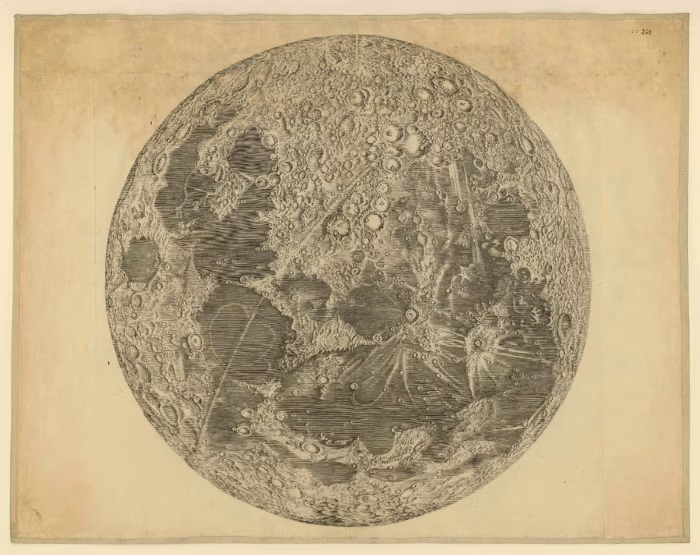
According to The Financial Times, “Scientists were lured to Versailles from across Europe by the promise of a salary and whatever rare equipment they desired: among them were the Dutch physicist and mathematician Christiaan Huygens, the Danish astronomer Olaüs Roemer and the mathematician and astronomer Giovanni (or Jean) Domenico Cassini of Bologna. On display is the latter’s map of the Moon, whose surface he spent several years recording in minute detail through a telescope. Lunar distance, meanwhile, was among the early proposals for the calculation of longitude, a major scientific challenge of the time and a recurrent theme in the show.”
The exhibition also includes objects relating to medical practices in early modern France, including a obstetrics mannequin used to teach midwives how to deliver babies.

The Financial Times provides a review of the exhibition on Versailles: Science and Splendour at London’s Science Museum. The exhibition will be on view through 21 April 2025.
Northern Illinois University students in HIST 311 Early Modern France and HIST 422 Early Modern Europe will be interested in this exhibition.


 Brian Sandberg: Historical Perspectives