
President Trump has declared himself king, opposing himself to the legitimately elected representatives of the State of New York over a congestion pricing law.
The White House issued a post on X stating that “CONGESTION PRICING IS DEAD. Manhattan, and all of New York, is SAVED. LONG LIVE THE KING!” –President Donald J. Trump.

The White House’s post included artwork depicting Trump as a King and calling “Long Live the King!”
This is no mere meme joke.
President Trump has made arrogant comments referring to himself as a king, and his administration and supporters are repeating and magnifying the offensive claims on social media.
This is part of a broader strategy to build monarchical power in the United States. The right-wing dominated U.S. Supreme Court essentially granted the President of the United States unqualified immunity in a highly controversial 2024 ruling.
Trump’s outrageous claim has prompted widespread anger and responses that the United States has no king.
New York Governor Kathy Hochul responded forcefully: “We are a nation of laws, not ruled by a king. We’ll see you in court.”
Illinois Governor J.B. Pritzker delivered his Illinois State of the State Speech, commenting that: “As governor of Illinois, my oath is to the constitution of our state and our nation. We don’t have kings in America, and I won’t bend the knee to one.”
Since Trump’s White House is using memes to promote the idea of a King Donald, I’ll respond with my own meme here:
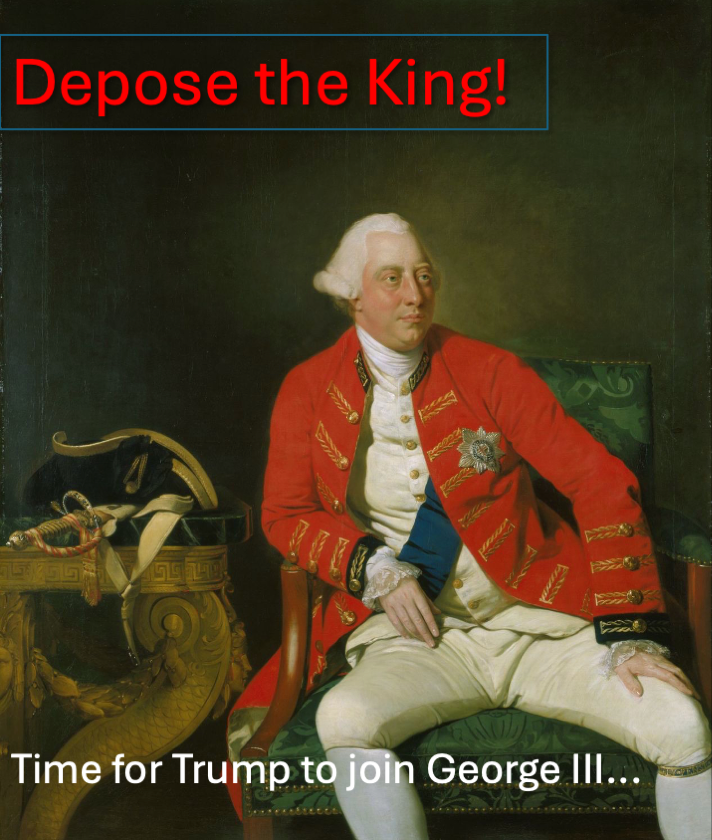
The citizens of the United States rejected monarchy and deposed King George III of Great Britain almost two hundred fifty years ago.
Historians of the United States, comparative revolutions, civil conflicts, and war and society have published numerous serious studies of the American Revolution and the War of Independence. Historians and legal scholars have studied complicated process of creating the Articles of Confederation and then the U.S. Constitution that established the world’s first modern democratic republic.
The founders of the United States utterly rejected monarchy and nobility.
U.S. citizens do not need an arrogant would-be king to claim monarchical authority and disrupt our constitutional system of government.
The University of Wisconsin’s Center for the Study of the American Constitution provides historical documents on monarchical tendencies during the Confederation period as well as debates over the writing of the U.S. Constitution.
For further reading on monarchy, revolution, republicanism, and constitutionalism in the early history of the United States see:
Bartoloni-Tuazon, Kathleen. For Fear of an Elective King: George Washington and the Presidential Title Controversy of 1789. Ithaca, NY: Cornell University Press, 2014.
Nelson, Eric. The Royalist Revolution: Monarchy and the American Founding. Cambridge, MA: Harvard University Press, 2014.
Rivage, Justin du. Revolution Against Empire: Taxes, Politics, and the Origins of American Independence. New Haven, CT: Yale University Press, 2017.
Wood, Gordon S. The Radicalism of the American Revolution. New York, NY: Vintage, 1991.
The New York Times and The Independent both report on President Trump’s claim to be king. The Guardian reports on responses to Trump’s claims. On the Supreme Court’s controversial 2024 ruling, and its relationship to monarchy, see reporting by The Nation.


 Brian Sandberg: Historical Perspectives