
In a Friday night purge, President Trump has fired the Chairman of the Joint Chiefs of Staff, the top military general in the United States, along with five other generals and military lawyers.
“President Trump fired the country’s senior military officer as part of an extraordinary Friday night purge at the Pentagon that injected politics into the selection of the nation’s top military leaders,” according to The New York Times.
“Gen. Charles Q. Brown Jr., a four-star fighter pilot known as C.Q. who became only the second African American to hold the chairman’s job, is to be replaced by a little-known retired three-star Air Force general, Dan Caine, who endeared himself to the president when they met in Iraq six years ago.”
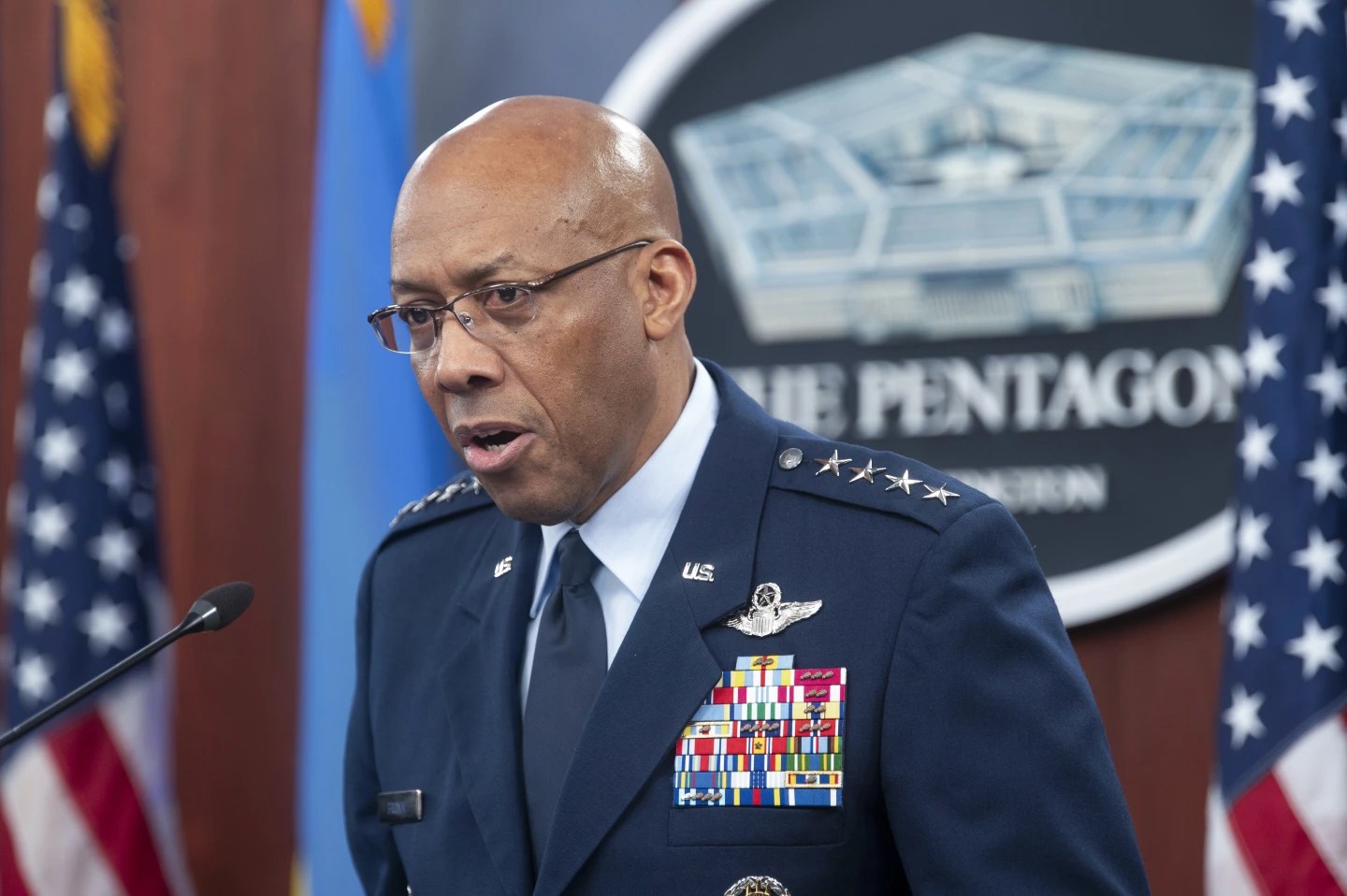
The New York Times reports that “In all, six Pentagon officials were fired, including Adm. Lisa Franchetti, the first woman to lead the Navy; Gen. James Slife, the vice chief of the Air Force; and the top lawyers for the Army, Navy and Air Force.”
“The decision to fire General Brown, which Mr. Trump announced in a message on Truth Social, reflects the president’s insistence that the military’s leadership is too mired in diversity issues, has lost sight of its role as a combat force to defend the country and is out of step with his ‘America First’ movement.”
This firing appears to have been made primarily based on General Brown’s status as an African-American, and thus violates anti-discrimination laws in the United States. I certainly hope that General Brown will file a lawsuit for wrongful termination.
The firing of the Chairman of the Joint Chiefs of Staff also violates precedents and norms of civil-military relations in the United States.
The New York Times point out that “Joint Chiefs chairmen traditionally remain in place as administrations change, regardless of the president’s political party. But current White House and Pentagon officials said they wanted to appoint their own top leaders.”
The Pentagon purge has been signaled for months. Ronald R. Krebs, Professor of Political Science (University of Minnesota), wrote prior to President Trump’s second inauguration that “During his successful 2024 reelection campaign, incoming U.S. President Donald Trump promised to purge the military of “woke” generals. Soon after his November victory, The Wall Street Journal reported that his transition team had drafted an executive order to establish a so-called warrior board of retired senior military officers tasked with identifying serving generals and admirals who ought to be dismissed. In the meantime, according to other media reports, Trump’s team has been drawing up its own list of generals to remove from their posts and perhaps even court-martial.”
Krebs argues: “That the Trump administration would put the military in its sights should not come as a surprise. … Nobody should be fooled by the Trump team’s claim that it aims, by culling top officers, to strengthen the U.S. military. The purpose would be precisely the opposite; weakening the professional military, in fact, is a move many populist leaders make as they consolidate power. If, like his fellow populists around the globe, Trump uses his second term to undermine the military’s independence and professionalism and transform it into a more politicized force, both American democracy and the U.S. armed forces’ war-fighting capacity will suffer.”
On the Pentagon purge, see the AP report and the following news articles:
Lamothe, Dan and Missy Ryan, “With Pentagon Purge, Trump Thrusts Military into Uncharted Territory.” The Washington Post (22 February 2025).
Krebs, Ronald R. “Trump vs. the Military.” Foreign Affairs (10 January 2025).
Schmitt, Eric, Helene Cooper, and Jonathan Swan, “Trump Fires Joint Chiefs Chairman Amid Flurry of Dismissals at Pentagon.” The New York Times (21 February 2025).
Historians of war and society and military institutions have long studied civil-military relations in the United States. For an introduction to these studies, see:
Bacevich, Andrew. Breach of Trust: How Americans Failed Their Soldiers and Their Country. New York: Metropolitan Books, 2013.
Bruneau, Thomas. “Civil-Military Relations.” Oxford Bibliographies in International Law. doi: 10.1093/obo/9780199796953-0184
Feaver, Peter D. Armed Servants: Agency, Oversight, and Civil-Military Relations. Cambridge, MA: Harvard University Press, 2003.
Feaver, Peter and Richard H. Kohn, eds. Soldiers and Civilians: The Civil-Military Gap and American National Security, BCSIA Studies in International Security. Cambridge, MA: MIT Press, 2001.
Huntington, Samuel P. The Soldier and the State: The Theory and Politics of Civil-Military Relations. Cambridge, MA: Belknap Press of Harvard University Press, 1957.
Janowitz, Morris. The Professional Soldier: A Social and Political Portrait, reissue edition. New York: Free Press, 2017.
Kohn, Richard H. “Building Trust: Civil-Military Behaviors for Effective National Security.” American Civil-Military Relations: The Soldier and the State in a New Era, ed. Suzanne Nielsen and Don Snider, 264-289. Baltimore, MD: Johns Hopkins University Press, 2009.
Kohn, Richard H. “The Constitution and National Security: The Intent of the Framers.” In The United States Military under the Constitution of the United States 1789–1989, ed. Richard H. Kohn, 61–94. New York, NY: New York University Press, 1991.
Kohn, Richard H. “Out of Control: The Crisis in Civil-Military Relations.” The National Interest 35 (Spring 1994), 3–17.
Note: This post has been updated to include a quote by Professor Krebs and to add references to additional news reports.


 Brian Sandberg: Historical Perspectives