
The Cold War continues to shape current German society and its voting patterns over 30 years after the Fall of the Berlin Wall in 1989 and the beginning of German Reunification.
This past weekend’s German Elections demonstrate that the frontiers of the Iron Curtain continue to bifurcate Germans into sharply separate spheres and voting blocs, despite decades of efforts at German Reunification and reintegration.
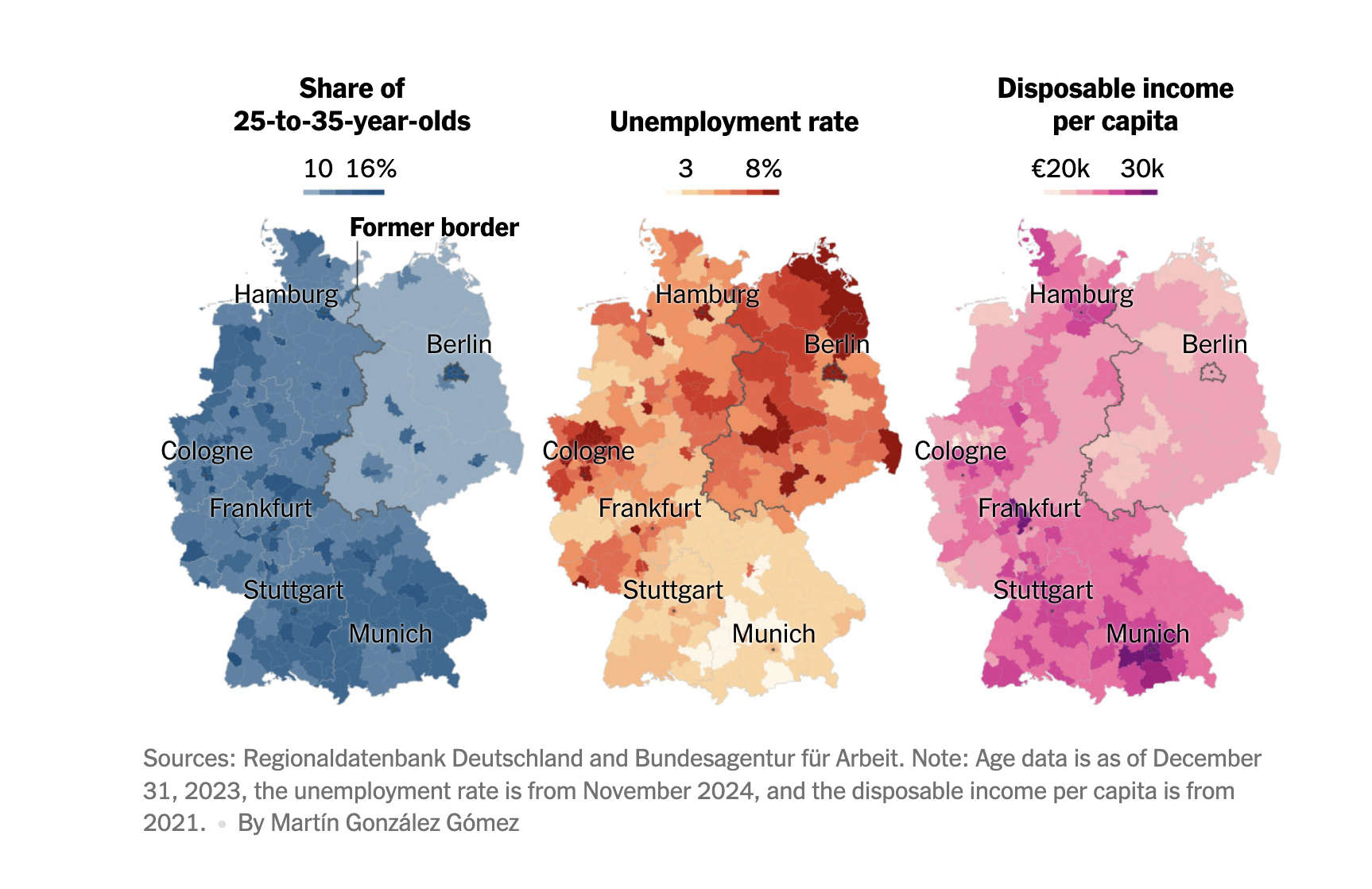
The New York Times reports that “Three and a half decades after reunification, a line runs through Germany where the Iron Curtain once stood. Instead of barbed wires and dogs, that line now divides Germans by measures like income and unemployment — and increasingly by the willingness to vote for extremist parties.”
The electoral map of regions with majority support for the Alternative für Deutschland (Alternative for Germany, or AfD) political party corresponds almost precisely with the boundaries of the former East Germany.
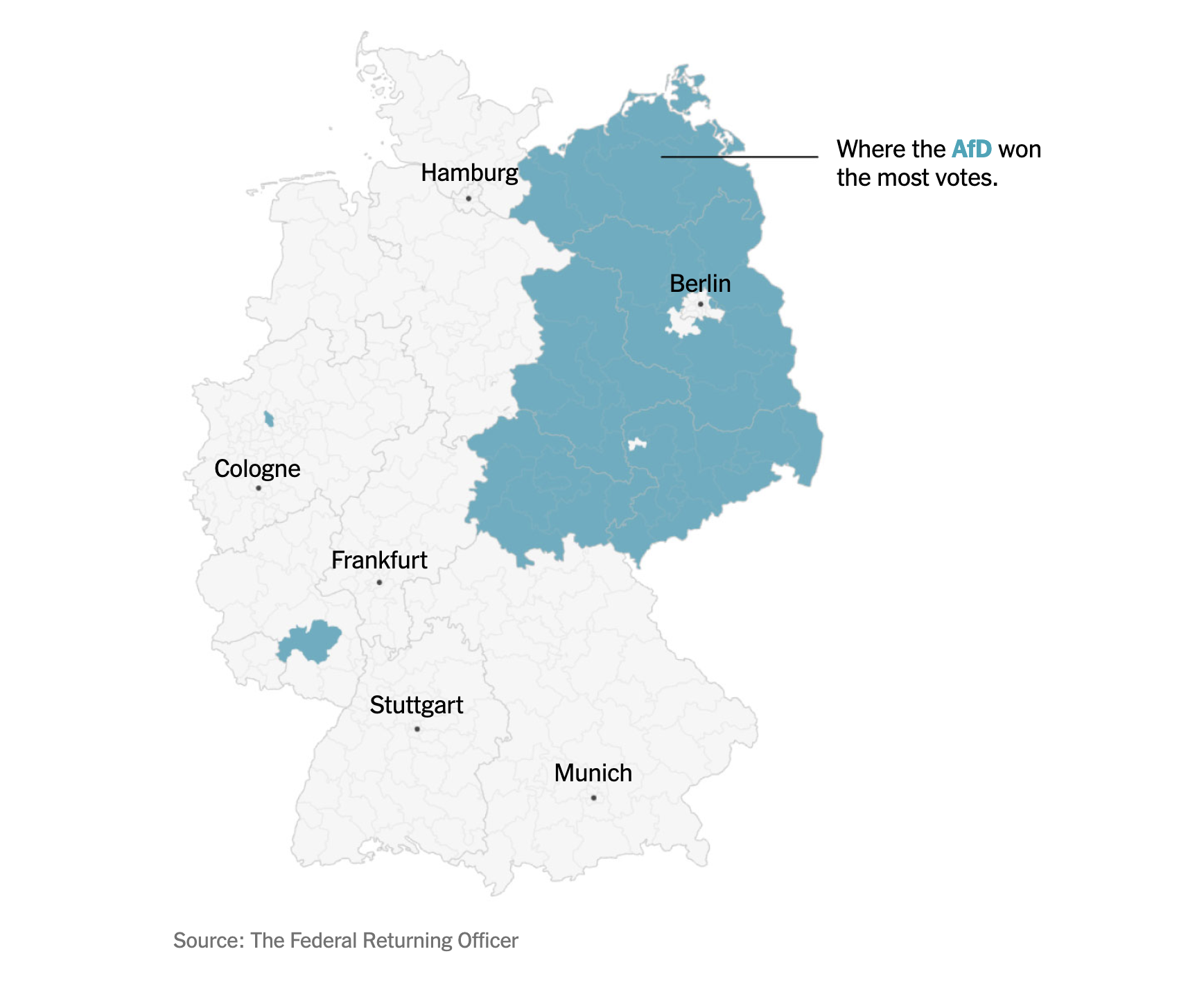
DW reports that “the big winner of the election in terms of voter gains was the right-wing populist AfD, which nearly doubled its voter share over the previous federal election in 2021. The party, whose chancellor candidate Alice Weidel received praise from Elon Musk for her hard stance on migration, was particularly strong in the East.”
An analysis of voter preferences by DW indicates that “nationally, the AfD achieved roughly 20% of the vote, but in eastern Germany, the AfD is the strongest force. In the states of Brandenburg, Mecklenburg-Western Pomerania, Saxony, Saxony-Anhalt and Thuringia, the AfD won the largest portion of the second-ballot vote, which determines the strength of the party’s representation in the Bundestag. In many constituencies, over 30% of the second vote went to the AfD. The CDU and SPD trailed far behind.”
Meanwhile, at the regional level, there were some surprises. DW points out that “in the state of Thuringia, home to Björn Höcke, who was convicted for using banned Nazi slogans, the party received more than 38% of the vote, double the number of votes for the CDU.”
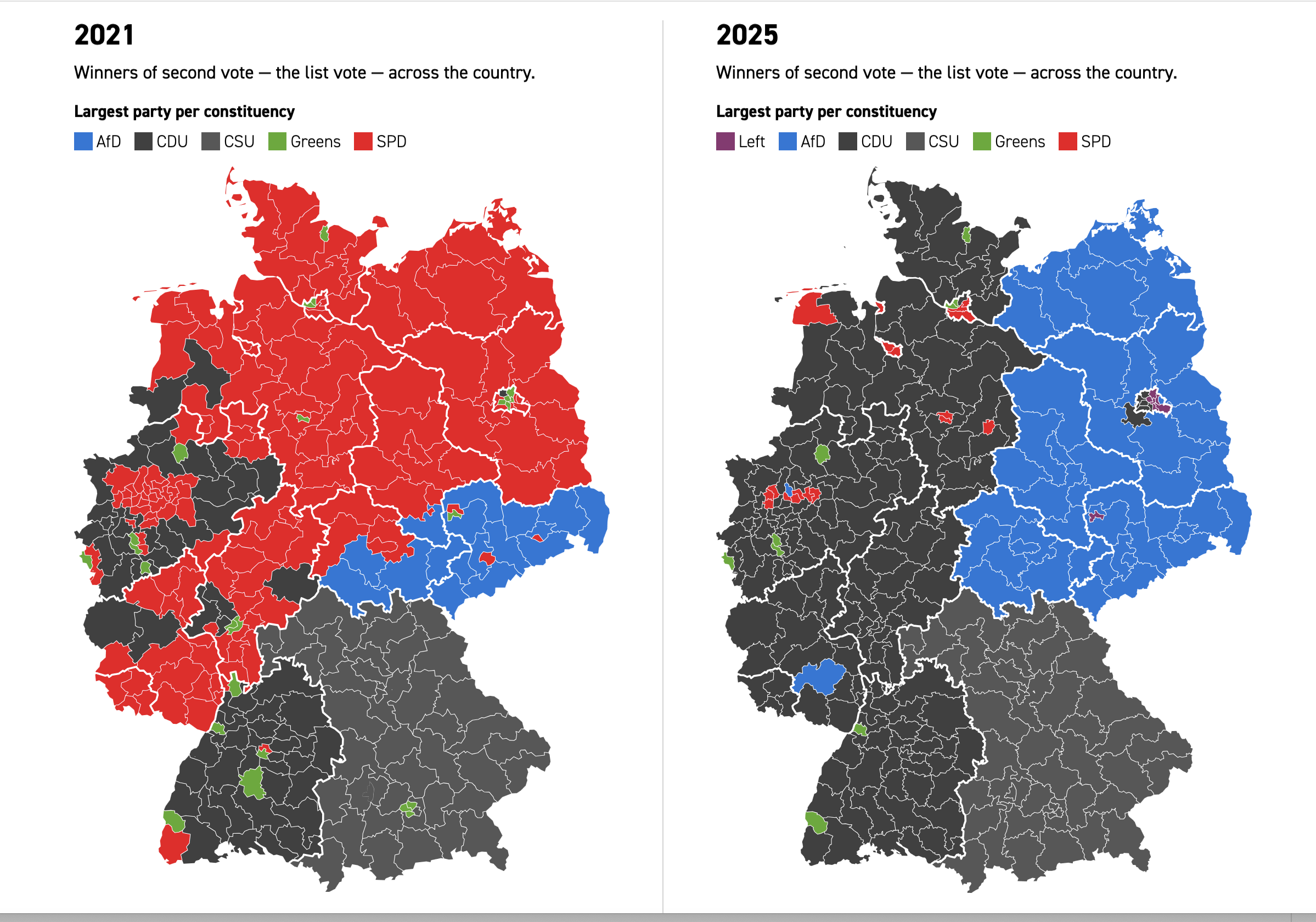
And, the Linke (Left) Party grew in the Berlin region: “The city-state of Berlin is the exception in Germany’s former East. Here the Left Party won the most votes.”
A more detailed electoral map reveals the shifts in voter preferences by region between the 2021 and 2025 German Elections.
Geographers, political scientists, sociologists point to deep social patterns that still divide the regions of the former East Germany from the rest of Germany.
Several maps published by The New York Times indicate some of the deep social and economic fault lines in German society.
Lunday, Chris and Hanne Cokelaere. “German Election 2025: Who Won Across the Country.” Politico.eu (23 February 2025).
Schuetze, Christopher F. “The Iron Curtain Casts a Long Shadow Over Germany’s Election.” The New York Times (25 February 2025).
Zeier, Kristin and Gianna-Carina Grün. “German election results explained in graphics.” DW (25 February 2025).


 Brian Sandberg: Historical Perspectives