
I participated in a workshop on Guerres de Religion et Changement Climatique (Religious Wars and Climate Change) at the IMéRA (Institute for Advanced Study) in Marseille, France, on 11 March 2025. This was a workshop that I co-organized with Jérémie Foa, Maître de conférences habilité à diriger des recherches (Aix-Marseille Université).
The conference went very well and we had great discussions of connections between climate change, disasters, social crises, and religious conflicts in France and Europe during the period of the Little Ice Age of the sixteenth and seventeenth centuries. Presentations focused on historical evidence of climate change, natural disasters, war zones, siege warfare, wolf populations, and recurrent plague epidemics. We also considered the plight of women and children as non-combatants and refugees during the religious wars.
Unfortunately, this is precisely the sort of research that is currently under attack by the Trump administration in the United States.
Climate history, environmental history, social history, cultural history, women’s history, gender history, migration history, and other forms of historical studies are being targeted for restricted funding or elimination by an administration that is using unconstitutional means to intervene in fundamental research and curricular programs at universities in the United States.
These interventions make clear that academic freedom, scientific research, and democratic education are under direct assault in the United States.
Following our workshop on Guerres de Religion et Changement Climatique, I was asked by the administrators of the IMéRA research institute to participate in a discussion of the state of higher education and research in the United States, held at the la Cité de l’Innovation et du Savoir Aix-Marseille (CISAM).
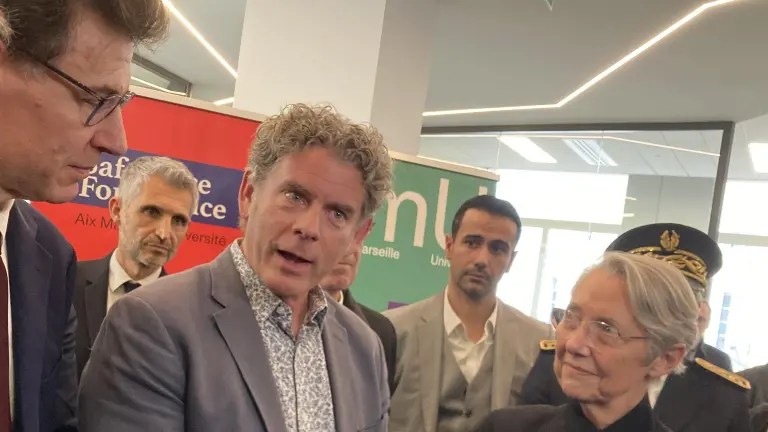
I had an opportunity to meet with Elisabeth Borne (Minister of Education) and Philippe Baptiste (Minister for Higher Education and Research), as well as the President of Aix-Marseille Université and the research administrative team of the university.
In the discussions at CISAM, I offered the perspective of an American professor and researcher who has engaged in sustained research collaborations with French researchers and universities. I spoke for myself as a professor and researcher, but I provided context on the situation of professors, postdocs, graduate students, undergraduate students in History and the Humanities during the press conference and following interviews.

The discussion at CISAM was held in part because Aix-Marseille Université has just launched a Safe Place for Science initiative to recruit scientists from the United States to join French laboratories and research teams in Marseille.
Aix-Marseille Université indicates the goals for this initiative: “At a time when academic freedom is sometimes called into question, Aix-Marseille Université is launching the Safe Place For Science program, offering a safe and stimulating environment for scientists wishing to pursue their research in complete freedom. In a context where some scientists in the United States may feel threatened or hindered in their research, our university is announcing the launch of the Safe Place For Science program, dedicated to welcoming scientists wishing to pursue their work in an environment conducive to innovation, excellence and academic freedom. As a major player in European research, Aix-Marseille University offers cutting-edge infrastructures, major international collaborations and strong support for scientists working on groundbreaking, forward-looking themes. The AMIDEX foundation will support the funding of research positions, particularly in the fields of climate, environment, health and human and social sciences (SHS).”
I also participated in several interviews during my research trip to Marseille, including with Chloé Leprince, a reporter with France Culture, and with a documentary film-making team.
The website for the Guerres de Religion et Changement Climatique (Religious Wars and Climate Change) workshop is at the IMéRA (Institute for Advanced Study) in Marseille, France.
BFM TV reported on the press conference at CISAM.
Elziere, Loïs. « Trump menace la science : des dizaines de chercheurs américains postulent à Marseille ». Made in Marseille (14 March 2025).
Laferté, Colombe. « “La souveraineté, ce n’est pas que la défense, c’est aussi la recherche ” assure Elisabeth Borne ». La Tribune (13 March 2025).
Leprince, Chloé. « Recherche aux États-Unis : “Même des mots comme ‘historique’ ou ‘socio-économique’ sont rayés” ». L’Info de France Culture (15 March 2025).
Vanderheyden, François-Samuel. « Une attaque sans précédent contre la recherche et l’éducation ». La Marseillaise (14 March 2025).
The Safe Place for Science program site is at Aix-Marseille Université.
La Cité de l’Innovation et du Savoir Aix-Marseille (CISAM) provides further information on its website.


 Brian Sandberg: Historical Perspectives