President Trump has declared himself king, opposing himself to the legitimately elected representatives of the State of New York over a congestion pricing law.
The White House issued a post on X stating that “CONGESTION PRICING IS DEAD. Manhattan, and all of New York, is SAVED. LONG LIVE THE KING!” –President Donald J. Trump.
The White House’s post included artwork depicting Trump as a King and calling “Long Live the King!”
This is no mere meme joke.
President Trump has made arrogant comments referring to himself as a king, and his administration and supporters are repeating and magnifying the offensive claims on social media.
This is part of a broader strategy to build monarchical power in the United States. The right-wing dominated U.S. Supreme Court essentially granted the President of the United States unqualified immunity in a highly controversial 2024 ruling.
Trump’s outrageous claim has prompted widespread anger and responses that the United States has no king.
New York Governor Kathy Hochul responded forcefully: “We are a nation of laws, not ruled by a king. We’ll see you in court.”
Illinois Governor J.B. Pritzker delivered his Illinois State of the State Speech, commenting that: “As governor of Illinois, my oath is to the constitution of our state and our nation. We don’t have kings in America, and I won’t bend the knee to one.”
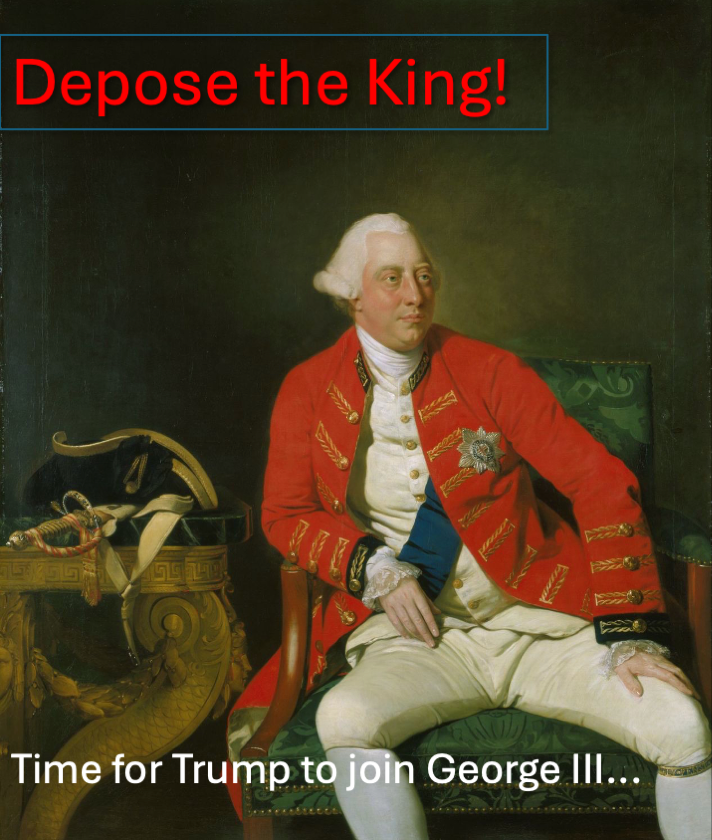
Since Trump’s White House is using memes to promote the idea of a King Donald, I’ll respond with my own meme here:
The citizens of the United States rejected monarchy and deposed King George III of Great Britain almost two hundred fifty years ago.
Historians of the United States, comparative revolutions, civil conflicts, and war and society have published numerous serious studies of the American Revolution and the War of Independence. Historians and legal scholars have studied complicated process of creating the Articles of Confederation and then the U.S. Constitution that established the world’s first modern democratic republic.
The founders of the United States utterly rejected monarchy and nobility.
U.S. citizens do not need an arrogant would-be king to claim monarchical authority and disrupt our constitutional system of government.
The University of Wisconsin’s Center for the Study of the American Constitution provides historical documents on monarchical tendencies during the Confederation period as well as debates over the writing of the U.S. Constitution.
For further reading on monarchy, revolution, republicanism, and constitutionalism in the early history of the United States see:
Bartoloni-Tuazon, Kathleen. For Fear of an Elective King: George Washington and the Presidential Title Controversy of 1789. Ithaca, NY: Cornell University Press, 2014.
Nelson, Eric. The Royalist Revolution: Monarchy and the American Founding. Cambridge, MA: Harvard University Press, 2014.
Rivage, Justin du. Revolution Against Empire: Taxes, Politics, and the Origins of American Independence. New Haven, CT: Yale University Press, 2017.
Wood, Gordon S. The Radicalism of the American Revolution. New York, NY: Vintage, 1991.
The New York Times and The Independent both report on President Trump’s claim to be king. The Guardian reports on responses to Trump’s claims. On the Supreme Court’s controversial 2024 ruling, and its relationship to monarchy, see reporting by The Nation.
President Trump shocked the world this week by falsely blaming Ukraine for starting the current Russian-Ukrainian War.
The New York Times reports: “In comments that stunned America’s allies in Europe and angered Ukraine’s government, President Trump on Tuesday appeared to blame Ukraine’s leaders for Russia’s invasion.”
“He also suggested that they do not deserve a seat at the table for the peace talks that he has initiated with President Vladimir V. Putin of Russia.”
“‘You should have never started it,’ Mr. Trump said, referring to Ukraine’s leaders. ‘You could have made a deal.’ He followed up on Wednesday in a post on social media, calling Ukraine’s president, Volodymyr Zelensky, a ‘dictator without elections’ and saying he had ‘done a terrible job’ in office.”
President Trump is attempting to rewrite history, outrageously claiming that Ukraine instigated the current Russian-Ukrainian War (2022 to present).
All wars have complex causes and preconditions, but this war was quite clearly instigated by a major Russian military invasion of Ukraine.
“When Russian forces crashed over the borders into Ukraine in 2022 determined to wipe it off the map as an independent state, the United States rushed to aid the beleaguered nation and cast its president, Volodymyr Zelensky, as a hero of resistance,” according to The New York Times.
A damaged church in Mariupol, Ukraine. Photo: The New York Times.
“Three years almost to the day later, President Trump is rewriting the history of Russia’s invasion of its smaller neighbor. Ukraine, in this version, is not a victim but a villain. And Mr. Zelensky is not a latter-day Winston Churchill, but a ‘dictator without elections’ who somehow started the war himself and conned America into helping.”
President Trump is putting the “squeeze” on President Zelensky, attempting to bully Ukraine into giving up half of its mineral wealth to the United States or capitulating to Russia.
President Zelenzky has responded by accusing Trump of “living in a disinformation space” and parroting Russian talking points.
Authoritarian regimes often rewrite historical accounts and distort historical records in order to promote their policies and political aims. This is a classic move by dictators and their regimes.
The New York Times argues that “Mr. Trump’s revisionism sets the stage for a geopolitical about-face unlike any in generations as the president embarks on negotiations with Russia that Ukraine fears could come at its own expense. By vilifying Mr. Zelensky and shifting blame for the war from Moscow to Kyiv, Mr. Trump seems to be laying a predicate for withdrawing support for an ally under attack.”
“The sharp exchange of words between Mr. Trump and Mr. Zelensky this week signaled how much has changed with the inauguration of a new president in Washington. Even for Mr. Trump, who has never been a fan of Ukraine and has long expressed admiration of President Vladimir V. Putin of Russia, the vitriol expressed toward Mr. Zelensky drew gasps of surprise on both sides of the Atlantic Ocean,” according to The New York Times.
The Trump administration has shockingly begun direct talks with Russia, without any Ukrainian participation.
President Trump’s statements and actions have purposefully created a severe diplomatic rift with Ukraine, but also with the United States’ closest military and political allies in Europe.
U.S. Defense Secretary Pete Hegseth angered NATO allies in Europe during his European trip this week. Vice President Vance’s anti-European comments at the Munich Security Conference have further alienated long-time U.S. allies. Trump has long been opposed to NATO and seems determined to destroy it entirely.
Stephen N. Walt, Robert and Renée Belfer Professor of International Relations (Harvard University), argues that “Yes, America Is Europe’s Enemy Now.”
Walt indicates hat “a few weeks ago, I warned that the second Trump administration might be squandering the tolerance and good will that Washington had long received from the world’s major democracies. Instead of seeing the United States as a mostly positive force in world affairs, these states might now ‘have to worry that the United States is actively malevolent.’ That column was written before Vice President J.D. Vance gave his confrontational speech at the Munich Security Conference, before President Donald Trump blamed Ukraine for starting the war with Russia, and before U.S. officials appeared to preemptively offer Russia almost everything it wants before negotiations on Ukraine were even underway. The reaction of mainstream European observers was neatly summed up by Gideon Rachman in the Financial Times: ‘[T]he Trump administration’s political ambitions for Europe mean that, for now, America is also an adversary.'”
The New York Times reports on “Trump Falsely Says Ukraine Started the War With Russia. Here Is What to Know.”
The New York Times also reports on President Trump’s foreign policy toward Ukraine.
The BBC fact checked President Trump’s comments on the Russian-Ukrainian War
Politico reports on the Munich Security Conference.
Stephen N. Walt’s article on “Yes, America Is Europe’s Enemy Now” is published by Foreign Affairs.
The Trump administration is seeking to militarize immigration policy enforcement and undermine civil-military relations in the United States.
“The Trump administration is ramping up plans to detain undocumented immigrants at military sites across the United States, a significant expansion of efforts by the White House to use wartime resources to make good on the president’s promised mass deportations,” according to The New York Times.
“President Trump’s team is developing a deportation hub at Fort Bliss, near El Paso, Texas, that could eventually hold up to 10,000 undocumented immigrants as they go through the process of being deported, according to three officials familiar with the plan.”
“Fort Bliss would serve as a model as the administration aims to develop more detention facilities on military sites across the country — from Utah to the area near Niagara Falls — to hold potentially thousands more people and make up for a shortfall of space at Immigration and Customs Enforcement facilities, the officials said. They spoke on condition of anonymity to discuss details of a plan that is still in its early stages and has not yet been finalized.”
The New York Times indicates that “previous administrations have held some immigrants at military bases, most recently children who would then be released into the country to the care of relatives or friends. The bases served as an emergency backup when the federal government’s shelter system for migrant children reached capacity.
“But the Trump administration plan would expand that practice by establishing a nationwide network of military detention facilities for immigrants who are subject to deportation. The proposal would mark a major escalation in the militarization of immigration enforcement after Mr. Trump made clear when he came into office that he wanted to rely even more on the Pentagon to curtail immigration.
“For Trump officials, the plan helps address a shortage of space for holding the vast number of people they hope to arrest and deport. But it also raises serious questions about the possibility of redirecting military resources and training schedules. Military officials say the impact would depend on the scale of arrests and how long detainees remained in custody. And advocates for immigrants point to a history of poor conditions for immigrants held in military facilities.”
The New York Times reports on the militarization of immigration policy enforcement.
Historians of war and society and military institutions have long studied civil-military relations in the United States. For an introduction to these studies, see:
Bacevich, Andrew. Breach of Trust: How Americans Failed Their Soldiers and Their Country. New York: Metropolitan Books, 2013.
Bruneau, Thomas. “Civil-Military Relations.” Oxford Bibliographies in International Law. doi: 10.1093/obo/9780199796953-0184
Feaver, Peter D. Armed Servants: Agency, Oversight, and Civil-Military Relations. Cambridge, MA: Harvard University Press, 2003.
Feaver, Peter and Richard H. Kohn, eds. Soldiers and Civilians: The Civil-Military Gap and American National Security, BCSIA Studies in International Security. Cambridge, MA: MIT Press, 2001.
Huntington, Samuel P. The Soldier and the State: The Theory and Politics of Civil-Military Relations. Cambridge, MA: Belknap Press of Harvard University Press, 1957.
Janowitz, Morris. The Professional Soldier: A Social and Political Portrait, reissue edition. New York: Free Press, 2017.
Kohn, Richard H. “Building Trust: Civil-Military Behaviors for Effective National Security.” American Civil-Military Relations: The Soldier and the State in a New Era, ed. Suzanne Nielsen and Don Snider, 264-289. Baltimore, MD: Johns Hopkins University Press, 2009.
Kohn, Richard H. “The Constitution and National Security: The Intent of the Framers.” In The United States Military under the Constitution of the United States 1789–1989, ed. Richard H. Kohn, 61–94. New York, NY: New York University Press, 1991.
Kohn, Richard H. “Out of Control: The Crisis in Civil-Military Relations.” The National Interest 35 (Spring 1994), 3–17.
Illinois State University is hosting an Illinois Digital Humanities Symposium on 11 April 2025.
Undergraduate and graduate students in History and other Humanities disciplines at Northern Illinois University may be interested in presenting at this symposium or attending the sessions.
Here is the call for submissions from the Milner Library at Illinois State University:
CALL FOR SUBMISSIONS
Illinois Digital Humanities Symposium: Focusing on Student Work 11 April 2025, 10–6 Milner Library, Illinois State University
Submissions will close at midnight on 7 March 2025. Notifications of acceptance will go out on 11 March 2025.
————
Dear Illinois (and neighboring!) DH Scholars and Students,
We would like to invite submissions for a one-day symposium of and on student DH work, to be held at Illinois State University, in Normal, Illinois, on the 11th of April 2025. We would like to engage universities throughout and neighboring Illinois, and have built the event around the Chicago-Normal and St. Louis-Chicago train schedules, in order to encourage participation from opposite ends of the state. Our hope is to start an annual rotation of conferences between Chicagoland and the rest of Illinois, and hope you will join us to kick off this event this year in Normal!
Our program will include a keynote lecture by Dr Ted Underwood, Professor of English and Information Sciences at the University of Illinois Urbana-Champaign on What Humanists Can Contribute to AI, a panel on DH pedagogy, panels of short papers, and a poster session.
Coffee breaks and lunch (sponsored by Milner Library) and a reception (sponsored by Loyola University) will be provided. There is no cost for attendance.
Please submit a 200–500 word abstract for a poster or 20-minute paper to Dr. Sean Winslow <smwinsl@ilstu.edu> by midnight on 7 March 2025. Acceptances will be sent out on 11 March 2025. Posters and papers should be by or in collaboration with students or focused on student DH work or pedagogy. We also invite instructors to nominate themselves or particularly involved students for the panel on PhD pedagogy.
Republicans in the House of Representatives are planning to make massive cuts to Medicaid, one of the essential healthcare programs in the United States.
“Mike Johnson, the House Speaker, has been hard at work on a major bill that can balance various priorities of Mr. Trump and his caucus: a desire for $4.5 trillion in tax cuts, a wish to trim federal spending, and concerns about rising federal debts,” according to The New York Times.
“The budget Mr. Johnson negotiated for the next decade, a first step in passing that agenda, calls for around $880 billion in cuts to Medicaid, in an effort to counterbalance a portion of the tax cuts.”
President Trump has endorsed the House Republicans’ plans for massive cuts to Medicaid and Medicare in order to cover the costs of his tax cuts.
Trump is now claiming on Fox News that he does not want cuts to Medicaid, however his frequent misstatements and outright lies mean that his promises are not credible.
President Trump has actually called for cuts to Medicaid and Medicare frequently during his presidential campaigns and previous administration, clearly signaling his intent to cut healthcare.
The Republicans’ proposed cuts to Medicaid would be devastating for millions of ordinary American citizens.
The New York Times points out that “Medicaid covers nearly half of all births in the country, and around two-thirds of nursing home stays. In 41 states that expanded the program as part of the Affordable Care Act, it also covers millions of working-class Americans with incomes close to the poverty line.”
Nursing home residents have no power to fight back against the proposed cuts, so their family members will have to mobilize to represent them.
“The House plan remains vague. It does not specify Medicaid policies other than the budget target for the committee that oversees the program. But spending reductions so large would require major changes. Adding a work requirement to the program, a proposal with some public support, would save only around $100 billion.”
The New York Times reports on “Trump Says Medicaid Won’t Be ‘Touched.’ House Republicans Want It Cut by Hundreds of Billions.”
Historians of medicine and analysts of public healthcare are monitoring these ongoing developments.
For an understanding of the history of public healthcare systems in the United States, see my colleague’s important study:
Hoffman, Beatrix. Health Care for Some: Rights and Rationing in the United States since 1930. Chicago, IL: University of Chicago Press, 2012.
U.S. citizens who are concerned about the proposed cuts to Medicaid should contact their U.S. Senators and Representatives to demand that they defend Medicaid and Medicare.
President Trump’s Department of Education is subverting established U.S. Civil Rights Law.
Craig Trainor, Acting Assistant Secretary for Civil Rights at the Department of Education, has sent an outrageous “Dear Colleague” letter to all institutions of higher education in the United States.
The Acting Assistant Secretary for Civil Rights claims (incorrectly) that “Educational institutions have toxically indoctrinated students with the false premise that the United States is built upon ‘systemic and structural racism’ and advanced discriminatory policies and practices. Proponents of these discriminatory practices have attempted to further justify them—particularly during the last four years—under the banner of ‘diversity, equity, and inclusion’ (‘DEI’), smuggling racial stereotypes and explicit race-consciousness into everyday training, programming, and discipline.”
The “Dear Colleague” letter continues: “But under any banner, discrimination on the basis of race, color, or national origin is, has been, and will continue to be illegal.”
Trainor focuses on a controversial 2023 Supreme Court decisions and attempts to broaden its applicability far beyond the original language of the decision.
“The Supreme Court’s 2023 decision in Students for Fair Admissions v. Harvard (SFFA), which clarified that the use of racial preferences in college admissions is unlawful, sets forth a framework for evaluating the use of race by state actors and entities covered by Title VI. The Court explained that ‘[c]lassifying and assigning students based on their race’ is lawful only if it satisfies ‘strict scrutiny,’ which means that any use of race must be narrowly tailored—that is, ‘necessary’—to achieve a compelling interest. To date, the Supreme Court has recognized only two interests as compelling in the context of race-based action: (1) ‘remediating specific, identified instances of past discrimination that violated the Constitution or a statute”; and (2) ‘avoiding imminent and serious risks to human safety in prisons, such as a race riot.’ Nebulous concepts like racial balancing and diversity are not compelling interests. As the Court explained in SFFA, ‘an individual’s race may never be used against him’ and ‘may not operate as a stereotype’ in governmental decision-making.”
According to Trainor, “Although SFFA addressed admissions decisions, the Supreme Court’s holding applies more broadly. At its core, the test is simple: If an educational institution treats a person of one race differently than it treats another person because of that person’s race, the educational institution violates the law. Federal law thus prohibits covered entities from using race in decisions pertaining to admissions, hiring, promotion, compensation, financial aid, scholarships, prizes, administrative support, discipline, housing, graduation ceremonies, and all other aspects of student, academic, and campus life. Put simply, educational institutions may neither separate or segregate students based on race, nor distribute benefits or burdens based on race.”
The Acting Assistant Secretary asserts that “This letter provides notice of the Department’s existing interpretation of federal law. Additional legal guidance will follow in due course. The Department will vigorously enforce the law on equal terms as to all preschool, elementary, secondary, and postsecondary educational institutions, as well as state educational agencies, that receive financial assistance.”
The Acting Assistant Secretary then threatens all universities directly:
“The Department intends to take appropriate measures to assess compliance with the applicable statutes and regulations based on the understanding embodied in this letter beginning no later than 14 days from today’s date, including antidiscrimination requirements that are a condition of receiving federal funding.”
Civil Rights leader Rev. Earle J. Fisher responds directly to the letter: “Make no mistake. This is not about fairness; it’s about erasure. It’s about rolling back decades of progress and silencing the very institutions that have fought to level the playing field.”
Fisher points out that ‘Trainor’s letter invokes the language of the Civil Rights Act of 1964 while twisting its intent beyond recognition. He writes, ‘This letter explains and reiterates existing legal requirements under Title VI of the Civil Rights Act of 1964, the Equal Protection Clause of the United States Constitution, and other relevant authorities.’ However, Title VI was designed to dismantle racial discrimination, not to prohibit corrective measures that address centuries of inequity. Trainor and the Department of Education now argue that race-conscious policies, even those explicitly aimed at remedying historical injustices, are unlawful. They are citing civil rights law to justify rolling back civil rights progress.”
Fisher calls for action to block the Trump Department of Education’s perversions of U.S. Civil Rights Law: “The policies outlined in the directive from the Education Department are an extension of a broader movement to roll back racial progress in every sector of society, including progress made in voting rights, economic justice and criminal justice reform. We cannot allow this to stand.”
The “Dear Colleague” letter is also an direct assault on academic research, research funding, educational rights, student scholarships, university autonomy, and academic freedom.
United States historians, constitutional lawyers, higher education researchers, university administrators, and professors are all responding to the “Dear Colleague” letter. I will attempt to update this post with links to additional perspectives soon.
Meanwhile, universities across the United States will be grappling with the implications of this outrageous subversion of Civil Rights Law.
Acting Secretary Craig Trainor’s “Dear Colleague” letter is posted on the website of the Department of Education.
Shaun Harper, Professor and Clifford and Betty Allen Chair in Urban Leadership (Univesrity of Southern California), has published a “Dear Colleague” letter in response at InsideHigherEd, providing suggestions on steps that universities can take to defend Civil Rights and higher education.
dotEDU Live hosted a discussion of “The Future of Campus Diversity and Student Support” discussing these issues.
Scott White published an article on “Colleges React To Perceived Over-Reach Of Education Department’s ‘Dear Colleague’ Letter,” in Forbes.
The Chronicle of Higher Education offers extensive reporting on the “Dear Colleague” letter and responses to it. However, their articles are behind a paywall, so access those reports via your local university library.
A former Associate White House Counsel and legal scholar asserts that the so-called Department of Government Efficiency (DOGE) is not a legitimate department at all, and as such is completely unconstitutional.
Alan Charles Raul, former Associate White House Counsel and Lecturer at Harvard Law School, has published an opinion piece in The Washington Post, laying out the legal questions surrounding DOGE.
Raul argues that: “The Constitution is well known to interpose meaningful checks and balances and a separation of powers among the responsibilities of the executive, legislative and judicial branches. It is also well understood that the respective branches’ powers and duties intersect and overlap. Fundamentally, however, all legislative power belongs to Congress, and executive power to the president. The judiciary steps in when the parameters of shared authority get complicated or confusing and constitutional lines are crossed.”
The actions taken by DOGE political appointees violate the U.S. Constitution. Raul points out that “the radical reorganization now underway is not just footfaulting over procedural lines; it is shattering the fundamental checks and balances of our constitutional order. The DOGE process, if that is what it is, mocks two basic tenets of our government: that we are a nation of laws, not men, and that it is Congress which controls spending and passes legislation. The president must faithfully execute Congress’s laws and manage the executive agencies consistent with the Constitution and lawmakers’ appropriations — not by any divine right or absolute power.”
The attorneys general of 14 states have filed a lawsuit against DOGE, arguing that its powers are indeed unconstitutional. That lawsuit is currently pending, meanwhile other lawsuits are also being filed against DOGE. “The attorneys general argue that Trump violated the Appointments Clause of the Constitution by creating DOGE — an unofficial government agency — without congressional approval and by granting Musk ‘sweeping powers’ without seeking the advice and consent of the Senate through a confirmation hearing,” according to NBC News.
“‘President Trump has delegated virtually unchecked authority to Mr. Musk without proper legal authorization from Congress and without meaningful supervision of his activities,’ the lawsuit reads. ‘As a result, he has transformed a minor position that was formerly responsible for managing government websites into a designated agent of chaos without limitation and in violation of the separation of powers.'”
United States historians, legal historians, constitutional lawyers, and political scientists are all weighing in on the unconstitutional nature of the so-called DOGE organization. I aim to post additional links to scholars’ analyses soon.
Alan Charles Raul’s opinion piece is published as “Why DOGE is unconstitutional” in The Washington Post.
NBC News reports on the lawsuit by 14 states against DOGE.
State universities in Illinois have been underfunded for decades and this is especially true of the second tier state universities such as Northern Illinois University.
Educational funding for state universities across the United States has long failed to pay for the costs of higher education, and the existing funds that have been appropriated have often been concentrated in the flagship universities, such as the University of Illinois at Urbana-Champaign.
The higher tuition costs at state universities across the United States stems largely from the massive disinvestment in public higher education by state governments over the past 40 years.
The University Professionals of Illinois (UPI) is now calling on Governor Pritzker to back increased funding for public higher education in Illinois, as well as for a more balanced funding model among state universities.
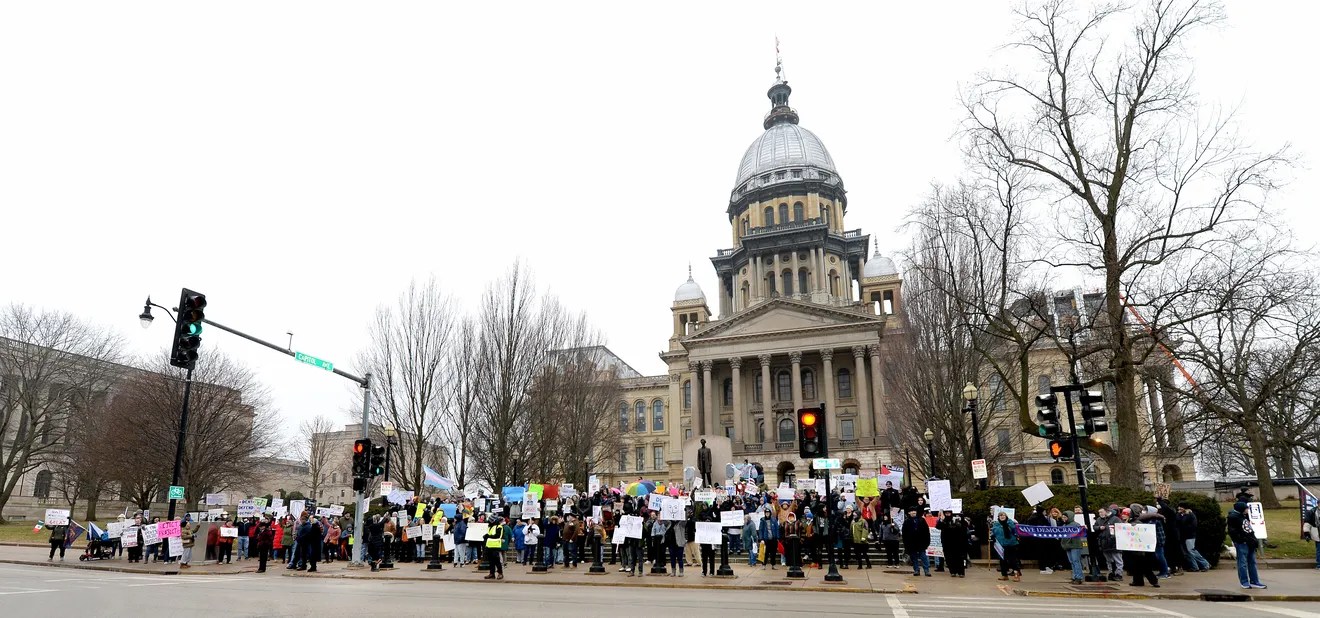
Protest at the State Capitol of Illinois in Springfield, February 2025.
Here is the statement from the UPI:
University Professionals of Illinois Local 4100 Responds to Governor Pritzker’s State of the State Address and His Lack of Support for SB13/HB1581
We applaud the governor’s stance against authoritarianism and his willingness to defend Illinois from various federal challenges including the attacks on federal grants, the Department of Education and other federal agencies/programs. Since public higher education is a main guardrail against authoritarianism, his lack of support for the Adequate and Equitable Public University Funding Act (SB13 and HB1581) is deeply disappointing and a missed opportunity to enact meaningful reform and strengthen our state’s resolve to stand against the national attacks on Illinoisans.
SB13/HB1581 represents a critical step toward funding our public universities and decreasing the reliance on student tuition and fees. This legislation has widespread support from community leaders, advocacy groups, and everyday Illinoisans who recognize the urgent need for change. This legislation would reverse Illinois’ decades long under funding of public higher education. The failure to fund our universities has resulted in significant student debt, students leaving our state and even students priced out of attending a public university. Our students, families, communities and institutions deserve better.
Illinois’ higher education system is a critical driver of economic growth, social mobility, and workforce development. Yet, year after year, state support remains inadequate, leading to tuition hikes, faculty layoffs, and reduced services that disproportionately impact low-income and first-generation students. Without substantial reinvestment, we risk further exacerbating the brain drain as talented students and educators leave Illinois for better-funded institutions elsewhere.
We urge the Governor to advocate strongly for the students and families of Illinois who are demanding change. It is not too late for him to do the right thing and support the Adequate and Equitable Public University Funding Act. The people of this state deserve leadership that prioritizes their needs over political calculations.
Note: See my previous posts on the massive disinvestment in public higher education by state governments.
Professors, researchers, and educators across the nation are taking actions to defend research and higher education in the United States.
The American Association of University Professors (AAUP) states:
“The Trump administration and many state governments are accelerating attacks on academic freedom, shared governance, and higher education as a public good. We are working with our chapters and with allies in higher ed and the labor movement to defend and advance our vision: Higher education that is accessible and affordable for all who want it. Freedom to teach, to learn, to conduct research, to speak out on issues of the day, and to assemble in the organizations of our choice. Colleges and universities that create opportunity for students, workers, and communities. Sufficient funding to provide true education and sustainable working conditions. Information and resources to help in this fight are being added below as they are developed.”
The AAUP and several allies have already filed a lawsuit to block the Trump administration’s suspension of some research grants.
The AAUP is posting information on particular issues in research and higher education that are being affected by the attacks by the Trump administration and Elon Musk’s so-called Department of Government Efficiency (DOGE) on federal agencies that conduct and/or fund research and higher education, such as the National Institutes of Health (NIH), National Science Foundation, Department of Education, NOAA, and NASA.
The Labor for Higher Education alliance is posting information on actions in defense of research and higher education across the United States.
Governor J.B. Pritzker delivered a powerful Illinois State of the State Speech this week, arguing that Illinois representatives and citizens must act to defend the U.S. Constitution and oppose tyranny in the United States.
After discussing Illinois policy issues and initiatives in the state of Illinois, Gov. Pritzker turned to discuss the threat of fascism in American society, citing the infamous 1978 case involving Nazis attempting to march through Skokie, Illinois, in order to intimidate Jews living there.
Pritzker then pivoted to the current unconstitutional actions being made by the Trump administration and Elon Musk’s so-called Department of Government Efficiency (DOGE).
“I’m watching with a foreboding dread what is happening in our country right now. A president who watches a plane go down in the Potomac – and suggests — without facts or findings — that a diversity hire is responsible for the crash. Or the Missouri Attorney General who just sued Starbucks – arguing that consumers pay higher prices for their coffee because the baristas are too ‘female’ and ‘nonwhite.’ The authoritarian playbook is laid bare here: They point to a group of people who don’t look like you and tell you to blame them for your problems.
“I just have one question: What comes next? After we’ve discriminated against, deported or disparaged all the immigrants and the gay and lesbian and transgender people, the developmentally disabled, the women and the minorities – once we’ve ostracized our neighbors and betrayed our friends – After that, when the problems we started with are still there staring us in the face – what comes next.
“All the atrocities of human history lurk in the answer to that question. And if we don’t want to repeat history – then for God’s sake in this moment we better be strong enough to learn from it.
“I swore the following oath on Abraham Lincoln’s Bible: ‘I do solemnly swear that I will support the constitution of the United States, and the constitution of the state of Illinois, and that I will faithfully discharge the duties of the office of Governor …. according to the best of my ability.’
“My oath is to the Constitution of our state and of our country. We don’t have kings in America – and I don’t intend to bend the knee to one. I am not speaking up in service to my ambitions — but in deference to my obligations.
“If you think I’m overreacting and sounding the alarm too soon, consider this:
“It took the Nazis one month, three weeks, two days, eight hours and 40 minutes to dismantle a constitutional republic. All I’m saying is when the five-alarm fire starts to burn, every good person better be ready to man a post with a bucket of water if you want to stop it from raging out of control.
“Those Illinois Nazis did end up holding their march in 1978 – just not in Skokie. After all the blowback from the case, they decided to march in Chicago instead. Only twenty of them showed up. But 2000 people came to counter protest. The Chicago Tribune reported that day that the ‘rally sputtered to an unspectacular end after ten minutes.’ It was Illinoisans who smothered those embers before they could burn into a flame.
“Tyranny requires your fear and your silence and your compliance. Democracy requires your courage. So gather your justice and humanity, Illinois, and do not let the ‘tragic spirit of despair’ overcome us when our country needs us the most.”
Many historians of Nazi Germany and fascist movements agree with Gov. Pritzker’s assessments of the relevance of the historical case of the Nazi Party’s rapid dismantling of the Weimar Republic and its constitution for understanding what is happening now in the United States.
The video of Gov. Pritzker’s Illinois State of the State Speech is available on YouTube. The full text of Gov. Pritzker’s speech is available at NBC 5 Chicago and also on NPR.
On the Nazi Party’s dismantling of the Weimar Republic’s democratic system, see a previous post entitled “On Hitler’s Dismantling of Democracy in 53 Days.”









 Brian Sandberg: Historical Perspectives