Mediterraneans Abandon Diet

For decades, nutritionists have celebrated the concept of the “Mediterranean Diet,” touted for its focus on vegetables, fish, and minimal meat. Historians and anthropologists have long considered the concept problematic, since actual diets vary widely across Mediterranean societies.

Whatever the benefits of the “Mediterranean Diet,” it seems that many people around the Mediterranean Sea are radically changing their food consumption habits, eating much more meat and fast food. This is hardly a surprise for historians who have spent time in Mediterranean countries doing research over the past decade or so.

Students in HIST 458 The Mediterranean World at NIU will be interested in a report on NPR that discusses the changing “Mediterranean Diet.”

Posted in Food and Cuisine History, French History, Italian History, Mediterranean World | Leave a comment

US-France Women’s World Cup Match

French historian Laurent Dubois commented on the US-France Women’s World Cup match yesterday.

Dubois is a historian of the French Revolution in the Caribbean, but he recently published a book on soccer and politics in France.

Dubois’s comments on the Women’s World Cup can be heard on PRI’s The World.


Posted in French History | Leave a comment

KUT’s Texas Music History

University of Texas at Austin’s KUT radio station has created a streaming mix of Texas music history that is worth checking out.

Texas music history is much more diverse than most people realize.

NPR has the story and the mix online.


Posted in Music History | Leave a comment

Berlusconi’s Bad Week

Italian Prime Minister Silvio Berlusconi is having a bad week.

Berlusconi announced earlier this week that he would not run for re-election, although some observers see this simply as a political maneuver.

Now, Berlusconi’s company Fininvest has lost a legal case and has been ordered to pay 560 million Euros in damages to a rival company over bribery allegations in Fininvest’s acquisition of the publisher Mondadori.

BBC reports on the story, as does La Repubblica.


Posted in European Union, Italian History | Leave a comment

Medieval Manuscript Stolen from Santiago de Compostela

The Codex Calixtinus, a twelfth-century manuscript account of the transportation of Saint James’s body, was stolen from Santiago de Compostela this week. Someone broke into the cathedral archive’s safe and took the manuscript. The loss of the manuscript, which is considered an important early description of Europe, is tragic.
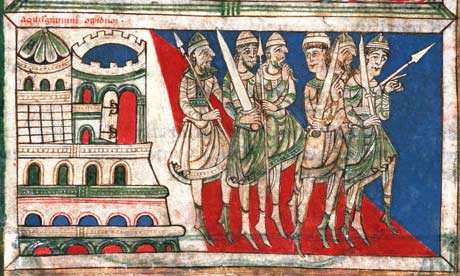
The Guardian reports on the theft of the Codex Calixtinus. [Thanks to art historian Rainbow Porthé for this link.]

Archives, museums, and private collections are frequently targeted for commissioned thefts of priceless manuscripts and art objects. Presumably this was the case with this manuscript theft.

Manuscript heists represent a serious threat to historical research, which depends historians having access to original manuscripts in the course of  their work. The loss or removal into private hands of manuscripts by theft prevents historical research on those manuscripts.  In many countries, budget cuts and poor facilities threaten the security of entire archival collections. The chilling effect of thefts on research is magnified by archivists’ fears of robberies, which lead them to restrict access to their existing manuscript collections. Historians and many scholars in art history, architectural history, music history, literary history, theater history, history of philosophy, political theory, religious studies, and cultural studies depend on being able to use manuscript collections in their research.

Professors and graduate students in history and related humanities fields need to be aware of the threats to manuscript collections worldwide and advocate for measures to ensure the protection of historical materials and world heritage. For more information about how to help conserve the documentary world heritage, see UNESCO’s Memory of the World Program.


Posted in Archival Research, European History, History in the Media | Leave a comment

Libyan Women Prepare for Combat

Women have long participated in warfare, despite assumptions that war has been a predominantly masculine activity.

Some Libyan women are now preparing for combat to support Qaddafi’s regime. Civil conflicts, such as the Libyan war, often present possibilities for women to participate more directly in warfare than other types of conflicts.

The Washington Post reports on the Libyan female combatants.

Posted in Civil Conflict, Gender and Warfare, War, Culture, and Society, Women and Gender History | Leave a comment

Case Against DSK May Collapse

The case against Dominique Strauss-Kahn now appears close to collapse, after prosecutors discovered serious credibility problems with the testimony of the housekeeper who accused him of sexual assault.  The New York Times reports on the developments in the case and provides further details on DSK’s release from house arrest.

The news has stunned French observers.  Le Monde reports the latest twist in the DSK case to the French public, relying on articles in the New York Times and New York Post. Liberation describes the latest developments as a coup de théâtre.

The possibility of dismissal of charges against DSK opens the possibility that he might recover his political status within France and still run for president against Nicolas Sarkozy. The New York Times reports on the political reaction in France. Liberation provides reactions from Socialist politicians in France.

The DSK affair is bound to have a lasting legacy on Franco-American relations, confirming French negative assessments of the United States justice system.

Posted in European Union, French History, Human Rights, Women and Gender History | Leave a comment

France Arms Rebels in Libya

The French government now admits that it is arming rebels in Libya in an overt attempt to oust Muammar el-Qaddafi.

Col. Thierry Burkhard, a French military spokesperson, said that French forces “airdropped water, food and medical supplies” to Misurata and to the region south of Tripoli.  “During this operation troops also airdropped arms and ammunition several times, including assault rifles, machine guns and rocket-propelled grenades and launchers,” he said.

The New York Times reports on the French weapons transfers.


Posted in Arms Control, French History, Mediterranean World, War, Culture, and Society | Leave a comment

Manuscript Research at the BNF

I recently returned from a short research trip to France, where I was conducting research on manuscript collections dating from the French Wars of Religion (1562-1629) held at the Bibliothèque Nationale de France (BNF) in Paris.  The manuscript collections are conserved at the BNF site on the rue de Richelieu, rather than at the new library at Tolbiac.

This trip, I was primarily examining French noblewomen’s letters dealing with aspects of religious violence and civil warfare during the French Wars of Religion.  I also read some short treatises and mémoires dealing with women and gender issues during the religious wars.

This research is intended for my next book project on A Virile Courage: Gender and Violence in the French Wars of Religion.  I have been gradually researching this book on-and-off over the past eight years and hope to complete the research in the next two years.  I have already published several journal articles and short pieces relating to this project, but I am looking forward to moving the manuscript forward with the new sources I located on this trip.

It was fabulous to be back in Paris and working with manuscripts!  It is always a pleasure to explore the holdings at the Salle des Manuscrits (even if they are currently moved over to the Salle Mazarine because of ongoing renovations of the building at Richelieu), and to enjoy lunch breaks in the gardens of the Palais Royal.

Readers of my blog will have noticed that there have been no new posts during my research trip to France.  Now that I am back in Chicago, the posts will be proliferating again.

Posted in Archival Research, French History, French Wars of Religion | Leave a comment

Christine Lagarde Chosen to Lead IMF

French Finance Minister Christine Lagarde has been chosen to lead the International Monetary Fund (IMF).

The United States has stated its support for Lagarde, effectively ensuring her selection for the IMF post recently vacated by Dominique Strauss-Kahn, who was arrested on charges of sexual assault in New York City.

Lagarde will be the first woman to head the IMF, but the latest in a long string of Europeans to lead the organization.  A number of governments around the world had expressed support for a non-European leader to take up the post, but the United States finally supported European nations’ bid to maintain control of the organization.

The Washington Post reports on Lagarde’s selection.


Posted in European Union, French History, Women and Gender History | Leave a comment