The American Council on Education (ACE), Association of American Universities (AAU), the Association of Public and Land-Grant Universities (APLU), and other associations have filed a lawsuit to defend medical research in the United States.
Here is the joint statement from the ACE website:
The following is a statement from ACE, the Association of American Universities, and the Association of Public and Land-grant Universities:
On Friday, February 7, 2025, the administration declared that it would cut funding for life-saving medical research. Its announcement that it would limit Facilities and Administrative (F&A) reimbursements to a 15% rate for all NIH research grants would have an immediate and dire impact on critical biomedical and health research nationwide. F&A costs are the real and necessary costs of conducting the groundbreaking research that has led to so many medical breakthroughs over the past decades. A cut to F&A for NIH grants is a cut to the medical research that helps countless American families whose loved ones face incurable diseases or untreatable debilitating conditions.
Besides harming the ability of research universities to continue doing critical NIH research that seeks out new and more effective approaches to treating cancer, heart disease, and dementia, among others, and translating basic science into cures, this cut would also undermine universities’ essential training of the next generation of biomedical and health science researchers. The loss of this American workforce pipeline would be a blow to the U.S. economy, to American science and innovation, to patients and their families, and to our nation’s position in the world as a leader in medical research.
It would be, quite simply, a self-inflicted wound.
Today, February 10, 2025, we have jointly filed suit in United States District Court for the District of Massachusetts, along with a number of impacted research university co-plaintiffs, seeking to halt the proposed cut. Besides its devastating impact on medical research and training, the proposed actions run afoul of the longstanding regulatory frameworks governing federal grants and foundational principles of administrative law. Judicial relief is amply justified and urgently needed. This action is ill-conceived and self-defeating for both America’s patients and their families as well as the nation as a whole. We look forward to presenting our case in court.
Historians utilize documents to analyze historical events, developments, and patterns.
Journalists also rely heavily on documents in their reporting on contemporary events, leading some news organizations to claim that journalism is the “first draft of history.” While this claim may be problematic, journalists and historians certainly share an interest in obtaining, analyzing, and preserving documents.
News organizations play an important role in modern society in obtaining government documents through freedom of information requests (known as FOIA in the United States) and through leaks from civil servants and whistleblowers.
The Washington Post has now obtained internal documents of the so-called Department of Government Efficiency (DOGE) team that reveal their “game plan” for gutting agencies of the federal government of the United States through a massive purge of civil servants that is politically motivated and arguably unlawful.
Reporters with The Washington Post are now analyzing these DOGE planning documents and publishing many of them on the news organization’s website.
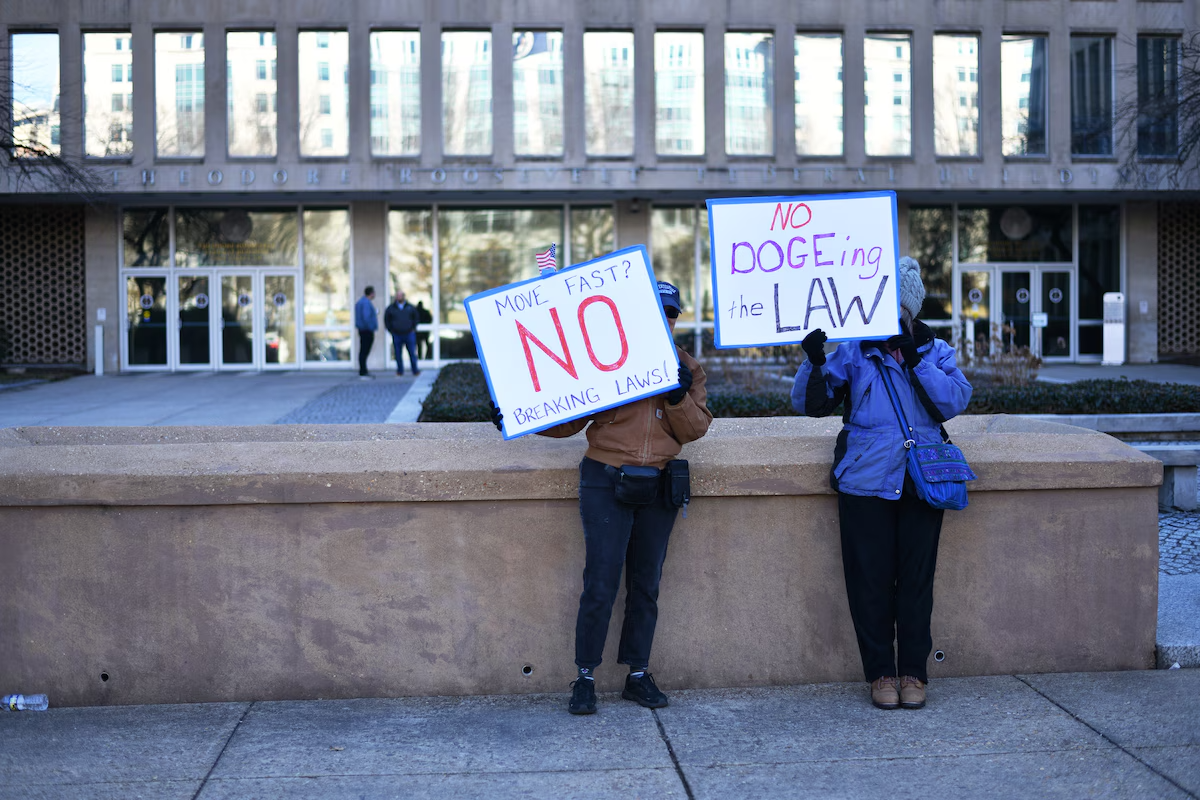
Protesters demonstrating against the so-called DOGE in Washington, D.C. Photo: The Washington Post.
The Washington Post reports: “A team of workers from the U.S. DOGE Service developed step-by-step plans for carrying out President Donald Trump’s order to purge diversity, equity and inclusion initiatives from the federal government — and over the next six months intends to expand that campaign dramatically, according to documents obtained by The Washington Post. DOGE aims to target staffers who are not in DEI roles and employees who work in offices established by law to ensure equal rights, internal DOGE documents show.
“In the coming weeks, the documents show, DOGE has planned for the Trump administration to trim staff from dozens of offices across the executive branch, including those that protect employees’ civil rights and others that investigate complaints of employment discrimination in the federal workplace. Among the groups targeted are a Veterans Affairs office that works to ensure all veterans receive equal access to care and an office within Health and Human Services that provides information about the health of minority populations,” according to The Washington Post.
“The DOGE team is also looking to place on leave, and ultimately fire, scores of government employees who do not work in DEI roles but who perform functions that DOGE determined were related to DEI, the documents show. It is unclear precisely how DOGE intends to decide whether employees’ jobs are tied to DEI. Such a strategy will push, if not violate, the law and could draw legal challenge, team members wrote in the documents.”
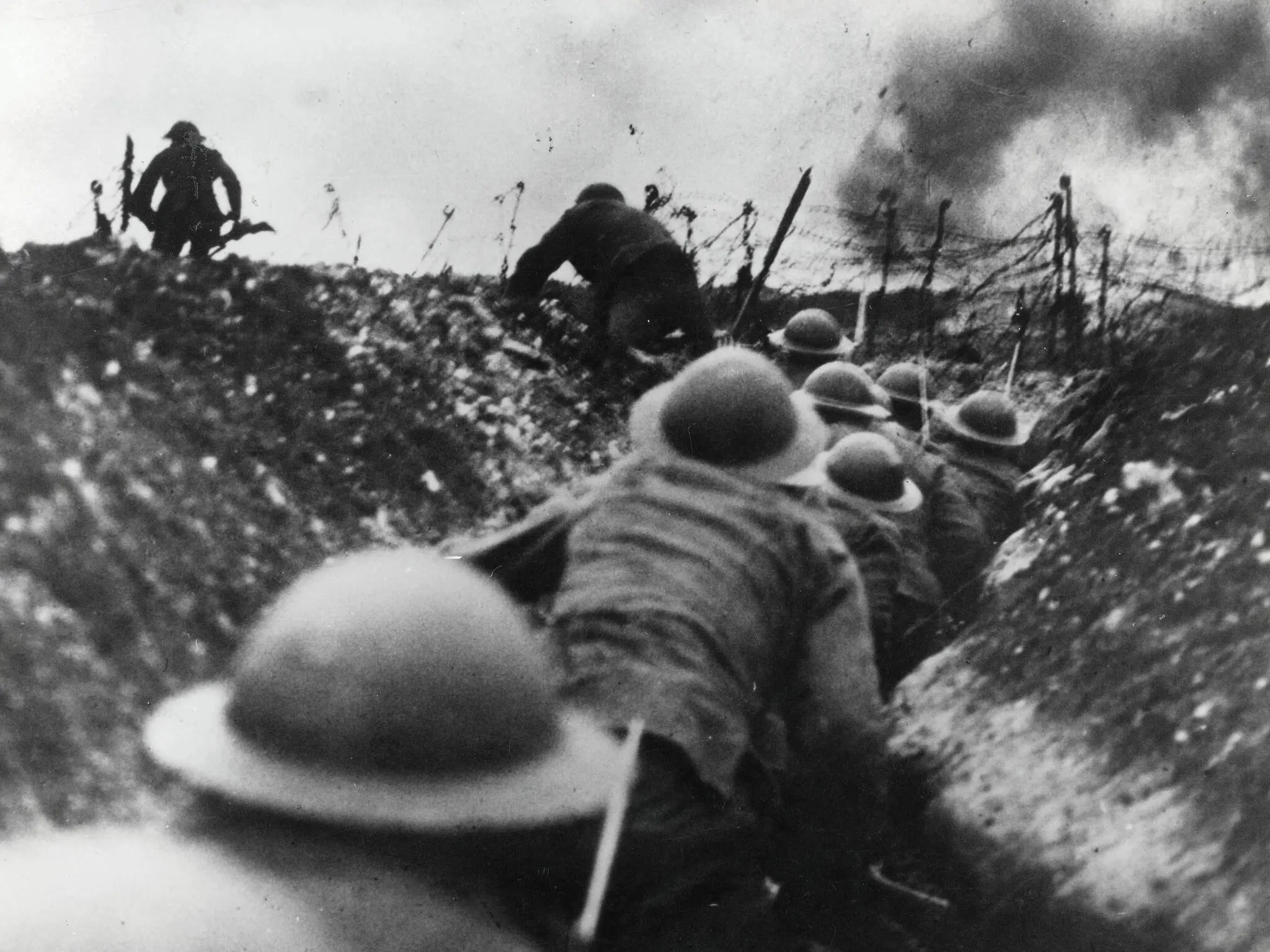
Paul Fussell’s The Great War and Modern Memory, a classic study of British soldiers’ writings about trench warfare on the Western Front during the First World War, is now 50 years old.
Dwight Garner, a book critic at The New York Times, offers an appreciation of Fussell’s award-winning book: “The Great War and Modern Memory turns 50 this year. It did not go unrecognized when it was published. It won a National Book Award and a National Book Critics Circle Award. In 1998, the Modern Library ranked it No. 75 on its list of the 100 best nonfiction books of the 20th century.”
Garner suggests that Fussell’s book “now seems distressingly neglected,” but this misses The Great War and Modern’s Memory’s enormous impact on studies of history and memory, which has become an entire subfield of historical studies.
Historian Jay Winter’s approach to history and memory of the First World War built on Fussell’s work, but provided a much broader base of archival sources from France and other nations and constructed a more sweeping analysis of the impact of the war on European societies.
Garner is certainly right to celebrate Paul Fussell’s powerful and evocative writing: “The Great War and Modern Memory is worth a revisit, and a new generation of readers. I would slide it forward, like a runaway checkers stone, at least 30 places on the Modern Library’s list, on writerly merit alone. It is filled with close and tragic perceptions, yet Fussell’s sentences crunch like tanks snapping woodland into twigs.”
“‘Every war is ironic because every war is worse than expected,’ Fussell writes. ‘Every war constitutes an irony of situation because its means are so melodramatically disproportionate to its presumed ends.’ He stretches mortal ironies until they shiver.”
Dwight Garner’s appreciation is published in The New York Times (15 February 2025).
For an introduction to studies of history and memory of the First World War, see:
Winter, Jay. Remembering War: The Great War Between Memory and History in the Twentieth Century. New Haven, CT: Yale University Press, 2006.
Winter, Jay. Sites of Memory, Sites of Mourning: The Great War in European Cultural History. Cambridge: Cambridge University Press, 1995.
Winter, Jay and Antoine Prost. The Great War in History: Debates and Controversies, 1914 to the Present. Cambridge: Cambridge University Press, 2020.
Professors of National Security and Public Affairs at the University of Texas at Austin have published a letter defending USAID and warning that dismantling the agency would damage U.S. national security.
The following letter was sent to the Texas Congressional Delegation on Monday and was shared with the American-Statesman Editorial Board for publication.
We are scholars and practitioners of national security at the University of Texas at Austin. We come from diverse ideological and professional backgrounds but share a deep commitment to the national security of the United States. We are alarmed that the Trump administration appears prepared to abruptly dismantle the United States Agency for International Development (USAID). We fear the administration’s hasty and ill-conceived efforts have done grave damage to signature programs like the President’s Emergency Plan for AIDS Relief (PEPFAR), President George W. Bush’s AIDS initiative which has saved more than 25 million lives.
USAID and foreign assistance play a vital role in protecting America, reducing the risk of instability, migration and disease coming to our borders. We know from experience that investments in foreign assistance can be a much less expensive way to protect the country than sending our soldiers into harm’s way overseas.
USAID works with other agencies across the federal government, including the State Department and the Department of Defense, to further U.S. national interests as critical instruments of national power that combine development, diplomacy and defense. Eliminating development from the toolkit will make the country less safe.
Dismantling USAID would be a catastrophic national security mistake by the administration, leaving the global playing field of influence to adversaries of the United States. It will make the United States less safe and less respected around the world and contribute to both instability in already fragile states as well as make the United States vulnerable to infectious diseases like bird flu and Ebola.
Proposals to shrink the USAID workforce from 10,000 to 300 are contrary to what the United States needs. At a moment when China is increasing its global footprint around the world, the United States should be doing more with its foreign assistance, not less. Eliminating USAID would be a gift to China and Russia.
For example, the proposal to shrink USAID staff to 300 would reduce the number of USAID officials covering Asia from around 1400 in field offices and 140 in Washington to 8 individuals in Washington. You can’t counter China with 8 people.
Our national security is at risk if we close USAID. The United States is the leading provider of foreign assistance to fragile states like Colombia which could fall back into conflict again without support. We have spent $1.7 billion since 2017 in development and security assistance to help Colombia emerge from a civil war against narco gangs and paramilitary groups. Colombia has also accepted millions of Venezuelan migrants. If Colombia goes the way of Venezuela, more migrants will come to America.
USAID funding supports monitoring of the emergent bird flu outbreak in 49 countries. The freeze in funding has halted those efforts. That cannot be in the national interests of the United States to lose visibility on an important emergent disease that could threaten us all. Already, a bird flu outbreak has decimated poultry populations and increased the price of eggs. What happens if more people get infected with bird flu from a dangerous new strain?
There is always room for efficiency and improvements in the delivery of foreign assistance, but claims that USAID is contrary to the national interest are misinformed and are likely influence operations from hostile powers.
Foreign assistance is less than 1% of the U.S. federal budget. More than half of USAID’s budget of $40 billion goes to support health programs like efforts to eradicate polio and stop people dying from AIDS.
Finally, the way this is being carried out is deeply damaging to America’s credibility with friends and allies around the world. The haphazard and rushed move to withdraw thousands of foreign service officers is putting their lives and their family’s lives at risk. It is also not clear the executive branch has the unilateral power to dissolve an agency for which there is Congressional statute. Congress also has the power of the purse under Article I of the Constitution, and unilateral efforts by the executive branch to repurpose appropriations also likely fall foul of the Impoundment Control Act of 1974. Efforts to dismantle USAID and unilaterally cancel programs already appropriated by Congress risks a constitutional crisis in the first weeks of the second Trump administration.
Should you wish to discuss this further, we are happy to meet with you or members of your staff.
Sincerely,
Ambassador (ret) Larry Andre, Professor of Practice, LBJ School of Public Affairs
Josh Busby, professor, LBJ School of Public Affairs, former Senior Advisor for Climate, U.S. Department of Defense (2021-2023)
Aaron O’Connell, associate professor of History and Director of Research, Clements Center for National Security, UT Austin
Jeremi Suri, Mack Brown Distinguished Chair for Leadership in Global Affairs, Professor of History and Public Affairs
The far-right Rassemblement National (National Rally) Party continues to grow in France, threatening to topple the current government, led by centrist François Bayrou, and preparing for the next presidential election.
David Broder, an political analyst who publishes on far-right movements in Europe, has written a commentary on the current situation in France, published in The New York Times.
Broder argues that “The [Rassemblement National] party is often stereotyped as a protest vote for left-behind industrial workers, but its appeal is much broader. While the party still trails the left among the very lowest paid, its electoral support has in recent years stretched deep into the middle class. Given that Ms. Le Pen inherited the leadership from her multimillionaire father, the party might not seem like an ideal champion of meritocracy. Yet this promise, to restore the value of individual endeavor, is its pitch today.”
Photo: The New York Times.
According to Broder, “Ms. Le Pen is often cast as a defender of the old French social model, and it’s true that her party opposed Mr. Macron’s raise of the retirement age. Yet she takes a far more ambiguous position on welfare provision generally, as her preference for a pension system more dependent on individual employees’ contributions shows. Her party channels the dissatisfaction of many late-career employees forced to work longer, to be sure, but also that of younger voters skeptical about paying into a system that might never reward them. By the same balancing logic, the party tends to oppose budget cuts while standing against tax rises for consumers and households.”
“The party’s signature move is to cast ethnic minorities, immigrants and the undeserving poor as a special drain on resources. Ms. Le Pen’s supporters are galvanized by fear of such populations, according to researchers such as Félicien Faury and Violaine Girard, yet — interestingly — they do not favor broad welfare support, even for white people. Rather, they increasingly identify with values of self-reliance and homeownership. This is less honey-eyed nostalgia for the postwar golden era than a 21st-century expression of individual autonomy. It demands a tough call to order, though always for someone else.”
French historians have been monitoring the rise of the Front National, the forerunner of the Rassemblement National, and far-right politics in France for several decades. Only now does it seem that the far-right movement might actually be poised to take power in France.
David Broder, “France is in a Deep, Deep Hole,” The New York Times (11 February 2025).
The American Association of University Professors (AAUP) is challenging the concept of “institutional neutrality” in higher education institutions.
The AAUP makes a forceful argument against so-called “institutional neutrality” on its website: “The AAUP urges universities not to hide behind the pretense of remaining neutral in times of conflict or crisis. As the second Trump administration continues its assaults on academic freedom—and on critical research that saves lives, advances science and innovation, and benefits communities in the United States and around the world—neutrality is neither possible nor viable.”
The statement on its website indicates that “today, the AAUP released the new statement On Institutional Neutrality. As college and university communities begin to suffer the consequences of unchecked power, the statement reaffirms that institutional neutrality is neither a necessary condition for academic freedom nor categorically incompatible with it—and that respect for faculty voices and shared governance procedures is essential to sound decision-making and the protection of those who dissent.”
The AAUP offers a historical perspective on the development of ideas of “institutional neutrality” over the past 50 years or so. “Challenging the notion that institutional neutrality is ‘a timeless principle with a fixed meaning,’ the statement explores the history of the concept and the interpretation of the University of Chicago’s 1967 Kalven Report, produced amid widespread protests over the Vietnam War on US campuses and invoked now as an authoritative source by those calling for neutrality in response to today’s most pressing political and social issues. ‘A commitment to neutrality,’ the new statement declares, ‘is not some magic wand that conjures freedom. Calls for neutrality instead provide an opportunity to consider how various practices of an institution—not only its speech or silence but also its actions and policies—might promote a more robust freedom of teaching, research, and intramural and extramural speech.'”
The AAUP explains: “Formulated by a subcommittee of Committee A on Academic Freedom and Tenure, On Institutional Neutrality asserts that principles of academic freedom and shared governance should be chief considerations in the issuing of institutional and departmental statements and in decisions about financial investments and campus protest policies. Its conclusion notes, ‘A university’s decision to speak, or not; to limit its departments or other units from speaking; to divest from investments that conflict with its mission; or to limit protest in order to promote other forms of speech are all choices that might either promote or inhibit academic freedom and thus must be made with an eye to those practical results, not to some empty conception of neutrality. The defense of academic freedom has never been a neutral act.'”
Ninety years ago a democratically elected leader dismantled a constitutional republic in record time.
This is a good reminder of how constitutional mechanisms can be used to undermine constitutional systems.
On 30 January 1933, “Adolf Hitler was appointed the 15th chancellor of the Weimar Republic. In one of the most astonishing political transformations in the history of democracy, Hitler set about destroying a constitutional republic through constitutional means. What follows is a step-by-step account of how Hitler systematically disabled and then dismantled his country’s democratic structures and processes in less than two months’ time,” according to historian Timothy W. Ryback, who is director of the Institute for Historical Justice and Reconciliation in The Hague.
Hitler had long been working to subvert the democratic system of Germany’s Weimar Republic. Ryback examines evidence of Hitler’s political methods: “Hans Frank served as Hitler’s private attorney and chief legal strategist in the early years of the Nazi movement. While later awaiting execution at Nuremberg for his complicity in Nazi atrocities, Frank commented on his client’s uncanny capacity for sensing ‘the potential weakness inherent in every formal form of law’ and then ruthlessly exploiting that weakness. Following his failed Beer Hall Putsch of November 1923, Hitler had renounced trying to overthrow the Weimar Republic by violent means but not his commitment to destroying the country’s democratic system, a determination he reiterated in a Legalitätseid—’legality oath’—before the Constitutional Court in September 1930. Invoking Article 1 of the Weimar constitution, which stated that the government was an expression of the will of the people, Hitler informed the court that once he had achieved power through legal means, he intended to mold the government as he saw fit. It was an astonishingly brazen statement. ‘So, through constitutional means?’ the presiding judge asked. ‘Jawohl!‘ Hitler replied.”
Ryback describes the gradual erosion of democratic norms in Weimar Germany: “By January 1933, the fallibilities of the Weimar Republic—whose 181-article constitution framed the structures and processes for its 18 federated states—were as obvious as they were abundant. Having spent a decade in opposition politics, Hitler knew firsthand how easily an ambitious political agenda could be scuttled. He had been co-opting or crushing right-wing competitors and paralyzing legislative processes for years, and for the previous eight months, he had played obstructionist politics, helping to bring down three chancellors and twice forcing the president to dissolve the Reichstag and call for new elections.”
“When he became chancellor himself, Hitler wanted to prevent others from doing unto him what he had done unto them. … Hitler had campaigned on the promise of draining the ‘parliamentarian swamp’—den parlamentarischen Sumpf—only to find himself now foundering in a quagmire of partisan politics and banging up against constitutional guardrails. He responded as he invariably did when confronted with dissenting opinions or inconvenient truths: He ignored them and doubled down.”
Hitler acted swiftly. “The next day, Hitler announced new Reichstag elections, to be held in early March, and issued a memorandum to his party leaders. ‘After a thirteen-year struggle the National Socialist movement has succeeded in breaking through into the government, but the struggle to win the German nation is only beginning,’ Hitler proclaimed, and then added venomously: ‘The National Socialist party knows that the new government is not a National Socialist government, even though it is conscious that it bears the name of its leader, Adolf Hitler.’ He was declaring war on his own government.”
As Germany prepared for another election, a massive fire destroyed the Reichstag building on 27 February 1933. Hitler’s government blamed the Communist arsonists for the fire and banned the Communist Party. The National Socialists declared a national emergency and President Paul von Hindenburg signed the emergency provisions into law.
The National Socialists won the election, but only with 44 percent of the vote. It was enough to allow Hitler to form a coalition government and prepare to pass an enabling law.
Hitler’s empowered government acted immediately to take over all state agencies. “The next day, the National Socialists stormed state-government offices across the country. Swastika banners were hung from public buildings. Opposition politicians fled for their lives. Otto Wels, the Social Democratic leader, departed for Switzerland. So did Heinrich Held, the minister-president of Bavaria. Tens of thousands of political opponents were taken into Schutzhaft (‘protective custody’), a form of detention in which an individual could be held without cause indefinitely. … Hindenburg remained silent.”
“On Thursday, March 23, the Reichstag delegates assembled in the Kroll Opera House, just opposite the charred ruins of the Reichstag. … Hitler, dressed now in a brown storm trooper uniform with a swastika armband, arrived to pitch his proposed enabling law, now formally titled the ‘Law to Remedy the Distress of the People and the Reich.'”
Many centrist and moderate delegates joined with the National Socialists and their allies to pass this enabling law, granting Hitler extraordinary dictatorial powers and effectively ending the Weimar Republic.
“Joseph Goebbels, who was present that day as a National Socialist Reichstag delegate, would later marvel that the National Socialists had succeeded in dismantling a federated constitutional republic entirely through constitutional means. … ‘The big joke on democracy,’ he observed, ‘is that it gives its mortal enemies the means to its own destruction.'”
The Trump administration is now launching direct attacks on fundamental research, applied research, higher education, and university and college institutions across the United States.
The Washington Post reports that “Days into President Donald Trump’s second term, colleges and universities are confronting sweeping, fast-moving challenges that touch on almost every aspect of their operations.”
“The administration has threatened their funding, federal agencies are launching investigations, lawmakers may increase the endowment tax, and executive orders aimed at wiping out diversity, equity and inclusion efforts nationwide could transform the culture at some universities.”
“And on Friday, the Trump administration spread alarm among universities with an announcement that the National Institutes of Health is cutting billions of dollars in ‘indirect’ costs for biomedical research funding.”
These moves will disrupt the basic functioning of scientific, medical, social sciences, humanities, educational, and applied research at universities, colleges, and their partner institutions.
And, further, student scholarships and financial aid programs have already been thrown into chaos.
The Washington Post reports on the so-called Department of Government Efficiency’s assault on research and higher education.
The unlawful and unconstitutional actions of Elon Musk and his so-called Department of Government Efficiency constitute a “Naked Power Grab,” according to the ranking member of the House Appropriations Committee, Representative Rosa DeLauro (D – Connecticut).
“The Constitution is clear about many things. There are three branches of government. Presidents can only be elected to two terms. And Congress, not the executive branch, has the power of the purse, meaning the power to control federal spending. It is right there, as clear as day in Article I, Section 9, Clause 7: ‘No Money shall be drawn from the Treasury, but in Consequence of Appropriations made by Law.'”
This clause of the U.S. Constitution is known as the Appropriations Clause, which is normally an uncontested and uncontroversial principle of constitutional law.
Image: The New York Times
DeLauro argues that “this is a bedrock principle of our government, which President Trump and his unchecked billionaire buddy are attempting to subvert. They are trying to do so through a variety of avenues, including using social media platforms to berate elected officials into submitting to their demands, impounding funds — which is nothing less than stealing congressionally appropriated dollars promised to Americans — and empowering the so-called Department of Government Efficiency.”
The U.S. Congress explains the historical background of the Appropriations Clause: “The Appropriations Clause makes part of American constitutional law a regular practice of British Parliaments dating from at least the Glorious Revolution of the late seventeenth century. Parliament’s function of granting its consent to raise revenue as a supplement to the Monarch’s ordinary revenue sources had by then been an established and powerful tool. However, prior to the Glorious Revolution, Parliament does not seem to have regularly directed its attention to decisions of how voted sums would be used. The view of King Charles II’s chief ministers in the decades prior to the Glorious Revolution, for example, was that the Monarch was the master of his own money and that his ministers had discretion to apply voted sums to defray any casual expenses, of any nature whatsoever. The ministers viewed a 1665 supply bill passed by the House of Commons, for example, as not fit for [a] monarchy because it included a clause of appropriation, that is, legislative language stating that sums the bill raised could be used only for the costs of war against the Dutch Republic. However, when King William III and Queen Mary II jointly assumed the throne in 1689, they recognized Parliament’s power to legislate supply and expenditure. Thereafter, clauses of appropriations became common features of parliamentary legislation.”
The experience of the American War of Independence and the rejection of monarchical rule arguably reinforced the principle of legislative control of appropriations in the fledgling United States.
The U.S. Congress emphasizes that “when the American states framed new systems of government after Independence, most state constitutions made legislative authorization a prerequisite for drawing any funds from a state treasury. … Perhaps owing to the pedigree then enjoyed by the view that a legislature should be solely endowed with the authority to identify the purposes for which public money may be spent, the Appropriations Clause itself attracted little debate at the Constitutional Convention of 1787.”
The Appropriations Clause is popularly referred to as “the power of the purse” and is rightly considered central to constitutional law on all spending by the federal government of the United States.
Representative Rosa DeLauro’s comments were published in an op-ed piece in The New York Times.
For more information on History and Constitutional Law, see the Historians Council on the Constitution at the Brennan Center for Justice, which is “an independent, nonpartisan law and policy organization that works to reform, revitalize, and when necessary, defend our country’s systems of democracy and justice.”
The United States has entered into the maelstrom of a constitutional crisis.
Constitutional lawyers and legal historians seem to agree that Elon Musk’s actions and the Trump administration’s broader attempts to disrupt federal agencies have created an unprecedented constitutional crisis in the nation.
The New York Times reports that “There is no universally accepted definition of a constitutional crisis, but legal scholars agree about some of its characteristics. It is generally the product of presidential defiance of laws and judicial rulings. It is not binary: It is a slope, not a switch. It can be cumulative, and once one starts, it can get much worse.”
“It can also be obvious, said Erwin Chemerinsky, dean of the law school at the University of California, Berkeley. ‘We are in the midst of a constitutional crisis right now,’ he said on Friday. ‘There have been so many unconstitutional and illegal actions in the first 18 days of the Trump presidency. We never have seen anything like this.'”
Professor Chemerinsky “ticked off examples of what he called President Trump’s lawless conduct: revoking birthright citizenship, freezing federal spending, shutting down an agency, removing leaders of other agencies, firing government employees subject to civil service protections and threatening to deport people based on their political views,” according to The New York Times.
“That is a partial list, Professor Chemerinsky said, and it grows by the day. ‘Systematic unconstitutional and illegal acts create a constitutional crisis,’ he said.”
Kate Shaw, Professor of Law (University of Pennsylvania) argues that “the administration’s early moves … also seem designed to demonstrate maximum contempt for core constitutional values — the separation of powers, the freedom of speech, equal justice under law.”
Adam Liptak, “Trump’s Actions have Created a Constitutional Crisis, Scholars Say,” The New York Times (10 February 2025).