Republicans in the House of Representatives are planning to make massive cuts to Medicaid, one of the essential healthcare programs in the United States.
“Mike Johnson, the House Speaker, has been hard at work on a major bill that can balance various priorities of Mr. Trump and his caucus: a desire for $4.5 trillion in tax cuts, a wish to trim federal spending, and concerns about rising federal debts,” according to The New York Times.
“The budget Mr. Johnson negotiated for the next decade, a first step in passing that agenda, calls for around $880 billion in cuts to Medicaid, in an effort to counterbalance a portion of the tax cuts.”
President Trump has endorsed the House Republicans’ plans for massive cuts to Medicaid and Medicare in order to cover the costs of his tax cuts.
Trump is now claiming on Fox News that he does not want cuts to Medicaid, however his frequent misstatements and outright lies mean that his promises are not credible.
President Trump has actually called for cuts to Medicaid and Medicare frequently during his presidential campaigns and previous administration, clearly signaling his intent to cut healthcare.
The Republicans’ proposed cuts to Medicaid would be devastating for millions of ordinary American citizens.
The New York Times points out that “Medicaid covers nearly half of all births in the country, and around two-thirds of nursing home stays. In 41 states that expanded the program as part of the Affordable Care Act, it also covers millions of working-class Americans with incomes close to the poverty line.”
Nursing home residents have no power to fight back against the proposed cuts, so their family members will have to mobilize to represent them.
“The House plan remains vague. It does not specify Medicaid policies other than the budget target for the committee that oversees the program. But spending reductions so large would require major changes. Adding a work requirement to the program, a proposal with some public support, would save only around $100 billion.”
The New York Times reports on “Trump Says Medicaid Won’t Be ‘Touched.’ House Republicans Want It Cut by Hundreds of Billions.”
Historians of medicine and analysts of public healthcare are monitoring these ongoing developments.
For an understanding of the history of public healthcare systems in the United States, see my colleague’s important study:
Hoffman, Beatrix. Health Care for Some: Rights and Rationing in the United States since 1930. Chicago, IL: University of Chicago Press, 2012.
U.S. citizens who are concerned about the proposed cuts to Medicaid should contact their U.S. Senators and Representatives to demand that they defend Medicaid and Medicare.
President Trump’s Department of Education is subverting established U.S. Civil Rights Law.
Craig Trainor, Acting Assistant Secretary for Civil Rights at the Department of Education, has sent an outrageous “Dear Colleague” letter to all institutions of higher education in the United States.
The Acting Assistant Secretary for Civil Rights claims (incorrectly) that “Educational institutions have toxically indoctrinated students with the false premise that the United States is built upon ‘systemic and structural racism’ and advanced discriminatory policies and practices. Proponents of these discriminatory practices have attempted to further justify them—particularly during the last four years—under the banner of ‘diversity, equity, and inclusion’ (‘DEI’), smuggling racial stereotypes and explicit race-consciousness into everyday training, programming, and discipline.”
The “Dear Colleague” letter continues: “But under any banner, discrimination on the basis of race, color, or national origin is, has been, and will continue to be illegal.”
Trainor focuses on a controversial 2023 Supreme Court decisions and attempts to broaden its applicability far beyond the original language of the decision.
“The Supreme Court’s 2023 decision in Students for Fair Admissions v. Harvard (SFFA), which clarified that the use of racial preferences in college admissions is unlawful, sets forth a framework for evaluating the use of race by state actors and entities covered by Title VI. The Court explained that ‘[c]lassifying and assigning students based on their race’ is lawful only if it satisfies ‘strict scrutiny,’ which means that any use of race must be narrowly tailored—that is, ‘necessary’—to achieve a compelling interest. To date, the Supreme Court has recognized only two interests as compelling in the context of race-based action: (1) ‘remediating specific, identified instances of past discrimination that violated the Constitution or a statute”; and (2) ‘avoiding imminent and serious risks to human safety in prisons, such as a race riot.’ Nebulous concepts like racial balancing and diversity are not compelling interests. As the Court explained in SFFA, ‘an individual’s race may never be used against him’ and ‘may not operate as a stereotype’ in governmental decision-making.”
According to Trainor, “Although SFFA addressed admissions decisions, the Supreme Court’s holding applies more broadly. At its core, the test is simple: If an educational institution treats a person of one race differently than it treats another person because of that person’s race, the educational institution violates the law. Federal law thus prohibits covered entities from using race in decisions pertaining to admissions, hiring, promotion, compensation, financial aid, scholarships, prizes, administrative support, discipline, housing, graduation ceremonies, and all other aspects of student, academic, and campus life. Put simply, educational institutions may neither separate or segregate students based on race, nor distribute benefits or burdens based on race.”
The Acting Assistant Secretary asserts that “This letter provides notice of the Department’s existing interpretation of federal law. Additional legal guidance will follow in due course. The Department will vigorously enforce the law on equal terms as to all preschool, elementary, secondary, and postsecondary educational institutions, as well as state educational agencies, that receive financial assistance.”
The Acting Assistant Secretary then threatens all universities directly:
“The Department intends to take appropriate measures to assess compliance with the applicable statutes and regulations based on the understanding embodied in this letter beginning no later than 14 days from today’s date, including antidiscrimination requirements that are a condition of receiving federal funding.”
Civil Rights leader Rev. Earle J. Fisher responds directly to the letter: “Make no mistake. This is not about fairness; it’s about erasure. It’s about rolling back decades of progress and silencing the very institutions that have fought to level the playing field.”
Fisher points out that ‘Trainor’s letter invokes the language of the Civil Rights Act of 1964 while twisting its intent beyond recognition. He writes, ‘This letter explains and reiterates existing legal requirements under Title VI of the Civil Rights Act of 1964, the Equal Protection Clause of the United States Constitution, and other relevant authorities.’ However, Title VI was designed to dismantle racial discrimination, not to prohibit corrective measures that address centuries of inequity. Trainor and the Department of Education now argue that race-conscious policies, even those explicitly aimed at remedying historical injustices, are unlawful. They are citing civil rights law to justify rolling back civil rights progress.”
Fisher calls for action to block the Trump Department of Education’s perversions of U.S. Civil Rights Law: “The policies outlined in the directive from the Education Department are an extension of a broader movement to roll back racial progress in every sector of society, including progress made in voting rights, economic justice and criminal justice reform. We cannot allow this to stand.”
The “Dear Colleague” letter is also an direct assault on academic research, research funding, educational rights, student scholarships, university autonomy, and academic freedom.
United States historians, constitutional lawyers, higher education researchers, university administrators, and professors are all responding to the “Dear Colleague” letter. I will attempt to update this post with links to additional perspectives soon.
Meanwhile, universities across the United States will be grappling with the implications of this outrageous subversion of Civil Rights Law.
Acting Secretary Craig Trainor’s “Dear Colleague” letter is posted on the website of the Department of Education.
Shaun Harper, Professor and Clifford and Betty Allen Chair in Urban Leadership (Univesrity of Southern California), has published a “Dear Colleague” letter in response at InsideHigherEd, providing suggestions on steps that universities can take to defend Civil Rights and higher education.
dotEDU Live hosted a discussion of “The Future of Campus Diversity and Student Support” discussing these issues.
Scott White published an article on “Colleges React To Perceived Over-Reach Of Education Department’s ‘Dear Colleague’ Letter,” in Forbes.
The Chronicle of Higher Education offers extensive reporting on the “Dear Colleague” letter and responses to it. However, their articles are behind a paywall, so access those reports via your local university library.
A former Associate White House Counsel and legal scholar asserts that the so-called Department of Government Efficiency (DOGE) is not a legitimate department at all, and as such is completely unconstitutional.
Alan Charles Raul, former Associate White House Counsel and Lecturer at Harvard Law School, has published an opinion piece in The Washington Post, laying out the legal questions surrounding DOGE.
Raul argues that: “The Constitution is well known to interpose meaningful checks and balances and a separation of powers among the responsibilities of the executive, legislative and judicial branches. It is also well understood that the respective branches’ powers and duties intersect and overlap. Fundamentally, however, all legislative power belongs to Congress, and executive power to the president. The judiciary steps in when the parameters of shared authority get complicated or confusing and constitutional lines are crossed.”
The actions taken by DOGE political appointees violate the U.S. Constitution. Raul points out that “the radical reorganization now underway is not just footfaulting over procedural lines; it is shattering the fundamental checks and balances of our constitutional order. The DOGE process, if that is what it is, mocks two basic tenets of our government: that we are a nation of laws, not men, and that it is Congress which controls spending and passes legislation. The president must faithfully execute Congress’s laws and manage the executive agencies consistent with the Constitution and lawmakers’ appropriations — not by any divine right or absolute power.”
The attorneys general of 14 states have filed a lawsuit against DOGE, arguing that its powers are indeed unconstitutional. That lawsuit is currently pending, meanwhile other lawsuits are also being filed against DOGE. “The attorneys general argue that Trump violated the Appointments Clause of the Constitution by creating DOGE — an unofficial government agency — without congressional approval and by granting Musk ‘sweeping powers’ without seeking the advice and consent of the Senate through a confirmation hearing,” according to NBC News.
“‘President Trump has delegated virtually unchecked authority to Mr. Musk without proper legal authorization from Congress and without meaningful supervision of his activities,’ the lawsuit reads. ‘As a result, he has transformed a minor position that was formerly responsible for managing government websites into a designated agent of chaos without limitation and in violation of the separation of powers.'”
United States historians, legal historians, constitutional lawyers, and political scientists are all weighing in on the unconstitutional nature of the so-called DOGE organization. I aim to post additional links to scholars’ analyses soon.
Alan Charles Raul’s opinion piece is published as “Why DOGE is unconstitutional” in The Washington Post.
NBC News reports on the lawsuit by 14 states against DOGE.
State universities in Illinois have been underfunded for decades and this is especially true of the second tier state universities such as Northern Illinois University.
Educational funding for state universities across the United States has long failed to pay for the costs of higher education, and the existing funds that have been appropriated have often been concentrated in the flagship universities, such as the University of Illinois at Urbana-Champaign.
The higher tuition costs at state universities across the United States stems largely from the massive disinvestment in public higher education by state governments over the past 40 years.
The University Professionals of Illinois (UPI) is now calling on Governor Pritzker to back increased funding for public higher education in Illinois, as well as for a more balanced funding model among state universities.
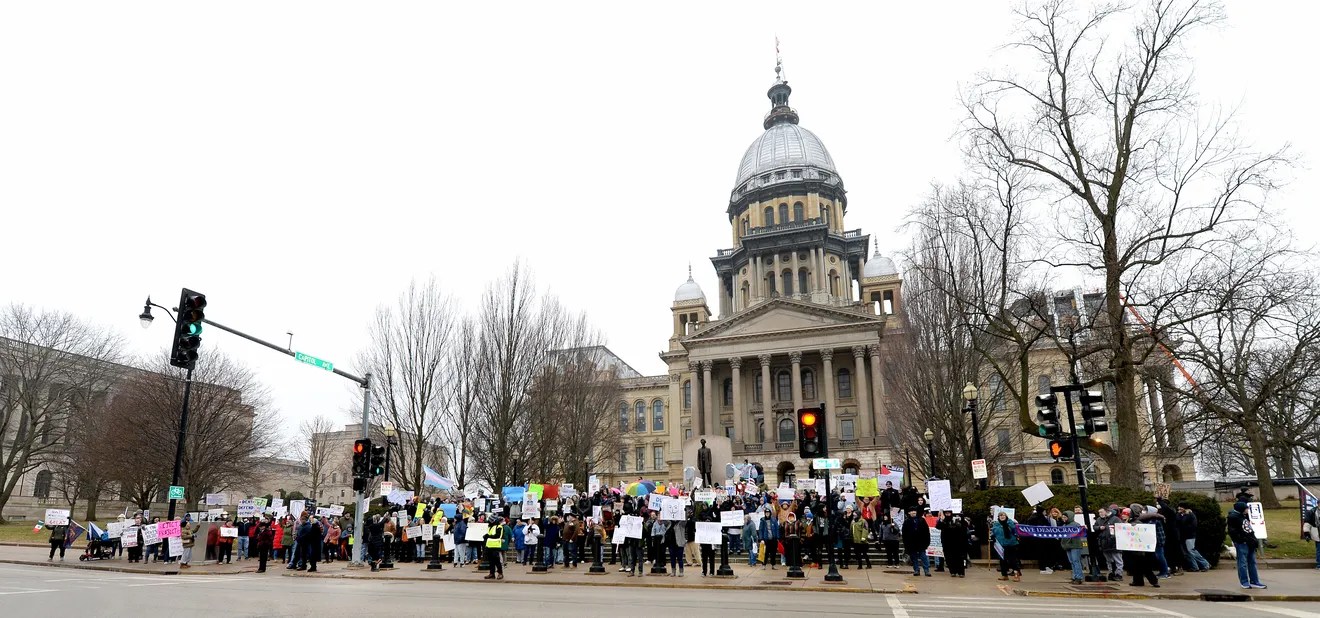
Protest at the State Capitol of Illinois in Springfield, February 2025.
Here is the statement from the UPI:
University Professionals of Illinois Local 4100 Responds to Governor Pritzker’s State of the State Address and His Lack of Support for SB13/HB1581
We applaud the governor’s stance against authoritarianism and his willingness to defend Illinois from various federal challenges including the attacks on federal grants, the Department of Education and other federal agencies/programs. Since public higher education is a main guardrail against authoritarianism, his lack of support for the Adequate and Equitable Public University Funding Act (SB13 and HB1581) is deeply disappointing and a missed opportunity to enact meaningful reform and strengthen our state’s resolve to stand against the national attacks on Illinoisans.
SB13/HB1581 represents a critical step toward funding our public universities and decreasing the reliance on student tuition and fees. This legislation has widespread support from community leaders, advocacy groups, and everyday Illinoisans who recognize the urgent need for change. This legislation would reverse Illinois’ decades long under funding of public higher education. The failure to fund our universities has resulted in significant student debt, students leaving our state and even students priced out of attending a public university. Our students, families, communities and institutions deserve better.
Illinois’ higher education system is a critical driver of economic growth, social mobility, and workforce development. Yet, year after year, state support remains inadequate, leading to tuition hikes, faculty layoffs, and reduced services that disproportionately impact low-income and first-generation students. Without substantial reinvestment, we risk further exacerbating the brain drain as talented students and educators leave Illinois for better-funded institutions elsewhere.
We urge the Governor to advocate strongly for the students and families of Illinois who are demanding change. It is not too late for him to do the right thing and support the Adequate and Equitable Public University Funding Act. The people of this state deserve leadership that prioritizes their needs over political calculations.
Note: See my previous posts on the massive disinvestment in public higher education by state governments.
Professors, researchers, and educators across the nation are taking actions to defend research and higher education in the United States.
The American Association of University Professors (AAUP) states:
“The Trump administration and many state governments are accelerating attacks on academic freedom, shared governance, and higher education as a public good. We are working with our chapters and with allies in higher ed and the labor movement to defend and advance our vision: Higher education that is accessible and affordable for all who want it. Freedom to teach, to learn, to conduct research, to speak out on issues of the day, and to assemble in the organizations of our choice. Colleges and universities that create opportunity for students, workers, and communities. Sufficient funding to provide true education and sustainable working conditions. Information and resources to help in this fight are being added below as they are developed.”
The AAUP and several allies have already filed a lawsuit to block the Trump administration’s suspension of some research grants.
The AAUP is posting information on particular issues in research and higher education that are being affected by the attacks by the Trump administration and Elon Musk’s so-called Department of Government Efficiency (DOGE) on federal agencies that conduct and/or fund research and higher education, such as the National Institutes of Health (NIH), National Science Foundation, Department of Education, NOAA, and NASA.
The Labor for Higher Education alliance is posting information on actions in defense of research and higher education across the United States.
Governor J.B. Pritzker delivered a powerful Illinois State of the State Speech this week, arguing that Illinois representatives and citizens must act to defend the U.S. Constitution and oppose tyranny in the United States.
After discussing Illinois policy issues and initiatives in the state of Illinois, Gov. Pritzker turned to discuss the threat of fascism in American society, citing the infamous 1978 case involving Nazis attempting to march through Skokie, Illinois, in order to intimidate Jews living there.
Pritzker then pivoted to the current unconstitutional actions being made by the Trump administration and Elon Musk’s so-called Department of Government Efficiency (DOGE).
“I’m watching with a foreboding dread what is happening in our country right now. A president who watches a plane go down in the Potomac – and suggests — without facts or findings — that a diversity hire is responsible for the crash. Or the Missouri Attorney General who just sued Starbucks – arguing that consumers pay higher prices for their coffee because the baristas are too ‘female’ and ‘nonwhite.’ The authoritarian playbook is laid bare here: They point to a group of people who don’t look like you and tell you to blame them for your problems.
“I just have one question: What comes next? After we’ve discriminated against, deported or disparaged all the immigrants and the gay and lesbian and transgender people, the developmentally disabled, the women and the minorities – once we’ve ostracized our neighbors and betrayed our friends – After that, when the problems we started with are still there staring us in the face – what comes next.
“All the atrocities of human history lurk in the answer to that question. And if we don’t want to repeat history – then for God’s sake in this moment we better be strong enough to learn from it.
“I swore the following oath on Abraham Lincoln’s Bible: ‘I do solemnly swear that I will support the constitution of the United States, and the constitution of the state of Illinois, and that I will faithfully discharge the duties of the office of Governor …. according to the best of my ability.’
“My oath is to the Constitution of our state and of our country. We don’t have kings in America – and I don’t intend to bend the knee to one. I am not speaking up in service to my ambitions — but in deference to my obligations.
“If you think I’m overreacting and sounding the alarm too soon, consider this:
“It took the Nazis one month, three weeks, two days, eight hours and 40 minutes to dismantle a constitutional republic. All I’m saying is when the five-alarm fire starts to burn, every good person better be ready to man a post with a bucket of water if you want to stop it from raging out of control.
“Those Illinois Nazis did end up holding their march in 1978 – just not in Skokie. After all the blowback from the case, they decided to march in Chicago instead. Only twenty of them showed up. But 2000 people came to counter protest. The Chicago Tribune reported that day that the ‘rally sputtered to an unspectacular end after ten minutes.’ It was Illinoisans who smothered those embers before they could burn into a flame.
“Tyranny requires your fear and your silence and your compliance. Democracy requires your courage. So gather your justice and humanity, Illinois, and do not let the ‘tragic spirit of despair’ overcome us when our country needs us the most.”
Many historians of Nazi Germany and fascist movements agree with Gov. Pritzker’s assessments of the relevance of the historical case of the Nazi Party’s rapid dismantling of the Weimar Republic and its constitution for understanding what is happening now in the United States.
The video of Gov. Pritzker’s Illinois State of the State Speech is available on YouTube. The full text of Gov. Pritzker’s speech is available at NBC 5 Chicago and also on NPR.
On the Nazi Party’s dismantling of the Weimar Republic’s democratic system, see a previous post entitled “On Hitler’s Dismantling of Democracy in 53 Days.”
The Trump administration has launched a direct assault on medical research, by drastically slashing the research funds for academic research across all disciplines.
The massive cuts to the National Institutes of Health (NIH) have been the focal point of reporting on these cuts to research funding, but if these cuts go through, they will disrupt the entire model for research in the United States.
Ever since the Second World War, the federal government and state governments have partnered with research laboratories, hospitals, and universities to share the costs of fundamental and applied research in all disciplines. The cost-sharing model is based on the federal government providing “indirect” costs to laboratories and universities that have to build laboratories, offices, and infrastructure to provide space for conducting research. Cost-sharing percentages are contractually negotiated between labs, universities, and federal agencies.
This research model has made the United States the leader of research in the entire world.
Curtailing federal research funding will halt most medical and scientific research, which rely on massive funding to construct laboratories and instrumentation. Research in psychology, sociology, anthropology, and other social sciences will also be heavily disrupted. Research on the humanities, arts, and education will be less directly affected, since their universities receive much smaller, if any, “indirect” costs.
However universities’ internal small research grants and awards for grant development, summer research, graduate training, graduate research in all disciplines are funded by cost-sharing models. So, these will also be cut.
These cuts do not represent cost-saving measures. Instead, they represent an attempt to torpedo the entire research model of the United States. This is one front in a Culture War on science and knowledge being waged by politicians and business owners.
WAMU’s A1 News Program offers a good discussion of how the cuts to research funding will affect medical research.
“The U.S. National Institutes of Health, or NIH, is the largest funder of biomedical research in the world.
“Last year, the agency put more than $32 billion towards trying to better understand cancer, genetics, and infectious diseases. That’s according to a New York Times analysis of agency data. It also helped fund the mRNA technology that led to the COVID-19 vaccines.
“In short, these grants bolster our scientific knowledge and help protect us. But that funding is under threat.
“Earlier this month, the Trump administration announced plans to seriously cut scientific spending. And thousands of employees across federal health agencies like the NIH and the Centers for Disease Control were laid off over the weekend.
“A federal judge ordered the Trump administration to temporarily pause its plans, but what could this loss mean for the future of science and medical research in the country?”
WAMU’s 1A reports on “Scientific Method: What NIH Funding Cuts Mean for Medical Research” (19 February 2025).
The foreign policy of the United States is being seriously harmed by the Trump administration’s political imperatives and vendettas.
In the latest move, the State Department is banning access for diplomats and staff to fundamental news and information sources.
“The State Department has ordered the cancellation of all news subscriptions deemed ‘non-mission critical,’ according to internal email guidance viewed by The Washington Post. The move aligns with the Trump administration’s crackdown on media companies that count the U.S. government as paying customers.”
This policy clearly undermines the ability of U.S. ambassadors, embassy staff, and other State Department officials to carry out the diplomatic mission of the United States around the world.
The Washington Post reports that “the mandate applies globally, to hundreds of U.S. embassies and consulates, according to a State Department official who spoke with The Post on Tuesday on the condition of anonymity to discuss internal matters. Embassy security teams rely on news coverage to prepare for diplomatic travel in conflict zones. Cancellation of subscriptions — including to local news outlets — could hinder their assessment of threats, the official said.”
This policy reflects a truly bizarre form of isolationism that must be unrecognizable to professional diplomats outside of authoritarian regimes. It will be interesting to see how political scientists and historians who work on U.S. foreign relations and international politics assess this development.
“A State Department employee who received the memos, and shared them with The Post, expressed concern that terminating news subscriptions — particularly to local outlets —would deprive embassies and consulates of information necessary to complete their mission. “This will endanger American lives overseas because we are being cut off from news sources that are needed on a daily basis,” said the employee, who spoke on the condition of anonymity because they are not authorized to comment to the press.”
It is ironic that my undergraduate and graduate students at Northern Illinois University were just considering the flow of news and information through embassies in the early modern period, and particularly through the Venetian bailate (embassy) in Istanbul.
Early modern states and their administrators understood very well that well-informed diplomats were essential to the conduct of international politics.
On news and information in the early modern world, see:
De Vivo, Filippo. Information and Communication in Venice: Rethinking Early Modern Politics. Oxford: Oxford University Press, 2007.
Dooley, Brendan, ed. The Dissemination of News and the Emergence of Contemporaneity in Early Modern Europe. Farnham: Ashgate, 2010.
Dooley, Brendan and Sabrina A. Baron, eds. The Politics of Information in Early Modern Europe. New York: Routledge, 2001.
Dursteler, Eric R. Venetians in Constantinople: Nation, Identity, and Coexistence in the Early Modern Mediterranean. Baltimore, MD: Johns Hopkins University Press, 2006.
Eisenstein, Elizabeth L. The Printing Revolution in Early Modern Europe. Cambridge: Cambridge University Press, 1983.
Pettegree, Andrew. The Invention of News: How the World Came to Know about Itself. New Haven, CT: Yale University Press, 2014.
Apple Maps and Google Maps have renamed the Gulf of Mexico as the “Gulf of America,” following President Trump desire to rename it. These applications and their companies are increasingly complicit in the Trump administration’s war on reality and their propagandistic control of information.
They have blocked posts on the location to prevent people from lodging protests. They have also made it difficult to report an issue with the location.
But, in Apple Maps, you can still lodge a protest by reporting a problem with the location (instead of the name).
In Apple Maps, search for Gulf of Mexico. When “Gulf of America” is located. Click the elipses (…) and then select Report an Issue. Select Location on Map is Wrong. Then, drag the location pin to the White House in Washington, D.C., which is the actual location of the “Gulf of America.” You can also leave a comment if you wish.
Good luck!
Historians of cartography, nations, empires, and state development know that mapping is an expression of state power. Projections of power into oceanic spaces and bodies of water are related to constructions of territoriality, and has been governed by maritime and international law since the early seventeenth century. And, historians of news and information know how media can be subverted into propagandistic instruments of the state.
The Trump administration is now promoting a foreign policy based on kleptocracy and imperialism.
The Washington Post reports that “Ukrainian President Volodymyr Zelensky rejected a Trump administration request this week that Kyiv hand over 50 percent of its rare-earth mineral resources — an extraordinary demand that could significantly overshadow the value of aid that has been sent to Ukraine. Ukrainian officials are working on a counterproposal that would still offer Washington more access to the country’s natural resources but would bolster U.S. security guarantees for Ukraine, four people familiar with the discussions said.”
Munich Security Conference, February 2025. Photo: The Washington Post.
“Zelensky told reporters Saturday that he had not agreed to the Trump administration’s proposal ‘because it’s not ready yet,'” according to The Washington Post.
“He said that security guarantees were not part of the U.S. proposal, and that Ukraine needed that in any agreement with the United States. …”
“Ukraine’s rare-earth mineral resources could be worth trillions of U.S. dollars, with rising demand in electronics, defense systems, drones, and the clean-energy and automotive industries, among others. They are difficult to extract at scale, and while Ukraine has some reserves, it does not mine them at the moment. China currently produces the vast majority of rare-earth minerals. Many but not all of Ukraine’s reserves are in territory occupied by Russia.”
Simon Johnson, Professor of Economics (Massachusetts Institute of Technology), argues that “Investment now in the Ukrainian critical minerals sector could make a lot of sense. But President Trump’s initial offer seems unreasonable, exploitative, and unlikely to help end the war. This is not a good way to promote American interests. … I expect the Ukrainian reaction to be dismay and disbelief.”








 Brian Sandberg: Historical Perspectives