Reframing Treaties Published

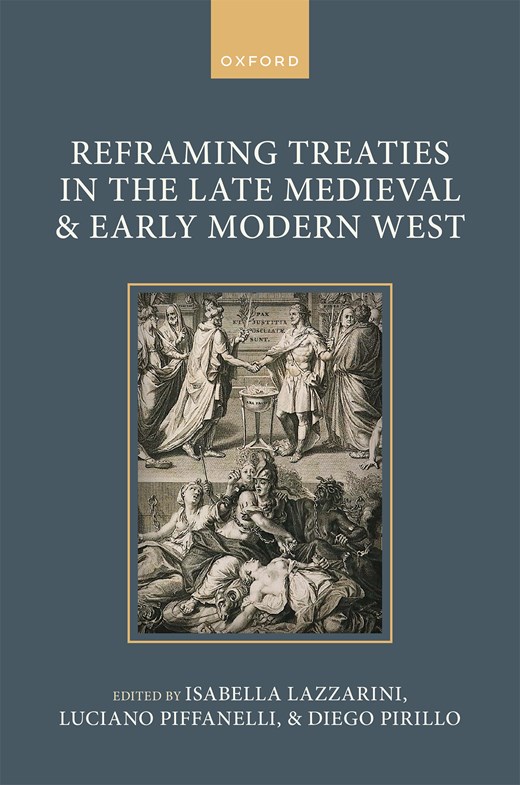
Reframing Treaties in the Late Medieval and Early Modern West, edited by Isabella Lazzarini, Luciano Piffanelli, and Diego Pirillo (Oxford: Oxford University Press, 2025) has been published.

I contributed an essay on “Peacemaking in the Context of Religious Violence: The Edict of Nantes and the Fragility of Conflict Resolution” to this collective volume and enjoyed participating in this publication project.

The book description reads: “Opening a fresh chapter in the burgeoning field of premodern diplomatic history, Reframing Treaties focuses on peacemaking through a wide geopolitical and constitutional range of case studies not limited to Europe, but including also the Mediterranean and Atlantic worlds, and along a chronological time frame which centres on the period between the 14th and the 18th centuries but explores crossings, continuities, and afterlives up to the 21st century. The volume has two main general objectives. First, to rethink the peacemaking process and uncover the flow of negotiations that shaped late medieval and early modern political interactions. Secondly, to add an important contribution to the ongoing debate about Eurocentrism and its consequences by breaking down one of the most spectacular mechanisms (the system of the European great treaties) that helped make Western late medieval ius commune and early modern ius gentium become a purported ‘universal international order’ in the 19th century and beyond. With a multidisciplinary approach, the volume puts at the heart of the investigation not the single peace treaty, but the peacemaking process in its many forms and outcomes and demonstrates that peacemaking was a complex and multilayered phenomenon. Used as a political grammar, its binding nature transformed it into a powerful instrument to settle conflicts and regulate interactions both within and outside polities and communities. The volume is organised into four parts (Sources, Peacekeeping, Peacemaking, and Intersections), and 21 chapters and an Epilogue (chapter 22), and brings together an international team of specialists from European and American universities and from different fields.”

The book is available online at the Oxford University Press website.

Posted in Civil Conflict, Current Research, Early Modern Europe, Early Modern France, European History, European Wars of Religion, French History, French Wars of Religion, History of the Western World, international relations, Italian History, Mediterranean World, Political Culture, Reformation History, Religious Politics, Religious Violence, Renaissance Art and History, Strategy and International Politics, Warfare in the Early Modern World | Leave a comment

Academic Presses Making Deals with AI Companies

I am alarmed to discover that Johns Hopkins University Press, one of the leading academic presses in the world is making deals with AI companies to license their titles to “train” LLMs.

Here is an urgent question for friends who are professors, authors, publishers, and lawyers: Should we sign over rights to allow academic presses to license our books and allow LLMs access to our publications?

It seems that many LLMs already have already accessed many of our publications, violating copyright laws to do so. However, there are already numerous lawsuits related to AI companies’ use of copyrighted material, including academic journal articles and research monographs. Multiple major lawsuits are already pending and others will certainly be launched soon.

Now, Johns Hopkins University Press has announced a new deal to license all of its titles to an unnamed company to “train” its LLM. The Baltimore Banner has published an article on JHUP’s announcement (25 July 2025).

Johns Hopkins University. Image: The Baltimore Banner.

Johns Hopkins University Press (JHUP) is one of the most important academic presses in the world and a bellweather for academic publication policies in the United States and worldwide. This case therefore has sweeping implications not only for JHUP, but for all academic authors around the world.

Here is an email that I recently received from the Johns Hopkins University Press, the academic publisher of my first book (a research monograph):

“Since generative AI burst on the scene, we have been carefully evaluating the potential benefits and the concerns raised about its risks. This technology—whether OpenAI’s ChatGPT, Google’s Gemini, or Anthropic’s Claude—is getting better every day. Our target readers are increasingly embracing it for search, research, and discovery. We have spent the last year exploring the possibility of licensing our books on one or more of these generative AI Large Language Models (LLMs). Here are some of the reasons why we feel now is the right time to move forward.

“Discovery. With readers moving from traditional search engines to AI-powered tools, it’s critical that your work is discoverable where your audience is. There are innovative technologies that, if adopted by the LLMs, will credit the sources of AI-generated responses. We believe that having the work in the LLMs in combination with an ability for readers to identify and click through to the original source is the best way to continue to engage with readers and disseminate your work widely.

“Guardrails on Content Use. As media reports have surfaced on some LLMs scraping content from pirated sites, we are increasingly concerned, although not certain, that the major LLM companies already have our books. Having a contract with legal language around how these companies may and may not use the content is the most effective way to manage the risk now.

“Financial. While we do not anticipate huge financial gain for individual books, the cumulative revenue would be meaningful for Johns Hopkins University Press and our mission. As we anticipate contraction in the higher-education market, these funds can help to sustain our important work as a non-profit publisher.

“Timing. While we hope that publishers, authors, and other content creators will prevail in upholding copyright as it pertains to use on LLMs, recent court decisions and other environmental factors point to heightened risk of decisions that may weaken our rights. We believe that these companies should pay for the use of your work. Our acceptance of their payments demonstrates that licensing is required. We are concerned that the window may be closing for such deals, especially for university press publishers like us, and so we need to move quickly.

“If your work is licensed for use in LLMs, you will receive the appropriate royalties as indicated in the contract we both signed before publishing your work.

“I hope that you agree with our reasoning for taking the step now to license your work for use in LLMs. While we have not yet signed any agreements for your book, we hope to do so in the near future. In your contract, you provide us with the rights to go ahead with this kind of licensing. However, we would like you to have the ability to opt out if you so choose.

“You do not need to take any action if you are fine with us moving forward with licensing your work on LLMs.

“If you prefer that we not license your work on LLMs, you need to send an email […] to request that an addendum to your contract be sent via DocuSign to opt out.”

Authors are being given only until 31 August 2025 to opt out of this deal.

I would welcome comments and advice on these issues….

Wolfe, Ellie. “Johns Hopkins University Press will License its Authors’ Books to Train AI Models.” The Baltimore Banner (25 July 2025).

Posted in Academic Freedom, Academic Publishing, Civil Rights Issues, Digital Humanities, Higher Education, History of the Book, Human Rights, Humanities Education, Information Management, Legal history, United States History and Society | Tagged , , , , , , , , , , , , , , , , , | Leave a comment

George Orwell’s ‘1984’ and Modern America

Charlie English has published an essay in The New York Times on the role that George Orwell’s 1984 played in the Cold War, drawing comparisons to the book being banned in the United States in the twenty-first century.

English is a former journalist for The Guardian and author of The CIA Book Club: The Secret Mission to Win the Cold War with Forbidden Literature (2025).

Charlie English introduces George Orwell’s 1984 and its central premise: “First published in English in 1949, Orwell’s novel describes the dystopian world of Oceania, a totalitarian state where the protagonist, Winston Smith, works in a huge government department called the Ministry of Truth. The ministry is ironically named: Its role is not to safeguard the truth but to destroy it, to edit history to fit the present needs of the party and its leader, Big Brother, since, as the slogan runs, ‘Who controls the past controls the future: who controls the present controls the past.'”

Orwell’s 1984 was an extended commentary on the censorship policies in Eastern European societies during the Cold War. “In the real Soviet system, every country had its equivalent of the Ministry of Truth, modeled on the Moscow template. In Poland, the largest Eastern European nation outside the Soviet Union, this censorship and propaganda apparatus was called the Main Office for the Control of Presentations and Public Performances, and its headquarters occupied most of a city block in downtown Warsaw,” English emphasizes.

“From art to advertising, television to theater, the Main Office reached into all aspects of Polish life. It had employees in every TV and radio station, every film studio and every publishing house. Every typewriter in Poland had to be registered, access to every photocopier was restricted, and a permit was needed even to buy a ream of paper. Books that did not conform to the censor’s rules were pulped. …”

Image: The New York Times.

Charlie English’s essay makes direct comparisons between censorship by the Polish state during the Cold War and the censorship being carried out today by the Trump administration and by Republican representatives and governors in many states of the United States.

In the mid-2020s, 1984 is again being restricted, this time by conservative, Trump-aligned politicians in the United States. In May 2023, the Republican governor of Iowa, Kim Reynolds, signed into law Senate File 496, which according to the governor “puts parents in the driver’s seat” when it comes to their children’s education. In fact SF 496 forces Iowa schools to remove from their libraries thousands of books of which cultural conservatives disapprove.

“Mostly, SF 496, which is the subject of an ongoing legal battle, bans books that feature L.G.B.T.Q.+ characters or progressive themes such as feminism or are written by people of color. But the legislation also sweeps up several authors whose works lampoon totalitarianism and that were sent east by the C.I.A. book program, including Aldous Huxley, Kurt Vonnegut and Orwell, whose 1984 and Animal Farm are both on banned lists,” according to English.

“SF 496 is but one cog in the growing apparatus of American censorship, as conservative action groups seek to ban books around the country. PEN America has documented close to 16,000 bans (instances in which a book has been withdrawn or access to it has been restricted because of its content) in schools since 2021, with 10,046 in the 2023-24 school year alone. The censorship efforts are mostly driven by Republican state legislators and parental-rights groups. Florida takes the lead, with more than 4,561 book bans recorded in that school year — including in one case a graphic novel adaptation of 1984 — via a combination of new state laws and parental pressure. Next come Iowa (with 3,671 book bans that year), Texas (538), Wisconsin (408), Virginia (121) and Kentucky (100).”

English, Charlie. “‘1984’ Hasn’t Changed, but America Has.” The New York Times (27 July 2025).

English, Charlie. The CIA Book Club: The Secret Mission to Win the Cold War with Forbidden Literature. (Penguin, 2025).

Simpson, John. “Review of The CIA Book Club: The Secret Mission to Win the Cold War with Forbidden Literature.” The Guardian (14 March 2025).

Posted in Academic Freedom, Academic Publishing, Authoritarianism, Civil Rights Issues, Education Policy, Empires and Imperialism, European History, European Studies, High School History Teaching, History in the Media, History of the Book, Human Rights, Humanities Education, Information Management, Intellectual History, international relations, Political Culture, Political History of the United States, Political Theory, Public History, The Past Alive: Teaching History, United States History and Society, World History | Tagged , , , , , , , , , , | Leave a comment

Summer Interns Lose Positions in Trump Cuts

The massive layoffs and disruptions in federal agencies carried out by Elon Musk’s so-called DOGE team and the broader Trump administration have eliminated thousands of summer internships positions for young Americans.

“The Trump administration’s sweeping cuts have pushed many lifetime civil servants out of their roles. They have also disrupted people at the other end of the career spectrum: summer interns, those energetic new arrivals who count on internships to serve as the on-ramp to their professional lives. (Some, but not all, are paid for their efforts),” according to The New York Times.

“Young people who hustled for competitive internships and research positions said they felt dejected when those offers were taken back. Their optimism gave way to a stressful scramble to find other roles or sources of income on short notice. Several second-guessed whether they really wanted to enter fields that seemed to be crumbling before their eyes. …”

The New York Times reports that “Summer roles have been rescinded from students who were offered positions supported by U.S.A.I.D., the National Institutes of Health, the Department of State, and the National Oceanic and Atmospheric Administration, among other agencies.”

Marlene McKinny, whose lost a summer internship when NIH funding was cut. Photo: The New York Times.

“Mr. Trump has also slashed medical research funding, affecting research programs for students studying science. Marlene McKinney, 20, an aspiring neurosurgeon at the City College of New York, had planned to spend her summer in a lab in Manhattan, studying the thermodynamic properties of elastic tissue proteins,” The New York Times reports.

“Her work had been funded through the U-RISE program, which provides financial support and mentorship to students from underrepresented backgrounds conducting biomedical research. In late March, Ms. McKinney found out that the grant, which received N.I.H. funding, was being suspended.

“She began furiously searching for part-time jobs. ‘I was like, ‘Oh, great, I can’t work at the lab anymore,’ she said. ‘How am I going to pay my rent?’”

This is a tragic loss for Marlene McKinney and for other young scientific researchers like her. The United States stands to lose an entire generation of young scientific and medical researchers who decide to abandon research careers or to move abroad to pursue them.

Young citizens who intended to pursue summer internships in other fields may be discouraged from pursuing careers in the federal government and the public sector, a loss for the nation.

Many undergraduate and graduate students in history and the humanities serve as interns with federal agencies, state institutions, and local governments. Public historians work in the National Archives, Library of Congress, Department of State, Department of Education, National Parks Service, Smithsonian Institute museums, military museums, military academies, state museums, state agencies, regional museums, municipal museums, historical societies, humanities councils, and many other agencies. Indeed, many of my former history students work as public historians at the federal, state, and local levels.

The National Council of Public History provides a description of public history: “Public historians come in all shapes and sizes. They call themselves historical consultants, museum professionals, government historians, archivists, oral historians, cultural resource managers, curators, film and media producers, historical interpreters, historic preservationists, policy advisers, local historians, and community activists, among many many other job descriptions. All share an interest and commitment to making history relevant and useful in the public sphere.”

Posted in Academic Freedom, Careers in History, Civil Rights Issues, Education Policy, Graduate Work in History, Grants and Fellowships, Humanities Education, Jobs and Positions, Political History of the United States, Public History, The Past Alive: Teaching History, United States History and Society | Leave a comment

“Israel is Committing Genocide” – Historian Omar Bartov

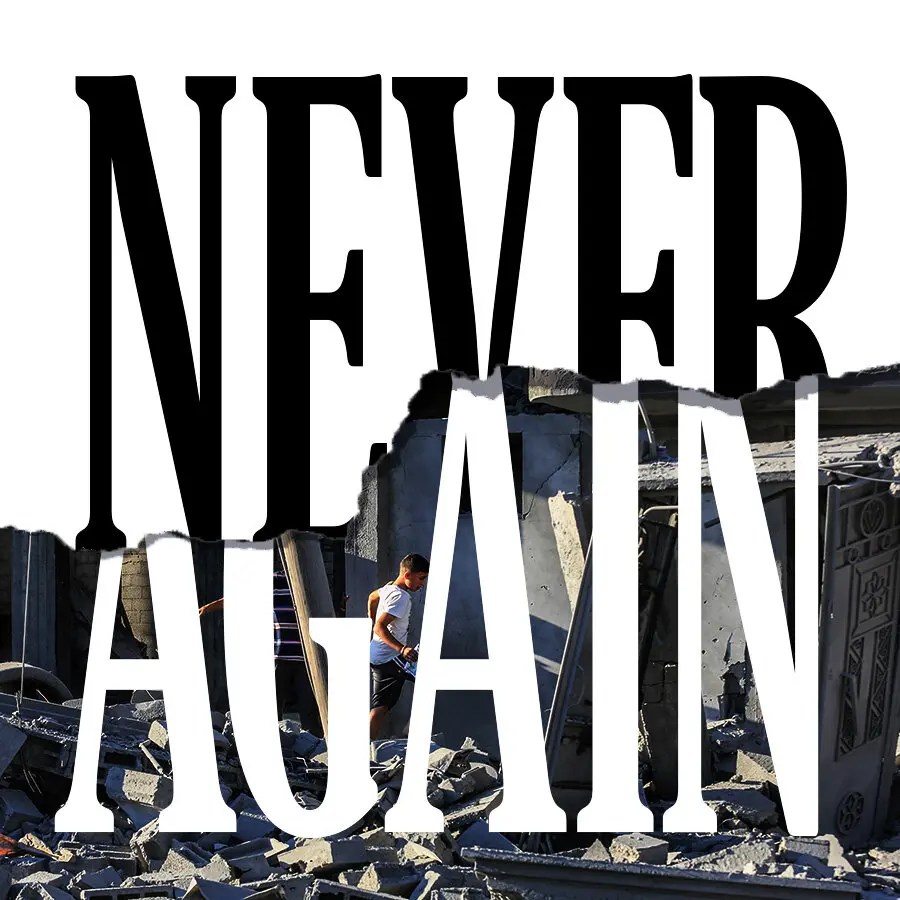
Historian Omar Bartov, one of the leading specialists on the history of genocides, demonstrates that Israel is indeed carrying out a genocidal military campaign against Palestinians in Gaza.

“Israel is committing genocide against the Palestinian people,” according to Bartov in an op-ed essay in The New York Times.

This is not a casual use of “genocide” as a pejorative or as a protest slogan.

Omar Bartov is an Israeli-American who is Professor of Holocaust and Genocide Studies at Brown University. He is a leading scholar on comparative genocide studies.

Bartov uses scholarly and legal definitions of genocide to make a compelling case that the state of Israel has been committing genocide on Palestinian people for over a year now (since at least May 2024).

This is an expert opinion by an academic specialist that could eventually be used as testimony in a judicial prosecution of Israeli government members for genocide.

Omar Bartov writes in The New York Times: “By May 2024, the Israel Defense Forces had ordered about one million Palestinians sheltering in Rafah — the southernmost and last remaining relatively undamaged city of the Gaza Strip — to move to the beach area of the Mawasi, where there was little to no shelter. The army then proceeded to destroy much of Rafah, a feat mostly accomplished by August.”

“At that point it appeared no longer possible to deny that the pattern of I.D.F. operations was consistent with the statements denoting genocidal intent made by Israeli leaders in the days after the Hamas attack. Prime Minister Benjamin Netanyahu had promised that the enemy would pay a ‘huge price’ for the attack and that the I.D.F. would turn parts of Gaza, where Hamas was operating, ‘into rubble,’ and he called on ‘the residents of Gaza’ to ‘leave now because we will operate forcefully everywhere.’

“Netanyahu had urged his citizens to remember ‘what Amalek did to you,’ a quote many interpreted as a reference to the demand in a biblical passage calling for the Israelites to ‘kill alike men and women, infants and sucklings’ of their ancient enemy. Government and military officials said they were fighting ‘human animals’ and, later, called for ‘total annihilation.’ Nissim Vaturi, the deputy speaker of Parliament, said on X that Israel’s task must be ‘erasing the Gaza Strip from the face of the earth.’ Israel’s actions could be understood only as the implementation of the expressed intent to make the Gaza Strip uninhabitable for its Palestinian population. I believe the goal was — and remains today — to force the population to leave the Strip altogether or, considering that it has nowhere to go, to debilitate the enclave through bombings and severe deprivation of food, clean water, sanitation and medical aid to such an extent that it is impossible for Palestinians in Gaza to maintain or reconstitute their existence as a group.

“My inescapable conclusion has become that Israel is committing genocide against the Palestinian people. Having grown up in a Zionist home, lived the first half of my life in Israel, served in the I.D.F. as a soldier and officer and spent most of my career researching and writing on war crimes and the Holocaust, this was a painful conclusion to reach, and one that I resisted as long as I could. But I have been teaching classes on genocide for a quarter of a century. I can recognize one when I see one.

“This is not just my conclusion. A growing number of experts in genocide studies and international law have concluded that Israel’s actions in Gaza can only be defined as genocide. So has Francesca Albanese, the U.N. special rapporteur for the West Bank and Gaza, and Amnesty International. South Africa has brought a genocide case against Israel at the International Court of Justice.

“The continued denial of this designation by states, international organizations and legal and scholarly experts will cause unmitigated damage not just to the people of Gaza and Israel but also to the system of international law established in the wake of the horrors of the Holocaust, designed to prevent such atrocities from happening ever again. It is a threat to the very foundations of the moral order on which we all depend. …”

Omar Bartov’s full essay is available at The New York Times website.

Bartov, Omar. “I’m a Genocide Scholar. I Know It When I See It.” The New York Times (15 July 2025).

Posted in Atrocities, Civil Rights Issues, Civilians and Refugees in War, Empires and Imperialism, Genocides, History of Race and Racism, History of Violence, Human Rights, international relations, Laws of War, Religious Violence, Strategy and International Politics, War, Culture, and Society, World History | Tagged , , , , , , , , , , , , , , , , , , | Leave a comment

Trump Blocks International Students Going to Harvard

The Trump administration is launching a new attack on Harvard University, one of the premier private academic institutions in the United States.

The New York Times reports that “The Trump administration on Thursday halted Harvard University’s ability to enroll international students, taking aim at a crucial funding source for the nation’s oldest and wealthiest college in a major escalation of the administration’s efforts to pressure the elite school to fall in line with the president’s agenda.”

This coercive move by the Trump administration threatens the principles of academic freedom, democratic education, and equitable access to education.

“The administration notified Harvard about the decision — which could affect about a quarter of the school’s student body — after a back-and-forth in recent weeks over the legality of a sprawling records request as part of the Department of Homeland Security’s investigation, according to three people with knowledge of the negotiations. The people spoke on the condition of anonymity because they were not authorized to discuss the matter publicly,” according to The New York Times.

The Trump administration’s actions are unlawful and will certainly be challenged by Harvard in a new lawsuit.

However, this action does not merely affect Harvard University and international students seeking to enroll in its educational programs. The Trump administration’s menacing behavior effectively threatens other universities and colleges across the nation that enroll international students.

“The latest move intensifies the administration’s attempt to upend the culture of higher education by directly subverting the ability of one of the nation’s premier universities to attract the best and brightest students from all over the world. That capability, across all of academia, has long been one of the greatest sources of academic, economic and scientific strength in America.”

Schmidt, Michael S. and Michael C. Bender. “Trump Administration Says It Is Halting Harvard’s Ability to Enroll International Students.” The New York Times (22 May 2025).

Posted in Academic Freedom, Civil Rights Issues, Education Policy, Higher Education, Human Rights, Legal history, Political History of the United States, United States History and Society | Tagged , , , , , , , , , , , | Leave a comment

“A Gross Usurpation of Power” by Trump Administration

The Trump administration’s recent takeover of the U.S. Institute of Peace (USIP) and firing of its leaders and staff members were unlawful acts.

In March 2025, members of Elon Musk’s so-called DOGE team, with the assistance of armed officers of the Washington Metropolitan Police Department, forced their way into the U.S. Institute of Peace, an independent research institute on peace and conflict studies. Trump administration officials then forced the USIP leaders and staff out of the building and fired them.

The attack on the USIP represented a major assault on research institutions, academic freedom, and higher education.

The New York Times now reports that “a federal judge ruled on Monday that the Trump administration’s takeover and gutting of the U.S. Institute of Peace, an independent nonprofit created by Congress to seek diplomatic solutions to global conflicts, were unlawful and a ‘gross usurpation of power.’ The judge ordered the reinstatement of officials ejected by the White House.”

“The March takeover and the subsequent termination of most of the institute’s work force followed an executive order from President Trump to cut its staffing to a bare minimum. The judge, Beryl A. Howell of the U.S. District Court in Washington, wrote that such changes required the consent of Congress, but that the Trump administration had removed the institute’s leadership and installed handpicked replacements ‘through blunt force, backed up by law enforcement officers from three separate local and federal agencies.'”

“Judge Howell’s ruling, in a suit brought by former institute officials, was the latest judicial order blocking the administration’s aggressive efforts to assert power over Washington institutions,” according to The New York Times.

“The judge also nullified the transfer of the peace institute’s building to the federal government’s General Services Administration.”

This judicial ruling is significant, addressing one of the most aggressive actions by the Trump administration to dismantle an entire research institution. The judge makes clear that members of the executive branch unlawfully invaded an independent nonprofit institution and that its occupation of the U.S. Institute of Peace’s headquarters constitutes trespassing.

“Judge Howell rejected the Trump administration’s argument that the institute was part of the executive branch. Instead, she wrote, ‘USIP supports both the executive and legislative branches as an independent think tank that carries out its own international peace research, education and training, and information services.’ Her order also prohibits the administration’s ‘further trespass’ of the institute’s headquarters.”

This judicial decision paves the way for a restoration of the U.S. Institute of Peace and, hopefully, the resumption of its work on peace and conflict studies.

Kavi, Aishvarya Kavi. “Judge Rules That Trump Administration Takeover of Institute of Peace Is Illegal.” The New York Times (20 March 2025).

Posted in Academic Freedom, Civil Rights Issues, Higher Education, Human Rights, Peacemaking Processes, Political History of the United States, Strategy and International Politics, United States History and Society | Tagged , , , , , , , , , , , , , | Leave a comment

Taxing Endowments Will Shift Tuition Costs to Students

The Trump administration plans to tax endowments at many private universities. This policy would shift the cost of tuition on students and their families, depriving many students of access to a university education at many private universities and colleges.

Universities and colleges “have pushed back against the tax, noting that they use their endowments to fund the education of poor and middle-class students,” according to The New York Times. The Trump administration’s proposed tax on endowments is potentially illegal, and will certainly be result in multiple lawsuits.

If the policy is implemented, it will directly impact millions of college and university students and their families, depriving them of access to higher education. The policy represents a further attack on higher education institutions, academic freedom, and democratic principles.

Universities and colleges use their endowments to provide scholarships to students, often spending around half of their endowments on financial aid to students. The rest of endowment funds are used to invest responsibly in the future of universities and colleges, including having “rainy day” reserves on hand to deal with crises (like the recent COVID pandemic).

“Of the $30 billion that schools spent in endowment funds in 2024, nearly half went to financial aid, according to an analysis by the National Association of College and University Business Officers.”

The New York Times points out that “Vice President Vance was a beneficiary of this need-based aid. He attended Yale Law School as a Marine Corps veteran with a financial aid package that he later wrote ‘exceeded my wildest dreams.'”

The Vice President now wants to deprive other military veterans, middle-class, and poor students of similar financial aid.

“Christopher L. Eisgruber, Princeton’s president, wrote in a recent message that 71 percent of students in this year’s freshman class received no-loan financial aid funded by the school’s endowment, with the average grant totaling $73,000,” according to The New York Times.

“‘This tax is a scholarship tax,’ said Steven M. Bloom, an assistant vice president at the American Council on Education, a large industry trade group that is opposing the proposal,” reports The New York Times.

“Williams College, a liberal arts school in Massachusetts, would be subject to at least a 14 percent tax. In an interview, its president, Maud S. Mandel, said the school devoted $92 million from its endowment this year to help over half the school’s student body.”

“‘Any tax on the endowment would have a direct impact on that,’ she said.”

Small liberal arts colleges like Grinell College (Iowa), Claremont McKenna College (California), Smith College (Massachusetts), Trinity University (Texas), Carleton College (Minnesota), DePauw College (Indiana), Reed College (Oregon), and Hillsdale College (Michigan) are all projected to be hit by the Trump administration’s tax on endowments.

Medical schools like the Mayo Clinic (Minnesota) and Baylor College of Medicine (Texas) are also projected to be taxed by the Trump policy.

The New York Times indicates that “in California, Pomona College’s vice president, Jonathan B. Williams, said the tax would cost the school $40 million a year, the equivalent of 460 full scholarships. Its enrollment is about 1,700.”

“‘This will shift the cost of tuition squarely on to families,’ he said.”

Saul, Stephanie and Steven Rich, “Republican Plan to Tax Elite Colleges Could Hit in Unexpected Places.” The New York Times (20 May 2025).

Posted in Academic Freedom, Education Policy, Higher Education, Human Rights, Political History of the United States, United States History and Society | Tagged , , , , , , , , , | Leave a comment

Mellon Foundation Assists Humanities Councils

The Mellon Foundation has thrown a lifeline to state humanities councils, which were stripped of their federal grant funding by the Trump administration recently as part of its dismantling of the National Endowment for the Humanities (NEH).

“The Mellon Foundation on Tuesday announced $15 million in emergency funding for state humanities councils across the country, throwing what advocates say is a crucial lifeline after the cancellation of federal support had left some in danger of collapse,” according to The New York Times.

“The new funding, which will support humanities councils in all 50 states and six jurisdictions, comes a month after the National Endowment for the Humanities abruptly cut off federal funding for the councils, as well as most of its existing grants. The endowment, which had a budget of $207 million last fiscal year, is the nation’s largest public funder of the humanities, providing crucial support to museums, historical sites, cultural festivals and community projects.”

The Mellon Foundation emergency funding is crucial for the state humanities councils, but it will only make up part of the missing federal grants from the NEH.

“The $15 million from the Mellon Foundation will offset only a portion of the $65 million the state councils were set to receive this year from the humanities endowment, as appropriated by Congress. But Elizabeth Alexander, the foundation’s president, said it would help preserve humanities programs, particularly in rural states without a robust base of private philanthropy.

“‘The projects that fall under the rubric of the humanities are of an extraordinary range,’ she said. ‘It would be terrible if countless people across the country lost access to all the things that help us understand what it is to be human, in history and in a contemporary community.'”

The New York Times reports that “The money from the Mellon Foundation, the nation’s largest funder of arts and humanities projects overall, with an annual grant-making budget of about $550 million, is a one-time infusion. Every council will get $200,000 in immediate operational support. Most of the remainder will come in the form of $50,000 challenge grants, which must be matched by other sources.”

The Mellon Foundation has long been the biggest funder of history and humanities projects in the United States.

As the Trump administration decimates the National Endowment for the Humanities, Mellon funding will become even more important for humanities researchers, writers, practitioners, and institutions.

Schuessler, Jennifer. “Mellon Foundation Announces $15 Million for Humanities Councils.” The New York Times (29 April 2025).

Posted in Academic Freedom, Civil Rights Issues, Education Policy, Graduate Work in History, Grants and Fellowships, Higher Education, Human Rights, Humanities Education, Political History of the United States, Public History, United States History and Society | Tagged , , , , , , , , , , , , | Leave a comment

Trump Admin Diverts NEH Funds to Sculpture Garden

The Trump administration has gutted the National Endowment for the Humanities (NEH), laying off staff members and cancelling current grants awards to humanities researchers and institutions across the nation.

I know many historians and humanities researchers who have had their research and public history grants suspended or cancelled by the Trump administration. These grant were legitimately awarded via academic competitions involving rigorous peer review processes. Cancelling these existing grant awards is improper and potentially illegal.

Now, Trump-appointed administrators of the NEH have announced their plans for next year’s grant funding cycle.

The NEH will divert its grant funds away from humanities research initiatives toward one of President Trump’s pet plans: a so-called “National Garden of American Heroes.”

The NEH announced in a press release that: “In preparation for the nation’s celebration of the 250th anniversary of the Declaration of Independence in 2026, the National Endowment for the Humanities (NEH) is pleased to announce a special funding opportunity to support the design and creation of statues of important American historical figures for the planned National Garden of American Heroes.”

“First proposed by President Trump in 2020, the National Garden of American Heroes sculpture garden will feature life-size statues of 250 great individuals from America’s past who have contributed to our cultural, scientific, economic, and political heritage. The National Garden, which will be constructed for the 2026 semiquincentennial and located at a site to be determined, will create a public space where Americans can gather to learn about and honor American heroes,” according to the NEH.

“NEH’s new National Garden of American Heroes: Statues grant program responds to the January 29, 2025 Presidential Executive Order 13978, “Celebrating America’s Birthday,” which names the National Endowment for the Humanities and sister agency, the National Endowment for the Arts (NEA), as key partners in the implementation of the National Garden. 

“NEH and NEA have jointly committed a total of $34 million to the creation of the National Garden of American Heroes. Of this $34 million, the two cultural agencies will devote $30 million from their FY 2025 appropriations to enable the creation of statues in marble, granite, bronze, copper, or brass depicting historical figures tied to the accomplishments of the United States. This new grant program is part of NEH’s larger A More Perfect Union initiative focused on exploring America’s story and celebrating its 250 years of cultural heritage.”

The NEH website has a press release on the so-called “National Garden of American Heroes.”

Posted in Academic Freedom, Civil Rights Issues, Education Policy, Higher Education, Human Rights, Humanities Education, Political History of the United States, United States History and Society | Tagged , , , , , , , , , , , | Leave a comment