Effacing History at the Smithsonian

President Trump has launched a coordinated effort to efface the historical record of the United States in the national museums of the Smithsonian Institution.

“The Trump administration said on Tuesday that it would begin a wide-ranging review of current and planned exhibitions at the Smithsonian Institution, scouring wall text, websites and social media ‘to assess tone, historical framing and alignment with American ideals,'” according to The New York Times.

This “review” will clearly be conducted as an unacademic, ahistoric, and politicized process to rewrite history to align with the Trumpist Republican Party’s partisan vision of the history of the United States.

The Trump administration claims to want to present a history that is “unifying” and in “alignment with American ideals.”

Many previous statements by President Trump and members of his administration make clear that their goal is to create a politicized and reactionary version of so-called “patriotic” history and American “exceptionalism.”

This explicitly partisan vision of “American ideals” ignores the realities of the complicated and contradictory history of the United States, which has often failed to live up to the ideals articulated in the Declaration of Independence and the Constitution of the United States.

The Trump administration’s partisan “review” and rewriting of history will clearly focus on Americans of European heritage in advancing a racist White Nationalist historical narrative.

Trump administration officials aim to limit discussions of the historical contributions of African Americans, Latino Americans, Asian Americans, and other minority groups at Smithsonian museums.

For this reason, the Trump administration is specifically targeting the National Museum of African American History and Culture, the National Museum of the American Indian, and National Museum of American History, which have revised and expanded their presentations of United States history in recent years, incorporating new historical research by academic historians and professional public historians.

The Trump administration also plans to scrub the Smithsonian museums of references to controversial policies, unsavory episodes, and atrocities committed by the federal government or within the territories of the United States.

National Museum of African American History and Culture. Photo: The New York Times.

Here, Trump and his White Nationalist allies want to remove or minimize the historical realities of the slave trade, plantation slavery, Jim Crow era lynchings, and segregation at the National Museum of African American History and Culture. They want to minimize the struggles and the achievements of African Americans who fought for voting rights and representation during the Civil Rights movement and up to today.

The Trump administration intends to remove references to atrocities, massacres, and ethnic cleansing carried out by settlers, companies, state governments, and the United States Army against Amerindians at the National Museum of the American Indian.

National Museum of the American Indian. Photo: The New York Times.

The New York Times reports that “White House officials announced the review in a letter sent to Lonnie G. Bunch III, the secretary of the Smithsonian. Museums will be required to adjust any content that the administration finds problematic within 120 days, the letter said, ‘replacing divisive or ideologically driven language with unifying, historically accurate and constructive descriptions.'”

“The review, which will begin with eight of the Smithsonian’s 21 museums, is the latest attempt by President Trump to try to impose his will on the Smithsonian, which has traditionally operated as an independent institution that regards itself outside the purview of the executive branch.”

Samuel J. Redman, Professor of History (University of Massachusetts Amherst) has rightly characterized the Trump administration’s review as “a full assault on the autonomy of all the different branches of the institution.”

Indeed, the Trump administration’s partisan political effort aims to undermine the documentary research and historical analysis carried out by academic historians and professional public historians, which have contributed to the current Smithsonian Institution’s exhibitions. This is a direct attack on the academic freedom of professional historians and museum curators to conduct historical research and present their findings in the public interest of all United States citizens.

The Smithsonian museums safeguard the historical objects and documents of the nation’s past and they preserve the historical memory of the United States.

The Trump-appointed officials who will carry out the “review” of the Smithsonian museums aim to replace documented historical presentation with a purely partisan and politicized image of the United States that conforms to President Trump’s fundamentally ahistoric vision of the nation’s past.

A widespread program to distort the documented historical record of the United States has begun.

Bowley, Graham, Jennifer Schuessler, and Robin Pogrebin. “White House Announces Comprehensive Review of Smithsonian Exhibitions.” The New York Times (13 August 2025).
Posted in Academic Freedom, Civil Rights Issues, Higher Education, Human Rights, Humanities Education, Museums and Historical Memory, Political History of the United States, United States History and Society | Tagged , , , , , , , , , , , , , , , | Leave a comment

Trump Orders a Politicized Rewriting of History

President Trump has ordered a politicized rewriting of history at the national museums of the Smithsonian Institution.

Trump’s order initiates a new offensive in the ongoing War on History, which represents one front in a broader set of Culture Wars.

“The White House is planning an extensive review into the Smithsonian Institution to ensure that its exhibitions reflect the administration’s view of American history ahead of the country’s 250th birthday — a move that comes amid President Donald Trump’s broader takeover of the nation’s cultural institutions,” according to Politico.

This is the latest move by the Trump administration to pressure leaders of the Smithsonian Institution and to alter the historical narratives presented in its museums.

“In a letter sent to Smithsonian Institution Secretary Lonnie Bunch and subsequently posted on the White House website on Tuesday, three administration officials outlined areas subject to review and revision in an effort to ‘reflect the unity, progress, and enduring values that define the American story,'” Politico reports.

“‘This initiative aims to ensure alignment with the President’s directive to celebrate American exceptionalism, remove divisive or partisan narratives, and restore confidence in our shared cultural institutions,’ senior associate staff secretary Lindsey Halligan, Domestic Policy Council Director Vince Haley and Office of Management and Budget Director Russ Vought wrote in the letter.”

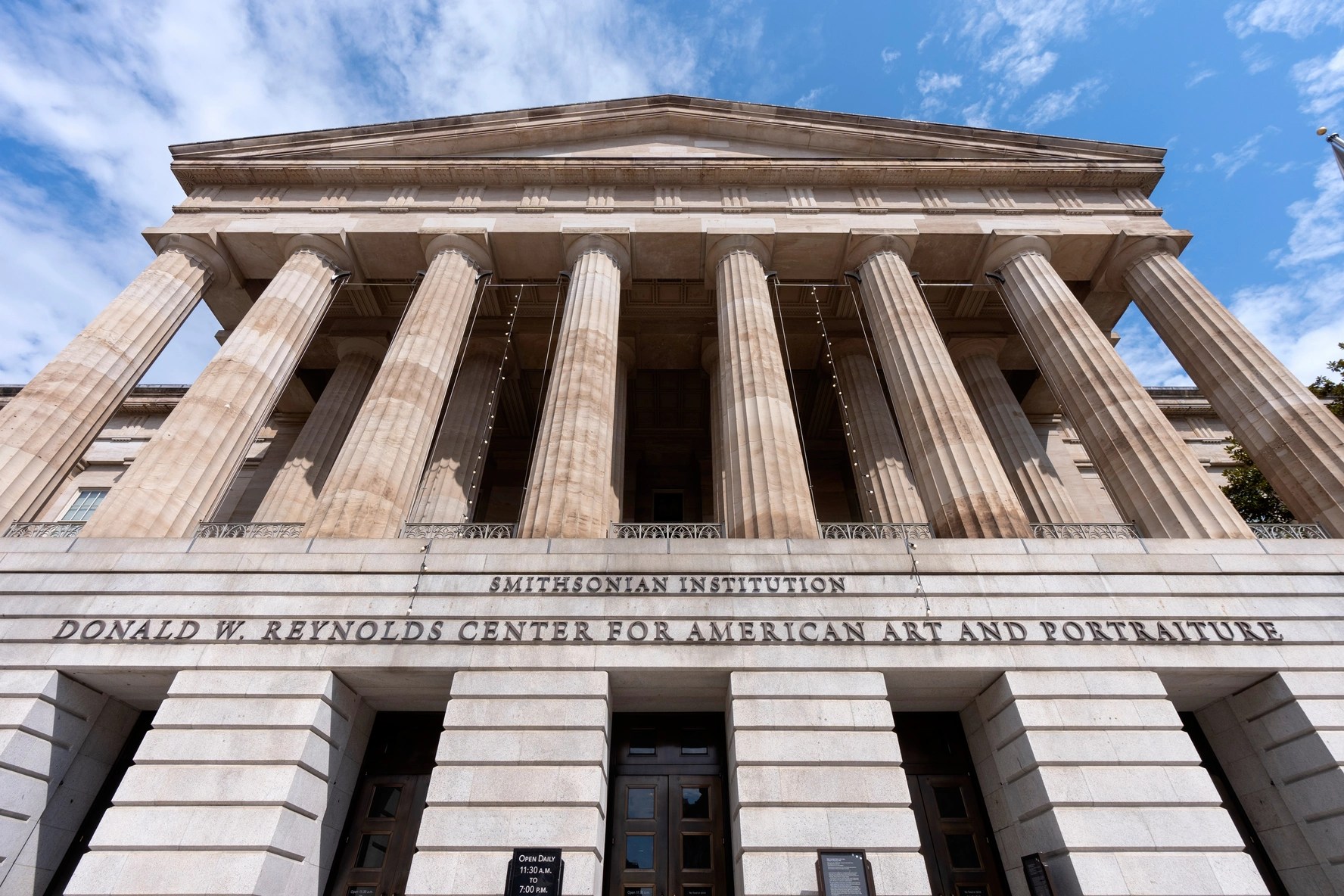
Donald W. Reynolds Center for American Art and Portraiture, Smithsonian Institution. Photo: Politico.

Politico reports that “The review aims to adjust not only the museums’ public exhibitions, planning and curation, but also narrative standards and collection use.

“The move is the latest in a sweeping effort by the Trump administration to overhaul how American history and culture is taught and presented in institutions across the country — from universities to museums to Washington’s Kennedy Center for the performing arts.”

David W. Blight, Professor of History (Yale University) and President of the Organization of American Historians (OAH), recently published a scathing criticism of the Trump administration’s assault on History.

Blight argues: “On March 27, President Donald Trump, echoing the Heritage Foundation’s Project 2025, issued an executive order, ‘Restoring Truth and Sanity to American History.’ The White House now believes it should pronounce on the nature of history and the purpose and substance of the nation’s treasures at the Smithsonian Institution. The order is nothing less than a declaration of political war on the historians’ profession, our training and integrity, as well as on the freedom and curiosity of anyone who reads or visits museums. In other words, Trump’s team has declared war on free minds and free education in order to erase more than a half-century of scholarship and replace it with official triumphal narratives rooted in a brand of pickled patriotism designed to force the past to serve the present.”

Blight’s essay is a call for mobilization of the entire historical profession to resist the Trumpist agenda to politicize historical narratives and deform the historical record.

Ewing, Giselle Ruhiyyih. “White House Announces Smithsonian Review Amid Trump’s Cultural Reckoning.” Politico (12 August 2025).

Blight, David W. “What if History Died by Sanctioned Ignorance?” The New Republic (7 August 2025).

Posted in Academic Freedom, Education Policy, Higher Education, Humanities Education, Museums and Historical Memory, Political Activism and Protest Culture, Political History of the United States, United States History and Society | Tagged , , , , , , , , , , | Leave a comment

Constructing European Historical Narratives

Constructing European Historical Narratives in the Early Modern World, edited by Hilary J. Bernstein, Fabien Montcher, and Megan Armstrong, is being published by Iter Press and will be released in paperback in December 2025.

I enjoyed contributing an essay on “Crusading Engagements: French Nobles’ Family Histories of
Religious Violence” to this collective volume.

The book description reads:

“This volume showcases the diversity of contributors and voices that intervened and shaped historical narratives in early modern Europe.

“Exploring the art of crafting historical narratives during the early modern period, Constructing European Historical Narratives in the Early Modern World reflects on the social and political implications of the diversification of research methods and writing practices associated with historical writing. It does so by considering the global and local situatedness of historical narratives from the perspective of both their makers and publics while interrogating the extent of the hegemony that a composite European world acquired over the elaboration of historical narratives. 

“The contributions to this volume take into account historical texts ranging from those most concerned with the self—revealing questions of personal or familial agency and identity—to those in which groups of writers collaborated to produce engaged narratives, to those focused on broader, disembodied concepts, such as language development and geographical features, using a significant mixture of textual references and personal experience. This volume deliberately mixes studies from numerous parts of Europe and its colonial outposts and juxtaposes writings by published scholars with the manuscript testimonies of occasional memorialists.”

Pre-orders for the book are available at the website of Iter Press or the University of Chicago Press.

Posted in Cultural History, Early Modern Europe, Early Modern France, Early Modern World, European History, French History, French Wars of Religion, History of the Book, Mediterranean World, Reformation History, Renaissance Art and History | Leave a comment

On Historical Advocacy and the Supreme Court

“As the Supreme Court’s decisions increasingly turn on their understanding of the distant past, the number of supporting briefs from historians has exploded and their influence has grown,” according to Adam Liptak, who has published an article in The New York Times on historical advocacy in amicus briefs.

Historical advocacy takes many forms, but it is nice to see a news article focusing on one of the ways in which professional historians advocate on policy issues based on their historical expertise.

Liptak’s article examines the ways in which the extensive use of historical claims by lawyers and judges affiliated with the legal theory of “originalism” has led a rapid increase in amicus briefs by professional historians. Many professors of history and historical researchers have filed amicus briefs in Supreme Court cases, responding to blatant distortions of the historical record by lawyers and judges.

Chief Justice John Roberts. Image: The New York Times.

“Judge Jeffrey S. Sutton, a prominent federal appeals court judge, was already marveling at the beginnings of the phenomenon in a 2009 law review article, noting that ‘honest-to-goodness historians, as opposed to lawyer historians,’ had filed supporting briefs in major Supreme Court cases on the Second Amendment and efforts to combat terrorism,” according to Liptak.

“‘By my count (an admittedly rough count),’ [Sutton] wrote, ‘historians filed more amicus briefs in the last four years than they filed in the preceding seven decades combined.'”

“Since then, bona fide historians have filed scores of additional briefs, according to a recent study in The Journal of American Constitutional History. And those filings have been cited by the justices at a sharply higher rate than other sorts of supporting briefs, except for those filed by lawyers for the federal government.”

By “bona fide historians,” Liptak is referring to professors of history and professional public historians, such as historians who work at federal agencies, Smithsonian Institute museums, state institutions, historical museums, archives, and other institutions.

“‘With the rise of history-based arguments at the Supreme Court, we’ve had a rise in briefs filed by actual historians,’ said M. Henry Ishitani, who conducted the study. A recent graduate of Yale Law School, he is teaching legal history at the University of Tulsa College of Law while finishing his history dissertation at Yale.”

This form of historical advocacy especially involves constitutional historians and legal historians who work on the History of the United States. But, historians working on history of politics, democracy, civil rights, race, women, gender, sexuality, class, labor unions, economics, environment, science, medicine, civil-military relations, violence, international relations, warfare, and many other historical issues may also provide historical expertise on legal cases.

Historical advocacy can take on many forms beyond simply providing expertise in legal cases.

Professors of history and public historians have a civic duty to preserve archives, historical records, and public history. This is part of their broader mission to defend academic freedom, democratic institutions, constitutional law, and the common good.

It certainly seems that professional historians will be increasingly called on to conduct historical advocacy as a part of their core duties.

Liptak, Adam. “As the Supreme Court Focuses on the Past, Historians Turn to Advocacy.” The New York Times (4 August 2025).

Posted in Academic Freedom, Civil Rights Issues, History in the Media, Legal history, Political History of the United States, United States History and Society | Tagged , , , , , , , , , , , , , , | Leave a comment

Trump Aims to Decrease International Students in U.S.

The Trump administration’s war on higher education is targeting the entire American research university model of excellence, which is based on open recruitment and democratic access to higher education.

One key part of Trump’s attack aims to decrease the number of international students in the United States.

The recent coerced agreement that the Trump administration extorted from Columbia University administrators makes this aim abundantly clear.

“The Trump administration is using rules, policies and formal agreements to compel and discourage U.S. universities from enrolling international students. A controversial immigration clause in the administration’s agreement with Columbia University represents the latest move to decrease international student enrollment. Settlements with other schools could soon follow. Despite what economists and educators view as the benefits of international students, Trump officials, led by White House Deputy Chief of Staff Stephen Miller, appear determined to reduce the number of international students who enter and remain in the United States to work,” Forbes reports.

Columbia University. Image: Forbes.

“On July 23, 2025, Trump officials and Columbia University signed an agreement after the administration withheld over $400 million in federal research funds. The Trump administration accused the school of not sufficiently combating antisemitism on campus. Under the agreement, Columbia will pay $200 million to the U.S. Treasury and an additional $21 million into a fund associated with the U.S. Equal Employment Opportunity Commission to settle claims. A Resolution Monitor will ‘monitor Columbia’s compliance’ with those and other provisions. Columbia’s leadership decided that future and current funding, more than $1 billion, would remain at risk without a settlement,” according to Forbes.

“The agreement includes a controversial provision that commits Columbia University to decreasing international student enrollment. The measure has received little attention. On page nine, the agreement states, ‘Columbia will examine its business model and take steps to decrease financial dependence on international student enrollment.'”

“The measure is extraordinary, given that international students typically pay higher tuition than domestic students. Admitting more international students would likely improve the school’s finances.”

The Trump administration’s policies are seriously damaging research universities in the United States and threatening their ability to provide world-class higher education to international and American students alike.

Ever since the Second World War, American research universities have been the leading higher education institutions in the world, in large part because of their openness and their international recruitment of students, researchers, and professors from around the globe.

The political leaders of other nations have often worried about a “brain drain” of the “best and brightest” researchers from their societies to the United States. Now, the United States is beginning to experience a reverse “brain drain” of international students staying home and international researchers in the United States returning to their home countries.

Anderson, Stuart. “Trump And Miller Compel Colleges Not To Enroll International Students.” Forbes (4 August 2025).

Posted in Academic Freedom, Civil Rights Issues, Education Policy, Higher Education, Human Rights, international relations, Political History of the United States, United States Foreign Policy, United States History and Society, World History | Tagged , , , , , , , , , , , , , , , | Leave a comment

Trump’s War on Education Hits Community Colleges

The Trump administration’s war on higher education is hitting state universities and community colleges across the nation.

On the impacts of the Trump administration’s attacks on community colleges:

“Since January, the Trump administration has waged war on the nation’s wealthiest and most prestigious universities, freezing billions of dollars in research grants to Harvard and blasting away at Columbia’s institutional autonomy. But collateral damage from these attacks has engulfed schools of all types, including the country’s 1,100 community colleges, which educate about 6.4 million undergraduates each year — roughly 40 percent of the national total and more than twice as many as are enrolled at every highly selective college and university in the country combined,” The New York Times reports.

A class at Delta Community College. Photo: The New York Times.

“Like their four-year counterparts, community colleges are grappling with disappearing federal grants, shuttered D.E.I. offices, eliminated programs, canceled cultural convocations and panicked students and staff. At Delta, many of the grants that fund financial aid for low-income students and the staff that support them have been eliminated or threatened. I went to see the hydraulic-circuit class in part because of how much government funding, a great deal of it federal, it takes to make the teaching possible. It was hardly the only class I could have chosen: Federal funding helps pay not just for heavy machinery used in courses like the one taught by Luna but also, elsewhere on the Delta campus, for the full dental lab for aspiring hygienists; the X-ray machines surrounded by lead-lined walls for radiography students; and the robotic medical mannequins, one that pushed out little baby mannequins and could simulate everything from a breech birth to a health emergency.”

Austen, Ben. “Trump Went to War With the Ivies. Community Colleges Are Being Hit.” The New York Times (4 August 2025).

Posted in Academic Freedom, Civil Rights Issues, Empires and Imperialism, Higher Education, Human Rights, Political History of the United States, United States History and Society | Tagged , , , , , , , , | Leave a comment

Reframing Treaties Published

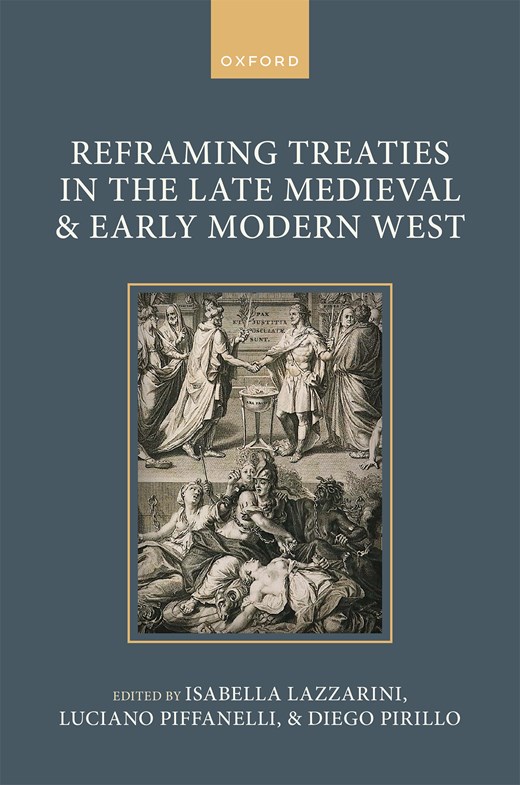
Reframing Treaties in the Late Medieval and Early Modern West, edited by Isabella Lazzarini, Luciano Piffanelli, and Diego Pirillo (Oxford: Oxford University Press, 2025) has been published.

I contributed an essay on “Peacemaking in the Context of Religious Violence: The Edict of Nantes and the Fragility of Conflict Resolution” to this collective volume and enjoyed participating in this publication project.

The book description reads: “Opening a fresh chapter in the burgeoning field of premodern diplomatic history, Reframing Treaties focuses on peacemaking through a wide geopolitical and constitutional range of case studies not limited to Europe, but including also the Mediterranean and Atlantic worlds, and along a chronological time frame which centres on the period between the 14th and the 18th centuries but explores crossings, continuities, and afterlives up to the 21st century. The volume has two main general objectives. First, to rethink the peacemaking process and uncover the flow of negotiations that shaped late medieval and early modern political interactions. Secondly, to add an important contribution to the ongoing debate about Eurocentrism and its consequences by breaking down one of the most spectacular mechanisms (the system of the European great treaties) that helped make Western late medieval ius commune and early modern ius gentium become a purported ‘universal international order’ in the 19th century and beyond. With a multidisciplinary approach, the volume puts at the heart of the investigation not the single peace treaty, but the peacemaking process in its many forms and outcomes and demonstrates that peacemaking was a complex and multilayered phenomenon. Used as a political grammar, its binding nature transformed it into a powerful instrument to settle conflicts and regulate interactions both within and outside polities and communities. The volume is organised into four parts (Sources, Peacekeeping, Peacemaking, and Intersections), and 21 chapters and an Epilogue (chapter 22), and brings together an international team of specialists from European and American universities and from different fields.”

The book is available online at the Oxford University Press website.

Posted in Civil Conflict, Current Research, Early Modern Europe, Early Modern France, European History, European Wars of Religion, French History, French Wars of Religion, History of the Western World, international relations, Italian History, Mediterranean World, Political Culture, Reformation History, Religious Politics, Religious Violence, Renaissance Art and History, Strategy and International Politics, Warfare in the Early Modern World | Leave a comment

Academic Presses Making Deals with AI Companies

I am alarmed to discover that Johns Hopkins University Press, one of the leading academic presses in the world is making deals with AI companies to license their titles to “train” LLMs.

Here is an urgent question for friends who are professors, authors, publishers, and lawyers: Should we sign over rights to allow academic presses to license our books and allow LLMs access to our publications?

It seems that many LLMs already have already accessed many of our publications, violating copyright laws to do so. However, there are already numerous lawsuits related to AI companies’ use of copyrighted material, including academic journal articles and research monographs. Multiple major lawsuits are already pending and others will certainly be launched soon.

Now, Johns Hopkins University Press has announced a new deal to license all of its titles to an unnamed company to “train” its LLM. The Baltimore Banner has published an article on JHUP’s announcement (25 July 2025).

Johns Hopkins University. Image: The Baltimore Banner.

Johns Hopkins University Press (JHUP) is one of the most important academic presses in the world and a bellweather for academic publication policies in the United States and worldwide. This case therefore has sweeping implications not only for JHUP, but for all academic authors around the world.

Here is an email that I recently received from the Johns Hopkins University Press, the academic publisher of my first book (a research monograph):

“Since generative AI burst on the scene, we have been carefully evaluating the potential benefits and the concerns raised about its risks. This technology—whether OpenAI’s ChatGPT, Google’s Gemini, or Anthropic’s Claude—is getting better every day. Our target readers are increasingly embracing it for search, research, and discovery. We have spent the last year exploring the possibility of licensing our books on one or more of these generative AI Large Language Models (LLMs). Here are some of the reasons why we feel now is the right time to move forward.

“Discovery. With readers moving from traditional search engines to AI-powered tools, it’s critical that your work is discoverable where your audience is. There are innovative technologies that, if adopted by the LLMs, will credit the sources of AI-generated responses. We believe that having the work in the LLMs in combination with an ability for readers to identify and click through to the original source is the best way to continue to engage with readers and disseminate your work widely.

“Guardrails on Content Use. As media reports have surfaced on some LLMs scraping content from pirated sites, we are increasingly concerned, although not certain, that the major LLM companies already have our books. Having a contract with legal language around how these companies may and may not use the content is the most effective way to manage the risk now.

“Financial. While we do not anticipate huge financial gain for individual books, the cumulative revenue would be meaningful for Johns Hopkins University Press and our mission. As we anticipate contraction in the higher-education market, these funds can help to sustain our important work as a non-profit publisher.

“Timing. While we hope that publishers, authors, and other content creators will prevail in upholding copyright as it pertains to use on LLMs, recent court decisions and other environmental factors point to heightened risk of decisions that may weaken our rights. We believe that these companies should pay for the use of your work. Our acceptance of their payments demonstrates that licensing is required. We are concerned that the window may be closing for such deals, especially for university press publishers like us, and so we need to move quickly.

“If your work is licensed for use in LLMs, you will receive the appropriate royalties as indicated in the contract we both signed before publishing your work.

“I hope that you agree with our reasoning for taking the step now to license your work for use in LLMs. While we have not yet signed any agreements for your book, we hope to do so in the near future. In your contract, you provide us with the rights to go ahead with this kind of licensing. However, we would like you to have the ability to opt out if you so choose.

“You do not need to take any action if you are fine with us moving forward with licensing your work on LLMs.

“If you prefer that we not license your work on LLMs, you need to send an email […] to request that an addendum to your contract be sent via DocuSign to opt out.”

Authors are being given only until 31 August 2025 to opt out of this deal.

I would welcome comments and advice on these issues….

Wolfe, Ellie. “Johns Hopkins University Press will License its Authors’ Books to Train AI Models.” The Baltimore Banner (25 July 2025).

Posted in Academic Freedom, Academic Publishing, Civil Rights Issues, Digital Humanities, Higher Education, History of the Book, Human Rights, Humanities Education, Information Management, Legal history, United States History and Society | Tagged , , , , , , , , , , , , , , , , , | Leave a comment

George Orwell’s ‘1984’ and Modern America

Charlie English has published an essay in The New York Times on the role that George Orwell’s 1984 played in the Cold War, drawing comparisons to the book being banned in the United States in the twenty-first century.

English is a former journalist for The Guardian and author of The CIA Book Club: The Secret Mission to Win the Cold War with Forbidden Literature (2025).

Charlie English introduces George Orwell’s 1984 and its central premise: “First published in English in 1949, Orwell’s novel describes the dystopian world of Oceania, a totalitarian state where the protagonist, Winston Smith, works in a huge government department called the Ministry of Truth. The ministry is ironically named: Its role is not to safeguard the truth but to destroy it, to edit history to fit the present needs of the party and its leader, Big Brother, since, as the slogan runs, ‘Who controls the past controls the future: who controls the present controls the past.'”

Orwell’s 1984 was an extended commentary on the censorship policies in Eastern European societies during the Cold War. “In the real Soviet system, every country had its equivalent of the Ministry of Truth, modeled on the Moscow template. In Poland, the largest Eastern European nation outside the Soviet Union, this censorship and propaganda apparatus was called the Main Office for the Control of Presentations and Public Performances, and its headquarters occupied most of a city block in downtown Warsaw,” English emphasizes.

“From art to advertising, television to theater, the Main Office reached into all aspects of Polish life. It had employees in every TV and radio station, every film studio and every publishing house. Every typewriter in Poland had to be registered, access to every photocopier was restricted, and a permit was needed even to buy a ream of paper. Books that did not conform to the censor’s rules were pulped. …”

Image: The New York Times.

Charlie English’s essay makes direct comparisons between censorship by the Polish state during the Cold War and the censorship being carried out today by the Trump administration and by Republican representatives and governors in many states of the United States.

In the mid-2020s, 1984 is again being restricted, this time by conservative, Trump-aligned politicians in the United States. In May 2023, the Republican governor of Iowa, Kim Reynolds, signed into law Senate File 496, which according to the governor “puts parents in the driver’s seat” when it comes to their children’s education. In fact SF 496 forces Iowa schools to remove from their libraries thousands of books of which cultural conservatives disapprove.

“Mostly, SF 496, which is the subject of an ongoing legal battle, bans books that feature L.G.B.T.Q.+ characters or progressive themes such as feminism or are written by people of color. But the legislation also sweeps up several authors whose works lampoon totalitarianism and that were sent east by the C.I.A. book program, including Aldous Huxley, Kurt Vonnegut and Orwell, whose 1984 and Animal Farm are both on banned lists,” according to English.

“SF 496 is but one cog in the growing apparatus of American censorship, as conservative action groups seek to ban books around the country. PEN America has documented close to 16,000 bans (instances in which a book has been withdrawn or access to it has been restricted because of its content) in schools since 2021, with 10,046 in the 2023-24 school year alone. The censorship efforts are mostly driven by Republican state legislators and parental-rights groups. Florida takes the lead, with more than 4,561 book bans recorded in that school year — including in one case a graphic novel adaptation of 1984 — via a combination of new state laws and parental pressure. Next come Iowa (with 3,671 book bans that year), Texas (538), Wisconsin (408), Virginia (121) and Kentucky (100).”

English, Charlie. “‘1984’ Hasn’t Changed, but America Has.” The New York Times (27 July 2025).

English, Charlie. The CIA Book Club: The Secret Mission to Win the Cold War with Forbidden Literature. (Penguin, 2025).

Simpson, John. “Review of The CIA Book Club: The Secret Mission to Win the Cold War with Forbidden Literature.” The Guardian (14 March 2025).

Posted in Academic Freedom, Academic Publishing, Authoritarianism, Civil Rights Issues, Education Policy, Empires and Imperialism, European History, European Studies, High School History Teaching, History in the Media, History of the Book, Human Rights, Humanities Education, Information Management, Intellectual History, international relations, Political Culture, Political History of the United States, Political Theory, Public History, The Past Alive: Teaching History, United States History and Society, World History | Tagged , , , , , , , , , , | Leave a comment

Summer Interns Lose Positions in Trump Cuts

The massive layoffs and disruptions in federal agencies carried out by Elon Musk’s so-called DOGE team and the broader Trump administration have eliminated thousands of summer internships positions for young Americans.

“The Trump administration’s sweeping cuts have pushed many lifetime civil servants out of their roles. They have also disrupted people at the other end of the career spectrum: summer interns, those energetic new arrivals who count on internships to serve as the on-ramp to their professional lives. (Some, but not all, are paid for their efforts),” according to The New York Times.

“Young people who hustled for competitive internships and research positions said they felt dejected when those offers were taken back. Their optimism gave way to a stressful scramble to find other roles or sources of income on short notice. Several second-guessed whether they really wanted to enter fields that seemed to be crumbling before their eyes. …”

The New York Times reports that “Summer roles have been rescinded from students who were offered positions supported by U.S.A.I.D., the National Institutes of Health, the Department of State, and the National Oceanic and Atmospheric Administration, among other agencies.”

Marlene McKinny, whose lost a summer internship when NIH funding was cut. Photo: The New York Times.

“Mr. Trump has also slashed medical research funding, affecting research programs for students studying science. Marlene McKinney, 20, an aspiring neurosurgeon at the City College of New York, had planned to spend her summer in a lab in Manhattan, studying the thermodynamic properties of elastic tissue proteins,” The New York Times reports.

“Her work had been funded through the U-RISE program, which provides financial support and mentorship to students from underrepresented backgrounds conducting biomedical research. In late March, Ms. McKinney found out that the grant, which received N.I.H. funding, was being suspended.

“She began furiously searching for part-time jobs. ‘I was like, ‘Oh, great, I can’t work at the lab anymore,’ she said. ‘How am I going to pay my rent?’”

This is a tragic loss for Marlene McKinney and for other young scientific researchers like her. The United States stands to lose an entire generation of young scientific and medical researchers who decide to abandon research careers or to move abroad to pursue them.

Young citizens who intended to pursue summer internships in other fields may be discouraged from pursuing careers in the federal government and the public sector, a loss for the nation.

Many undergraduate and graduate students in history and the humanities serve as interns with federal agencies, state institutions, and local governments. Public historians work in the National Archives, Library of Congress, Department of State, Department of Education, National Parks Service, Smithsonian Institute museums, military museums, military academies, state museums, state agencies, regional museums, municipal museums, historical societies, humanities councils, and many other agencies. Indeed, many of my former history students work as public historians at the federal, state, and local levels.

The National Council of Public History provides a description of public history: “Public historians come in all shapes and sizes. They call themselves historical consultants, museum professionals, government historians, archivists, oral historians, cultural resource managers, curators, film and media producers, historical interpreters, historic preservationists, policy advisers, local historians, and community activists, among many many other job descriptions. All share an interest and commitment to making history relevant and useful in the public sphere.”

Posted in Academic Freedom, Careers in History, Civil Rights Issues, Education Policy, Graduate Work in History, Grants and Fellowships, Humanities Education, Jobs and Positions, Political History of the United States, Public History, The Past Alive: Teaching History, United States History and Society | Leave a comment