I am happy to report that my latest publication on military contractors in the French Wars of Religion is finally in print. This is a chapter in a collective volume on Die Kapitalisierung des Krieges / The Capitalization of War.
Here is the full citation:
Brian Sandberg, “‘Avarice Never Made Him Unsheathe a Mercenary Sword’: Military Contractors in the French Wars of Religion, 1562–1629,” in Die Kapitalisierung des Krieges: Kriegsunternehmer in Spätmittelalter und Früher Neuzeit, ed. Matthias Meinhardt and Markus Meumann (Berlin: LIT Verlag, 2021), 85-104.
This chapter is published in a collective volume that grew out of a conference on Die Kapitalisierung des Krieges / The Capitalization of War, held at the Deutsches Historisches Museum in Berlin in 2009.
The collective volume includes works on warfare, war finance, and political economy in the early modern period. The essays are written in English and German languages and cover a range of topics on war, culture, and society in the sixteenth and seventeenth centuries. The citation for the collective volume is:
Matthias Meinhardt and Markus Meumann, eds., Die Kapitalisierung des Krieges: Kriegsunternehmer in Spätmittelalter und Früher Neuzeit, (Berlin: LIT Verlag, 2021).
A preview of the book is now available on Google Books.
Nothing could seem more “natural” than our rhythms of sleep, yet there is a history of sleep. Historians have recognized various changes in sleeping patterns in the modern industrialized and post-industrial world, which have also been studied by scientists.
Over the past several decades historians are discovering and documenting earlier patterns of sleep in the medieval and early modern periods.
Late medieval sleeping arrangements depicted in an illuminated manuscript. Image: BBC/Getty.
Historian Roger Ekirch (Virginia Tech University) has studied pre-industrial sleep patterns and has made some interesting discoveries. According to the BBC, “Ekirch had been researching a book about the history of night-time, and at the time he had been looking through records that spanned the era between the early Middle Ages and the Industrial Revolution. He was dreading writing the chapter on sleep, thinking that it was not only a universal necessity – but a biological constant. He was sceptical that he’d find anything new.”
Ekirch began to discover curious references to sleep in court records, literary sources, and other period documents. Many medieval and early modern people slept in two different blocs of sleep nightly, referred to in English as “first sleep” and “second sleep.” Ekirch has designated these patterns as segmented sleep patterns (or biphasic sleep).
The BBC explains that “Biphasic sleep was not unique to England, either – it was widely practised throughout the preindustrial world. In France, the initial sleep was the ‘premier somme‘; in Italy, it was ‘primo sonno‘. In fact, Eckirch found evidence of the habit in locations as distant as Africa, South and Southeast Asia, Australia, South America and the Middle East.”
Historian Craig Koslofsky (University of Illinois at Urbana-Champaign) has examined the history of the night in early modern Europe, focusing on the use of stage lighting and street lights to illuminate darkness in early modern cities. His study also explores distinctions between urban and rural experiences of lightness and darkness, which may help explain divergences in urban and rural sleep patterns even before the Industrial Revolution.
Sleep scientists have been conducting sleep experiments for decades, examining how clocks, electric lighting, and industrial work routines have significantly altered sleep patterns. Some of their recent findings suggest that segmented sleep patterns still exist in some areas of the world and that they can be encouraged by certain environmental factors.
The history of sleep in the medieval and early modern periods is informing the ways in which sleep scientists research sleep patterns today.
A. Roger Ekirch, The Great Sleep Transformation: How the Industrial Revolution Changed Our Nights (Amsterdam, 2021).
A. Roger Ekirch, “The Modernization of Western Sleep: Or, Does Insomnia Have a History?,” Past & Present 226 (February 2015): 149-192.
Craig Koslofsky, Evening’s Empire: A History of the Night in Early Modern Europe (Cambridge: Cambridge University Press, 2011).
A. Roger Ekirch, At Day’s Close: Night in Times Past (W.W. Norton, 2005).
The BBC reports on the history of segmented sleep patterns.
Renaissance letter-writing is being re-examined using Digital Humanities tools to explore letterlocking techniques of securing correspondence.
The New York Times explains: “To safeguard the most important royal correspondence against snoops and spies in the 16th century, writers employed a complicated means of security. They’d fold the letter, then cut a dangling strip, using that as an improvised thread to sew stitches that locked the letter and turned the flat writing paper into its own envelope. To get inside, a spy would have to snip the lock open, an act impossible to go undetected.”
Historians who study the Renaissance using manuscript correspondence will certainly recognize the signs of letterlocking in archival collections. Letters that were received and opened during the sixteenth century have the pierced holes and sometimes fragments of the strips of paper that formed the spiral locks.
Letterlocking provided a certain level of security for correspondence, allowing recipients to recognize that the letter had not been opened in transit. Other security techniques utilized in Renaissance correspondence included encryption, secret ink, and oral transmission by couriers. Historians, archivists, and librarians have been studying all of these techniques and broader the material culture of letter-writing for some time.
A research team at M.I.T. has been digitally modeling letterlocking techniques and analyzing letters written by Queen Elizabeth I of England, Mary Queen of Scots, and Queen Catherine de’ Medici of France. What is new here is the use of Digital Humanities tools in conjunction with the material culture methodologies. The M.I.T. team’s major new approach is to scan unopened letters and digitally “unfold” them.
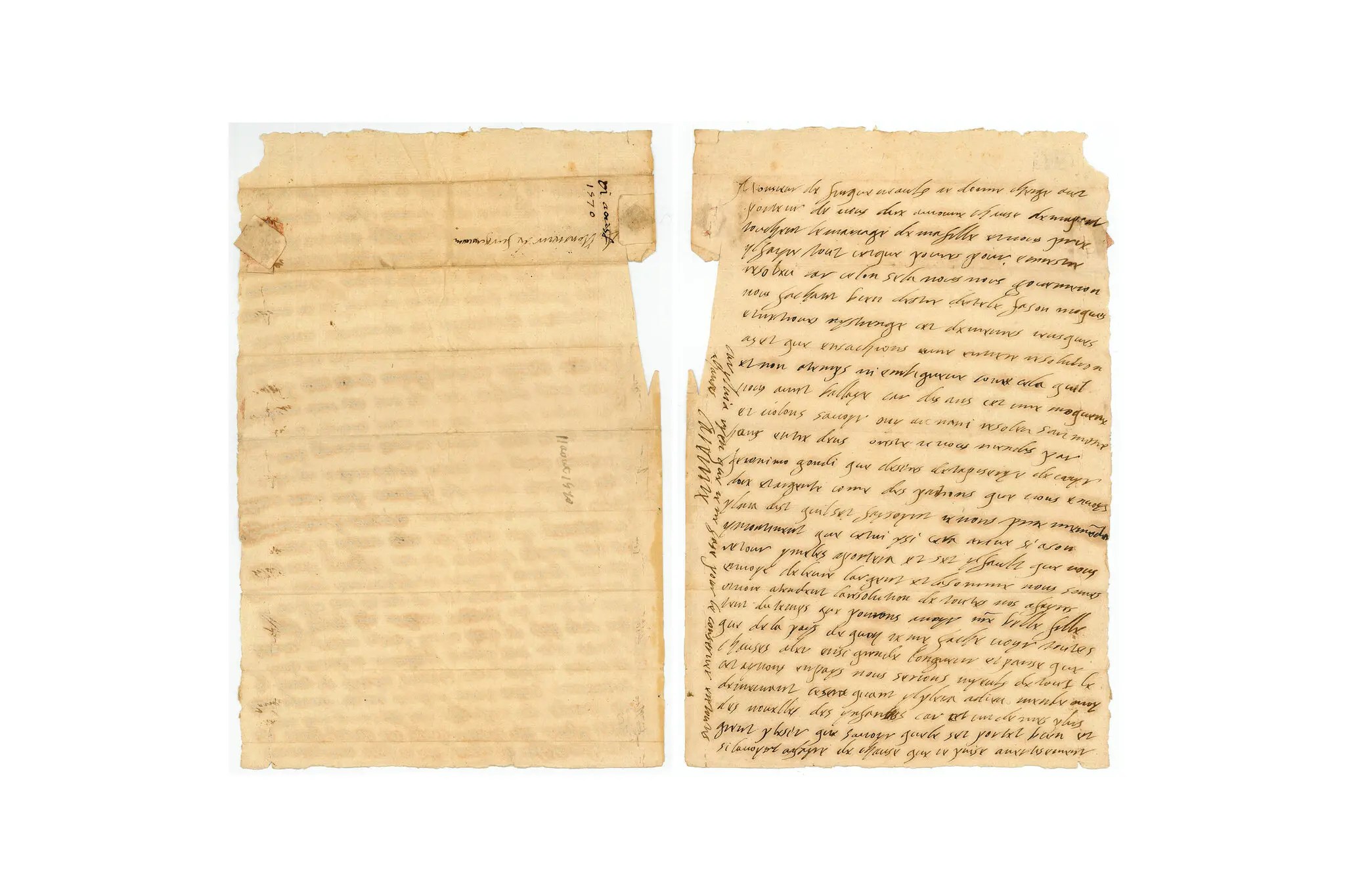
One of the letters analyzed by the M.I.T. team is a letter by Queen Mother Catherine de’ Medici written in 1570.
Catherine de’ Medici to Raimond de Beccarie, sieur de Fourquevaux, 1570.
The M.I.T. team has published their findings in several articles and has created a video (available on YouToube) to demonstrate letterlocking techniques:
The New York Times reports on the M.I.T. reseach project on letterlocking.
Previous reports by The New York Times, NPR, and the BBC have discussed the M.I.T. project and Mary Queen of Scots’ use of letterlocking.
The M.I.T. team has published their findings in several articles, including:
Dambrogio, J., Ghassaei, A., Smith, D.S. et al. “Unlocking history through automated virtual unfolding of sealed documents imaged by X-ray microtomography.” Nature Communications12, 1184 (2021).
The Newberry Library will be hosting a National Endowment for the Humanities Summer Institute on Mapping the Early Modern World in Summer 2022.
This NEH Summer Institute is being co-organized by the Hermon Dunlap Smith Center for the History of Cartography and the Center for Renaissance Studies of the Newberry Library.
The NEH Summer Institutes provide university and college faculty opportunities to engage in specialized education and research on particular themes during a concentrated period during the summer break. Each year, summer institutes are offered on different themes and issues in the humanities.
I participated in one of the previous NEH Summer Institutes in early modern studies and highly recommend the institutes for other faculty members.
Here is the announcement from the Newberry Library:
The Newberry Library is pleased to announce Mapping the Early Modern World, a four-week summer institute for higher education faculty from July 18 through August 12, 2022. The institute will be held on site at the library, situated on the near north side of Chicago. The interdisciplinary institute will be co-organized by the Newberry’s Hermon Dunlap Smith Center for the History of Cartography and its Center for Renaissance Studies. Dr. James Akerman (Director of the Smith Center) and Dr. Lia Markey (Director of the Center for Renaissance Studies) will co-direct the institute. The institute’s 25 participants will pursue a program of seminars, workshops, discussion, and research exploring interdisciplinary approaches to the study of maps in connection with the global intellectual, cultural, and geographical transformations of the world between 1400 and 1700. The course of reading and discussion will consider five major “theaters” in which the production and use of maps operated: the world, the city, the land, the sea, and the skies. The co-directors have invited eight accomplished guest faculty from a broad range of humanities fields to lead seminar sessions and research workshops. In addition to these sessions, each participant will pursue a research project utilizing the Newberry’s renowned collections of early modern maps and other humanities resources.
Undergraduate and graduate students interested in European history, Atlantic World history, African history, and World history may need to pursue French language studies.
Students at Northern Illinois University and in the Chicago area who are looking for French language classes may want to take online courses through the City Colleges of Chicago.
Truman College is offering synchronous online courses via Zoom during Spring 2022 and other colleges appear to be offering courses, too.
For more information, see the City Colleges of Chicago website or contact the French language faculty members.
The Center for Renaissance Studies at the Newberry Library will host a Summer Institute in Italian Paleography during Summer 2022.
This is a fantastic opportunity for graduate students who are interested in Renaissance studies, Italian history, and early modern European history.
Graduate students in History and World Languages and Cultures at Northern Illinois University should especially consider applying for this Summer Institute, since NIU is a member of the Center for Renaissance Studies Consortium.
Here is the announcement from the Center for Renaissance Studies:
Summer Institute in Italian Paleography
July 11-22, 2022 Newberry Library
Application Deadline: March 15, 2022
CRS is pleased to announce that applications are now being accepted for this two-week residential course, which will be directed by Maddalena Signorini, Università degli Studi di Roma “Tor Vergata.”
The course offers an intensive introduction to reading and transcription of handwritten Italian vernacular texts from the late medieval through the early modern periods. This graduate-level course is taught in Italian and requires advanced language skills.
While the emphasis is on building paleographical skills, the course also offers an overview of materials and techniques, and considers the history of scripts within the larger historical, literary, intellectual, and social contexts of Italy. Participants practice on a wide range of documents, including literary, personal, legal, notarial, official, and ecclesiastical works. The course provides insight into the systems of Italian archives and allows participants to work with inventories, letters, diaries, and other primary source materials from the Newberry Library.
The institute enrolls 15 participants by competitive application. We welcome applications from advanced graduate students and junior faculty from universities, from professional staff of libraries and museums, and from qualified independent scholars. First consideration will be given to applicants from Center for Renaissance Studies Consortium institutions.
The Detroit Institute of Arts is searching for a new Editor.
This job could be ideal for a candidate with a M.A. in History or Art History, specializing in Renaissance studies or other periods covered by the collections of the Detroit Institute of Arts (DIA).
The DIA describes the Editorial position: “Under the direction of the Director of Exhibitions, contributes to the long-range strategic planning of museum publications, manages museum-wide publication projects and edits high quality museum publications.”
Here is the full job announcement from the Detroit Institute of Arts:
Martin Luther King, Jr., commenting in 1963 on the “minority of misguided senators” who would use the filibuster to block voting rights legislation:
The Washington Post provides a brief analysis of King’s comments, which were given in a television interview on Press Conference U.S.A. During that interview, King was asked about John F. Kennedy’s proposed civil rights act.
In an extended response to a question about the civil rights bill, Martin Luther King, Jr. stated: “I think the tragedy is that we have a Congress with a Senate that has a minority of misguided senators who will use the filibuster to keep the majority of people from even voting. They won’t let the majority senators vote. And certainly they wouldn’t want the majority of people to vote, because they know they do not represent the majority of the American people. In fact, they represent, in their own states, a very small minority.”
As voting rights and the filibuster are once again connected in United States politics, it is a perfect time to revisit Martin Luther King’s perspective on the filibuster’s role in denying voting rights to African Americans and other groups who have been denied civil rights.
The Washington Post reports on Martin Luther King, Jr.’s comments and provides the video here:
The Center for Renaissance Studies is hosting an online discussion of Race in the Museum: Representing the Diversity of the Early Modern World.
This discussion will interest early modern scholars working in pre-modern race studies, early modern history, public history, and museum studies.
Here is the announcement from the Center for Renaissance Studies:
CRS is pleased to announce the next conversation in the Race in Dialogue series.
This session features curators Stephanie Schrader (J. Paul Getty Museum, Los Angeles) and Heather Hughes (Davis Museum, Wellesley College) in conversation about their own curatorial work that engages with Renaissance and Baroque materials representing people across the globe. What is the role of the curator, as both a scholar and public humanist, in the field of premodern critical race studies today? How do exhibitions today engage with different communities and audiences?
This program is a part of Race in Dialogue, a series of virtual conversations on medieval and early modern critical race studies and Indigenous studies. Each hour-long session will feature a conversation between scholars across professional generations about foundational works and the current state of the field.
The Renaissance Society of America is hosting an online lightening talk series on Rethinking the Renaissance Archive during Spring 2022.
This series is being organized by the RSA’s Graduate Student Advisory Committee. Here is their call for proposals:
The Renaissance Society of America’s Graduate Student Advisory Committee is pleased to announce that our Online Graduate Student Lightning Talk Series will continue in 2022. The first session will be held on Thursday, February 24.
This year’s theme is “Rethinking the Renaissance Archive.” We invite participants, from various disciplinary backgrounds, to think about the nature of the Renaissance archive. Specifically, what constitutes a Renaissance archive and how can it be reimagined to account for a broader variety of experiences, traditions, ideas, and practices across time and space?
Abstracts of 150 words are due by Sunday, January 16. Please submit your name, email address, affiliation, proposed title, and short abstract by clicking here and answering the questionnaire at the bottom of the page. Participants will be notified by Monday, January 24.
Lightning talks are concise oral presentations of five minutes, which may or may not include visual aids. Presentations could be based on:
• An argument from your work (BA/MA thesis, PhD dissertation, or article)
• Initial findings from side projects, or work in progress
• Archival findings
• Pedagogical questions
• Field/experience-based observations, and/or
• Any archive-related topic that might stimulate discussion.
This event is open to all graduate students but preference will be given to RSA graduate student members. Please email the RSA with questions.
Best of luck,
RSA Graduate Student Advisory Committee
Farah Bazzi Rachel Carlisle Bar Leshem Thomas Santa Maria Wenrui Zhao





 Brian Sandberg: Historical Perspectives