Remembering the Saint Bartholomew’s Day Massacre

I will be offering my course, HIST 414 European Wars of Religion, 1520s-1660s, at Northern Illinois University beginning next Monday.

Just in time for the beginning of the semester, today is the anniversary of the Saint Bartholomew’s Day Massacre in Paris on 24 August 1572, one of the most shocking atrocities of the French Wars of Religion (1559-1629).
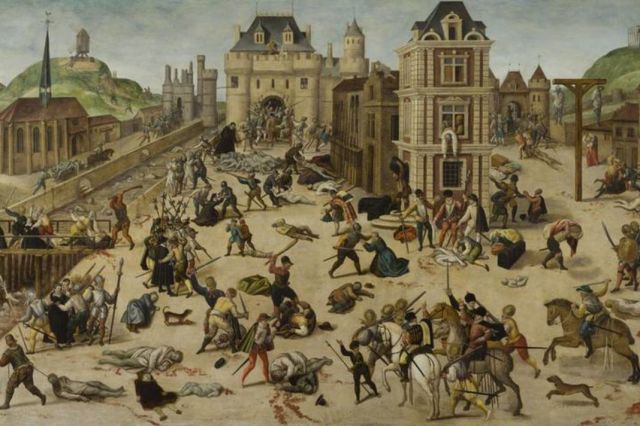
As I prepare my classes this week, I am reminded of the other major historical commemorations that intersect with my course on the European Wars of Religion. 

Last year was the 500th anniversary of Martin Luther’s challenge to papal authority and his publication of the Ninety-Five Theses (1517). Reformation historians in Germany and around the world held numerous conferences, workshops, lectures, and services throughout 2017 in celebration or commemoration of the beginning of the Protestant Reformation. Scholars, clergy, and journalists published many articles and books reflecting on Martin Luther’s life and the historical significance of the Lutheran movement. I previously posted on the 2017 commemorations on this website.

This year is the 400th anniversary of the beginning of the Thirty Years’ War (1618-1648) in May 1618. While there have already been some commemorations and publications, responses to this major historical event seem more muted.

In remembrance of the Saint Bartholomew’s Day Massacre, here (below) is a lecture by Professor Barbara B. Diefendorf (Boston University), a leading specialist on the massacre and the French Wars of Religion, that was videotaped in 2006:

For those readers wanting to find out more about the Saint Bartholomew’s Day Massacre, see the following works:

Crouzet, Denis. La nuit de la Saint-Barthélemy: un rêve perdu de la Renaissance. Paris]: Fayard, 1994.

——. Les guerriers de Dieu. 2 vols. Seyssel: Champ Vallon, 1990.

Diefendorf, Barbara B. Beneath the Cross: Catholics and Huguenots in Sixteenth-Century Paris. New York: Oxford University Press, 1991.

——. Blood Wedding: The Saint Bartholomew’s Day Massacre in History and Memory. Boston, MA: Boston University, 2006.

——. The Saint Bartholomew’s Day Massacre: A Brief History with Documents. Boston, MA: Bedford/St. Martin’s, 2009.

Jouanna, Arlette. The Saint Bartholomew’s Day Massacre: The Mysteries of a Crime of State. Trans. Joseph Bergin. Oxford: Manchester University Press, 2016.

 

Posted in European History, European Wars of Religion, French History, French Wars of Religion, History in the Media, History of Violence, Paris History, Reformation History, Religious History, Religious Politics, Religious Violence, Warfare in the Early Modern World | Leave a comment

Aristocratic Souls in Democratic Times

Aristocratic Souls in Democratic Times, edited by Richard Avramenko and Ethan Alexander-Davey (Lexington Books, 2018) is currently being published.

This collective volume examines elites, political culture, and political theory from a variety of perspectives. The book includes an essay I wrote on “Furnishing War on Noble Credit: French Nobles, Commerce, and the Political Economy of Crédit.

The book description reads: “Great statesmen and gentlemen, men of honor and rank, seem to be phenomena of a bygone Aristocratic era. Aristocracies, which emphasize rank, and value difference, quality, beauty, rootedness, continuity, stand in direct contrast to democracies, which value equality, autonomy, novelty, standardization, quantity, utility and mobility. Is there any place for aristocratic values and virtues in the modern democratic social and political order? This volume consists of essays by political theorists, historians, and literary theorists that explore this question in the works of aristocratic thinkers, both ancient and modern. The volume includes analyses of aristocratic virtues, interpretations of aristocratic assemblies and constitutions, both historic and contemporary, as well as critiques of liberal virtues and institutions. Essays on Tacitus, Hobbes, Burke, Tocqueville, Nietzsche, as well as some lesser known figures, such as Henri de Boulainvilliers, John Randolph of Roanoke, Louis de Bonald, Konstantin Leontiev, Jose Ortega y Gasset, Richard Weaver, and the Eighth Duke of Northumberland, explore ways of preserving and adapting the salutary aspects of the aristocratic ethos to the needs of modern liberal societies.”

Aristocratic Souls in Democratic Times is listed on the website for Rowman and Littlefield.


Posted in Early Modern Europe, Early Modern World, European History, French History, Noble Culture and History of Elites, Political Culture, State Development Theory | Leave a comment

H-France Forum on Fanny Cosandey’s Le Rang

The latest H-France Forum, volume 13, number 1, has been published online.


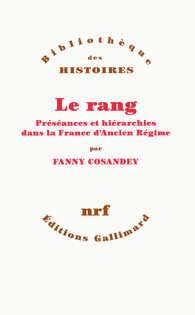
This issue of H-France Forum includes review essays on Fanny Cosandey’s Le rang. Préséances et hierarchies dans la France d’Ancien Régime (Paris: Gallimard, 2016).

The forum on Cosandey’s Le Rang consists of review essays by Susan Broomhall, Brian Sandberg, Jay M. Smith, and Jonathan Spangler, as well as a response essay by Fanny Cosandey.

The essays are available at H-France Forum.

Posted in Cultural History, Current Research, Early Modern Europe, Early Modern World, European History, French History, Noble Culture and History of Elites, Political Culture, State Development Theory | Leave a comment

Review of War and Conflict in the Early Modern World

The Journal of Modern History has published Peter Wilson’s review of my recent book, War and Conflict in the Early Modern World (Polity, 2016).

The review is available online at the Journal of Modern History website.


Posted in Early Modern Europe, Early Modern World, European History, Globalization, History of Violence, Reformation History, Renaissance Art and History, War and Society, War, Culture, and Society, Warfare in the Early Modern World | Leave a comment

Spanish Paleography Course

Burgos: Deciphering Secrets of Medieval Spain

A new MOOC on Spanish paleography is being launched:

“Roger Martinez is pleased to announce the launch of a new Massive Open Online Course (MOOC) that specifically focuses on medieval Spanish paleography training. The course is called Burgos: Deciphering Secrets of Medieval Spain and it will be offered on a monthly basis on coursera.org at https://www.coursera.org/learn/burgos-deciphering-secrets-medieval-spain. The next class begins on 9 April 2018. This six-week course is intensive — it requires, on average, 10-12 hours of your time per week.”

“This is the first of three new MOOCs that offer intensive paleography training. Three additional MOOCs pertaining to the medieval/early modern history of Toledo, Plasencia, and Granada, will be launched over the next 3 to 9 months. These courses are in addition to an introductory course on medieval Spain titled, Coexistence in Medieval Spain: Jews, Christians, and Muslims, and another titled, Deciphering Secrets: The Illuminated Manuscripts of Medieval Europe.”

Posted in Archival Research, Early Modern Europe, Early Modern World, Renaissance Art and History | Leave a comment

Position in Early Modern European History

Northeastern Illinois University is advertising for a faculty position in Early Modern European History.

The position description reads:

“Early Modern Europe and the World: Assistant Professor with a strong field in Europe (excluding Russia) from c. 1450-c. 1789.  Desirable fields include, but are not limited to, transnational processes such as trade, migration, capitalism, the history of science and technology, or the formation of European states. The successful candidate will be required to teach within the department’s Western Civilization sequence, as well as upper-division and graduate courses in her/his specialty.  The ability to teach historical methods at the undergraduate and graduate levels is a plus, as would be experience with digital historical sources and new media.

Applicants should send a cover letter, CV, three letters of recommendation, a chapter or article-length writing sample, and evidence of teaching preparation (syllabi, course evaluations, etc.).  Materials can be sent to Professor Francesca Morgan, Chair, Early Modern Europe Search, Dept. of History, Northeastern Illinois University, 5500 N. St. Louis Ave., Chicago, IL 60625-4699.   Electronic submissions are welcome: F-Morgan@neiu.eduReview of applications begins February 20, 2018.”

For more information, see H-Net.

Posted in Early Modern Europe, Early Modern World, European History, Graduate Work in History, Jobs and Positions | Leave a comment

Presentation at the University of Chicago

I am looking forward to presenting at the Early Modern and Mediterranean Worlds Workshop at the University of Chicago next week.

Brian Sandberg, “Conversion, Confessional Politics, and Violence in the Final Stages of the French Wars of Religion, 1598-1629”
Early Modern and Mediterranean Worlds Workshop
Monday 29 January 2018
Rosenwald 405
University of Chicago

For more information, see: https://voices.uchicago.edu/emmw/

Posted in Civil Conflict, Cultural History, Early Modern Europe, Early Modern World, European History, European Wars of Religion, French Wars of Religion, History of Violence, Languedoc and Southern France, Political Culture, Reformation History, Religious History, Religious Politics, Religious Violence, Renaissance Art and History, Warfare in the Early Modern World | Leave a comment

Graduate Student Conference at the Newberry Library

I am pleased that several of my former graduate students are participating in this week’s Multidisciplinary Graduate Student Conference, sponsored by the Center for Renaissance Studies at the Newberry Library.

“The Center for Renaissance Studies’ annual graduate student conference, organized and run by advanced doctoral students, has become a premier opportunity for emerging scholars to present papers, participate in discussions, and develop collaborations across the field of medieval, Renaissance, and early modern studies in Europe, the Americas, and the Mediterranean world. Participants from a wide variety of disciplines find a supportive and collegial forum for their work, meet future colleagues from other institutions and disciplines, and become familiar with the Newberry and its resources.”

For the conference program and further information, see the Newberry Library website for the conference.

Posted in Conferences, Early Modern Europe, Early Modern World, European History, European Wars of Religion, Graduate Work in History, Reformation History, Renaissance Art and History | Leave a comment

Cultures of Voting in Pre-Modern Europe

I am happy to report that my latest publication has been released, just in time for the new year.  Happy 2018!

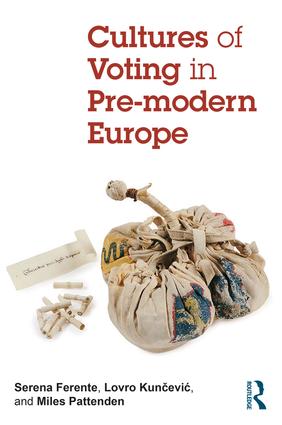
My chapter on “Municipal elections and contested religious space: electoral practices and confessional politics in Mediterranean France during the French Wars of Religion,” appears in Cultures of Voting in Pre-Modern Europe, ed. Serena Ferente, Lovro Kunčević, and Miles Pattenden (Routledge, 2018).

The book description reads:

Cultures of Voting in Pre-modern Europe examines the norms and practices of collective decision-making across pre-modern European history, east and west, and their influence in shaping both intra- and inter-communal relationships.

Bringing together the work of twenty specialist contributors, this volume offers a unique range of case studies from Ancient Greece to the eighteenth century, and explores voting in a range of different contexts with analysis that encompasses constitutional and ecclesiastical history, social and cultural history, the history of material culture and of political thought. Together the case-studies illustrate the influence of ancient models and ideas of voting on medieval and early modern collectivities and document the cultural and conceptual exchange between different spheres in which voting took place. Above all, they foreground voting as a crucial element of Europe’s common political heritage and raise questions about the contribution of pre-modern cultures of voting to modern political and institutional developments.

Offering a wide chronological and geographical scope, Cultures of Voting in Pre-modern Europe is aimed at scholars and students of the history of voting and is a fascinating contribution to the key debates that surround voting today.


Posted in Early Modern Europe, European History, European Wars of Religion, French Wars of Religion, Mediterranean World, Noble Culture and History of Elites, Political Culture, Religious Politics, Renaissance Art and History, State Development Theory | Leave a comment

Renaissance Map Forgery

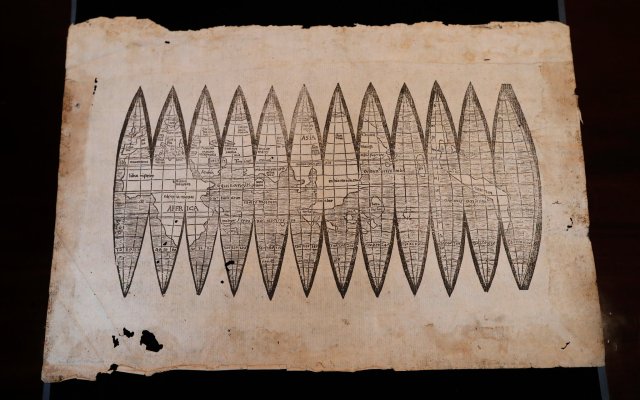
The auction house Christie’s has withdrawn an allegedly forged Renaissance map from its auction listings after scholars and map dealers questioned its authenticity.

The map is a print of Martin Waldseemüller’s famous 1507 world map, one of the first to use the name “America” to designate the continents of North and South America.

Nick Wilding, Associate Professor of History at Georgia State University, was one of the experts to raise concerns about the authenticity of the map.  Nick is a former colleague of mine at the Medici Archive Project and an expert on the history of science and the history of the book in the early modern world.

The New York Times interviewed Nick for its story on the forgery and explains that: “For Mr. Wilding, the biggest clue that something was off, he said, was a white line in the Christie’s map. It matched a spot in an authentic print of the map now held at the James Ford Bell Library at the University of Minnesota in Minneapolis, where extra paper had apparently been added to repair a tear. An original map, one that came directly off the woodblock, would not have replicated that tear, which happened later, Mr. Wilding said. But this map did and so, he said, he believes the map Christie’s has represents a reproduction of the Bell map.”

The New York Times reports on the Waldseemüller forgery.

Posted in Atlantic World, Cartographic History, Digital Humanities, Early Modern Europe, Early Modern World, European History, Globalization, History in the Media, History of Science, History of the Book, Italian History, Maritime History, Renaissance Art and History | Leave a comment