American Historical Association Conference 2016

The American Historical Association (AHA) conference is in being held in Atlanta this week. Thousands of history professors, researchers, graduate students, and editors are gathering for the largest historical conference in North America.

The conference includes sessions on recent research and business meetings. Many graduate students and recent doctorates will be interviewing for teaching jobs at universities and colleges across the country.

I am unable to attend the AHA this year, but am following the action from a distance.

For coverage of AHA 2016, see:

The AHA Today blog

Chronicle of Higher Education (articles not yet posted)

History News Network

Inside Higher Ed


Posted in Conferences, Graduate Work in History | Leave a comment

Newberry Consortium Fellowships

Newberry Library Center for Renaissance Studies Consortium Fellowships

The Newberry Library has announced a series of fellowships for the 2016-17 academic year.

Here is the Newberry Library’s announcement:

“Newberry Library Fellowships provide support to researchers who wish to use our collection. We promise you intriguing and often rare materials; a lively, interdisciplinary community of researchers; individual consultations on your research with staff curators, librarians, and other scholars; and an array of both scholarly and public programs.

“The Newberry Library Center for Renaissance Studies Consortium Fellowships provide support for scholars at Center for Renaissance Studies Consortium member institutions. These fellowships offer support for one month’s work in residence at the Newberry for one PhD candidate and one postdoctoral scholar working in medieval, Renaissance, or early modern studies. The postdoctoral scholar could be a full-time faculty member, adjunct faculty, librarian, or curator (with preference given for non-tenured faculty). Please note that applicants from Chicago-area member institutions are not eligible for this fellowship.

“For more information, including a comprehensive list of long- and short-term fellowships opportunities, eligibility requirements, and application guidelines, please visit our website at www.newberry.org/fellowships.”

Deadline: January 15, 2016*

Posted in Archival Research, Early Modern Europe, Early Modern World, European History, Graduate Work in History, Grants and Fellowships, Reformation History, Renaissance Art and History | Leave a comment

Millstone Research Travel Fellowship

WSFH Millstone Fellowship
Applications due 1 March 2016

The Millstone Fellowship provides $2500 for research in France.  Eligibility is restricted to doctoral students, untenured and adjunct faculty members, and independent scholars who reside in North America and whose research related to French history and culture requires work in archives, libraries, or other repositories in France.  Preference is given to doctoral students and scholars in the early stages of their academic careers.

Applications should include the following:  a curriculum vitae, including current contact information; a description of the project not to exceed five double-spaced pages, explaining its purpose and significance, its contribution to scholarship on France, and where and when the research is to be carried out; and two letters of recommendation.  All materials should be submitted in electronic format as e-mail attachments in Microsoft Word. The e-mail must carry the header “Millstone Fellowship.” Candidates are responsible for seeing that letters of recommendation arrive in a timely fashion.  Proposals will be reviewed by a five-member committee chaired by the Vice-President of the Western Society for French History.  The next winner will be notified by 30 April 2016, and the award will be announced at the Annual Meeting in Cedar Rapids, Iowa.

The prize committee members are:
Naomi Andrews, Santa Clara University (Chair)
Rebecca J. Jacobs-Pollez, Murray State College
Kenneth Loiselle, Trinity University
Sandrine Sanos, Texas A & M University, Corpus Christi
John Shovlin, New York University

Applications must be submitted by 1 March 2016 to:
Naomi Andrews, Vice-President
Western Society for French History
wsfhvicepresident@gmail.com

Posted in Archival Research, French History, Graduate Work in History, Grants and Fellowships | Leave a comment

Attaques Choquantes à Paris

Je pense à tous mes amis et tous les Parisiens suite aux attaques choquantes dans le cœur de Paris.

Solidarités et amitiés des américains francophiles….

Posted in Uncategorized | Leave a comment

Making and Knowing: Early Modern Geometries

The Newberry Library and Northwestern University are hosting an upcoming conference:

Making and Knowing: Early Modern Geometries, a History of the Book Symposium

EarlyModernGeometries

The conference will be held on Thursday, October 29, 2015 and Friday, October 30, 2015.

The schedule is Thursday: 5 to 7 pm at Northwestern University. Friday: 9:30 am to 3:30 pm at the Newberry Library.

Organized by J. B. Shank, University of Minnesota; Claudia Swan, Northwestern University; and Rebecca Zorach, Northwestern University

The conference is sponsored by the Newberry Library Center for Renaissance Studies and is part of its History of the Book Program.

The conference program is available at the Newberry Library website.

Graduate students in History at Northern Illinois University are encouraged to attend.

Posted in Art History, Conferences, Early Modern Europe, Early Modern World, European History, History of Science, History of the Book, Information Management, Reformation History, Renaissance Art and History | Leave a comment

Femmes à la cour de France

I will be participating in a conference on Femmes à la cour de France, hosted by Cour de France and the Institut d’Études Avancées de Paris, this week.

FemmesalacourdeFrance

I will be presenting a paper on “‘Je ne vis jamais cette cour plus plein de tourment’: Noblewomen and Confessional Parties at the French Court during the French Wars of Religion.”

The conference program is available as online at Cour de France.


Posted in Conferences, Cultural History, Early Modern Europe, European History, French History, Paris History, Political Culture, Reformation History, Religious History, Renaissance Art and History, Women and Gender History | 1 Comment

Graduate Student Conference at the Newberry Library

briansandberg's avatarCluster for the Study of Religious Violence

There is a great opportunity at the Newberry Library for graduate students working on religious violence in the Renaissance and early modern periods. The Center for Renaissance Studies holds an annual Graduate Student Conference at the Newberry.

Putti

The call for papers reads:

“The Center for Renaissance Studies’ annual graduate student conference, organized and run by advanced doctoral students, has become a premier opportunity for emerging scholars to present papers, participate in discussions, and develop collaborations across the field of medieval, Renaissance, and early modern studies.

“Participants from a wide variety of disciplines find a supportive and collegial forum for their work, meet future colleagues from other institutions and disciplines, and become familiar with the Newberry Library and its resources. This year’s conference will comprise twenty-four sessions with three twenty-minute papers each, for a total of seventy-two presenters.”

The deadline to submit a proposal is 15 October 2015.

Northern Illinois University…

View original post 55 more words

Posted in Uncategorized | Leave a comment

Révoltes et révolutions à l’écran

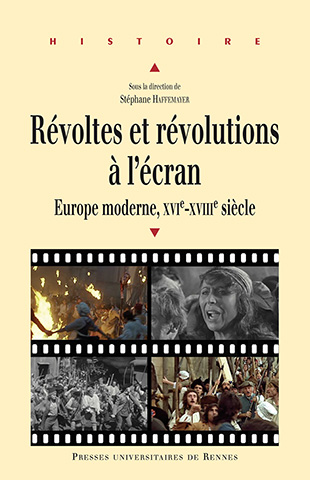
I am happy to announce that a new edited volume has been published on Révoltes et révolutions à l’écran. Europe moderne, XVIe-XVIIIe siècle (Rennes: Presses Universitaires de Rennes, 2015).

Revoltesalecran-cover

My chapter, entitled “Les révoltes nobiliaires et les histoires confessionnelles : représentations de la violence nobiliaire dans les films sur les guerres de Religion,” is included in the volume.

Here is the blurb for the book:

“Une douzaine d’historiens français, anglais, irlandais et américains proposent dans cet ouvrage une analyse érudite de représentations filmiques de révoltes et révolutions européennes des XVIe et XVIIIe siècles. Sont ici abordés à travers une filmographie sélective les guerres de religion dans la France du XVIe siècle, les révolutions anglaises de 1640 et 1689, la révolte napolitaine de 1647, la Fronde (1648-1653), les Camisards (Cévennes, 1702), une révolte antisémite dans le duché de Württemberg en 1733 et les prémisses de la Révolution en 1788.”

This collective volume is the outgrowth of a conference held in Caen in 2012.

For a full description, see the website of the Presses Universitaires de Rennes.

Posted in Current Research, Early Modern Europe, Early Modern World, French History, French Revolution and Napoleon, French Wars of Religion, Historical Film, History in the Media, History of Violence, Political Culture, Revolts and Revolutions, War in Film, War, Culture, and Society, Warfare in the Early Modern World | Leave a comment

Digital Humanities and ConverStations

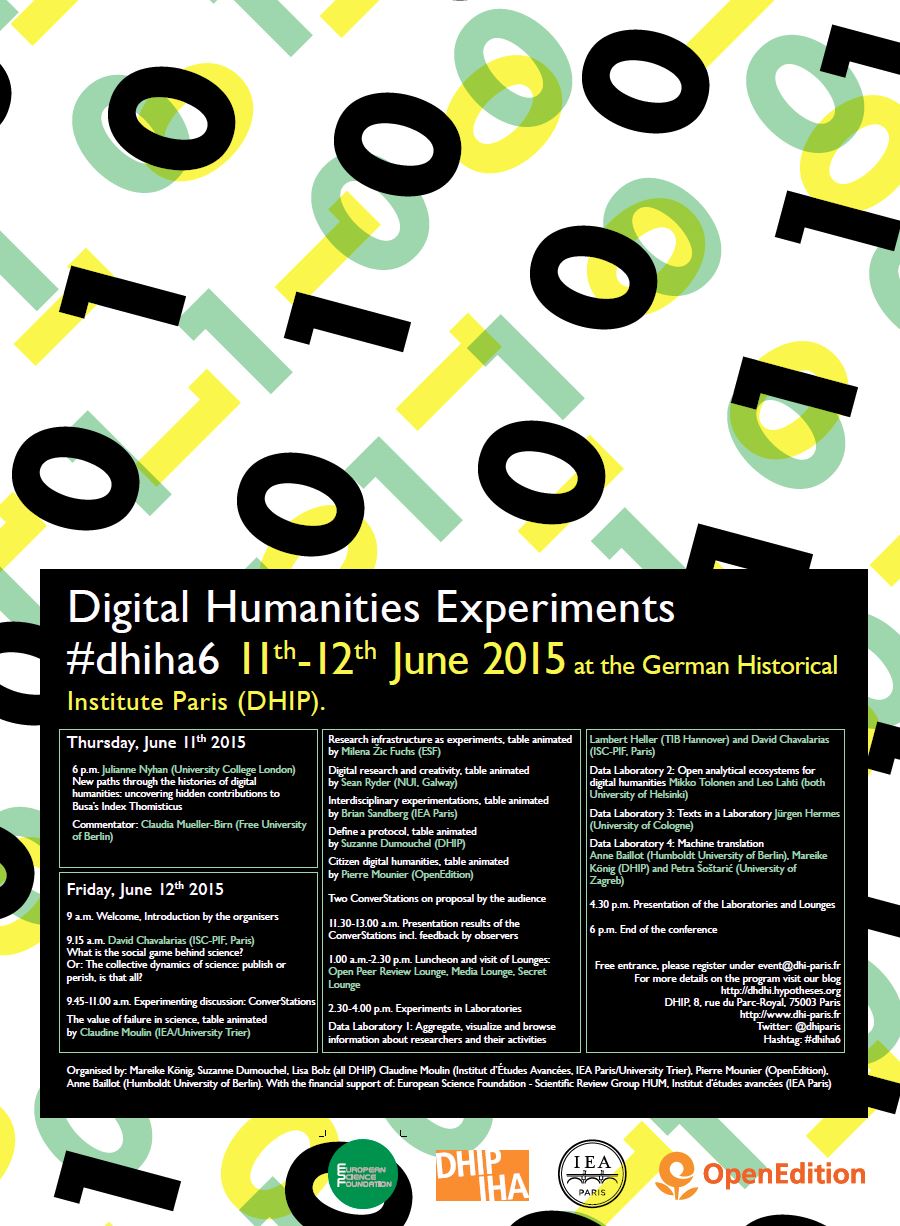
A conference on Digital Humanities Experiments was recently  held in Paris on 11-12 June 2015 at the Deutsches Historisches Institut Paris (DHIP), or Instistut Historique Allemand. The conference was jointly sponsored by the European Science Foundation – Scientific Review Group HUM, the DHIP, and the Institut d’études avancées (IEA) de Paris.

The conference was organized by Mareike König, Suzanne Dumouchel, Lisa Bolz (all DHIP), Claudine Moulin (IEA/University Trier), Pierre Mounier (OpenEdition), and Anne Baillot (Humboldt University of Berlin).
dhiha6_plakat

The conference featured an intriguing mixture of presentation and discussion formats, including a keynote lecture, digital lounges, and discussion groups. I participated in the ConverStations section of the program, in which participants moved through a series of round table discussions on specific themes in Digital Humanities. I thoroughly enjoyed leading a ConverStation round table on “Interdisciplinary Experimentations,” in which participants discussed how to create interdisciplinary research and collaboration in the Digital Humanities.

I felt that the ConverStations were very effective at producing new conversations and ideas among diverse participants from the humanities, social sciences, and computer sciences. Each group’s brainstorming discussions produced distinct ideas and proposals on the possibilities for interdisciplinary collaboration, as well as roadblocks preventing or disrupting interdisciplinarity.

According to the conference website : “This conference addresses the gap between the research culture with which Digital Humanists are equipped via their disciplinary backgrounds and the research culture they foster in this field. Why does experimentation play a crucial role in Digital Humanities? How does it contribute to define the relationship between method and research questions? Can we identify barriers which currently prevent Digital Humanities from developing their full potential, leaving little room for iteration, comparison or failure? The conference itself is conceived as an experimental set-up with labs, data experiments and round tables.”

Masters students and doctoral candidates from universities in France, Germany, and across Europe participated in this DH conference.

For more information on the conference, see the DHIP website. For the conference Twitter feed, see: #dhiha6

Posted in Conferences, Digital Humanities, Graduate Work in History, History in the Media, Humanities Education, Information Management | Leave a comment

French Diplomacy in a Digital Age

French diplomacy is often portrayed as formal, rigid, and arrogant. Yet, the current French ambassador to the United States, Gérard Araud, has shaken up the staid diplomatic world with his openness and his use of social media.

Maureen Dowd recently wrote a column for the New York Times on Gérard Araud and his Twitter diplomacy.

Communication strategies have always been crucial to diplomatic activity, and French diplomats have been constructing theories of diplomatic methods since the sixteenth century.

Researchers and students of French history, political culture, and early modern diplomacy will find Araud’s methods interesting.

Dowd’s column is available at the New York Times.

Posted in Early Modern Europe, Early Modern World, European History, French History, Political Culture, Strategy and International Politics | Leave a comment