Nina Dubin Lecture

The Newberry Center for Renaissance Studies presents:

Saturday, April 19, 2014, 2:00 pm
Eighteenth-Century Seminar
Nina Dubin, University of Illinois at Chicago
“Love, Trust, Risk: Painting ‘The Papered Century'”
http://www.newberry.org/04192014-nina-dubin

The precirculated paper for this seminar will be delivered electronically to registrants.

A reception will follow the lecture. Those who attend are also welcome to join Nina Dubin and the organizers for dinner. If interested, please contact Lisa Freeman by email: lfreeman@uic.edu

This program is free and open to the public, but space is limited and registration in advance is required by 10 am Friday, April 18.

Please forward this message to others who may be interested. Download a printable PDF flyer to post and distribute.

Keep up with the Center for Renaissance Studies by following our blog: http://www.newberry.org/center-renaissance-studies-blog

Faculty and graduate students at member institutions of the Center for Renaissance Studies consortium (including Northern Illinois University) may be eligible to apply for travel funding to attend this program (http://www.newberry.org/newberry-renaissance-consortium-grants).
Posted in Art History, Early Modern Europe, Early Modern World, European History, History of the Book, Lectures and Seminars | Leave a comment

Rethinking State Trials

Symposium on Rethinking the State Trials: The Politics of Justice in Later Stuart England
Organized by Brian Cowan (McGill University) and Scott Sowerby (Northwestern University) and sponsored by the Newberry Center for Renaissance Studies

newberrylibrary

Thursday, April 10 (at Northwestern University)
Friday, April 11 (at the Newberry)

This program is free and open to the public, but space is limited and registration in advance is required by 10 am Thursday, April 10.

Papers will be precirculated electronically to registrants.

Faculty and graduate students at member institutions of the Center for Renaissance Studies consortium (including Northern Illinois University) may be eligible to apply for travel funding to attend this program (http://www.newberry.org/newberry-renaissance-consortium-grants).

For more information, see the symposium website:
http://www.newberry.org/04102014-symposium-rethinking-state-trials-politics-justice-later-stuart-england

Posted in Civil Conflict, Conferences, Early Modern Europe, Early Modern World, European History, European Wars of Religion, History of Violence, Human Rights, Noble Culture and History of Elites, State Development Theory | 1 Comment

Cosimo I de’ Medici in Chicago

Early Modern Workshop

Christine Zappella, PhD Student in Art History, will present a paper on “Bronzino’s Portrait of Cosimo I de’ Medici as Orpheus: Erotic Furor and Florence’s Perfect Prince” in the The Early Modern Workshop at the University of Chicago.

Monday April 14th at 5pm.

Pick 319

University of Chicago

Graduate students interested in Renaissance history and art history may be interested in this workshop.


Posted in Art History, Early Modern Europe, Early Modern World, European History, Italian History, Lectures and Seminars, Mediterranean World | Leave a comment

Problems with Big Data

Big Data is touted as revolutionary by many media pundits and computer enthusiasts, but there are serious limitations to the uses of so-called Big Data.

BigData

An op-ed in the New York Times discusses the many problems with Big Data. The authors of this piece ask “Is big data really all it’s cracked up to be?”

Their answer is that: “There is no doubt that big data is a valuable tool that has already had a critical impact in certain areas. … But precisely because of its newfound popularity and growing use, we need to be levelheaded about what big data can — and can’t — do.”

The New York Times published the op-ed online. I discussed the problems with ‘big data’ in a previous post on “Big Data is Bullshit.”

Posted in Digital Humanities, History in the Media, History of Science | Leave a comment

Early Modern Domestic Space

A lecture on “Illuminating Early Modern Domestic Spaces”

by

Professor Ann Smart Martin

Stanley and Polly Stone Professor

Director, Material Culture Program and Department of Art History

University of Wisconsin, Madison

Wednesday, April 9, 2014 at 5:30 PM

DePaul Art Museum

935 W. Fullerton Ave.

Chicago, Illinois

(just west of the Red Line stop at Fullerton)

Professor Martin specializes in American material culture and early American decorative arts.  Her publications include Buying into the World of Goods: Early Consumers in Backcountry Virginia (Baltimore: Johns Hopkins University Press, 2008) and American Material Culture: The Shape of the Field (Knoxville: University of Tennessee Press, 1997), co-edited with J. Ritchie Garrison.

For more information, please contact Prof. Paul Jaskot at pjaskot@depaul.edu

Posted in Art History, Early Modern Europe, Early Modern World, Lectures and Seminars, Renaissance Art and History | Leave a comment

Wreckage, Waste, and Globalization

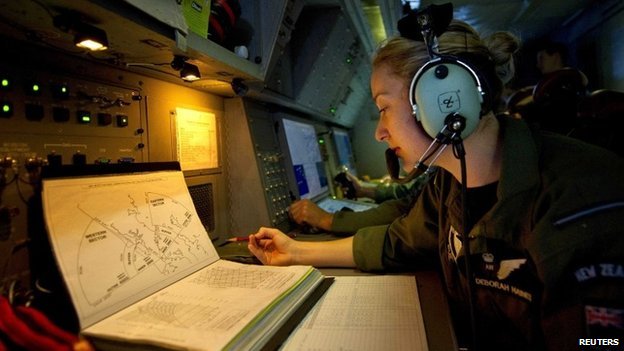
The continuing search for Malaysian Airlines flight MH370 is complicated by the immense size of the search area and its distance from sea lanes and major ports, as well as the nature of the Indian Ocean.

IndianOcean-waste

The currents and turbulence of the Indian Ocean presents challenges in sighting and tracking potential aircraft wreckage. Satellite photos showing possible pieces of an airplane could be instead showing flotsam from previous wrecks and storms, or simply waste produced by globalization and circulated through transoceanic currents.

SearchVectors

According to the BBC, “the satellite photos [of potential objects] cover a zone where the Indian Ocean meets the Southern Ocean, encircling Antarctica. There is a risk … that waste in this area could have come from any of the world’s major oceans – all of which border Antarctica. In that case, the flecks in the pictures may just be the floating detritus of globalisation, such as some of the thousands of shipping containers thought to be lost at sea every year.”


The frustrating search for the missing Malaysian Airlines aircraft highlights the growing problems of the globalization of waste and marine debris. Plastic pollution is perhaps the best known type of marine debris, due to scientific research and frequent media reports on the “Great Pacific Garbage Patch.”

NOAA-marinedebris

Environmental historians, maritime historians, marine archaeologists, and historians of globalization have been working on tracing the historical development of pollution, wreckage, and waste in the world’s seas and oceans over the past several centuries.

The BBC reports on the continuing search. See NOAA’s website on the “Great Pacific Garbage Patch,” and its project on Marine Debris.


Posted in Globalization, Information Management, Maritime History, Mediterranean World | Leave a comment

When Robots Can Kill

Robotic technology is advancing rapidly, raising questions about decision-making processes in shooting to kill.

TalonMAARS

Although robotics have many applications, much of the research on robots is funded by military services and defense contractors. This raises serious ethical questions for university researchers working on robotics projects, especially as tracking and firing systems become automatic.

Peter Singer (Brookings Institute) argues: “Too often scientists try and kid themselves. … [They] act like just because I work on this system that is not directly a weapon system I have nothing to do with war.” Singer is the author of Wired for War: The Robotics Revolution and Conflict in the 21st Century (Penguin, 2009).

The robotics technologies are new, but many of the ethical questions of distance, target identification, and decision-making in the act of killing have long histories. For one perspective on such questions, see Paul Virilio, War and Cinema: The Logistics of Perception (London: Verso, 1989).

NPR reports on military robots and robotics competitions.

Posted in Arms Control, History of Science, History of Violence, Laws of War, War, Culture, and Society | Leave a comment

Museum Summer Internships

The Missouri History Museum is accepting applications from students who are interested in oral history internships (paid positions) with our Exhibitions and Research department. Two interns will be selected and will report to the Director of Exhibitions and Research.

The Missouri History Museum is developing a new space devoted to first-hand accounts of our area’s history. A major feature of The Story Center, which will open in 2016, is a theater that will be used to play films created from excerpts of longer oral histories. During the first year, a series of films will be created called “Show Me Stories.” These films will feature stories from a wide range of fascinating people. To help create these films, we need two interns capable of both conducting long-form interviews and editing those interviews into shorter presentations that will be engaging for a wide audience. These interns will help identify potential interviewees, will conduct interviews along with a videographer, and will work with the videographer and other staff to edit excerpts of the interviews into completed films. Each intern will conduct at least six oral histories over the course of the summer and will create at least two films based on these interviews.

The work schedule is flexible, with hours typically between 9:00 a.m. and 5:00 p.m., Monday through Friday. A minimum of 25 hours of work per week is required. This internship will run from May to August 2014, and the final schedule will be determined with the supervisor.

Undergraduate and graduate student will be considered.  The ideal candidate will major in American Studies, History, Communication, Journalism, or other related fields. Candidates for the position should have both interviewing and editing experience

The Missouri History Museum is a nonprofit organization dedicated to deepening the understanding of past choices, present circumstances and future possibilities; strengthening the bond of community and facilitating solutions to common problems.

To apply, the applicant must provide a cover letter, and the completed intern application found at http://www.mohistory.org/employment. Please submit these documents by email, as well as writing samples of your work, and references to:

Vicki Kaffenberger, Director of Volunteer and Interns Services

vak@mohistory.org

For more information, see H-Net.


Posted in Jobs and Positions, Museums and Historical Memory, Undergraduate Work in History | Leave a comment

Undergraduate Research at NIU

The 5th annual Undergraduate Research and Artistry Day at Northern Illinois University will be held on Tuesday, April 22, 2014 in Holmes Student Center, Duke Ellington Ballroom from 9:00am-3:30pm.

Any undergraduate student who has participated in a faculty-mentored research or artistry project is eligible to showcase his/her work at the fifth annual Undergraduate Research and Artistry Day.  This includes independent study, capstone projects, URAP, EURA, UARAP, USOAR, URA, SROP, Research Rookies or any other related research/artistry projects. Undergraduate students include currently enrolled NIU undergraduates and community college students planning to transfer to NIU.

Prizes will be awarded in two categories (STEM & SSHA).

In addition, one research advisor/mentor will be honored with the Faculty Mentor of the Year award.

Online registration opens Monday, January 13, 2014.  Abstracts (250 words or less) are due by Friday, March 7, 2014.

Two poster design workshops will be held to assist students with designing their posters for the day. These will be held on Tuesday, March 4th from 1:00 – 2:00 p.m., and Wednesday, March 26th from 10:00 – 11:00 a.m. in the Holmes Student Center, room 305.

NIU majors and minors in History have usually done multiple research papers based on archival, printed, and/or historiographical sources. History students should consider submitting a paper for consideration in the Undergraduate Research and Artistry Day competition.

Posted in Archival Research, Lectures and Seminars, Northern Illinois University, Undergraduate Work in History | Leave a comment

Rising Cost of Not Attending College

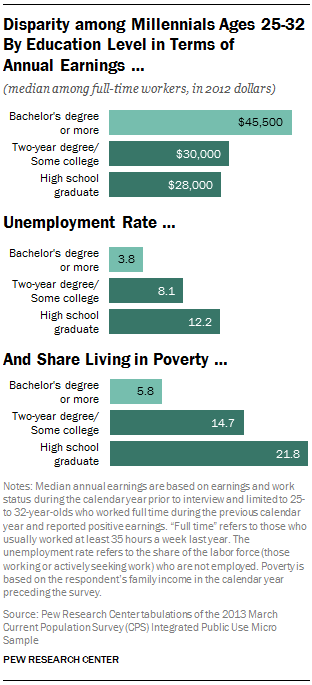
A new research survey by the Pew Research Center demonstrates the rising costs of not attending college. “On virtually every measure of economic well-being and career attainment—from personal earnings to job satisfaction to the share employed full time—young college graduates are outperforming their peers with less education.”

Pew-RisingCost

This may sound surprising to Americans who regularly follow news media in the United States. Popular news organizations, spurred by conservative politicians and right-wing radio shows, have been repeatedly questioning the value of higher education. Numerous articles on the rising cost of college tuition have been published in print and online newspapers and magazines over the past year or so.

According to the Pew Research Center, “the economic analysis finds that Millennial college graduates ages 25 to 32 who are working full time earn more annually—about $17,500 more—than employed young adults holding only a high school diploma.”

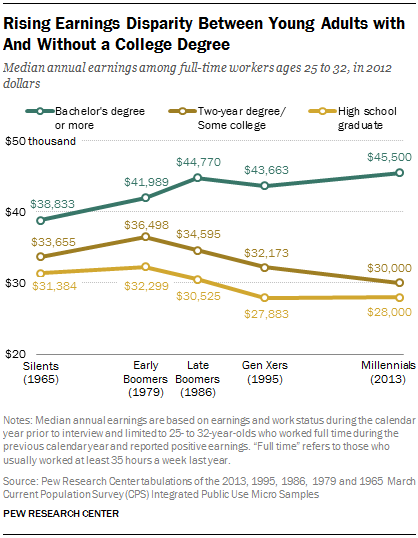
The Pew findings also indicate a growing gap between those with and without a college degree:

RisingEarnings

Also, note that despite the Obama Administration’s continual championing of community colleges, that there is little difference in the salaries of high school and community college graduates.

See the Pew Research Center website for additional findings from this survey.

Posted in Careers in History, Education Policy, Humanities Education, Undergraduate Work in History | Leave a comment