The French Question

The “French Question” has become central to European economic development and  European Union (EU) politics. Labor unrest, racial tensions, and high unemployment have created a delicate political and economic situation in France.

Paris-GoodyearStrike

According to the New York Times, “The French are justifiably proud of their social model. Health care and pensions are good, many French retire at 60 or younger, five or six weeks of vacation every summer is the norm, and workers with full-time jobs have a 35-hour week and significant protections against layoffs and firings.”

The French system clearly has great strengths that have produced a high quality of life for French citizens over the past 50 years. “But in a more competitive world economy,” the New York Times points out, “the question is not whether the French social model is a good one, but whether the French can continue to afford it. Based on current trends, the answer is clearly no, not without significant structural changes — in pensions, in taxes, in social benefits, in work rules and in expectations.”

Economists and political analysts have been advocating major reforms to the French social system for years. According to the New York Times, “there is a broad consensus that real social and structural renovation can be carried out only by the left. But that can happen only if Mr. Hollande, who has a legislative majority, is willing to confront his own party in the name of the future, as the former German chancellor Gerhard Schröder did a decade ago with a series of legal modifications that now get much of the credit for Germany’s revival.”

Any comprehensive reform would be difficult, as it would be require scaling back or stripping popular economic and social benefits from government workers, unionized workers, and French citizens in general. It is not at all clear that the German or American social systems can provide a model for French reforms, nor is it clear that French President Hollande can provide the leadership for comprehensive reform.

The New York Times reports on the “French Question.”

Posted in European History, European Union, French History, Globalization, Human Rights | Leave a comment

History of the Muslim Brotherhood in Egypt

briansandberg's avatarCluster for the Study of Religious Violence

The Muslim Brotherhood has been an important religious and political organization in Egypt for decades and is one of the major participants in the ongoing Egyptian Revolution.

NPR provides a brief history of this important Islamic organization, which was founded in 1928. The article points out that “The Muslim Brotherhood, which has a presence in dozens of Muslim countries, has been banned, repressed or restricted for much of its more than eight-decade history in Egypt, the place where it was born.” So, although current reporting has focused on violence by members of the Muslim Brotherhood against Coptic churches in Egypt, the Muslim Brotherhood has been targeted for violence by Egyptian military and police forces throughout much of its existence. The photo below shows the Muslim Brotherhood headquarters being burned in 1954.

MuslimBrotherhoodHQ-1954

The NPR article quotes Vidino Lorenzo, the author of The New Muslim Brotherhood in the West, on the development…

View original post 101 more words

Posted in Civil Conflict, Civilians and Refugees in War, History of Violence, Mediterranean World, Religious Politics, Religious Violence, Terrorism, War, Culture, and Society | Leave a comment

Supporting the Arts and Humanities

The National Endowment for the Arts (NEA) and the National Endowment for the Humanities (NEH) are currently leaderless.  Although they have acting directors and staffs, both endowments desperately need active leadership—especially in a time of budget cuts.

The New York Times reports that “The House Appropriations Committee has proposed cutting each budget by half. Present financing levels are about $155 million each, a mite in the federal government’s overall $3.5 trillion budget. Even at these modest levels, the endowments are essential to art and enlightenment all across the country, and they help local economies in the bargain.”

The budgets of the NEA and NEH have already been cut significantly in recent years.  A 50% cut in their budgets would be simply disastrous for research, teaching, exhibitions, and performances in the arts and humanities.

Many communities’ arts and humanities programs (museum programs, art exhibitions, dance performances, public sculptures, public history, digital humanities projects, public lectures, scholarly conferences, historical preservation projects, student programs, teaching development programs, community college programs, etc.) would be directly affected by the lack of grants and matching funds for local initiatives that are often supported by the NEA and NEH.

In Illinois, the Illinois Humanities Council (IHC) is supported by the NEH, as well as donations and gifts by public and private organizations. The IHC, in turn, has made grants to organizations such as the Jane Addams Hull-House Museum, African American Cultural Center of UIC, Springfield Art Association, Bishop Hill Heritage Association, Chicago Metro History Education Center, Instituto Cervantes of Chicago, Illinois Institute For Community Law, Chicago Filmmakers, and New Philadelphia Association. The NEH also directly supports other organizations within Illinois.

The NEH provides a fact sheet on its support of the humanities within each state.  The NEH’s Illinois fact sheet is available. Find your own state’s NEH fact sheet here.

An editorial at the New York Times comments on the current situation of the NEA and NEH.

Posted in Digital Humanities, Education Policy, Humanities Education, Museums and Historical Memory | Leave a comment

A New Production of Mother Courage

briansandberg's avatarCluster for the Study of Religious Violence

Shakespeare and Company is producing a new version of Bertolt Brecht’s Mother Courage, a play about everyday life and death in Germany during the Thirty Years’ War (1618-1648).

Bruce Chadwick provides a synopsis of the 1939 play in his review of this production: “Mother Courage is about a small tine war profiteer, Ann Fierling, who, with her three grown children, two men and a mute woman, follows the Swedish army and trudge across enemy lines pulling their canteen wagon to sell food, drink and supplies to soldiers. They are sucked into the middle of the war and quickly discover that everybody likes them – and everybody hates them. It is the story of Anna’s need to make money in a war that leaves her practically bankrupt and threatens the lives of her children. Yet she keeps at it.”

MotherCourage

According to Chadwick, “Director Tony Simotes has staged a dramatic play…

View original post 114 more words

Posted in Uncategorized | Leave a comment

Increasing Sectarian Attacks in Iraq

briansandberg's avatarCluster for the Study of Religious Violence

Sectarian violence between Sunni and Shia militant groups is increasing once again in Iraq.

According to the New York Times, “Across the country, the sectarianism that almost tore Iraq apart after the American-led invasion in 2003 is surging back. The carnage has grown so bloody, with the highest death toll in five years, that truck drivers insist on working in pairs — one Sunni, one Shiite — because they fear being attacked for their sect. Iraqis are numb to the years of violence, yet always calculating the odds as they move through the routine of the day, commuting to work, shopping for food, wondering if death is around the corner.”

SadrCitycarbombattack

In the capital of Baghdad, “The drastic surge in violence — mainly car bombs planted by Al Qaeda’s Iraq affiliate against the Shiite majority, and the security sweeps in majority-Sunni neighborhoods that follow — has lent a new sense…

View original post 73 more words

Posted in Uncategorized | Leave a comment

Area 51 Acknowledged

Recently released Central Intelligence Agency (CIA) documents acknowledge the existence of the Area 51 military base, which has developed experimental aircraft since the 1950s.

The U2 spy plane was developed and tested at Area 51, but the base has since become the epicenter of UFO watchers and alien film plots.

Area51

Area 51, located in the Mojave Desert in Nevada, has long been known, but not officially recognized by its name.

The CIA documents were released as a result of a FOIA request related to a CIA-authored history of the U2 program. According to the Washington Post, “The CIA internally published its official history of the U-2 program in 1992. It was released in heavily redacted form thereafter, and National Security Archive fellow Jeffrey Richelson reviewed a copy in 2002. He filed a new Freedom of Information Act request in 2005 and the documents arrived about a month ago, this time with fewer redactions. Therein, the first-ever reference to Area 51.”

The Washington Post reports on Area 51.

Graduate students in History will be interested in this story, which shows the importance of public history work.

Posted in Graduate Work in History, History of Violence, War in Film, War, Culture, and Society | Leave a comment

Cost of a College Education

As the Fall 2013 semester fast approaches, Illinois students and their parents are expressing concerns about the cost of a college education. Yet, news reports on the costs of higher education are often filled with erroneous data and exaggerated figures that conflate the costs of living with the costs of education.

Despite much of the media hype about the high cost of higher education, many public universities continue to offer affordable undergraduate education. My own university, Northern Illinois University (NIU), offers in-state undergraduate tuition and fees at the very reasonable rate of approximately $11,500 per year for 2013-2014. This rate is based on a full courseload of 12 hours per semester. To gauge tuition costs at NIU, see the tuition estimator at NIU’s website.

Many students and their parents have been confused by reports that Pell Grants no longer exist, based on politicians’ threats to cut the grants. The US Department of Education website still lists Pell Grants as functioning.  The amounts of the grants were cut last year, but my understanding is that the amount of the grants has varied over the years with changes in the economy and Congressional composition.

There have certainly been highly publicized fears about the costs of the Pell Grants program. Inside Higher Ed published a story about the situation as of early this year: http://www.insidehighered.com/news/2013/02/07/cbo-estimates-pell-shortfall-gone-2014

Just as important for many Illinois students are the Monetary Award Program (MAP) Grants given by the State of Illinois.  The most recent data reported in NIU Today indicates: “More than 6,100 NIU students received grants through the Monetary Award Program in the fall of 2011. Limited state funding and a high application volume reduced the 2011-2012 maximum award by 5 percent from $4,968 to $4,720.” This means that more than one third of NIU undergraduate students are receiving MAP Grants.

The Illinois Congress made further cutbacks to the program in the past two years, and threatened to suspend payments of existing MAP Grants.  Some university administrators believe that this ill-conceived move led to lower enrollments at NIU and other public universities in Illinois.

NIU also has approximately 500 veterans enrolled every year, using their GI Bill to fund their education.  So, this is another important group to consider in calculating the costs of higher education.

One of the most disturbing aspects of higher education funding is that for-profit universities are getting massive public funding through Pell Grants and the GI Bill. An New York Times article on the Harkin Report from 2012 indicates that “The amount of available federal student aid is large and growing. The Apollo Group, which operates the University of Phoenix, the largest for-profit college, got $1.2 billion in Pell grants in 2010-11, up from $24 million a decade earlier. Apollo got $210 million more in benefits under the Post-9/11 G.I. Bill. And yet two-thirds of Apollo’s associate-degree students leave before earning their degree.”

Undergraduate students often express worries about the status of their grants and the burdens of student loans.  Taking advantage of public university programs and in-state tuition rates can drastically cut the cost of higher education for many undergraduate students.

Current and future students and their parents should examine the costs of higher education carefully in weighing their options.

Posted in Education Policy, Humanities Education, Undergraduate Work in History | Leave a comment

Defending the Humanities and the Idea of America

Carol Geary Schneider (President of the Association of American Colleges and Universities) and David Townsend (Senior Advisor for Seminars of the Aspen Institute, and Director of Wye Seminars on Citizenship in the American and Global Polity) have proposed a new patriotic rationale for an educational model centered on the humanities.

They argue that “America arose on a foundation of ideas, dialogue, values, and aspirations that still stand today at the heart of a strong liberal — and liberating — education. America is an idea, not just a land or an institution.”

Their essay focuses on the archetypical “founders” of the United States of America: Thomas Jefferson, John Adams, and Benjamin Franklin, but could have offered a broader range of historical contributors to the “idea” of America. A new patriotic rationale for the humanities is useful, however, it will need to embrace a much more inclusive and multicultural vision of America in order to succeed as one of several rationales for the humanities in public life.

Nonetheless, Schneider and Townsend persuasively argue for the importance of the history and the humanities in today’s world, stating that “through the study of history we come to understand the roots, contexts, and complexities of issues we face as citizens.”

Schneider and Townsend, citing cuts to the arts and humanities by United States politicians, warn that “leaders who undervalue ideas, arts, and humanities open the door to plutocrats, despots, factions, violence and chaos — all of the ancient enemies of prosperity, freedom, and democracy.”

Schneider and Townsend’s essay is published in Inside Higher Ed.

Posted in Academic Freedom, Education Policy, Humanities Education | Leave a comment

H.G. Wells and the History of Wargames

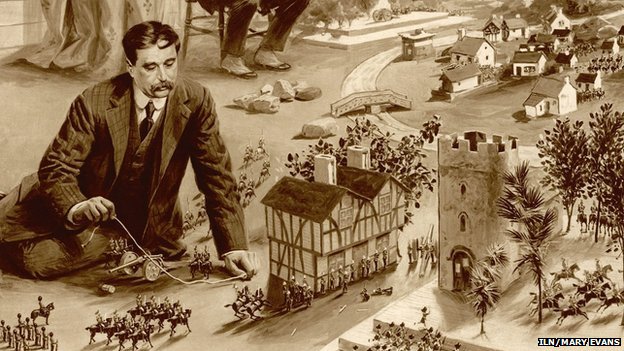
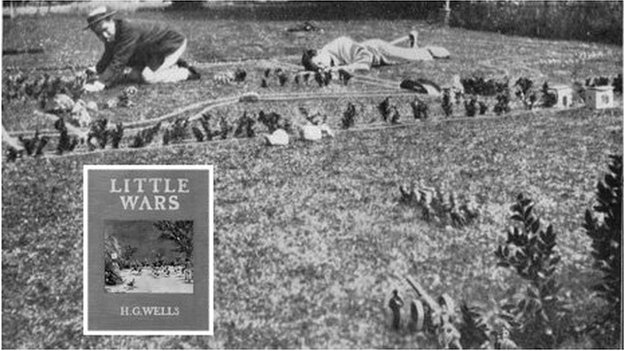
This year marks the 100th anniversary of the publication of H.G. Wells’s Little Wars, which created modern wargaming. Long before shooter and strategic video games, model lead soldiers were used to simulate battles in miniature wargames.

In 1913, just before the First World War, H.G. Wells published Little Wars, the first widely available miniature wargame rules, intended for a popular audience.

LittleWars

BBC News reports that “for Wells, the horror of WWI and what he called the ‘almost inconceivable silliness’ of the top brass had a great effect on him.

H.G. Wells related that “Up to 1914 I found a lively interest in playing a war game, with toy soldiers and guns… and I have given its primary rules in a small book. … I like to think I grew up out of that stage [somewhere] between 1916 and 1920 and began to think about war as a responsible adult should,” according to the BBC.

Little Wars continues to be played by a few enthusiasts, but the rules also spawned many imitators, creating an entire hobby of miniature wargaming—not only in Great Britian, but around the world.

Wells-LittleWars-photo

Rules and miniatures have been created for almost every major historical period, allowing wargamers to simulate the battles of the Egyptian-Hittite Wars, the Roman Civil Wars, the Mongol expansion, the Hundred Years’ War, the Sengoku Wars, the Thirty Years’ War, the British Civil Wars, the American Revolution, the Zulu War, the First World War, and Second World War, and beyond.

Miniature wargaming continues to be a popular hobby among some groups, but occupies a niche in comparison with the mass appeal of video wargames.

As H.G. Wells pointed out, there are moral dilemmas in participating in wargaming, especially if used to celebrate violence or to rehearse for war. However, historical simulations do have the potential to teach participants about the horrors of war, and some history teachers use them effectively as learning tools with their students, especially at the undergraduate level.

Wargames also shape popular perceptions of past conflicts, contributing to the construction of historical memory.

BBC News reports on the legacy of H.G. Wells’s Little Wars.

Posted in History in the Media, History of Violence, Museums and Historical Memory, The Past Alive: Teaching History, Undergraduate Work in History, War, Culture, and Society | Leave a comment

Debate on Dissertation Embargos

Debate continues on dissertation ’embargos’ following the recent statement by the American Historical Association (AHA). A previous post on this website discussed the AHA statement and criticisms of its policy recommendations.

DissertationEmbargos

The Chronicle of Higher Education explores the issue through the eyes of a recent Ph.D. in History who has had trouble publishing her dissertation and wishes that she could have embargoed it.

Former AHA President William Cronon has written a post on AHA Today in defense of the AHA statement advocating policies on dissertation embargos. The AHA Today also has a Q&A page on this controversy.

Posted in Academic Freedom, Academic Publishing, Digital Humanities, Education Policy, Graduate Work in History, Humanities Education, Information Management | Leave a comment