Challenging Trump’s Use of Unitary Executive Theory

“In his opening weeks back in office, President Trump is asserting power in a way that pushes hard on, and sometimes past, the boundaries of executive authority,” according to Cass R. Sunstein, Professor of Law (Harvard University).

“One of the most important of those boundaries involves his relationship with independent regulatory agencies. Mr. Trump is the first president since the 1930s to assert control over many of them, and this assertion of power will almost certainly be tested in the Supreme Court.”

Cass R. Sunstein explains the historical development of constitutional law on executive authority and unitary executive theory.

“Mr. Trump is operating under the theory that the executive branch is unitary, in the sense that Article II of the Constitution places executive power in a single person, the president, who gets to control every high-level official who executes federal law (and plenty of lower-level ones, too).”

Sunstein argues that “The president is not a king. In its most extreme version, the unitary executive theory is a form of invented history, a modern creation that threatens to change, and in important ways to undermine, the operations of the national government.”

Sunstein traces the key Supreme Court cases and legal precedents related to executive authority.

He asserts that “the best historical research throws the whole idea of a unitary executive into serious doubt. In the Federalist Papers, Alexander Hamilton, who rejected a plural executive, also insisted that the president lacks unlimited removal power.”

So, Alexander Hamilton and other architects of the U.S. Constitution (1789) refused to embrace the notion of a unitary executive. The presidential power of appointment does not extend to a power to remove federal government officials at a whim.

“And defenders of the unitary executive appear to have misunderstood the Decision of 1789. The most careful evidence suggests that, at the time, a majority of members of Congress did not embrace but actually rejected the view that Congress lacks power to protect subordinate officials in the executive branch from presidential control. Indeed, independent agencies are hardly a creation of the New Deal — they have been with us since the founding era.”

The First Federal Congress of the United States passed legislation creating the Departments of War, State, and Treasury during 1789. The U.S. Senate confirmed the President George Washington’s nominees to head those departments the same year, establishing the precedents for presidential cabinet nominations.

Sunstein concludes that “there are decent arguments in favor of reforms that would increase presidential control over the administrative state. But the broadest current claims about executive authority are a creation of the 21st century, not the 18th. They are a form of hubris. They strike at the heart of our founding document.”

Sunstein, Cass R. “This Theory Is Behind Trump’s Power Grab.” The New York Times (26 February 2025).

Several of the legal and political science studies of unitary executive theory are:

Barilleaux, Ryan J. and Christopher S. Kelley, eds. The Unitary Executive and the Modern Presidency. College Station, TX: Texas A&M University Press, 2010.

Birk, Daniel D. “Interrogating the Historical Basis for a Unitary Executive.” Stanford Law Review 73 (January 2021): 175-236.

Crouch, Jeffrey, Mark J. Rozell and Mitchel A. Sollenberger. The Unitary Executive Theory A Danger to Constitutional Government. Lawrence, KS: Kansas University Press, 2020.

I have not had a chance to read these books and articles and cannot vouch for them.

Posted in Civil Rights Issues, Democracy, Human Rights, Legal history, Political History of the United States, Political Theory, Republicanism, State Development Theory, United States History and Society | Tagged , , , , , , , , , , , , , | Leave a comment

Legal Opinion on Department of Education Letter

Sonja B. Starr, Professor of Law (University of Chicago) offers a legal opinion on the incendiary “Dear Colleague” letter issued recently by an Acting Assistant Secretary at the Department of Education.

Starr assesses the “Dear Colleague” letter: “The Department of Education issued a threatening letter this month addressed to all educational institutions that receive federal funds. The letter offers an extreme and implausible interpretation of the law governing diversity, equity and inclusion policy. It demands that schools abandon not just affirmative-action-like programs that consider the race of individuals but also policies that are blind to individuals’ race if those policies were adopted, even in part, to promote racial diversity.”

“The letter also claims that federal law prohibits schools from teaching or promoting certain ideas about race that the department deems unacceptable,” Starr notes.

“The department gives schools until Feb. 28 to comply with this interpretation of the law or risk losing their federal funding, which would endanger the existence of many colleges and universities. This threat is a brazen attempt to bully schools into making policy changes that the law does not require,” according to Starr.

The Trump-appointed officials at the Department of Education are indeed attempting to bully colleges and universities into abandoning their critical higher education missions of providing an education based in scientific research and academic knowledge.

This is a clear assault on the principles of academic freedom, university autonomy, faculty governance, and faculty-driven curricula. Professors are researchers and teachers who are trained to have expertise in their disciplinary fields. Professors, not politicians, should determine what subjects are taught and how the curricula are composed within their disciplinary programs.

“The primary legal authority the letter cites is the Supreme Court’s 2023 decision in Students for Fair Admissions v. Harvard, which effectively ended affirmative action in university admissions. Some of the letter’s demands, such as getting rid of scholarship programs that consider an applicant’s race, are reasonable extensions of the court’s decision. But the letter goes beyond those demands, misreading the law in a way that further imperils racial diversity in schools.”

Starr argues that “The Department of Education’s letter also overreaches in its attempt to police schools’ communication of certain ideas about race. It cites ‘D.E.I. programs’ that teach, for example, ;that certain racial groups bear unique moral burdens that others do not.’ That passage of the letter is brief, and what exactly it prohibits is left vague. But the implication is that the department interprets Title VI of the Civil Rights Act of 1964 as restricting what schools can teach students.”

Sonja B. Starr provides advice to universities and colleges on how to respond to the “Dear Colleague” letter, stating emphatically that “schools should not cave to the Department of Education’s indefensible further demands, and the courts must curtail this blatant overreach.”

Starr, Sonja B. “The Department of Education Threatens to Pull the Plug on Colleges.” The New York Times (26 February 2025).

Posted in Academic Freedom, Civil Rights Issues, Higher Education, Human Rights, Humanities Education, Information Management, Political History of the United States, United States History and Society | Tagged , , , , , , , , , , | Leave a comment

Jeff Bezos Declares War on Democracy

I have cancelled my subscription to The Washington Post today.

The reason why? Jeff Bezos has declared war on democracy, free speech, and independent journalism.

Today’s actions by Jeff Bezos have destroyed The Washington Post as a credible news organization. I can no longer subscribe to what is now an oligarch’s personal ideological rag.

The Washington Post reports: “Washington Post owner Jeff Bezos said Wednesday that the newspaper’s opinions section would now be focused on ‘personal liberties and free markets’ and won’t publish anything that opposes those ideas. With the shift, opinions editor David Shipley has resigned, and The Post is searching for a successor.”

Bezos has dismantled the independence of the opinion office, making the opinion section and the entire news organization untrustworthy.

According to The Washington Post: “‘We are going to be writing every day in support and defense of two pillars: personal liberties and free markets,’ the billionaire Amazon founder wrote in an email to Post staffers that he also published on X. ‘We’ll cover other topics too of course, but viewpoints opposing those pillars will be left to be published by others.'”

The Washington Post Headquarters in Washington, D.C.

“In his memo, Bezos wrote that he offered Shipley a chance to continue in ‘this new chapter’ but that Shipley instead ‘decided to step away.'”

“Bezos said that The Post no longer needs to offer a ‘broad-based opinion section’ because of a diversity of opinions available online.”

This is an absurd statement meant to mask Jeff Bezos’s clear desire to control The Washington Post’s entire opinion section’s commentaries on politics and current events. It is a corporate takeover of opinion section to advance the opinions of a single oligarch, Jeff Bezos.

This represents a clear assault on independent journalism and democratic values. Opinion sections at real news organizations provide anyone with the ability to submit opinion columns and essays for evaluation for potential publication. Bezo’s actions violate democratic principles, destroy free speech, and threaten civil rights in the United States.

Many friends and colleagues have already cancelled their subscriptions immediately following Jeff Bezos’s acquisition of The Washington Post in 2013. Others cancelled in 2023, following Bezos’s changes in the news organization.

I had maintained my subscription until now, hoping to be able to support the vital reporting of Washington Post reporters and their investigative reporting on federal government issues.

As a Professor of History at Northern Illinois University, I rely on quality news reporting to relate historical events and patterns to the contemporary world. I sometimes use quality news articles and expert opinion pieces as sources on contemporary history and public history issues that relate to the themes of my classes.

I have often used news articles and opinion pieces from The Washington Post and other major news organizations as readings with my undergraduate and graduate students, especially when examining the echoes of previous historical periods in the contemporary world. My professional website and blog has a section on History in the Media that features many of these news publications.

I had hoped that the wall between the news office, opinion office, and the business office at the news organization could be maintained under Bezos’s ownership.

However, this is clearly not possible in the new age of Trumpian domination in Washington, D.C.

Farewell to The Washington Post. It has died a shameful death.

I will watch All the President’s Men (1976) as a funeral tribute.

On Bezos’s dismantling of The Washington Post, see:

“Post owner Bezos announces shift in opinions section; Shipley to leave.” The Washington Post (26 February 2025).

Mullin, Benjamin. “Bezos Orders Washington Post Opinion Section to Embrace ‘Personal Liberties and Free Markets.'” The New York Times (26 February 2025).

Mullin, Benjamin and Katie Robertson. “A Decade Ago, Jeff Bezos Bought a Newspaper. Now He’s Paying Attention to It Again.” The New York Times (2023).

Posted in Academic Freedom, Civil Rights Issues, Democracy, Human Rights, Humanities Education, Information Management, Political Culture, Political History of the United States, Political Parties and Organizations, United States History and Society | Tagged , , , , , , , , , , | Leave a comment

American Federation of Teachers Lawsuit vs. Dept. Ed.

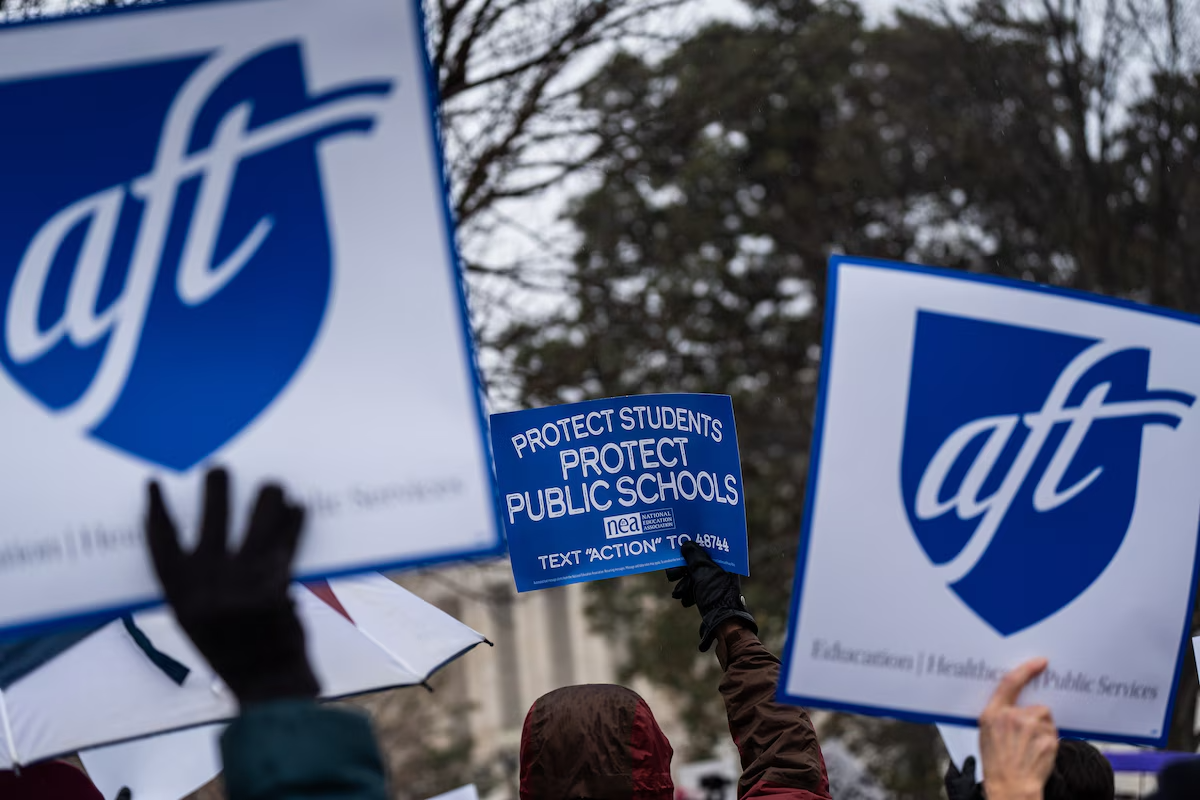
The American Federation of Teachers (AFT), Democracy Forward, and their allies have filed a lawsuit against the Department of Education and its Trump-appointed leaders.

“A lawsuit filed Tuesday accuses the Trump administration of trying to radically rewrite well-established civil rights law when it issued a sweeping directive barring colleges and K-12 schools from considering race in virtually any way,” according to The Washington Post.

This lawsuit is a direct response to the “Dear Colleague” letter issued by an Acting Assistant Secretary at the Department of Education who was appointed by President Trump.

The Washington Post reports that “the guidance from the Education Department’s Office for Civil Rights was sent as a “Dear Colleague” letter to school officials throughout the country Feb. 14. It threatened to deny federal funding to any school or college that considers race in hiring, discipline policy, scholarships, prizes or any other aspect of campus life. It gave schools a two-week deadline to comply, setting off confusion and panic on campuses nationwide.”

I have written a previous essay on “Subversion of Civil Rights by Trump’s Education Dept.” This essay assesses the “Dear Colleague” letter and provides links to additional reporting on it (see link below).

As a faculty member of Northern Illinois University, I am a proud member of the NIU United Faculty Alliance, the union representing tenure-track and tenured faculty at Northern Illinois University.

The NIU United Faculty Alliance is affiliated with the American Federation of Teachers and fully supports its lawsuit.

The NIU United Faculty Alliance provides this information on its affiliations:

“The Northern Illinois University United Faculty Alliance (NIU-UFA) is a chapter of the University Professionals of Illinois (UPI), Local 4100. The UPI represents seven of the 12 public universities in Illinois. As a UPI chapter, the NIU-UFA is also affiliated with the Illinois Federation of Teachers, the American Federation of Teachers, the Illinois AFL-CIO, and the AFL-CIO. The Illinois Federation of Teacher’s explains the relationship among affiliated unions and the benefits of these local, state, and national connections.”

More information regarding the NIU United Faculty Alliance is available at its website.

The AFT and Democracy Forward lawsuit is available at the Democracy Forward website.

Meckler, Laura. “Teachers union files lawsuit over Trump’s crackdown on race, DEI in schools.” The Washington Post (25 February 2025).

Sandberg, Brian. “Subversion of Civil Rights by Trump’s Education Dept.” Brian Sandberg: Historical Perspectives (21 February 2025).

Posted in Academic Freedom, Education Policy, High School History Teaching, Higher Education, Human Rights, Humanities Education, Legal history, Political Activism and Protest Culture, Political Culture, Political History of the United States, Public History, The Past Alive: Teaching History, United States History and Society | Tagged , , , , , , , , , , , , , , , , | Leave a comment

Cold War Still Shapes Elections in Germany

The Cold War continues to shape current German society and its voting patterns over 30 years after the Fall of the Berlin Wall in 1989 and the beginning of German Reunification.

This past weekend’s German Elections demonstrate that the frontiers of the Iron Curtain continue to bifurcate Germans into sharply separate spheres and voting blocs, despite decades of efforts at German Reunification and reintegration.

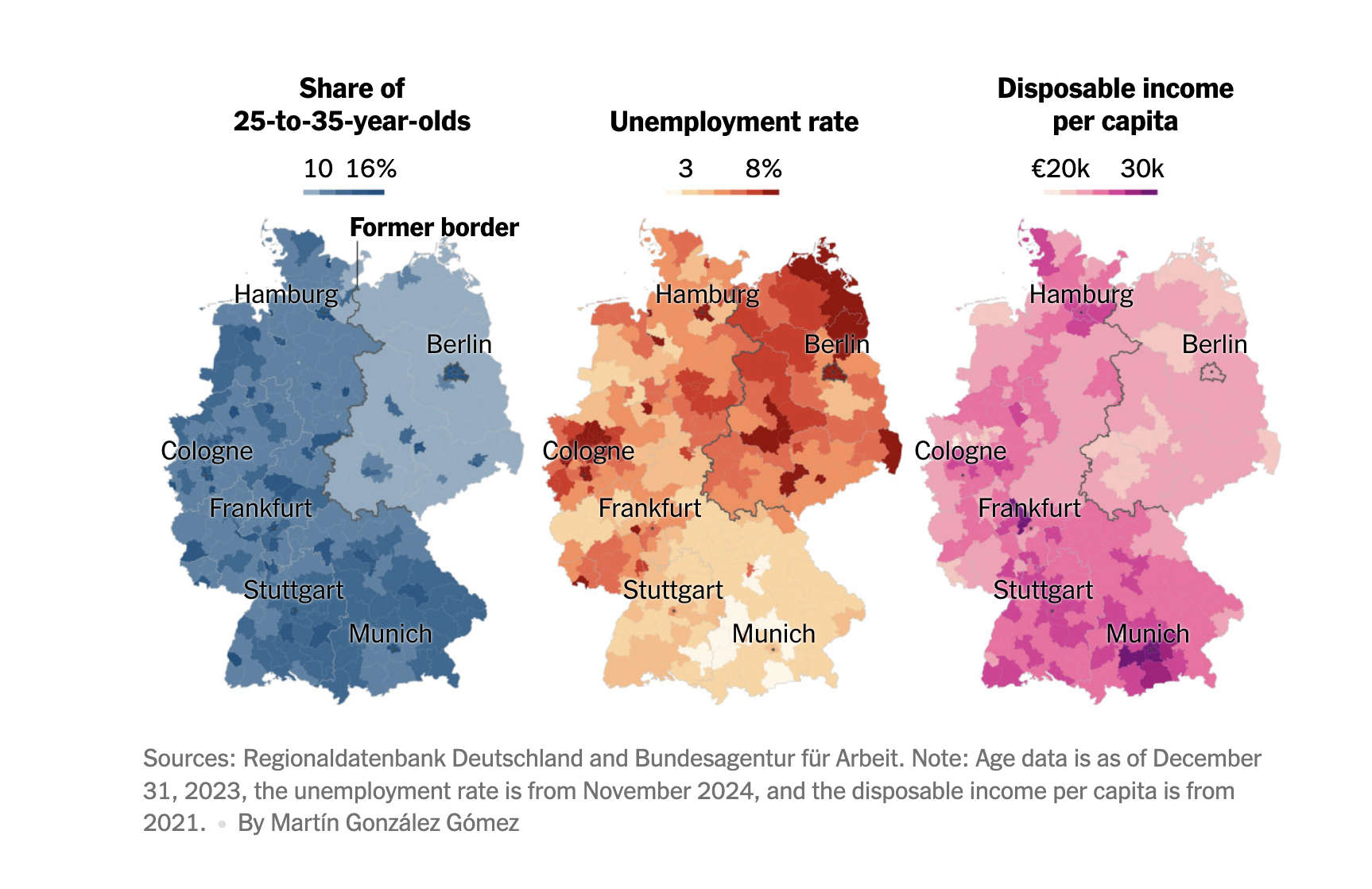
The New York Times reports that “Three and a half decades after reunification, a line runs through Germany where the Iron Curtain once stood. Instead of barbed wires and dogs, that line now divides Germans by measures like income and unemployment — and increasingly by the willingness to vote for extremist parties.”

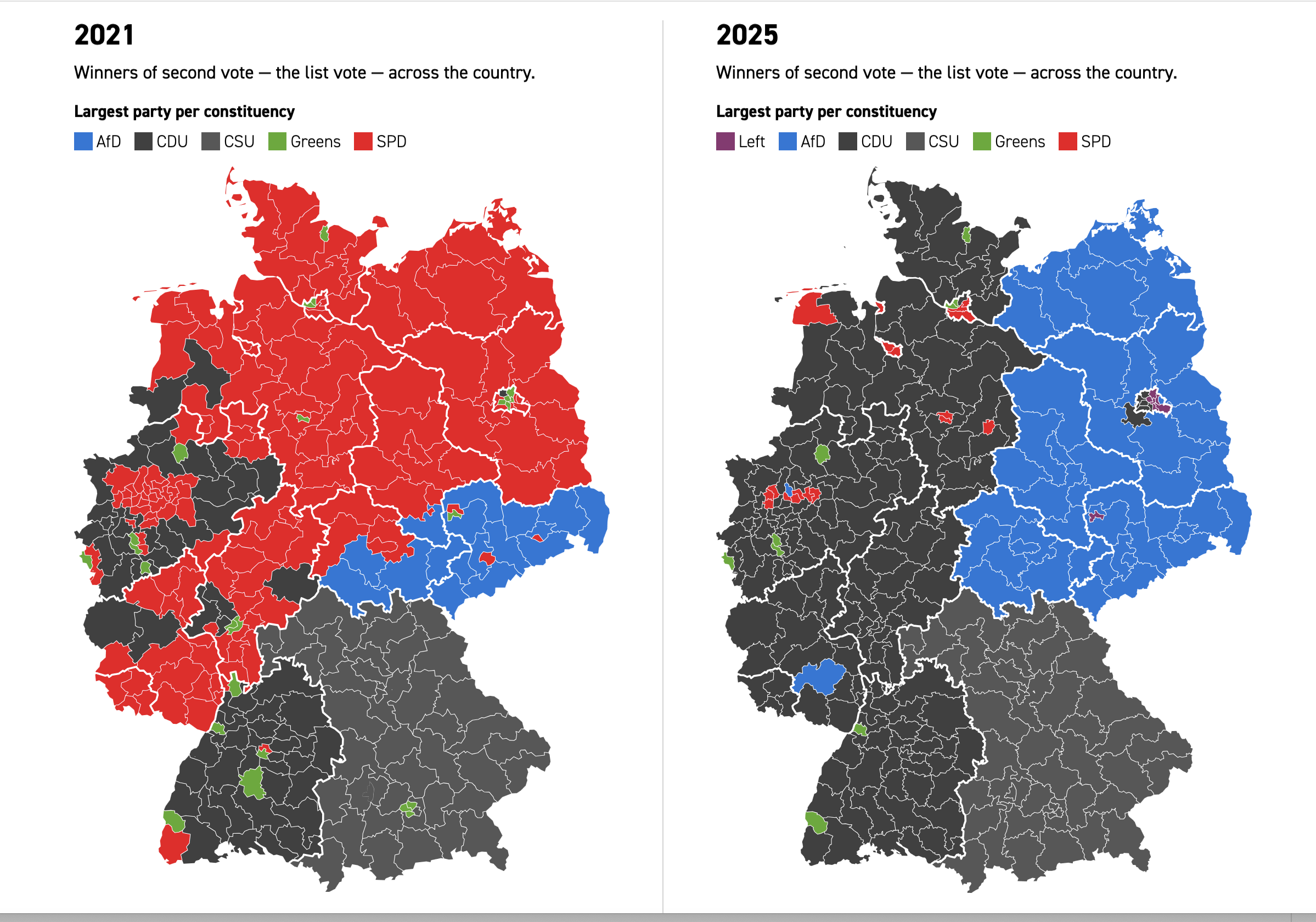
The electoral map of regions with majority support for the Alternative für Deutschland (Alternative for Germany, or AfD) political party corresponds almost precisely with the boundaries of the former East Germany.

Map: The New York Times.

DW reports that “the big winner of the election in terms of voter gains was the right-wing populist AfD, which nearly doubled its voter share over the previous federal election in 2021. The party, whose chancellor candidate Alice Weidel received praise from Elon Musk for her hard stance on migration, was particularly strong in the East.”

An analysis of voter preferences by DW indicates that “nationally, the AfD achieved roughly 20% of the vote, but in eastern Germany, the AfD is the strongest force. In the states of Brandenburg, Mecklenburg-Western Pomerania, Saxony, Saxony-Anhalt and Thuringia, the AfD won the largest portion of the second-ballot vote, which determines the strength of the party’s representation in the Bundestag. In many constituencies, over 30% of the second vote went to the AfD. The CDU and SPD trailed far behind.”

Meanwhile, at the regional level, there were some surprises. DW points out that “in the state of Thuringia, home to Björn Höcke, who was convicted for using banned Nazi slogans, the party received more than 38% of the vote, double the number of votes for the CDU.”

And, the Linke (Left) Party grew in the Berlin region: “The city-state of Berlin is the exception in Germany’s former East. Here the Left Party won the most votes.”

A more detailed electoral map reveals the shifts in voter preferences by region between the 2021 and 2025 German Elections.

Map: Politico.eu

Geographers, political scientists, sociologists point to deep social patterns that still divide the regions of the former East Germany from the rest of Germany.

Several maps published by The New York Times indicate some of the deep social and economic fault lines in German society.

Map: The New York Times.

Lunday, Chris and Hanne Cokelaere. “German Election 2025: Who Won Across the Country.” Politico.eu (23 February 2025).

Schuetze, Christopher F. “The Iron Curtain Casts a Long Shadow Over Germany’s Election.” The New York Times (25 February 2025).

Zeier, Kristin and Gianna-Carina Grün. “German election results explained in graphics.” DW (25 February 2025).

Posted in Cultural History, European History, European Studies, European Union, History of the Western World, Political Culture, Political Parties and Organizations, World History | Tagged , , , , , , , , | Leave a comment

Apocalypse Hier et Demain at the BnF in Paris

The Bibliothèque nationale de France (Paris) has organized an exhibition on Apocalypse Hier et Demain (Apocalypse, Yesterday and Tomorrow), which is on display from February through June 2025.

The exhibition explores the Book of Revelation and apocalyptic visions, before turning to examine crises and catastrophes in the pre-modern and modern world.

The BnF website provides a description the exhibition:

“La BnF propose la première grande exposition consacrée à l’apocalypse. L’apocalypse ? Un mot obscur, qui fait peur, un mot qui parle de la fin du monde. Il n’en finit pas de résonner depuis deux mille ans dans notre culture et nos sociétés occidentales quand survient une catastrophe majeure, et aujourd’hui encore, en fond de nos angoisses climatiques. Et pourtant… Ce mot signifie révélation, dévoilement. Dans sa source biblique, l’Apocalypse parle d’un voile se levant sur le royaume intemporel qui réunira les croyants dans la Jérusalem céleste. Un mot porteur d’espoir, fait pour déjouer nos peurs profondes ?”

“Du Moyen Âge à notre époque, l’exposition traverse cet imaginaire en montrant certains des plus prestigieux manuscrits de l’Apocalypse de Jean, des fragments rarement présentés de la célèbre tenture de tapisseries d’Angers, ou la fameuse suite de gravures de Dürer consacrées au texte, mais aussi de nombreux chefs-d’œuvre, tableaux, sculptures, photographies, installations, livres rares, extraits de films, venant des collections de la Bibliothèque comme des plus grandes collections françaises et européennes, publiques et privées (Centre Pompidou, musée d’Orsay, British Museum, Victoria and Albert Museum, etc.).”

Posted in Art History, Atrocities, Civilians and Refugees in War, Cultural History, Early Modern Europe, Early Modern France, Early Modern World, European History, European Wars of Religion, French History, French Wars of Religion, History of the Western World, History of Violence, Italian History, Material Culture, Medieval History, Mediterranean World, Museums and Historical Memory, Reformation History, Religious History, Religious Violence, Renaissance Art and History, War, Culture, and Society, Warfare in the Early Modern World, Women and Gender History, World History | Leave a comment

French and U.S. Presidents are Divided on Ukraine

The Presidents of France and the United States are sharply divided on the Russian-Ukrainian War. The future of Ukraine and the European Union seems to hang in the balance.

“President Trump and President Emmanuel Macron of France put on a show of friendship on Monday in their first meeting since last month’s inauguration, but for all the clubby hugs and handshakes they could not disguise the growing rift between the United States and Europe over the Ukraine war,” according to The New York Times.

“Meeting on the third anniversary of Russia’s full-scale invasion of Ukraine, the two leaders seemed intent on avoiding an open rupture as they traded compliments during a convivial White House meeting. But they diverged significantly over the causes of the war, each side’s role in the conflict and its possible resolution.”

“But even as Mr. Macron called the president ‘dear Donald’ and repeatedly used words like ‘friendship’ and ‘shared agenda,’ he gently and politely struck a different note from Mr. Trump’s on the war,” The New York Times observed.

“‘This peace must not mean a surrender of Ukraine,’ the French president said during a joint news conference in the East Room of the White House. ‘It must not mean a cease-fire without guarantees. This peace must allow for Ukrainian sovereignty.'”

“Mr. Trump made no mention of guarantees or Ukrainian sovereignty, refused to call Mr. Putin a dictator and falsely stated that the United States had spent three times as much on the war as Europe had. Mr. Macron, careful not to provoke Mr. Trump, made clear that Russia was to blame for the war, not Ukraine, and corrected the president’s assertions about European aid,” according to The New York Times.

“Speaking with reporters in the Oval Office before their news conference, Mr. Trump, who last week said that Ukraine had ‘started’ the war and called the country’s popularly elected president, Volodymyr Zelensky, a ‘dictator without elections,’ declined to use the term for Mr. Putin, who has ruled as an autocrat for a quarter-century. ‘I don’t use those words lightly,’ Mr. Trump said.”

“Mr. Macron, by contrast, gave voice to the consensus view in Europe and, until now, in the United States that Moscow is to blame for the war. ‘This is a responsibility of Russia because the aggressor is Russia,’ the French president said.”

Historians of France and the United States are observing the fraying relationship of one of the closest alliances in the international relations.

Baker, Peter. “Trump and Macron Display Old Friendship but Split on the Ukraine War.” The New York Times (24 February 2025).

“Macron Tries to Sway Trump as U.S. Backs Russia Over Ukraine in U.N. Vote.” The Washington Post (24 February 2025).

Posted in Atlantic World, Contemporary France, Empires and Imperialism, French History, Peacemaking Processes, Strategy and International Politics, United States Foreign Policy, United States History and Society, War, Culture, and Society, World History | Tagged , , , , , , , , , , | Leave a comment

Defending Academic Freedom

Defending academic freedom has become an essential daily task for professors and researchers in the United States.

The Center for the Defense of Academic Freedom (CDAF) at the American Association of University Professors (AAUP) has prepared resources and toolkits for defending academic freedom.

Professors, researchers, and educators across the nation will be interested in utilizing the legal tools available to resist the dismantling of key agencies and policies that support academic research and teaching, as well as scientific labs and higher education institutions.

Here is a letter from the Director of the Center for the Defense of Academic Freedom at the AAUP:

Dear Colleague,

The cruelty of the new administration’s attack on democracy and higher education has been staggering, from arbitrary cuts to research funding to the malicious misrepresentation of our work to Linda McMahon’s unwillingness to say that teaching African American history is still legal.

Fighting back requires understanding the threats we face as well as developing the tools necessary to convey the value of higher education to a wide audience. In this context, the AAUP’s Center for the Defense of Academic Freedom has recently published a number of resources that we hope will be useful in the fight ahead:

  • Academic Freedom on the Line is a weekly Substack edited by CDAF fellow John Warner. This newsletter examines questions around academic freedom, its role in a democratic society, and what is lost when academic communities face politicized attacks on institutional autonomy and shared governance. Check out posts on CDAF’s mission, the risks of obeying in advance, advice for college and university boards, and reflections on the recent “Dear Colleague” letter.
  • Executive Power Watch is a series of short handouts that offer analyses of education-related executive actions, including executive orders that target diversity, equity, and inclusion; weaponize antisemitism; and target transgender, intersex, and nonbinary people. These resources offer concrete suggestions about what you can do to fight back.
  • Action Reports are short studies that offer concrete analysis and guidance on how to respond to particular threats to academic freedom, such as

Future Action Reports will examine the American Council of Trustees and Alumni and strategies for using collective bargaining agreements to resist post-tenure review laws.

Review, use, and share these tools, and stay tuned for more resources and related webinars.

In solidarity,


Isaac Kamola, Director, AAUP Center for the Defense of Academic Freedom

Posted in Academic Freedom, Education Policy, Higher Education, Human Rights, Humanities Education, Political Activism and Protest Culture, Political History of the United States, Public History, United States History and Society | Tagged , , , , , , , , , , , | Leave a comment

Three Years of War in Ukraine

Today, we are remembering the Russian invasion of Ukraine and marking the third anniversary of the start of the current Russian – Ukrainian War.

The war began with a major Russian invasion of Ukraine in February 2022 that sought to overwhelm Ukraine’s air and ground defenses. Ukraine resisted bravely and repelled the Russian forces around its capital, Kiev.

The Russian-Ukrainian War represents the most extensive war in Europe since the Second World War and has featured large tank battles, lengthy sieges, trench warfare, massive missile strikes, and pervasive drone attacks.

The new Trump administration has radically reshaped the war in Ukraine in the past four weeks by abandoning support for Ukraine and American allies in Europe.

“After three years of grinding warfare and isolation by the West, a world of new possibilities has opened up for Mr. Putin with a change of power in Washington,” observes Paul Sonne, reporter with The New York Times.

“Gone are the statements from the East Room of the White House about the United States standing up to bullies, supporting democracy over autocracy and ensuring freedom will prevail.

“Gone, too, is Washington’s united front against Russia with its European allies, many of whom have begun to wonder if the new American administration will protect them against a revanchist Moscow, or even keep troops in Europe at all.”

In a show of solidarity, the leaders of European nations and the European Union joined Ukrainian President Zelenzky in Kyiv to mark the grim three-year anniversary of the Russian invasion of Ukraine.

Lawrence Freedman, Professor Emeritus of War Studies (King’s College London) comments that “There is something very big going on at the moment. … This is not business as usual. This is a very different administration, and it’s very hard to see how trans-Atlantic relations will be the same at the end of this.” Freedman was quoted in Paul Sonne’s article.

Foreign Policy has published a series of essays on “Three Years On, What’s Next for Europe and Ukraine?” Nine policy analysts examine the status of the Russian-Ukrainian War and the radical changes international relations.

“Three Years On, What’s Next for Europe and Ukraine?” Foreign Policy (21 February 2025).

Sonne, Paul. “Three Years Into War in Ukraine, Trump Ushers in New World for Putin.” The New York Times (24 February 2025).

“World Leaders Reiterate Support on Third Anniversary of War as Zelenskyy Hails ‘Absolute Heroism of Ukrainians.'” The Guardian (24 February 2025).

“Western leaders visit Kyiv and pledge military support against Russia on the war’s 3rd anniversary.” AP (24 February 2025).

Note: this essay has been updated with additional references.

Posted in Empires and Imperialism, European History, European Studies, European Union, History of the Western World, Strategy and International Politics, United States Foreign Policy, War, Culture, and Society, World History | Tagged , , , , , , , , , , , , | Leave a comment

Tuning Out Trump is Dangerous

“Many who had hoped to tune out Trump this time realize they don’t have that luxury. It’s far more dangerous now,” writes political analyst and columnist Maureen Dowd.

News fatigue is a real problem when democratic institutions are under assault.

“There are frightening moments when our 236-year-old institutions don’t look up to the challenge. With flaccid Democrats and craven Republicans, King Donald can pretty much do whatever he wants to whomever he wants,” Dowd observes.

President Trump is increasingly presenting himself as a king in social media and official statements.

“After pillaging and gutting the U.S. government, the Western alliance and our relationship with Volodymyr Zelensky, Trump is thinking of himself as a king and cogitating on a third term. He basks in the magniloquent rhetoric of acolytes genuflecting to an instrument of divine providence.”

President Trump as a would-be king. Image: The New York Times.

Trump’s supporters have fully embraced the image and rhetoric of monarchy and dictatorhip.

Maureen Dowd indicates that “at the Conservative Political Action Conference this week, a group calling itself the ‘Third Term Project’ erected a sign depicting Trump as Caesar. A wag on X wondered if they knew what happened to Caesar.”

“Trump delights in reposting memes of himself as a king and as Napoleon, with a line attributed to the emperor: ‘He who saves his country does not violate any law.'”

Down emphasizes that “his [Trump’s] dictatorial impulses were clear when he refused to accept the results of the 2020 election and egged on a mob to disrupt the certification of the election, even if it meant that his own vice president might be hanged. And now he has added imperialistic impulses, musing about taking over the Panama Canal, Greenland, Canada, Gaza, D.C., and mineral rights in Ukraine.”

Dowd argues that “His [President Trump’s] megalomania has mushroomed. His derisive behavior toward Zelensky — how can a modestly talented reality show veteran mock Zelensky as ‘a modestly successful comedian’? — shows Trump can’t abide anyone saying he is doing anything wrong.”

Mauren Dowd’s opinion piece, “Fail, Caesar!” is available at The New York Times.

Posted in Information Management, Political History of the United States, United States Foreign Policy, United States History and Society | Tagged , , , , , , , , , , , | Leave a comment