Get Out the Vote!

Election day in the United States is 6 November 2012.

University students are often very busy during the middle of the semester, but it is important to exercise your citizenship and vote.

Many people think that their votes don’t count. If you have ever been tempted to not vote, please check out filmmaker Errol Morris’s film  11 Excellent Reasons Not to Vote?

Get out the vote!


Posted in Human Rights, Political Culture | Leave a comment

Careers for Ph.D.s in History

Anthony Grafton published an article last year on the need for doctoral programs in History to prepare their Ph.D. candidates for the possibility of careers outside of academic positions. The article went viral, prompting an extended debate online over the academic job market in History and other career paths for professional historians. For a glimpse of this debate, see Grafton’s original pieceanother Grafton piece with Jim Grossman, articles in AHA Perspectives, and in the Chronicle of Higher Education.

The latest article responding to this debate is a piece in the Chronicle of Higher Education on “What Doors Does a Ph.D. in History Open?”

This article analyzes “the career outcomes of history Ph.D.’s who graduated between 1990 and 2010 (taking every other year) from four history departments: at Duke University, Ohio State University, and the Universities of North Carolina at Chapel Hill and California at Santa Barbara.”

The study is based on a “total sample of 487 history Ph.D.’s.” The article provides a series of charts to display the data, finding that “Only 50.7 percent of doctoral graduates from those four top-tier programs ended up in tenure-track jobs. For those who graduated in 2008 and 2010, the average was even lower: 38.5 percent.”

Of course, the 2008-2010 data is skewed both by the global economic crisis and by the growing number of postdoctoral fellowships in the humanities and social sciences. Many Ph.D. recipients now move into one- to three-year postdoctoral fellowships after completing their doctorates. So, tracking how many doctoral recipients end up in tenure-track positions requires examining data several years out from graduate dates.

Data on academic administrators is also unclear, since some of those positions are filled by faculty members.

The piece provides encouraging news about those Ph.D. recipients who moved into careers outside of university teaching. “Far from the stereotype of the Ph.D. baristas at Starbucks, career-outcome data (see charts for each of the four institutions here) shows that history Ph.D.’s are thriving in a versatile range of careers.” The article indicates that many of the history doctoral recipients now work in “higher-education administration, publishing and editing, high schools, museums, government agencies, and public-history sites.” Others have careers as “researchers, consultants, and editors.”

The author claims that “Most history departments, it turns out, do not track the career outcomes of their alumni.” This, I believe is an exaggeration. Most Ph.D. granting history departments I am familiar with do attempt to track their doctoral recipients’ careers. However, it is not always possible to compile effective data, especially on Ph.D.s who go on to careers outside of professorial and academic administrative positions.

 

Posted in Careers in History, Graduate Work in History, Humanities Education | Leave a comment

Ecole des Chartes Fellowship

École Nationale des Chartes Fellowship

Application deadline: December 1, 2012

This fellowship, which has existed since 1979, provides auditor tuition and a portion of living expenses for an American or Canadian graduate student who has advanced to PhD candidacy to study at the École Nationale des Chartes in Paris. The École is the oldest institution in Europe specializing in the archival sciences, including paleography, codicology, bibliography, diplomatics, textual editing, and the history of the book. Preference is given to students attending member institutions of the Center for Renaissance Studies consortium. It is strongly recommended that the recipient be in residence at the École during the fall semester. Applications are especially encouraged from students who are in the research stage of their dissertation work.

This Fellowship listing is cross-posted from the Newberry Library’s announcement.

For more information and application instructions, see http://www.newberry.org/center-renaissance-studies-fellowships.

Posted in French History, Graduate Work in History, Grants and Fellowships, Renaissance Art and History | Leave a comment

SMH Group Blog

The Society for Military History has a new group blog, the SMH Blog, which will offer posts and discussions of all aspects of the history of war and society.

I am thrilled to be participating in the SMH blog as one of the authors, along with Robert Bateman, Mark Grimsley, Brett Holman, and Jamel Ostwald.

This week, I posted my first SMH blog piece on “The Cultural History of War.”

Please do check out the new SMH blog and consider adding it to your bookmarks and feeds.

Posted in Digital Humanities, History of Violence, War, Culture, and Society, Warfare in the Early Modern World | Leave a comment

US Elections Viewed from France

The 2012 United States Presidential Election is being closely followed in France, where I am currently doing archival research. Daily radio and television news broadcasts are filled with the latest U.S. political news, tracking opinion polls and each major twist of the campaign. French magazines and websites have been filled with news and analysis of the party conventions, stump speeches, and debates.

Here is a sample of French coverage of the U.S. Presidential Election….

A number of articles cover the U.S. Presidential Debates, often noting peculiarities in the  political discourse used by Mitt Romney and Barack Obama. Le Monde covers the third Presidential Debate on foreign policy issues, providing an outsider perspective on the issues covered in it. Other pieces focus on omissions in the debates, as when Libération noted the absence of discussion of the Guantanamo base in the third debate.

Much of the French reporting on the elections delves into the obscure processes of running elections in the United States. Le Monde explains the role of a debate moderator to a French audience. Le Nouvel Observateur analyzes the battle over the swing states and the role of the electors (grands électeurs).

Libération has a story on “le relooking permanent” of Mitt Romney.

A new issue of Le Monde Diplomatique investigates “Où va l’Amérique?” and has a special issue on the election.

A new book by Justin Vaïsse, Barack Obama et sa politique étrangère (2008-2012), published in France examines President Obama’s foreign policy and pragmatism. See a review of the book in Libération.

TF1 held a debate between Democrats and Republicans in France. Harry’s Bar held a straw poll among Americans to gauge the election results.

Posted in French History, Globalization, Political Culture, Strategy and International Politics | Leave a comment

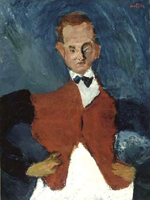
Chaïm Soutine Exhibition at Musée de l’Orangerie

A blustery fall day seemed like the perfect occasion to visit the Musée de l’Orangerie and enjoy Claude Monet’s waterlillies. The permanent collection of works by Modigliano, Picasso, Dérain, Cézanne, Soutine, and others is fabulous.

The current temporary exhibition at the Orangerie is a nice bonus: Chaïm Soutine, l’ordre du chaos.

The exhibition combines the Soutine paintings from the Orangerie’s permanent collection with works borrowed from diverse collections, including museums in Moscow, New York City, Philadelphia, Los Angeles, Minneapolis, and Baltimore. The exhibition is organized around different genres in Soutine’s work: portraits, landscapes, and still lifes.

Posted in Art History, European History, French History, Paris History | Leave a comment

Grant Writing Workshop at NIU

Grant Writing Workshop for Graduate Students
On Monday, 29 October from 5-5:50 in DuSable 422, the Graduate Office will be holding a workshop on applying for grants that is open to all graduate students.
Andrea Buford from the Office of Sponsored Projects will make a presentation on getting grants, and Professor Andy Bruno will be there to share his experiences and answer questions about getting grants and fellowships as a graduate student and just beyond graduation. Please mark your calendars and save the date. I hope to see many of you there.
Also, save the date for Monday, 26 November when the Graduate Office will hold a workshop on Alternative Careers in History. Watch for an announcement with more details in early November.
Posted in Graduate Work in History, Grants and Fellowships, Northern Illinois University | Leave a comment

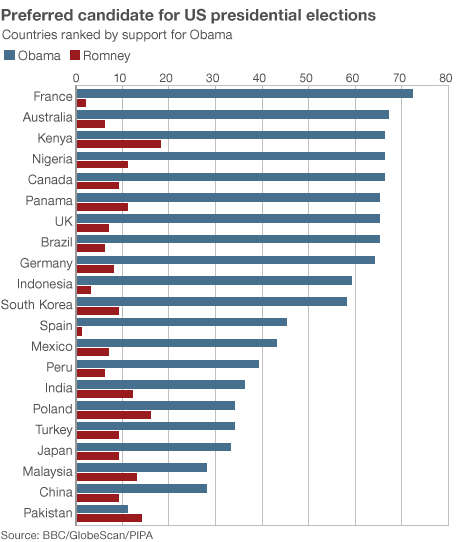
World Poll on US Presidential Election

If the United States Presidential Election were a worldwide election, it wouldn’t even be close: Obama would win in a massive landslide.

The BBC recently conducted a worldwide poll, asking which candidate non-U.S. citizens around the world would vote for if they were able to vote in the election.  The results show that President Obama has overwhelming support worldwide, when compared with Mitt Romney.

France is the country with the heaviest support for Obama, with 72% of French citizens polled indicating that they would vote to re-elect the President.  For historians and other humanities scholars who study French culture, this is no surprise.  American political news is reported daily in the French media, so French citizens are well informed on the  positions of both major political parties in the United States. Although traditional left-center-right distinctions have become confused in the Post-Cold War world, I would argue that the political “center” of France is far left of the “center” in the United States. President Obama is clearly not a socialist, but many French citizens would like to see him adopt policies to regulate banks and multinational corporations.

I am currently doing research in Paris, so it is fascinating to watch the French reporting on the U.S. Presidential Debates and to talk with French people about the election.


Posted in European Union, French History, Globalization, Paris History, Political Culture | Leave a comment

Italian Voices Conference

CALL FOR PAPERS

Italian Voices: Oral and Written Cultures in Early Modern Italy

Conference at the University of Leeds

Thursday 5-Friday 6 September 2013
Venue: School of Music

This conference is being organized as part of the project ‘Oral culture, manuscript and print in early modern Italy, 1450-1700’, funded by the European Research Council. It will
investigate how Italian oral culture was related to written culture in this period and how far it was independent of writing. For further information on the project, please visit our website: http://arts.leeds.ac.uk/italianvoices/.

Confirmed speakers: Peter Burke (Cambridge), Elizabeth Cohen (Toronto), Thomas Cohen
(Toronto), Massimo Firpo (Turin), Rob Henke (St Louis), Robert Kendrick (Chicago),
Françoise Waquet (Paris).
Potential topics for papers include, but are not limited to:
· Performances of texts in public and private spaces
· Musical settings of texts
· Reading aloud to others
· Improvisation of texts
· Religious and political oratory
· Orality in learned and popular culture
· Linguistic variety and usage in performed texts
· Transcribing performed texts

To propose an individual paper of twenty minutes, in English or in Italian, or a session of
three papers, please send a title and 200-word abstract for each paper, and contact
information and a brief (one-page) curriculum vitae for each speaker, to
italianvoices@leeds.ac.uk. Round-table sessions relating to methodological issues may also be proposed. Any queries should also be addressed to the same address.

Deadline for receipt of proposals: 31 January 2013.

Posted in Conferences, Early Modern Europe, European History, Italian History, Renaissance Art and History | Leave a comment

Western Society for French History Conference in Banff

Last weekend, I attended the Western Society for French History conference in Banff, Canada. The WSFH is one of two major academic conferences concerning French history  held annually in North America.

I participated in two sessions on “The Wars of Religion: Militancy in Word and Deed,” and “Warriors for King and Christ: Noble Violence in Early Modern France.” I commented on papers by Allan Tulchin, Amanda Eurich, and Jill Fehleison in the first session, then presented a paper on “‘The Lord God Wishes to Fortify Us’: Huguenot Noble Protectors and Religious Violence after the Edict of Nantes,” in the second session. Mack Holt chaired both sessions and led the discussion.

The WSFH conference included a number of early modern French historians and French Revolutionary historians, including Mack Holt, Rob Schneider, Michael Breen, Erik Thomson, Hilary Bernstein, Allan Tulchin, Amanda Eurich, Jill Fehleison, Kathryn Norberg, Katherine Crawford, Jeffrey Merrick, Nina Kushner, and Jotham Parsons.

Martin Staum gave a keynote address on the revolutionaries’ understanding of the Enlightenment through the writings of the members of the Institut de France during the Directory and Napoleonic period.

Posted in Conferences, Early Modern Europe, European History, French History, French Revolution and Napoleon, French Wars of Religion, Warfare in the Early Modern World | Leave a comment