Hollande Wins French Presidency

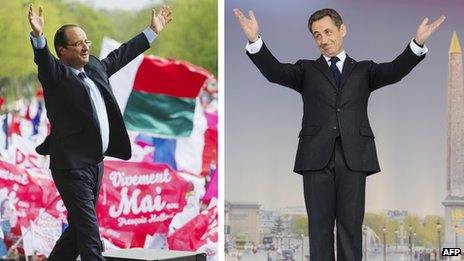
François Hollande has won the French Presidential Elections today, becoming the first Socialist President in France since François Mitterand stepped down in 1995. Hollande won by a narrow, but convincing margin: 51.7% to 48.3% (according to the latest results as reported by Le Monde). President Nicholas Sarkozy, who had sought reelection, has conceded defeat.

Hollande’s supporters celebrated in the streets and squares of Paris and across France.  Libération called the victory “a historic moment” in France’s history.

NPR reports on the election results in English, as does the BBC.

Meanwhile, The Independent reports on Sarkozy’s loss and the legacy of his presidency for the French nation.


Posted in European History, European Union, French History, Political Culture | Leave a comment

Swiss Guard Saved Rome

The legendary Swiss Guard of the Vatican is in the news today on the anniversary of the Sack of Rome of 1527.

NPR reports on the swearing in ceremonies of the Swiss Guard in Rome today.

Northern Illinois University students in HIST 420 The Renaissance and HIST 458 Mediterranean World, 1450-1750 will be interested in this article.


Posted in Early Modern Europe, European History, European Wars of Religion, History in the Media, Mediterranean World, Mercenaries, Renaissance Art and History, War, Culture, and Society, Warfare in the Early Modern World | Leave a comment

Hollande-Sarkozy Presidential Debate

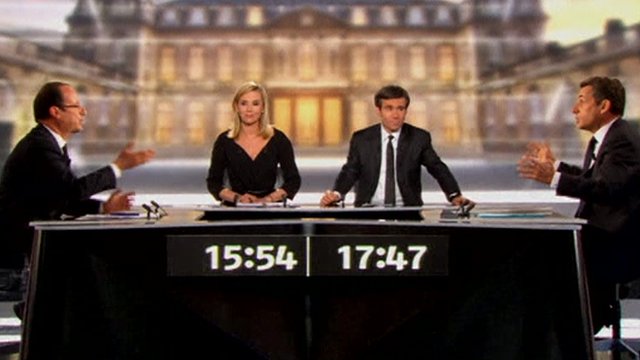
François Hollande and Nicolas Sarkozy squared off in a major presidential debate on French television this week, in preparation for this Sunday’s second round of the French presidential election.

Sarkozy, the incumbent president, has been trailing Hollande in the polls and desperately needed to win the debate decisively.

The debate certainly produced fireworks and verbal jabs between the two candidates, but most political commentators seem to feel that Sarkozy failed to land a knock-out blow. Indeed, despite the drama, the polls of French voters seem unchanged by the debate: Hollande is still leading at approximately 53% of the vote to Sarkozy’s 47%.

LeMonde and Libération both have coverage of the debate as well as the full video of the televised event.  The BBC and the New York Times provide reports in English.

NIU Students in HIST 311 Early Modern France and HIST 423 French Revolution and Napoleon will be interested in these reports.


Posted in European Union, French History, Political Culture | Leave a comment

Financial Cutbacks at European Universities

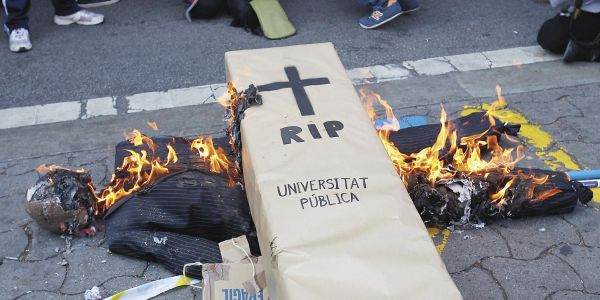
As European nations institute “austerity measures,” public universities are feeling the pain. For decades, European Union member states have promoted higher education as a right for all citizens. The Euro crisis and massive budget cuts are now threatening public higher education systems in many EU countries.

The implementation of “austerity measures” in Greece, Italy, Portugal, and Spain have already had a severe impact on public education in those countries. According to the Chronicle of Higher Education, “Institutions are trimming costs wherever they can. The University of Barcelona has eliminated budget allocations for the preservation of old books and manuscripts, although Adelaida Ferrer, the university’s head librarian, says she is able to authorize spending on a selective basis. Summer temperatures in Barcelona can reach the 90’s and, without proper care for the materials, the sweltering humidity can be especially damaging. In a cost-cutting measure, most of the university’s 16 libraries were closed over the Easter break, leaving only two open at a time, and subscriptions to some 500 of the library’s 15,000 publications have been canceled.”

Faculty salaries and work conditions have also suffered. The Chronicle of Higher Education reports: “António Costa Pinto, a political scientist and a research professor at Lisbon’s Institute of Social Sciences, says that throughout Portugal, professors have endured salary cuts amounting to 30 percent of their net income over the past two years. The country is quickly losing the ability to attract the best faculty and retain the best graduates, and he fears that it is falling into what he calls ‘a sort of third-world pattern.'”

The Chronicle of Higher Education reports on the financial cutbacks at European universities. The Chronicle of Higher Education may be accessed through databases at most university and public libraries.

Posted in Education Policy, Humanities Education, Information Management | Leave a comment

French History Review of Warrior Pursuits

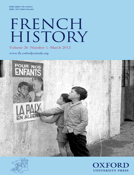
French History has published a review of my monograph, Warrior Pursuits: Noble Culture and Civil Conflict in Early Modern France (Baltimore, MD: Johns Hopkins University Press, 2010).

Fadi el Hage, who is based at the Institut Universitaire de Technologie at Université de Paris XIII – Saint-Denis, nicely situates Warrior Pursuits in the historical literature on history of the French nobility and studies of royal offices in France.

El Hage identifies one of the major theoretical issues addressed, stating that: “This book underlines how much we have to be wary of the concept, expounded by Max Weber, known as as the monopoly on legitimate violence. The permanent royal army was not the proof of a complete royal monopoly.”

El Hage rightly emphasizes the notion of confusion des pouvoirs in early modern French politics and society, seeing the provincial nobles analyzed in Warrior Pursuits as powerful political actors and members of the royal state.

French History is the leading academic journal published in the United Kingdom in the field of French historical studies. This book review has been published online at French History as an “advance access” review.  I will update the citation for El Hage’s review when the print version is released:

Fadi El Hage, “Review of Warrior Pursuits. Noble Culture and Civil Conflict in Early Modern France. By Brian Sandberg.” French History (2012).

Posted in Current Research, Early Modern Europe, European History, European Wars of Religion, French History, French Wars of Religion, Languedoc and Southern France, Noble Culture and History of Elites, Religious Violence, State Development Theory, War, Culture, and Society, Warfare in the Early Modern World | 1 Comment

Bernard Lewis Claims to Have Opposed Iraq War

Bernard Lewis, Professor Emeritus of History at Princeton University, is one of the most controversial figures in Middle Eastern and Mediterranean history. Lewis is known for his many books on Middle Eastern history, but also for his influential formulation of a “clash of civilizations” between Islam and the West in a 1990 article in The Atlantic. Samuel Huntington and conservative politicians later expanded and exploited this concept of a “clash of civilizations,” to justify the so-called War on Terror and the Iraq War of 2003-2011.

Bernard Lewis now claims that he opposed Dick Cheney’s drive to invade Iraq in 2003. An article in the Chronicle of Higher Education discusses Lewis’s claims, which stem from his new memoir, Notes on a Century: Reflections of a Middle East Historian (Viking, forthcoming).

It appears that Lewis is attempting to rehabilitate his academic reputation, which has been heavily tarnished by his clashes with Edward Said and his support for the War on Terror, as well as for his reductionist portrayal of Islam in constant opposition to the West in numerous books, such as The Crisis of Islam: Holy War and Unholy Terror (2004) and Islam and the West (1994).

If you need a quick reminder of Lewis’s positions during the Iraq War and the War on Terror, see an interview with him sponsored by the Pew Forum. Note that he quibbles with the term “War on Terror,” but completely supports its policies. Also note that toward the end of the interview he contemplates historians revising their own history: “Remember, Churchill was asked how he thought history would treat him, and he said, ‘Very well; I intend to write it myself.’ (Laughter.) And he did, of course.”

For confirmation of Lewis’s influence within the US policy community during the War on Terror, see pieces in the BBC and the Washington Monthly from the mid-2000s.

NIU students in HIST 458 Mediterranean World, 1450-1750 will be interested in reading this article, after having discussed historical models based on the “clash of civilizations” concept as well as critiques of it.

Posted in History in the Media, Mediterranean World, Political Culture, Strategy and International Politics, Terrorism, War, Culture, and Society | 1 Comment

Kuhn’s Paradigm Shift at 50

This year is the 50th anniversary of Thomas Kuhn’s The Structure of Scientific Revolutions, with its influential concept of the “paradigm shift.” The book has reportedly sold over 1.4 million copies and is still on science and history of science syllabi around the world.

The Structure of Scientific Revolutions examines in detail the so-called Scientific Revolution of the seventeenth century, so the book a must-read for historians of early modern European history and historians of early modern science in particular.

An article in the Chronicle of Higher Education discusses the legacy of Kuhn’s “paradigm shift.”


Posted in Academic Publishing, Early Modern Europe, Early Modern World, European History, Historiography and Social Theory, History of Medicine, History of Science | Leave a comment

Hollande Wins First Round of French Presidential Election

French citizens went to the polls today (22 April) to vote in the first round of the 2012 French Presidential Election.

François Hollande, the Socialist Party candidate, has won the first round with 28.8% of the vote, edging out President Nicolas Sarkozy, who had 26.1%.

Marine Le Pen of the extreme right-wing Front National won a surprising 18.5% of the vote. A number of other candidates gained marginal percentages of the electorate.

Hollande and Sarkozy, the top two vote-getters, now head into the Second Round Election.

Le Monde and Libération provide full coverage of the French Presidential elections.  See the BBC for coverage in English.

Posted in European History, European Union, French History, Political Culture | Leave a comment

French Elections and the Weight of History

French people are used to having their politicians make historical references in their campaign speeches and policy statements. As the French head to the polls, the weight of French history is again shaping the presidential campaigns.

The BBC reports on the use of history by the presidential candidates in France.  Olivier Guez comments in a New York Times op-ed on the inward-looking rhetoric and historical allusions of the presidential campaign.

Earlier posts have dealt with the use of Jeanne d’Arc (Joan of Arc) by candidates in the current 2012 French presidential campaign.

If historical rhetoric has been a major part of the 2012 presidential campaign, new techniques of campaigning have also been adopted, according to a report in the New York Times. For a summary of the presidential candidates and a description of their platforms in English, see the BBC.

Posted in European Union, French History, History in the Media, Political Culture | Leave a comment

Journal of Modern History Review of Warrior Pursuits

The Journal of Modern History has published a review by Jonathan Dewald of my book, Warrior Pursuits: Noble Culture and Civil Conflict in Early Modern France.

Jonathan Dewald, Professor of History at the University of Buffalo, is a noted historian of early modern French history and the history of the European nobility.

The JMH book review may be found at: http://www.jstor.org/stable/10.1086/663136

Posted in Current Research, Early Modern Europe, French Wars of Religion, History of Violence, Noble Culture and History of Elites, Religious Violence, Warfare in the Early Modern World | Leave a comment