Restrictions on Academic Speech

Universities normally tout their star professors, celebrating each newspaper op-ed or magazine article that showcases new scholarship and highlights the value of their institutions.  The marketing arms of universities effectively use faculty members’ media publications and appearances to advertise their institutions and to recruit students.

However, at Chicago State University, professors are paradoxically being silenced by their administrators. The Chicago Tribune reports that Chicago State University has issued a new policy threatening its faculty members with firing for communicating with any media without administrative authorization.
The Chicago Tribune report indicates that:

Sabrina Land, the university’s director of marketing and communications, wrote that all communications must be “strategically deployed” in a way that “safeguards the reputation, work product and ultimately, the students, of CSU.”

The policy applies to media interviews, opinion pieces, newsletters, social media and other types of communications, stating that they must be approved by the university’s division of public relations. “All disclosures to the media will be communicated by an authorized CSU media relations officer or designate,” the policy says.

Failure to follow the rules “will be treated as serious and will result in disciplinary action, possible termination and could give rise to civil and/or criminal liability on the part of the employee.”

This policy clearly violates the principle of academic freedom and may violate faculty members’ First Amendment rights.

The AAUP has already responded to this outrageous policy, aiming to lift these restrictions on academic speech at Chicago State University.  Faculty members at public universities in Illinois and across the nation should be alarmed by these dangerous restrictions on academic speech.

Posted in Academic Freedom, Academic Publishing, Education Policy, Humanities Education | 1 Comment

American Women in France

Study abroad programs have fundamentally transformed American higher education and presented new opportunities for thousands of students.

Often forgotten is how crucial study abroad programs have been for female students from the United States.  A new article by Alice Kaplan, professor of French at Yale University, argues that study abroad experiences were formative for American feminists in the postwar period.  Kaplan focuses especially on the Parisian sojourns of Jacqueline Bouvier Kennedy, Susan Sontag, and Angela Davis.

Alice Kaplan’s article appears in the Chronicle of Higher Education.

NIU students who are affiliated with the Women’s Studies Program or who are taking French history courses will be interested in this article.

Posted in Education Policy, European History, French History, Humanities Education, Study Abroad, Women and Gender History | Leave a comment

World War II in Soviet Film

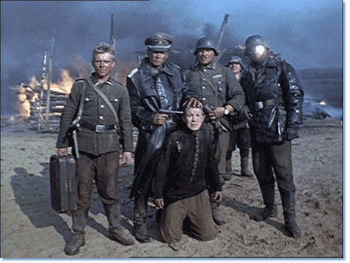
Soviet filmmakers portrayed the Great Patriotic War (or World War II) in numerous films produced from the 1940s to 1980s.

The AHA Perspectives provides an assessment of one of the last of the Soviet films about World War II, Elem Klimov’s Come and See (1985).

An introduction by Robert Brent Toplin is followed by Denise J. Youngblood’s analysis, “Apocalyptic Visions of the Great Patriotic War: Elem Klimov’s Come and See.”

Posted in European History, Historical Film, History of Violence, War in Film, War, Culture, and Society | Leave a comment

Body Counts and Human Rights

Body counts seem morbid, conjuring up grim memories of the horrifying language of the Vietnam War.  Yet, body counts have become key aspects of human rights law and efforts to prosecute individuals accused of war crimes.

A recent article by Tina Rosenberg in Foreign Policy discusses one of the modern body counters.

This article is recommended reading for people interested in war and society issues, particularly conflict resolution and reconciliation processes.  NIU students in HIST 640 Religious Violence in Comparative Perspective will want to read this piece.

Posted in History of Violence, Human Rights, Religious Violence, Strategy and International Politics, War, Culture, and Society | Leave a comment

France and the Origins of the Great Depression

Did French economic policies contribute to, or even cause, the Great Depression of the 1930s?

This is the provocative question posed by historian Douglas A. Irwin (Dartmouth College) in an article on History News Network (HNN), which is an outgrowth of his latest book, Peddling Protectionism: Smoot-Hawley and the Great Depression (Princeton, NJ: Princeton University Press, 2011).

Irwin concludes that: “economic historians have traditionally focused on the tightening of U.S. monetary policy as the origin of the Great Depression. These findings suggest that the French contribution to the worldwide deflationary spiral deserves much greater prominence than it has thus far received.”

NIU students of Modern French History may be interested in this article.


Posted in European History, French History, Globalization | Leave a comment

Film and Fiction for French Historians

The new e-issue of Film and Fiction for French Historians is now out at a new website on the H-France platform. Historians of French history and scholars interested in historical filmmaking should find this website useful in their research and teaching.

My review of the film Louis, roi enfant, a depiction of the early reign of Louis XIV and the Fronde civil war, is one of the reviews published in this issue of the e-journal. This review appears alongside a review by Bill Beik of two films about Louis XIV’s reign.

Northern Illinois University students in HIST 311 Early Modern France, 1500-1789 and HIST 390 History and Film may be interested in this review and the overall website.


Posted in Current Research, Early Modern Europe, French History, Historical Film, History in the Media, Noble Culture and History of Elites, War in Film, War, Culture, and Society, Warfare in the Early Modern World | Leave a comment

Renaissance Society of America Conference 2012

The Renaissance Society of America Conference 2012 has now concluded.  The conference, which is the premier conference on interdisciplinary Renaissance studies in North America, was held from 21-24 March at the Grand Hyatt hotel in Washington, DC.

This annual conference on Renaissance and early modern European and Mediterranean studies is sponsored by the Renaissance Society of America and information about the 2012 RSA conference is available at their website. History students at Northern Illinois University may be interested in finding out more about the Renaissance Society of America or about historical conferences in general.

My sessions with the Medici Archive Project on Saturday afternoon went well.  I was chairing one of their sessions on information circulation and management.  My own paper on Mediterranean slavery and the French Mediterranean seemed to go over well, as did Mark Rosen’s on Livorno’s Quattro Mori statue, and then a good discussion of Mediterranean slavery developed in the lengthy Q&A.

I attended several of the sessions dedicated to the editorial career of Henry Tom, who was a senior acquisitions editor at Johns Hopkins University Press. Henry was the editor of my monograph, Warrior Pursuits: Noble Culture and Civil Conflict in Early Modern France (Johns Hopkins University Press, 2010), as well as a dizzying 1000 books over his career. The sessions were a splendid tribute to Henry and his life’s work, with papers and comments by Eric Dursteler, John Marino, Ed Muir, Guido Ruggiero, and others. It is rare to have sessions dedicated to editors’ work at an academic conference, but the presentations and questions from members of the audience prompted interesting discussions on the state of academic publishing today.

I also attended sessions on “Early Modern Globalization”, “Mediterranean Travel and Pilgrimage”, “Bent Broken and Shattered: European Images of Death and Torture, 1300-1650”, “Diplomacy, Secrecy, and Espionage in Early Modern France (1560-1630)”, and “The Politics of Culture of Violence”. The papers presented in these sessions will contribute new ideas to my teaching of my courses on HIST 458 Mediterranean World, 1450-1750, HIST 414 European Wars of Religion, 1520-1660, and HIST 640 Early Modern Globalization.

Finally, the conference offers Renaissance and early modern historians excellent opportunities for academic networking and exchange.  I enjoyed reconnecting with many colleagues in Renaissance studies, Mediterranean history, Italian history, and early modern French history.

Posted in Academic Publishing, Conferences, Current Research, Early Modern Europe, Early Modern World, Italian History, Mediterranean World, Renaissance Art and History | Leave a comment

History Open House

The Department of History at Northern Illinois University will be holding a History Open House for undergraduate students.

The History Open House will be held tomorrow (Tuesday, 27 March) from 11am – 3pm on the sixth and seventh floors of Zulauf Hall.

Faculty will be around to meet and talk with undergraduate students about their courses or history in general.  There will also be information on the Fall 2012 and Spring 2013 schedule, summer trips, graduate school, and history organizations.

Posted in Northern Illinois University, Undergraduate Work in History | Leave a comment

Tournées French Film Festival at NIU

The Tournées Festival: New French Films on Campus is once again at Northern Illinois University. The festival opened yesterday and will continue through Thursday evening.

The Tournées Festival is organized by FACE, in partnership with the Cultural Services of the French Embassy. Various departments and programs at NIU have participated in sponsoring the festival’s appearance at NIU.

The films will be shown at the Egyptian Theater in DeKalb.  For the festival schedule and information, see the Department of English website or NIU Today online.

The Déjeuner français conversation group and undergraduate and graduate students of French history in the Department of History will be interested in this film festival.


Posted in French History, Historical Film, Northern Illinois University | 1 Comment

Napoléon Restored (in Film)

Abel Gance’s epic silent film Napoléon (1927) utilized a number of innovative filmmaking techniques and it has since become a classic work in the linked genres of historical film and war film.

A new restored version of the film is being screened this month in San Francisco as part of the San Francisco Silent Film Festival.

The New York Times reports on the restored film.

Northern Illinois University students in HIST 390 Film and History: War in Film will be interested in this article.


Posted in Comparative Revolutions, Early Modern Europe, French History, French Revolution and Napoleon, Historical Film, History in the Media, War in Film, War, Culture, and Society, Warfare in the Early Modern World | Leave a comment