Coptic Christianity in Transition

Pope Shenouda III, head of the Coptic Christian Church in Egypt, has died. Shenouda III had led the Coptic Church through several periods of turmoil in Egypt, including the ongoing Egyptian Revolution. Coptics represent a small religious minority in present-day Egypt and their position in Egyptian society has been made more precarious by the instability in Egypt since the beginning of the Arab Spring movements.
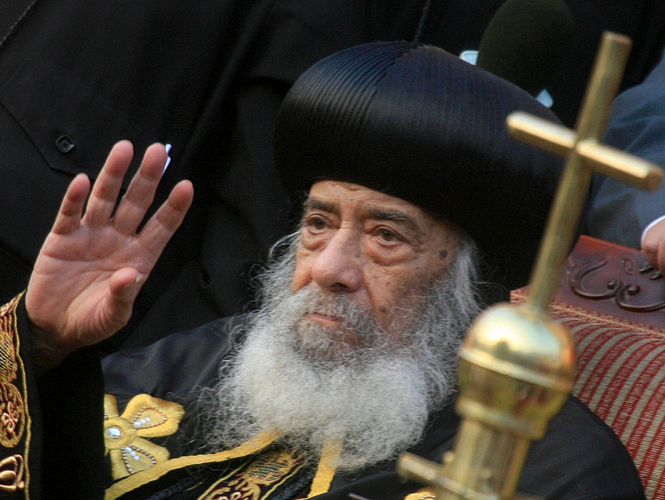
NPR covers the legacy of Shenouda III and the current situation of Coptic Christianity in Egpyt.

Northern Illinois University students in HIST 420 The Renaissance and HIST 458 Mediterranean World, 1450-1750 will recognize the references to Saint Mark’s evangelization in Egypt from our study of Gentile and Giovanni Bellini’s Saint Mark Preaching in Alexandria (c. 1507).

NIU graduate students from HIST 640 Religious Violence in Comparative Perspective will also be interested in this story.
Posted in Civil Conflict, Mediterranean World, Religious Violence | Leave a comment

Lower State Funding for Higher Education = Higher Tuition

State governments in the United States continue to slash funding for “public” higher education. For a generation, states have been gradually gutting public funding for state universities, shifting the costs of college education to students, who must pay higher  tuition and fee payments as a result of underfunding universities.

The 2008 financial collapse and recession has greatly worsened the situation for students. State governments have further cut funding to public universities and colleges, as a new report by the State Higher Education Executive Officers shows.  The Chronicle of Higher Education summarizes the report’s findings:

“From the beginning of the recession, in the 2007-8 fiscal year, through the 2011 fiscal year, college enrollment increased nationally by 12.5 percent, to 11.5 million students, the report says. But state and local appropriations have decreased by $1.3-billion over the same period.”

These budget cuts directly affect the available education funds per student: “The national average for combined state and local support is now down to $6,290 per full-time student—2.5 percent less than in 2010 and the lowest amount in the past 25 years,” according to the Chronicle of Higher Education.

The result of successive budget cuts to public education funding is, of course, higher tuition and fees for students: “Over the past 25 years, the percentage of educational revenue supported by tuition has climbed steadily, from 23.2 percent in 1986 to 43.3 percent in 2011.”

The conclusion is clear: higher tuition rates at state universities result directly from the massive de-funding of public education by politicians. A 25-year low in funding equals a 25-year high in tuition.

If Americans want lower college tuitions, they must contact their state legislators and tell them that they want public universities funded by their states.

The Chronicle of Higher Education has a short article on the SHEEO report, as well as a link to download that report as a .pdf file.


Posted in Education Policy, Humanities Education, Undergraduate Work in History | 1 Comment

Halal Meat and French Politics

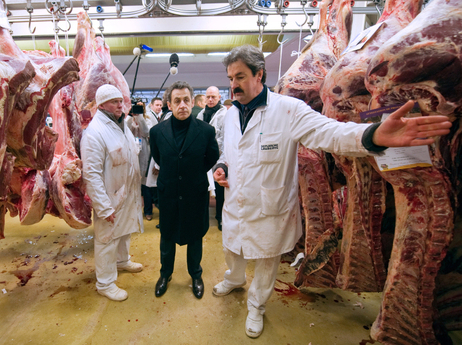
Meat often enters French politics, usually through the anti-immigrant rhetoric of the Front National (FN). In almost every recent election cycle, the FN pushes for the adoption of new anti-immigrant laws and regulations, especially targeted at France’s considerable Muslim population.

The FN often uses identity politics and racist rhetoric to get out its message. Over he past decade, the FN has also highlighted its anti-Muslim rhetoric by sponsoring soup kitchens that serve soupe au cochon (pig soup), so that only non-Muslims will benefit from the food donations.

Now, the FN is attacking halal meat (the Muslim equivalent of the Jewish Kosher process of slaughtering meat). The FN wants all halal meat to be labeled as such so that French consumers can choose to avoid halal meat and instead buy “traditional” meat.

The candidates for the French presidency will increasingly have to address identity politics during their election campaigns.  NPR reports on this story.

NPR also provides an update on Muslim bistrots that serve halal meat.

Northern Illinois University students in French and Mediterranean history courses will be interested in this story.

Posted in Food and Cuisine History, French History, Human Rights, Mediterranean World, Paris History, Religious Violence | 1 Comment

Graduate Programs in the Humanities

Graduate programs in the humanities across the United States are scaling back considerably by cutting their admissions.  The pattern of humanities departments limiting graduate admissions periodically (especially during economic recessions) is nothing new, but the scale of the cutbacks are significant.

Humanities departments and scholars are actively debating the ethical implications of admitting graduate students at a time of crisis in humanities funding and positions in academic institutions.

The American Historical Association and the Modern Language Association have published many reports and stories on the issue of graduate admissions and graduate program size.

The Chronicle of Higher Education reports on the admissions cutbacks and the academic debate over graduate admissions policies.

History departments figure significantly in The Chronicle of Higher Education’s report:

The history department at the University of Wisconsin at Madison cut its new graduate admissions in half this past fall, to just 21 students. “Why train people if the outlook for professional historians is not nearly as good as it was five years ago?” asks Laird Boswell, director of graduate studies in the department.

Pennsylvania State University’s history department has gone even farther, dropping entire subfields in which graduate students were once invited to specialize and keeping only those in which it has a good track record of helping graduates find jobs. As of this academic year, it is no longer admitting students who want to write dissertations in 20th-century American history, modern European history, or medieval history. In the process, it is hoping to cut overall graduate enrollment by around 30 students—to a total of 40—in two years.

“This is the way of the future, and we’re way ahead of the curve here,” says Michael Kulikowski, chairman of the history department, which was featured at this year’s annual meeting of the American Historical Association as one of 10 departments doing innovative things. “People have been talking about the oversupply of unemployable Ph.D.’s in the humanities for several decades, and I think we’ve found a part of the solution. We are concentrating on areas where we can place students competitively.”

Historians and other humanities scholars will continue to debate these issues each year, as the graduate admissions season approaches.

Graduate students at Northern Illinois University will be interested in following the development of graduate program admissions policies.

Posted in Education Policy, Graduate Work in History, Humanities Education | Leave a comment

Facing History Positions Available

Facing History, an educational organization preparing teachers to teach history in public schools, has two positions open in its Chicago office.

Program Associate (M.A. degree preferred): full-time job

Development Assistant (B.A. degree required): full-time job

To apply, see the Facing History website.

Facing History

200 E. Randolph Street

Chicago, IL 60601

Northern Illinois University students with appropriate experience may be interested in these positions.

Posted in Careers in History, Graduate Work in History, Northern Illinois University, Undergraduate Work in History | Leave a comment

AHR Review of Warrior Pursuits

My monograph, Warrior Pursuits: Noble Culture and Civil Conflict in Early Modern France, has been reviewed in American Historical Review, the flagship journal of the discipline of History in the United States.

The review is by Ronald G. Asch, Professor of History at Universität Freiburg, and appears in American Historical Review 117 (February 2012): 278-279.

The AHR review is available via JSTOR through most major library databases.


Posted in Current Research, Early Modern Europe, European Wars of Religion, French History, French Wars of Religion, Noble Culture and History of Elites, War, Culture, and Society, Warfare in the Early Modern World | Leave a comment

Denying Communion in DC

The Washington Postreports on a Christian woman who was denied Communion in Washington, D.C.:Deep in grief, Barbara Johnson stood first in the line for Communion at her mother’s funeral Saturday morning. But the priest in front of her immediately made it clear that she would not receive the sacramental bread and wine.

Johnson, an art-studio owner from the District, had come to St. John Neumann Catholic Church in Gaithersburg with her lesbian partner. The Rev. Marcel Guarnizo had learned of their relationship just before the service.

“He put his hand over the body of Christ and looked at me and said, ‘I can’t give you Communion because you live with a woman, and in the eyes of the church, that is a sin,’ ” she recalled Tuesday.

Barbara Johnson

To deny someone a role in his or her mother’s funeral for whatever reason is shocking and cruel. Such a denial being employed on the basis of someone’s sexual orientation is blatantly discriminatory.

The specific form of denial used in this episode has a long history, however.

Denying Communion to a Christian challenges the status of that believer’s soul, effectively accusing the person of living in sin, which threatens his or her salvation. Christian religious authorities have used the tactic of denying access to the Eucharist (body and blood of Christ) for centuries, although it is somewhat rare to hear of it in today’s world.

The issues of who (if anyone) has the authority to deny Communion and under what circumstances has been debated by Christian theologians. Denial of Communion may be perceived as an act of discrimination or even as an aggressive attack on a believer. Religious authorities and organization have long been empowered to discriminate against believers and to expel lay people who fail to meet their standards.

Historians of early modern Europe are familiar with evidence of Catholic authorities denying Communion to believers. In the Latin Christian Church, the Pope periodically used excommunication to bar individuals, or even entire communities, from Communion.  Protestant churches have used very similar tactics from the early days of the Protestant Reformation. Lutheran communities outlawed Masses for the Dead and insisted that believers conform to a new liturgy for the Eucharist. Calvinist churches in Geneva and Scotland excluded sinners from the Lord’s Supper, as they referred to Communion as a commemorative act. The Council of Trent clarified and standardized the Catholic liturgy of the Mass, as well as techniques for dealing with “defects” in the celebration of the Eucharist. Some early modern historians see these tactics as part of a much broader pattern of “social disciplining” during the period of the Catholic and Protestant Reformations.

Sixteenth-century Reformers intensely debated the proper meaning and form of celebrating the Eucharist. Such debates were not merely intellectualized theological debates, since ordinary Christian priests and believers had to negotiate how to perform Communion rituals in their local communities. The sharp differences over this central Christian act were instrumental in producing the European Wars of Religion.

This historical context suggests that acts of denying Communion should be perceived as acts of religious intolerance and symbolic violence.

For more information on the historical development of Communion during the period of the Reformations, see: Lee Palmer Wandel, The Eucharist in the Reformation: Incarnation and Liturgy (Cambridge: Cambridge University Press, 2006).

Northern Illinois University students in HIST 414 European Wars of Religion, 1520-1660 will be interested in the Washington Post article.

Update: the Washington Post has published another article updating this story.

Posted in Early Modern Europe, Early Modern World, European Wars of Religion, French Wars of Religion, Religious Violence | Leave a comment

Ritual and Violence

The French Wars of Religion are featured in a new special issue of Past & Present, which reexamines Natalie Zemon Davis’s concept of “rites of violence” 40 years after her landmark article. The issue is entitled “Ritual and Violence: Natalie Zemon Davis and Early Modern France,” ed. Graeme Murdock, Penny Roberts, and Andrew Spicer, Past & Present, supplement 7 (2012).

The supplement’s table of contents:

Preface, 7
Graeme Murdock, Penny Roberts, and Andrew Spicer

1. Introduction

Writing ‘The Rites of Violence’ and Afterward, 8
Natalie Zemon Davis

2. Rites and Ritual

Rites of Repair: Restoring Community in the French Religious Wars, 30
Barbara B. Diefendorf

Religious Violence in Sixteenth-Century France: Moving Beyond Pollution and
Purification, 52
Mack P. Holt

Peace, Ritual, and Sexual Violence during the Religious Wars, 75
Penny Roberts

3. Rights and Agency

Massacres during the French Wars of Religion, 100
Allan A. Tulchin

The Rights of Violence, 127
Stuart Carroll
Prophets in Arms? Ministers in War, Ministers on War: France, 1562–74, 163
Philip Benedict

4. Rites and Representation

Rites of Torture in Reformation Geneva, 197
Sara Beam
From Christ-like King to Antichristian Tyrant: A First Crisis of the Monarchical
Image at the Time of Francis I, 220
Denis Crouzet (Translated by Philippa Woodcock)

Painting Power: Antoine Caron’s Massacres of the Triumvirate, 241
Neil Cox and Mark Greengrass
5. Afterword, 275
Graeme Murdock and Andrew Spicer

Posted in European Wars of Religion, French History, French Wars of Religion, History of Violence, Religious Violence, Warfare in the Early Modern World | Leave a comment

Mediterranean World Workshop

The first meeting of the Mediterranean World Workshop will be held on Thursday 1 March at O’Leary’s in DeKalb at 5:15.

The Mediterranean World Workshop is a new group of professors and graduate students interested in Mediterranean history from antiquity to today.  This group is being formed based on common research and teaching interests in Mediterranean studies within the Department of History at Northern Illinois University.  Damián Fernandez studies Iberia and the Mediterranean in late antiquity and teaches courses on the Roman Empire.  Valerie Garver, a Carolingianist, has teaching interests in the expansion of Islam and Christian-Muslim relations in the medieval Mediterranean.  Brian Sandberg does research on the French Mediterranean and teaches on the early modern Mediterranean world.  Ismael Montana studies the trans-Saharan slave trade, North African culture, and the modern Mediterranean.

Our aim is to meet 2 or 3 times per semester to discuss recent work in Mediterranean history, including unpublished works by workshop members.

We will begin by discussing two recent articles on Mediterranean history:

Peregrine Horden and Nicholas Purcell, “The Mediterranean and ‘the New Thalassology,'” American Historical Review 111 (June 2006): 722-740.

Walter Scheidel and S. Friesen, “The Size of the Economy and the Distribution of Income in the Roman Empire,” The Journal of Roman Studies 99 (2009): 61-91.

Both of these articles are available through NIU Library databases.

We hope that you will be able to join us for the first meeting of the Mediterranean World Workshop.

best,

Damián Fernández and Brian Sandberg, co-organizers

Posted in Conferences, Mediterranean World | Leave a comment

Act of Valor: Entertainment or Propaganda?

The new film, Act of Valor, depicts Navy SEALs in action against smugglers and terrorists. The film openly touts its active-duty SEALs who act as the protagonists in the film, alongside plenty of military hardware and vehicles. The filmmakers reportedly shot scenes of actual SEALs drills and training exercises. The film highlights the cozy relationship between Hollywood and the Pentagon, leading many analysts to question whether the film is merely entertainment or outright propaganda.

An article in the Washington Post investigates the motives of the filmmakers and examines the production of the film. The important role of the SEALs in current anti-terrorist operations makes this discussion timely.

Northern Illinois University Students in HIST 390 History and Film: War in Film will be interested in this article.

Posted in Historical Film, History in the Media, Terrorism, War in Film, War, Culture, and Society | Leave a comment