
Elon Musk may exhibit highly erratic and volatile behavior, but he espouses a coherent Technocratic and Fascist ideology that was articulated in the 1930s.
Jill Lepore, Professor of History and Law (Harvard University), traces the history of Elon Musk’s grandfather, Joshua Haldeman, and his role in the development of the Technocracy and Fascist movements of the 1930s.
Lepore writes that “I was again struck at how little of what Mr. Musk proposes is new and by how many of his ideas about politics, governance and economics resemble those championed by his grandfather Joshua Haldeman, a cowboy, chiropractor, conspiracy theorist and amateur aviator known as the Flying Haldeman. Mr. Musk’s grandfather was also a flamboyant leader of the political movement known as technocracy.”

According to Jill Lepore, “Leading technocrats proposed replacing democratically elected officials and civil servants — indeed, all of government — with an army of scientists and engineers under what they called a technate. Some also wanted to annex Canada and Mexico. At technocracy’s height, one branch of the movement had more than a quarter of a million members.”
“Under the technate,” she explains, “humans would no longer have names; they would have numbers. One technocrat went by 1x1809x56. (Mr. Musk has a son named X Æ A-12.) Mr. Haldeman, who had lost his Saskatchewan farm during the Depression, became the movement’s leader in Canada. He was technocrat No. 10450-1.”
After the Technocratic movement splintered and Haldeman’s political career in Canada failed, he moved to South Africa in 1950, excited to join the fledgling Apartheid state just being constructed there.
“Much that Mr. Musk has attempted to do at DOGE can be found in the technocracy manuals of the early 1930s,” according to Jill Lepore.
Lepore documents Musk’s fascination with his grandfather Joshua Haldeman’s Technocratic ideology and his application of its ideas and principles.
“Mr. Musk’s possible departure from Washington will not diminish the influence of Muskism in the United States. His superannuated futurism is Silicon Valley’s reigning ideology. In 2023 the venture capitalist Marc Andreessen, who helped staff DOGE, wrote ‘The Techno-Optimist Manifesto,’ predicting the emergence of ‘technological supermen.’ It consists of a list of statements:
We can advance to a far superior way of living and of being.
We have the tools, the systems, the ideas.
We have the will. …
We believe this is why our descendants will live in the stars. …
We believe in greatness. …
We believe in ambition, aggression, persistence, relentlessness — strength.
“Mr. Andreessen cited, among his inspirations, Filippo Tommaso Marinetti, who in 1909 wrote ‘The Futurist Manifesto,’ which glorified violence and masculine virility and opposed liberalism and democracy. It, too, is a list of statements:
We want to sing the love of danger, the habit of energy and rashness.
We want to exalt movements of aggression, feverish sleeplessness, the double march, the perilous leap, the slap and the blow with the fist. …
We want to sing the man at the wheel. …
We want to demolish museums and libraries, fight morality, feminism. …
Standing on the world’s summit, we launch once again our insolent challenge to the stars!
“Ten years after Mr. Marinetti wrote ‘The Futurist Manifesto,’ fists raised to the stars, he co-wrote the founding document of the movement led by Mussolini: ‘The Fascist Manifesto.'”
Marinetti’s influence on Mussolini’s Fascist ideology has long been analyzed by Italian historians studying Fascist Italy.
One of my personal favorites in this line of historical work is Claudio Segrè’s Italo Balbo: A Fascist Life (1990). I studied with Claudio Segrè as an undergraduate History major at the University of Texas at Austin.
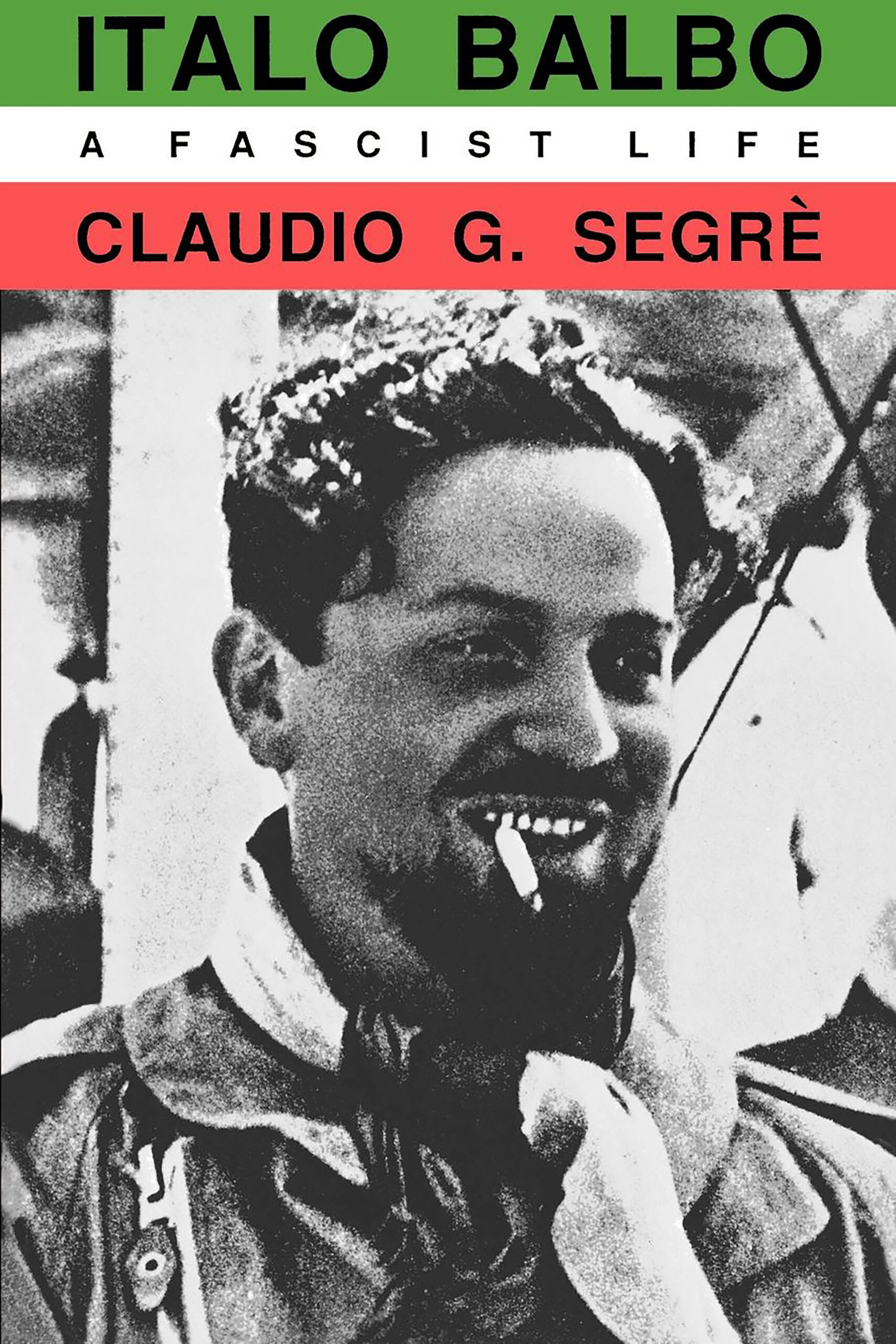
The book description reads: “Pioneering aviator, blackshirt leader, colonial governor, confidante and heir-apparent to Benito Mussolini, the dashing and charismatic Italo Balbo exemplified the ideals of Fascist Italy during the 1920s and 30s. He earned national notoriety after World War I as a ruthless squadrista whose blackshirt forces crushed socialist and trade union organizations. As Minister of Aviation from 1926 to 1933, he led two internationally heralded mass trans-Atlantic flights. When his aerial armada reached the U. S., Chicago honored him with a Balbo Avenue, New York staged a ticker-tape parade, and President Roosevelt invited him to lunch. As colonial governor from 1933 to 1940, Balbo transformed Libya from backward colony to model Italian province. To many, Italo Balbo seemed to embody a noble vision of Fascism and the New Italy. Pioneering aviator, blackshirt leader, colonial governor, confidante and heir-apparent to Benito Mussolini, the dashing and charismatic Italo Balbo exemplified the ideals of Fascist Italy during the 1920s and 30s. He earned national notoriety after World.”
Claudio Segrè’s fascinating portrait of Italo Balbo reveals the melding of Futurism and Fascism in the aviation culture in Fascist Italy in the 1920s and 1930s.
“Muskism isn’t the beginning of the future,” Jill Leporte insists. “It’s the end of a story that started more than a century ago, in the conflict between capital and labor and between autocracy and democracy. The Gilded Age of robber barons and wage-labor strikes gave rise to the Bolshevik Revolution, Communism, the first Red Scare, World War I and Fascism. That battle of ideas produced the technocracy movement, and far more lastingly, it also produced the New Deal and modern American liberalism. Technocracy lost because technocracy is incompatible with freedom.”
Lepore concludes that “That is still true, but unlike his forefathers, Mr. Musk does have a theory for the assumption of power. That theory is to seize power with the dead robotic hand of the past. It remains for the living to wrest free of that grip.”
Lepore, Jill. “The Failed Ideas That Drive Elon Musk.” The New York Times (4 April 2025).
Segrè, Claudio. Italo Balbo: A Fascist Life (Berkeley, CA: University of California Press, 1990).


