Revolutionary Waves

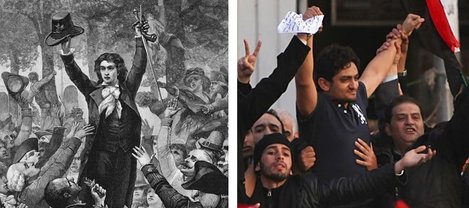
The ongoing Arab protests and revolutionary movements are simultaneously fascinating, inspiring, and confusing.

One of my students in HIST 423 French Revolution and Napoleon sent me this great question: “Do you know of a historical, sociological, or political theory that would attempt to explain why or how the political demonstrations that began in Tunis eventually spread throughout the Middle East? During the break I have been reading a variety of ‘comparative revolutionary studies literature,’ . . . but these works are focused on identifying the origins of revolutionary upheavals, or categorizing revolutionary phases, etc. I have not been able to find a theoretical framework, other than the ‘domino theory,’ that can be applied to the political situation in the Middle East, with respect the spread of demonstrations, or one that would predict, or explain the spread of a revolutionary movement from one region, or from one country to another.  Are there any books or articles you can refer me to?”

This is a great question, but a complex one!

Comparative revolutionary studies is a vast field, and there are a number of different theoretical approaches to comparing revolutionary movements. Many revolutionary theories focus on comparing “great” revolutions, such as the French Revolution of 1789 and the Russian Revolution of 1917, over time.  A good example of this approach is David Parker, ed., Revolutions and the Revolutionary Tradition in the West, 1560-1991 (London: Routledge, 2000).  Other comparative approaches consider successive revolutions within a single nation, as when a study examines the 1789, 1830, 1848, and 1871 revolutions in France.  Charles Tilly, The Contentious French (Cambridge, MA: Belknap Press, 1989), is an exemplary study of this kind. Some comparative revolutionary theories and histories do examine contemporaneous revolutionary movements, providing intriguing historical perspectives for considering the current Arab revolutions.  The remainder of this post introduces some of the key works in this field.

Classic Marxist studies see revolutions as responses to changes in economic modes of production, so revolutions should occur in waves across geographic areas affected by similar economic conditions.  Karl Marx himself analyzed the French Revolution and the Revolutions of 1848 through this method, and predicted a coming revolution of the proletariat.  Many other Marxist historians, political scientists, and sociologists have since adapted Marx’s methods to other cases of revolutions, especially the Russian Revolution of 1917 and the Chinese revolution of 1949.

Decolonization movements in India, southeast Asia, and Africa in the 1940s-1960s prompted a new round of comparative revolutionary studies.  Many of the decolonization struggles have been described principally as nationalist movements, but some see transnational forces such as Arab nationalism or pan-Africanism as crucial to decolonization. The Civil Rights movement in the United States is sometimes also set into decolonization frameworks of analysis.  The prolonged guerrilla and counter-insurgency warfare in Algeria and Indochina (Vietnam) brought sustained analysis of revolutionary movements in both areas.  These conflicts and revolutionary movements in Latin America led scholars such as Edward E. Rice to describe “wars of the third kind” as explaining similar dynamics in conflicts that were dominated by unconventional war (as opposed to conventional warfare or nuclear war).

Ted Robert Gurr and other theorists developed social and political models to explain revolutionary preconditions and processes, debated with Marxist scholars in the 1960s and 1970s.

In the 1960s and 1970s, R.R. Palmer examined the American, French, and other late eighteenth-century revolutions through the lens of an “Age of Democratic Revolutions,” by which he referred principally to the spreading of democratic ideals throughout Europe and the Atlantic World.

Charles Tilly’s model of revolutionary situations and revolutionary outcomes offers another method for studying revolutionary movements comparatively, although his framework is based on a state-by-state analysis.  Tilly has numerous books on revolutions (published from the late 1960s to the 2000s), but perhaps the best introduction to his work on revolutions is European Revolutions, 1492-1992 (Oxford: Blackwell, 1993).

Jack A. Goldstone (following Theda Skocpol) has produced an interesting theory of “state breakdowns” as explaining revolutions.  His theory is comparative, but (like Tilly) is largely based on analyzing individual states, then comparing results.  Goldstone does “waves of state breakdowns” as sweeping through Europe at certain historical moments in his Revolution and Rebellion in the Early Modern World (Berkeley: University of California Press, 1991).

The revolutions of 1989 led to an outpouring of writing on the revolutions.  There have been numerous comparative analyses, but often focused on the Eastern European Communist bloc as a linked unit, and thus based ultimately on the collapse of the Soviet Union.

The Chinese and Iranian revolutions have often been left out of comparative analyses, except by Asian and Middle Eastern specialists such as Jeffrey Wasserstrom and Farrokh Moshiri.  A comparative approach considering European and Asian examples of revolutionary movements is provided in Mark N. Katz, Revolutions and Revolutionary Waves (Palgrave Macmillan, 1997).

More recently, historians have examined the spread of human rights language through abolition movements, novels, and literature.  Some historians identify a series of cultural revolutions in the Atlantic World, seeing the Haitian Revolution as the most radical.  Others see global dimensions of the spread of the concept of human rights or modern political culture, even in India and beyond.  For an example of this line of study, see: Jeffrey N. Wasserstrom, Lynn Hunt, and Marilyn B. Young, eds., Human Rights and Revolutions (Lanham, MD: Rowman and Littlefield, 2000).

In recent years, the various “color” revolutionary movements of Eastern Europe and elsewhere in the 2000s have prompted some comparative study.

I will post my bibliography on comparative revolutions once I have a chance to update it.
Posted in Comparative Revolutions, French Revolution and Napoleon, History in the Media, History of Violence, The Past Alive: Teaching History | Leave a comment

The American Civil War Remembered in the South

History is in the news all this spring as the 150th anniversary of the beginning of the American Civil War approaches.  The New York Times is running an almost daily series of blog posts on the 150th anniversary, entitled Disunion, and numerous other news media are running stories.

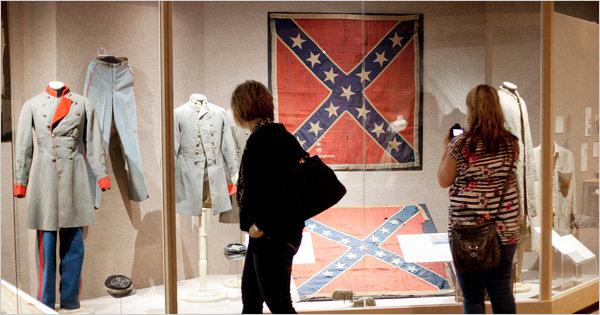
Today, there is a story about the construction of historical memory of the American Civil War in Southern museums.  This is a subject that has been well researched by academic historians and discussed by popular writers on the Civil War, but this article provides a nice introduction to the complex productions of historical memory of the war in Southern culture.

Students in my HIST 390 War in Film course have been grappling with these issues as we analyze American Civil War films such as Gone with the Wind and Glory.


Posted in Civil Conflict, Historical Film, History in the Media, The Past Alive: Teaching History | 1 Comment

New Special Adviser at the University of Texas

More news today of the growing politicization of university administrations across the United States.  While university faculty positions nationwide have remained almost stable over the past generation, administrative jobs have grown incredibly.  The Chronicle of Higher Education recently estimated the administrative expansion at 20 percent over the past 20 years!  This administrative growth includes numerous highly paid non-academic manager positions such as vice presidents, associate deans, assistant deans, and coordinators.

Today, there are reports of a newly created Special Adviser position (salary $200,000) at the University of Texas that has been given to a non-academic entrepreneurial adviser who runs his own political policy consultant group.

This story, reported in the New York Times, helps reveal why the constitution of university boards and administrative positions will determine the future of public higher education.

Posted in Education Policy | Leave a comment

Remembering Japanese Earthquake Victims

Remembering the victims of the recent Sendai earthquake and tsunami….

The tremendous human losses from this massive disaster are incredibly tragic.  No words can express our sorrow at such terrible devastation.

Even as we remember the victims, we may wish to reconsider whether or not this was a “natural disaster.”  Historians have recently begun to explore the history of disasters, including earthquakes, in comprehensive ways.  René Favier, professor of history in Grenoble, has been studying changing patterns of human responses to natural disasters. Other historians raise questions regarding the extent to which human settlement patterns,  environmental transformations, and poverty conditions often contribute to “natural” disasters.

Historian Gregory Smits provides an especially relevant perspective on the history of Japanese experiences of earthquakes in the early modern and modern periods.  His recent article is “Shaking Up Japan: Edo Society and the 1855 Catfish Picture Prints,” Journal of Social History 39 (Summer 2006): 1045-1078.

Here is the abstract for the article:

“Following the Ansei Edo Earthquake of 1855, Japanese print makers produced hundreds of varieties of catfish picture prints (namazu-e). These prints afforded the common people of Edo (soon to become Tokyo) an ideal vehicle for commenting on politics and society under the cover of discussing the recent earthquake. Some were sharply critical of the existing situation, and some adumbrated alternative political and social visions. One of these visions was of “Japan” as a natural community. Some prints portrayed the earthquake that shook Edo as having shaken all of Japan, and others incorporated events of the recent past into new narratives of world-renewal and change. The solar deity Amaterasu, who played a prominent role in national ideology after 1868, first came to widespread attention in Edo via these prints. In this and other ways, the catfish picture prints helped lay the psychological groundwork for the process of “making Japanese” that would begin in earnest after 1868. Furthermore, owing to a coincidence in which 1855 and 1867 were both years of special religious significance, it is likely that the folk memory of the Ansei Edo Earthquake helped condition popular expectations of upheaval and change during the Tokugawa bakufu’s final year.”

Earthquakes have histories, and we should move beyond mere recounting of statistics to understand their broader significance for human societies and the environment.


Posted in Environmental History, History in the Media | Leave a comment

Raising Teachers’ Status

Teachers’ economic and social status in American society is widely perceived to be in decline.  Although it is very difficult and highly subjective to measure any profession’s status, a new study attempts to gauge teachers’ status in a number of industrialized nations and formulate comparisons.

The lead author of the report argues that “Teaching in the U.S. is unfortunately no longer a high-status occupation.”

The New York Times article on this story also has a link to the original report.


Posted in Education Policy | Leave a comment

Phrygian Cap Still Used as Revolutionary Symbol

The Phrygian cap is still being used as a revolutionary symbol, more than 200 years after the French Revolution.  Stéphane Hessel recently wore a Phrygian cap while speaking at a pro-Palestinian rally. This story is very timely for my HIST 423 French Revolution and Napoleon class, since we are currently discussing political culture and revolutionary symbolism in the French Revolution.

Hessel’s best-selling pamphlet, Indignez-Vous!, has ignited a new debate within France about Israeli policies toward Palestine.  The pamphlet has been translated into English and has been reprinted by The Nation magazine.  The New York Times reported today on Hessel’s pamphlet and the controversy surrounding it.

Posted in Comparative Revolutions, French History, French Revolution and Napoleon, History in the Media | 1 Comment

Robert Darnton Comments on Egyptian Revolution

French historian Robert Darnton recently commented on the ongoing Egyptian Revolution.  Historians of the Ancien Régime and the French Revolution, including David Bell and James Collins, have been actively considering various comparisons between the French Revolution of 1789-1794 and the still unsettled Egyptian Revolution of 2011.

Read Robert Darnton’s piece in the New York Review of Books online.


Posted in Comparative Revolutions, French Revolution and Napoleon, History in the Media | Leave a comment

Italy-Libya Arms Deal

Italy has long had a close (some would argue neocolonial) relationship with Libya.  Recent revelations of a major shipment of small arms from Italy to Libya is disappointing, but hardly surprising.  Those Italian arms are surely now being used in the growing conflict in Libya.

Read more about this arms deal at EU Observer online.

Posted in Uncategorized | Leave a comment

NIU History Professor Discusses Wisconsin Labor Battles

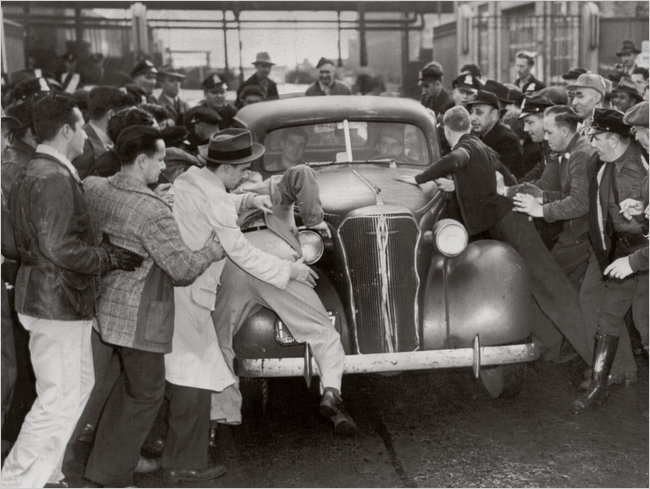
Professor Rosemary Feurer contributed to a New York Times article this weekend on “Wisconsin’s Legacy of Labor Battles.” Professor Feurer is a labor historian and a colleague of mine in the Department of History at Northern Illinois University.  Feurer argues that “the play by the governor [Walker] is part of a longer history and a longer struggle over ideas and social policy,” citing patterns of anti-union network activity in the Midwest over the past century.

Congratulations to Rosemary Feurer on her contribution to this significant article, which provides crucial historical context on the current labor crisis in Wisconsin.

See the entire article in the Week in Review section of the New York Times or online at the New York Times.

Posted in History in the Media, Humanities Education, Northern Illinois University | Leave a comment

French Historian’s Blog

Jim Collins, a friend and French historian colleague who is Professor of History at Georgetown University, now has an active blog on French history and comparative revolutions.

Current posts are focused on the ongoing demonstrations and revolutions in the Arab world.

Check out Jim Collins’s blog here.

Posted in Comparative Revolutions, French History, French Revolution and Napoleon | Leave a comment