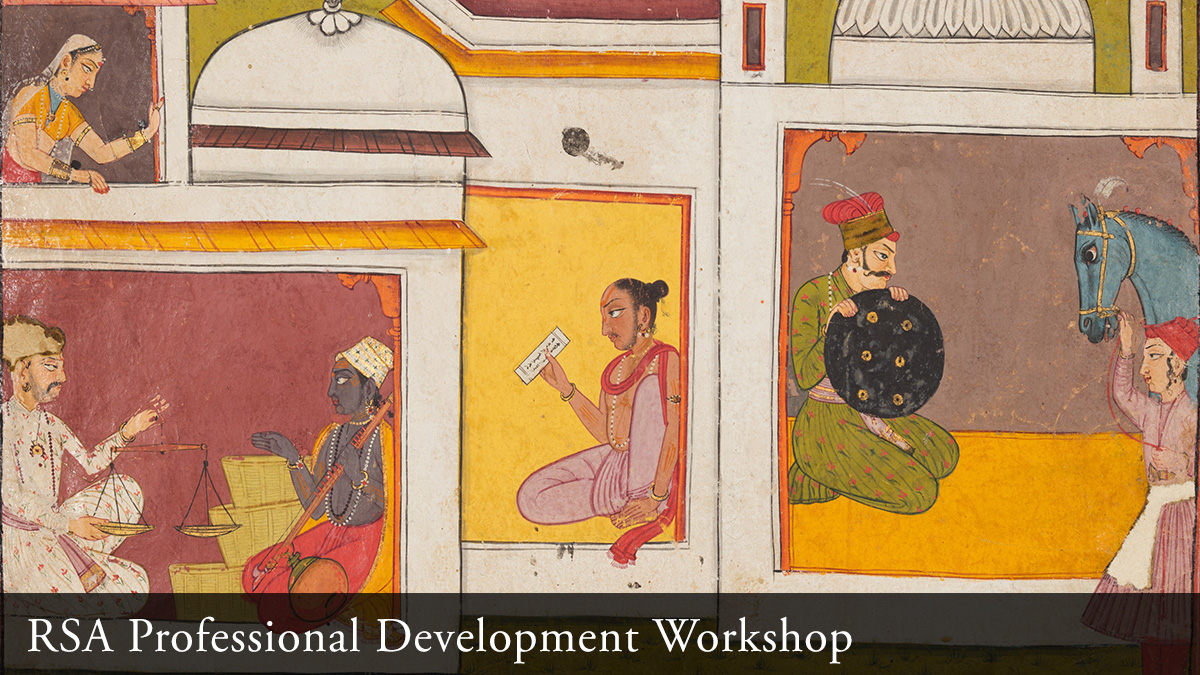
Panelists will discuss the perpetual challenge of finding the time to write while also juggling heavy teaching, administrative, public facing, or other commitments.
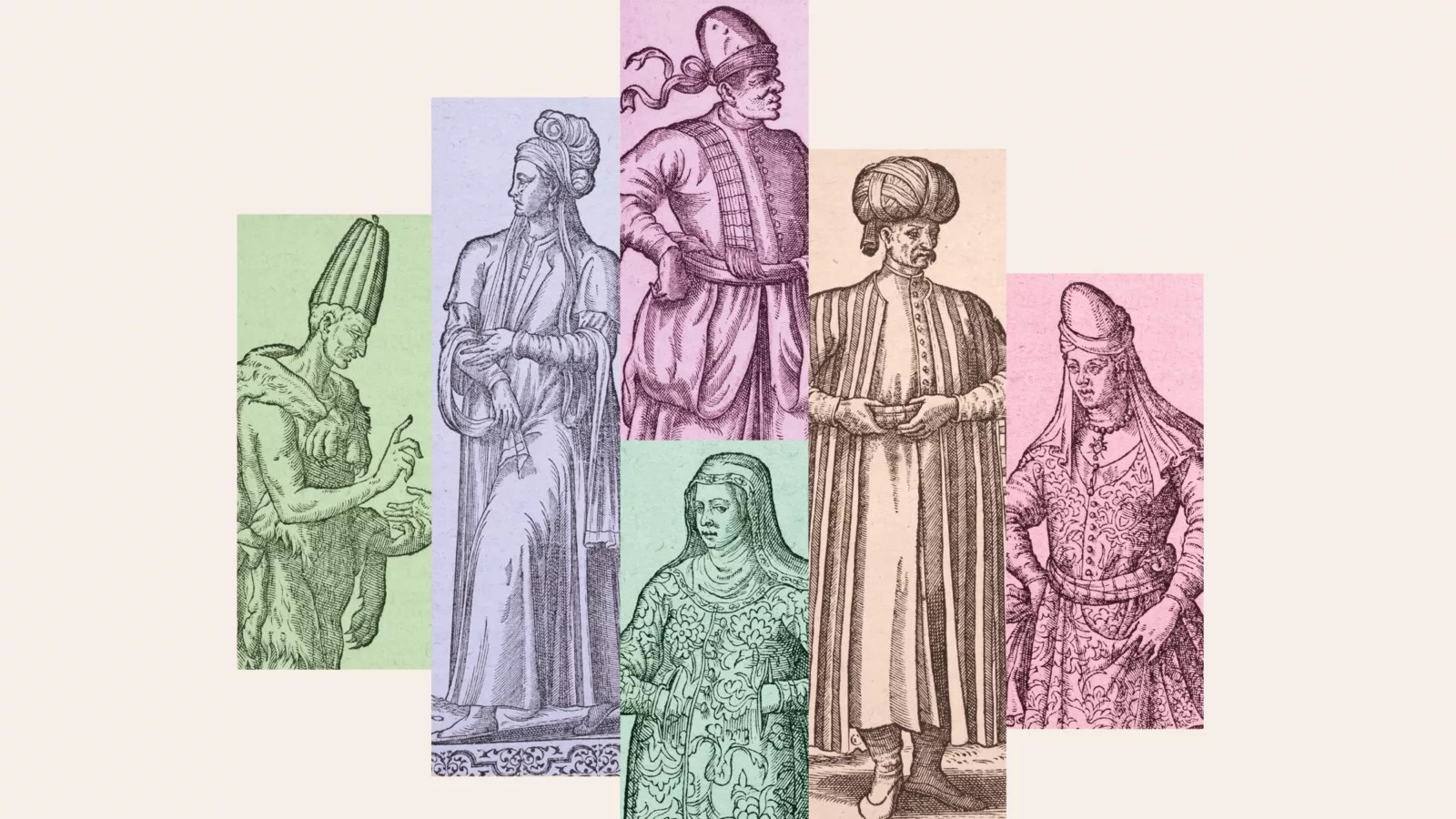
The Newberry Library in Chicago is preparing to open a new exhibition on Seeing Race Before Race, curated by the Center for Renaissance Studies in collaboration with the researchers associated with the RaceB4Race network.
The Newberry Library website provides an overview of the exhibition:
“Race is a powerful and challenging concept. When, where, and why did conceptions of race come into being? How might learning about its history help us better understand the complex role that race plays in our lives today?
“Centuries before the term race came into popular use, people around the world used distinctions like language, dress, class, geography, and religion—in addition to traits like skin color or facial features—to categorize each other. Seeing Race Before Race explores these early expressions of race in medieval and early modern Europe between 1100 and 1800.
“Seeing Race Before Race is generously supported by the Carl & Marilynn Thoma Foundation, the Samuel H. Kress Foundation, and Pam and Doug Walter.
Brian Sandberg on Zemmour contre l’histoire, Tracts Gallimard no. 34 (2022)
Daniel A. Gordon on Brigitte Granville, What Ails France (2021)
Aurelie Toitot on Sara Hume, Regional Dress Between Tradition and Modernity (2022)
Helen Abbott on Nikolaj Lübecker, Twenty-first-century Symbolism, Verlaine, Baudelaire, Mallarmé (2022)
Héloïse Elisabeth Marie-Vincent Ghislaine Ducatteau on B. Martin, Zwischen Verklärung und Verführung: Die Frau in der französischen Plakatkunst des späten 19. Jahrhunderts (2016)
Elizabeth Benjamin on Kathryn Robson, I Suffer, Therefore I Am: Engaging with Empathy in Contemporary French Women’s Writing (2019)
Héloïse Elisabeth Marie-Vincent Ghislaine Ducatteau on D. Roster, Lou Koster. Komponieren in Luxemburg (2020)
Beth Kearney on Antonia Wimbush, Autofiction: a Female Francophone Aesthetic of Exile (2021)
My good friend David Krugler, Professor of History at the University of Wisconsin at Platteville, has published an impressive historical film review of Oppenheimer, the new feature film by Christopher Nolan about J. Robert Oppenheimer, one of the key architects of the atomic bomb.
Krugler is a specialist of the history of the early Cold War and civil defense responses to the threat of nuclear attacks. He critiques the film’s depictions of the Manhattan Project, the Trinity Test, and the development of atomic weapons.
“The test scene is spectacular, but the sustained drama in Oppenheimer comes from its vivid, sensitive depiction of the life and travails of the bomb’s most vital architect. To adapt Kai Bird and Martin J. Sherwin’s Pulitzer Prize-winning biography of Oppenheimer, American Prometheus, Nolan makes a daring narrative choice. He centers the story around Oppenheimer’s 1954 closed hearing before a security board of the Atomic Energy Commission (AEC). Despite Oppenheimer’s undisputed accomplishments, his prior associations with communists (which were well-known in 1942, when General Leslie Groves, the military director of the Manhattan Project, recruited him) have made him a target of powerful anti-communists at the height of the Red Scare.”
The full historical film review of Oppenheimer is entitled “Bringing Fire from the Gods,” and is published online on Law and Liberty.
Monarchies are alive and well in the twenty-first century. And, the notion that “constitutional monarchies” have tamed the power of rulers is perhaps misplaced….
The plans for King Charles III’s upcoming coronation ceremonies reveal new assertions of power and authority by a modern monarch.
“Coronation organizers will ask millions of King Charles III’s new subjects to cry out their allegiance to the monarch in unison from wherever they are watching the service, according to newly released plans for the ceremony,” according to the Washington Post.
“Anyone watching, streaming or listening to Saturday’s service will be invited to recite a new ‘homage of the people,’ sounding what organizers hope will form a ‘chorus of millions’ from across the royal realm to mark the symbolic accession of Britain’s new king.”
The text of the planned pledge of allegiance to King Charles III will read: “I swear that I will pay true allegiance to Your Majesty, and to your heirs and successors according to law. So help me God.”
Advocates of monarchical reform and of republicanism in the United Kingdom will probably be shocked by this political innovation and extension of royal authority.
British royal family watchers abroad often view monarchy as quaint, but it may be time to reexamine the continuing strength of the British monarchy and monarchies throughout the modern world.
The History Wars are being waged in classrooms in the State of Florida, as a new front in the broader Culture Wars across the United States.
Governor Ron DeSantis and the Republican-dominated state legislature of Florida have passed a series of laws restricting primary, secondary and higher education curricula, particularly affecting the teaching of historical subjects. The Stop WOKE Act (2022) has already been implemented, while additional legislation, such as House Bill 999, is currently under consideration.
These dangerous laws challenge the principle of academic freedom and disrupt the ability of professors and teachers to select course books, materials, curricular themes, and pedagogical approaches that are appropriate for the subjects they teach.
A reporter for the Washington Post writes: “A chill has fallen over the Sunshine State. On a recent visit to the University of Florida, a student asked me a question that seemed more appropriate to an authoritarian state than an American college campus. …”
The Washington Post reports on Florida college students’ responses to the History Wars: “When talking with me, some students responded to the changes with mockery, others with fear or sadness. But all felt that their education was being compromised and resented that the legislation would limit their choice of study.”
Student’s comment on the History Wars. Source: The Washington Post.
“‘Education can and should expose us to diverse perspectives,’ first-year student Megan Meese said. ‘Ignorance permits hate, discrimination and marginalization. And by limiting discussions and awareness of identity, the legislation in Florida is going to instill ignorance in our students, which will promote intolerance and inequity in our future.'”
Graduate students working on the history of war and society, civil conflict, and violence studies may be interested in attending upcoming conferences on related issues. Some of these conferences may still have open calls for papers for graduate students wanting to present their current research.
These listings are drawn from the Society for Military History Newsletter:
September 22-24 – Nineteenth Annual Seminar on the American Revolution. Fort Ticonderoga Museum, NY. Contact:rstrum@fort-ticonderoga.org.
September 27-30 – Northern Great Plains History Conference, Sioux Falls, SD. SMH panels coordinated by Mike Burns – smhatngphc@gmail.com.
October 25-29 – The Society for the History of Technology will hold its annual meeting in Long Beach, California. For more details as they become available, see the Society’s website at News – Society for the History of Technology (SHOT).
November 9-12 – The History of Science Society will hold its annual meeting in Portland, Oregon. For more details as they become available, see the Society’s webpage at History of Science Society (hssonline.org)
Jeremy Black, in collaboration with the Italian Society of Military History (SISM), is pleased to announce publication of a new edited volume titled Global Military Transformations: Change and Continuity, 1450-1800 by SISM. SISM, founded by Raimondo Luraghi in 1984, promotes the critical history of security and conflicts.
I was pleased to participate in this project and contributed a chapter on “Early Modern France and the Military Revolution” to the collective volume.
The book is now available online at Academia.edu and Research Gate:
The Army Heritage Center Foundation (AHCF) offers research grants to graduate students adn researchers who are working on military history.
Graduate students pursuing research on civil conflict, violence studies, and war and society may be interested in applying for a grant.
Here (below) is the announcement from the AHCF:
American military forces in Vietnam during the Vietnam War
Ruth Research Fellowship.
Graduate students in good standing may apply for the annual Ruth Fellowship. One student will be selected to receive a $1,500 research fellowship to engage in a concentrated 3 week summer research program with the Army Heritage Center Foundation (AHCF) at the U.S. Army Heritage and Education Center (USAHEC) in Carlisle, Pennsylvania. Funding for the award is graciously provided by AHCF Board Member, Christopher Gleason, in memory of and to honor the service of two members of his family. Applicants are not limited to topics of military history but may apply to work on any topic that the USAHEC collection supports. Applicants are encouraged to consult USAHEC’s online catalog and identify resources they would like to utilize for their research and include in their application. Currently, research at USAHEC is by appointment only, so the awardee will need to coordinate with USAHEC staff for an appointment and provide a pull list of materials in advance. Application deadline has been extended to May 1, 2023. Application is available at: https://www.armyheritage.org/wp- content/uploads/2022/12/Ruth-Application-Form-2.0.pdf.
Lieutenant Colonel John William Whitman Research Fellowship
In honor of Lieutenant Colonel John William Whitman, the Army Heritage Center Foundation is pleased to announce the LTC John William Whitman Research Grant. This grant of up to $1,750 is designed to provide monetary support to unfunded independent researchers who are working on under-explored topics of military history. Funded research is to be conducted at the U.S. Army Heritage and Education Center (USAHEC) in Carlisle, Pa. Applicants interested in the LTC John William Whitman Research Grant should submit an application including a proposed project budget, to the Army Heritage Center Foundation. Application deadline has been extended to May 1, 2023. Grant funds must be expended not later than August 31 the following year. Application is available at: https://www.armyheritage.org/wp-content/uploads/2020/06/WhitmanResearchGrant.pdf.
We are excited to invite you to a lively discussion led by the Association of Canadian University Presses (ACUP), Edinburgh University Press, Berghahn Books, and University of British Columbia.
Topics will include collection development strategies for university press books and the multitude of considerations from transaction processes to the value of content to academic institutions. Publishers will share their perspectives on the unrelenting challenges and tensions between the business of publishing books and their scholarly mission.
Our panelists include:
Arielle Lomness, Collections Librarian, University of British Columbia Okanagan Campus
Brian Scrivener, President, Association of Canadian University Presses, and Director, University of Calgary Press
This session is also an opportunity to meet the university press communities in Canada and the U.K. as well as the particular challenges of smaller scholarly presses.
We hope you’ll be able to join us and share your experiences and perspectives. Please share this invitation with colleagues who you think might be interested.