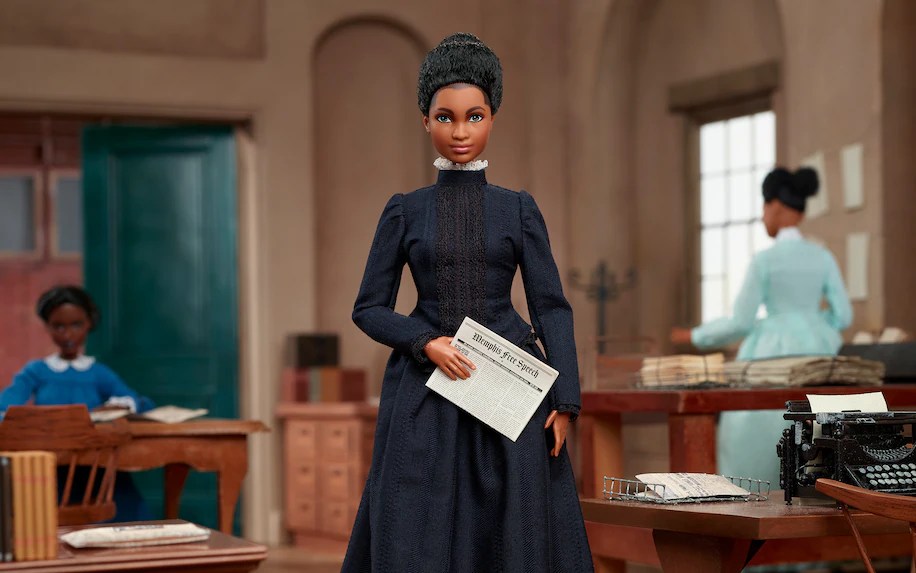
This Martin Luther King Day, a new historical action figure is being released. Mattel is launching a Barbie doll portraying Ida B. Wells.
The Washington Post reports that “Black American journalist, suffragist and anti-lynching crusader Ida B. Wells will have her likeness transformed into a Barbie doll to honor her historic achievements.
“Wells, who was born into slavery in Mississippi in 1862 during the Civil War, went on to break boundaries as a prominent suffragist fighting to expand the right to vote. Wells also won a posthumous Pulitzer Prize in 2020 for her ‘courageous reporting on the horrific and vicious violence against African Americans during the era of lynching’ and helped to found the National Association for the Advancement of Colored People (NAACP).”
Historical dolls and action figures have become quite popular among adult history fans, as well as children and teenagers.
Action figures depict major political and military leaders from many periods in world history: Ramses II, Alexander the Great, Genghis Khan, Pope Innocent III, George Washington, Wolfgang Amadeus Mozart, Napoléon Bonaparte, Karl Marx, Dwight Eisenhower, and The Beatles.
Historical action figures have been created for modern heroes of the Civil Rights movements, including Martin Luther King, Jr. Women’s Rights movements are celebrated with historical action figures of Susan B. Anthony and Ruth Bader Ginsburg, as well as images of powerful women like Rosie the Riveter and Wonder Woman.
Some historical action figures have been created for major historical commemorations. For example, Playmobil launched a Martin Luther action figure to coincide with the 500th anniversary of the Ninety-Five Theses in 2017.
Many graduate students and professors’ desks and bookshelves are now adorned with historical action figures.
The Washington Postarticle on the Ida B. Wells Barbie doll is available on its website.
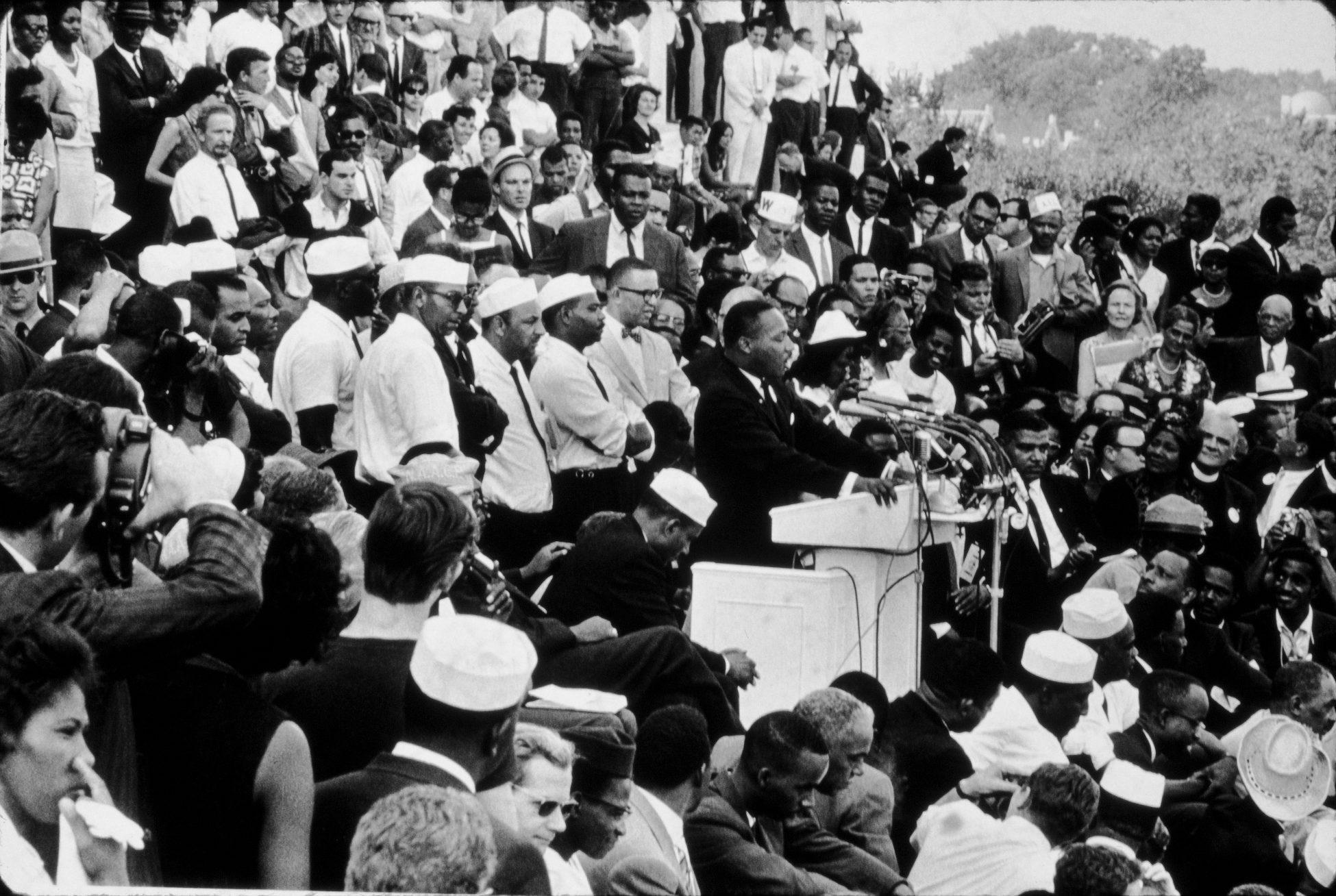
We are remembering Martin Luther King, Jr., and his powerful leadership of the Civil Rights Movement today on MLK Day 2022.
WBEZ in Chicago provides Studs Terkel’s famous recordings of the 1963 Train Ride to Washington, focusing on interviews with Chicagoans heading to Washington, D.C., to participate in the March on Washington. Many of those interviewees probably heard Martin Luther King, Jr., deliver his “I Have a Dream” speech.
Martin Luther King, Jr., commented in 1963 on the “minority of misguided senators” who would use the filibuster to block voting rights legislation.
The Washington Post recently reported on Dr. King’s comments on the filibuster and provided the video of those comments.
WBEZ provides Studs Terkel’s recordings on its website.
The Chicago History Museum offers a exhibition on Remembering Dr. King: 1929-1968, a virtual tour of Chicago sites associated with Martin Luther King, Jr.
Brown University’s Digital Publications Initiative is organizing an NEH Institute on Born-Digital Scholarly Publishing: Resources and Roadmaps in summer 2022.
Professors, post-doctoral researchers, and independent scholars working in Digital Humanities may be interested in this opportunity.
I have previously participated in NEH summer institutes and seminars for faculty and can recommend them highly.
Here is the announcement from Brown University’s Digital Publications Initiative, as posted on H-Net:
Brown University Library’s Digital Publications Initiative invites applications for participation in an NEH Institute on Advanced Topics in the Digital Humanities, Born-Digital Scholarly Publishing: Resources and Roadmaps. The three-week hybrid Institute will take place virtually July 11-24 and in person at Brown University July 25-29, 2022. Participant travel, lodging, and per diem expenses will be covered for the in-person component.*
Born-Digital Scholarly Publishing: Resources and Roadmaps supports scholars who wish to pursue interpretive projects that require digital expression and are intended for publication by a scholarly press, but who lack resources and capacity at their home institutions. Projects must be conceived of as born-digital, or digital-first. The Institute does not support digitization projects or the development of supplemental websites for print books, but rather publication projects anchored by an original, longform narrative. The Institute will train a cohort of 15 scholars – including unaffiliated scholars, adjunct professors, and part-time faculty from a range of disciplines, institution type, and geographical location – in best practices unique to the development of digital scholarly publications. The cohort will be supported by a faculty composed of authors of published or in-progress enhanced digital monographs and digital publishing experts from university presses and the Brown University Library.
The Institute has been organized as a hybrid, multi-phased training and mentoring program:
A two-week virtual course will introduce participants to resources, considerations, and strategies for digital publishing (July 11–22, 2022).
A one-week in-person workshop will yield individualized roadmaps for cohort projects (July 25–29, 2022).
Two two-day virtual check-ins will extend individualized project support (Oct. 2022 and Jan. 2023).
Eligibility
The application is open to scholars of all ranks, including university faculty and adjuncts, postdoctoral researchers, and independent scholars. Applicants must have a Ph.D.
Brown University Library is a member of the HBCU Library Alliance. Based on this affiliation, some slots will be reserved for participants from member institutions.
Applicants based in any country are welcome, though the NEH Institutes for Advanced Topics in the Digital Humanities (IATDH) program focuses on scholars currently studying or employed at institutions in the U.S. Thus, U.S. citizens and/or U.S.-based scholars will be given priority. International applicants and/or persons without a current U.S. visa should note that, if selected and if an in-person meeting is possible, a visa cannot be guaranteed.
How to Apply
The following materials should be sent to Allison Levy, Digital Scholarship Editor, Brown University Library (digitalpublishing@brown.edu), no later than March 15, 2022:
A statement (maximum 3 pages) thatdirectly addresses the following questions:
Describe your digital monograph project. Why is the digital format necessary for advancing your argument? What is the current state of the project?
How would your project benefit from and contribute to a collaborative Institute experience?
How will your participation in the Institute contribute to expanding digital scholarship at your institution or in your field?
A current C.V.
Notification of Acceptance: April 15, 2022
*Depending on public health guidelines related to COVID-19, plans for in-person training are subject to change.
All news reports adopt positions that are essentially political in nature (whether consciously or unconsciously), by presenting social issues through their selection of interview subjects, quotes, framing, interpretation, and commentary. Political philosophies and positions (not necessarily aligned with political parties) inform journalists’ choices in composing their reports. In this sense, the field of Journalism (like the discipline of History) is fundamentally interpretive. No reporter or columnist can escape from the interpretive nature of their practice.
News media companies and organizations inherently adopt political tendencies, since the editors (and sometimes the owners and managers) shape the selection of newsworthy events and issues, the reporting assignments, the writing and copyediting processes, the word counts of individual articles, the approval processes, the placement of articles within the print and/or online publication, the promotion and distribution of reports, and follow-up possibilities.
Unfortunately, these political positions and tendencies are often discussed simply through the lens of “biases,” which is a rather reductive and misleading notion in discussing news media.
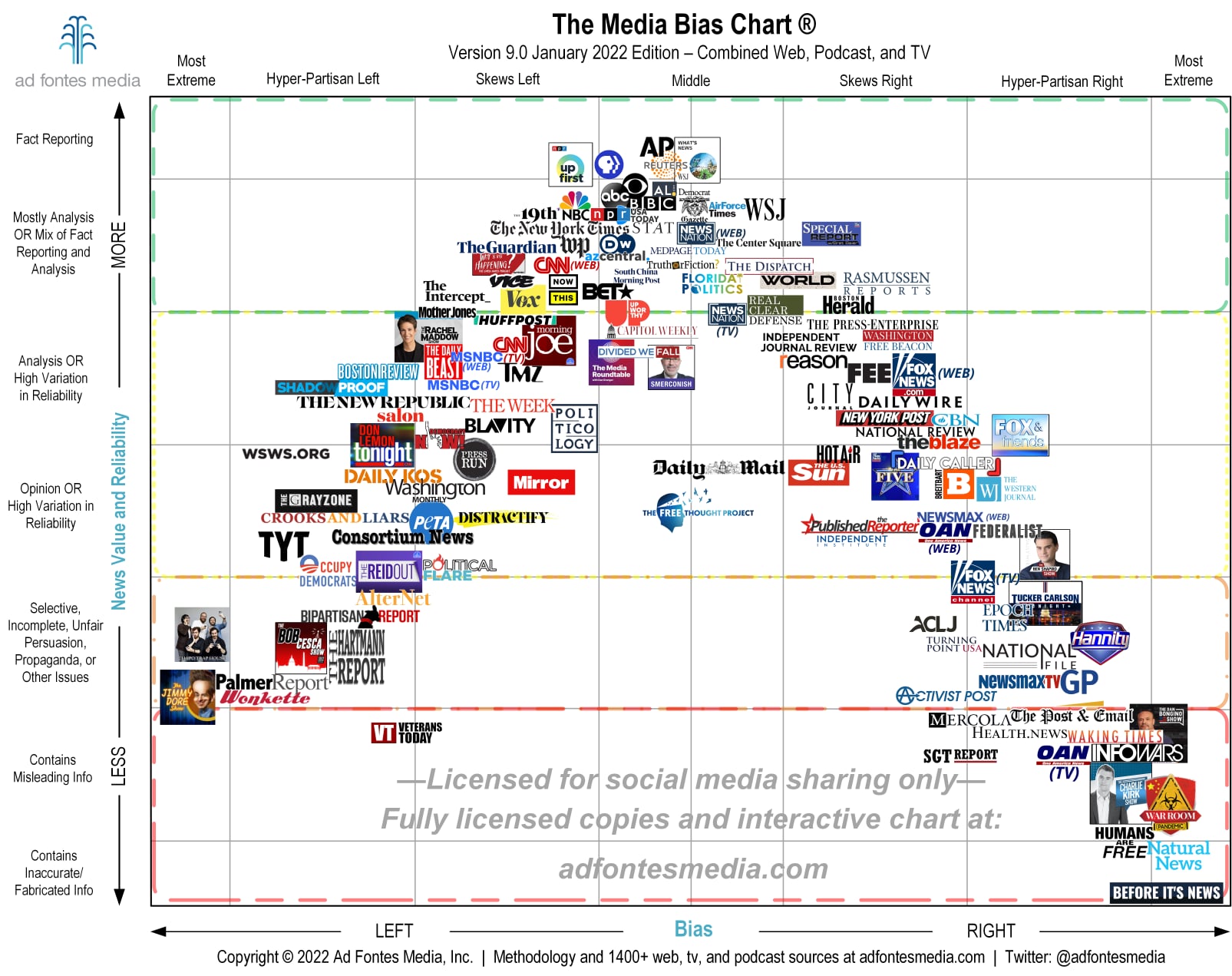
Many organizations seek to assess “media biases,” and Ad Fontes Media has just released its annual Media Bias Chart for 2022.
Media Bias Chart, 2022. Ad Fontes Media.
The Media Bias Chart provides an interesting visualization of the news media landscape in the United States, but its organization of media positions onto a Left – Middle – Right spectrum is highly problematic. This reifies an outdated model of politics which stems from the seating of deputies within the National Assembly during the French Revolution and their affiliations with Republican, Constitutional Monarchist, and Absolute Monarchist positions. However, these left, middle, and right distinctions broke down during the course of the French Revolution and Napoleonic Empire.
The Left, Middle, and Right spectrum was then used to describe classical political ideologies of nineteenth-century French and European political systems: Socialism, Liberalism, and Conservatism (with Communism eventually added). However, these ideological identifications with Left, Middle, and Right did not always work well to describe political identities or party affiliations. The distinctions were later modified to describe twentieth-century ideologies (Communism, Liberalism, and Fascism), Cold War ideologies, and the United States political system.
However, in the post-Cold War world, the continued use of Left, Middle, Right political labels has been completely disrupted by ethnic, racial, gender, environmental, and other political identities that simply cannot be grafted onto older political identification schemes. Political landscapes arguably need to be completely rethought.
Further the Media Bias Chart rates media organizations in terms of Skews (Left or Right) Hyper-Partisan (Left or Right), and Most Extreme (Left or Right), instead of actually identifying the positions and party affiliations or reporting. Further, the chart imagines a Middle as being unbiased, which reinforces an unattainable ideal news reporting as being “unbiased.”
Interestingly, there seems to be a sharp divergence between understandings of news media in the United States and Europe. Americans often complain of “biased” news reporting, but have no idea of political positions or affiliations of news organizations. Citizens of European nations are often much more aware of the political positions of the news media organizations that produce news reports. The public news media in many nations have channels designated for the majority party or coalition in the national parliament, as well as for the opposition party or coalition.
Since the late eighteenth century, newspapers, news radio channels, television news programs, and internet news companies have often had direct connections with organized political parties. Indeed, throughout modern history, many news media organizations have been official arms of political parties.
So, organizations like Ad Fontes Media might usefully alter their methodologies to investigate political positioning rather than “bias” in news media in the United States. Ad Fontes Media’s current Media Bias Chart uses a generic “left versus right” spectrum, rather than examining connections with particular political positions, parties, wings of parties, or organized political groups.
Ad Fontes Media’s mission statement reads: “Ad Fontes Media, Inc. is a company founded in 2018 by Vanessa Otero, creator of the Media Bias Chart®. The mission of Ad Fontes Media is ‘to make news consumers smarter and news media better.’ We rate the news for reliability and bias to help people navigate the news landscape. Ad Fontes is Latin for ‘to the source,’ because at the heart of what Ad Fontes Media does is look at the source—analyze the very content itself—to rate it. We have created a system of news content ratings that has beneficial applications for all stakeholders in a healthy news media landscape, including consumers, educators, publishers, researchers, advertisers, and social media platforms.”
At the same time, the Ad Fontes Media company is trying to sell memberships and products to individuals, media companies, and public school systems. So, readers may wonder about its political positions and educational agendas, too.
A deeper understanding of the history of news would arguably help students and citizens develop a better understanding of modern news media and a stronger analytical framework for reading news reports more critically.
For more information on the history of news media, see:
Peter Burke, A Social History of Knowledge, 2 vols. (Polity Press, 2000, 2012).
Peter Burke, What is the History of Knowledge (Polity Press, 2015).
Asa Briggs, Peter Burke, and Espen Ytreberg, Social History of the Media, 4th ed. (Polity Press, 2020). A book description is available at Polity Press.
Brendan Dooley, ed., The Politics of Information in Early Modern Europe (Routledge, 2001).
Brendan Dooley, ed., The Dissemination of News and the Emergence of Contemporaneity in Early Modern Europe (Ashgate, 2010).
Andrew Pettegree, The Invention of News (Yale, 2014).
Today, the FBI arrested a eleven members of the Oath Keepers, a far-right militia, over their involvement in the Storming of the United States Capitol on 6 January 2021. The U.S. Department of Justice is charging Stewart Rhodes, founder of the Oath Keepers, and his comrades with seditious conspiracy.
Stewart Rhodes, founder of the Oath Keepers. Image: The New York Times
Historians, political scientists, and scholars working on far-right political groups and militia organizations have been tracking the growing racial violence and civil conflict in the United States over the past decade. The Storming of the U.S. Capitol clearly brought heightened public awareness of these trends, even if some politicians have sought to downplay the threat of extremist violence and domestic terrorism.
Analysts have been debating the level of civil unrest and the forms and dynamics of violence. Much of the news media discussion of these issues has focused on whether or not there is a threat of a “civil war” in the United States, often referencing the American Civil War (1861-1865) as a model for understanding civil warfare. Yet, there are other ways of envisioning the potential for civil conflict in contemporary American society, which is deeply divided by partisan politics, culture wars, religious animosities, and racial tensions. After all, the United States has experienced many periods of serious civil conflict in its history that involved armed coercion, intimidation, political assassinations, bombings, raids, massacres, and guerrilla warfare.
Storming of the U.S. Capitol, 6 January 2021
Students who have taken my courses on Religious Violence in Comparative Perspective and on Religious Politics and Sectarian Violence over the past fifteen years have considered readings on far-right politics, militia movements, the Turner Diaries, Timothy McVeigh, and White Christian Nationalists in the context of terrorism and comparative religious violence. They have read works on comparative religious violence by Mark Juergensmeyer, Talal Asad, R. Scott Appleby, Stanley Tambiah, and other scholars to contextualize and understand this violence.
Last semester (Fall 2021), I taught a course on Communal Strife: Civil Wars in World History, in which students considered White Christian Nationalists and the Storming of the U.S. Capitol as a case of civil conflict. My students read analyses of the Storming of the Capitol by Kathleen Belew, Philip Gorski, Monica Duffy Toft, Stathis Kalyvas, and others. They also had the opportunity to compare the recent civil violence with other episodes of civil conflict from 1500 to the present.
The charging of the Oath Keepers with seditious conspiracy brings the potential for sedition and civil violence into sharper relief, as legal arguments will now be deployed on the issue.
The New York Times rightly indicates that “the arrest of Mr. Rhodes, 56, was a major development in the sprawling investigation of the Capitol attack. He and the other Oath Keepers are the first to be charged with sedition among the more than 700 people accused so far of taking part in the assault.”
According to The New York Times, “beginning only days after the 2020 election, Mr. Rhodes oversaw a seditious plot ‘to oppose the lawful transfer of presidential power by force,’ prosecutors said. Some members of the Oath Keepers under his command broke into the Capitol in a military-style formation on Jan. 6 and went in search of Speaker Nancy Pelosi, the indictment said. Others, it said, were stationed in a hotel in Alexandria, Va., as an armed ‘quick reaction force,’ ready to rush into Washington if needed.”
The active prosecution of the Oath Keepers for sedition should bring an awareness of the reality of civil conflict in United States society and the serious potential for further violence.
The New York Times reports on the arrest of the Oath Keepers and the charges of seditious conspiracy.
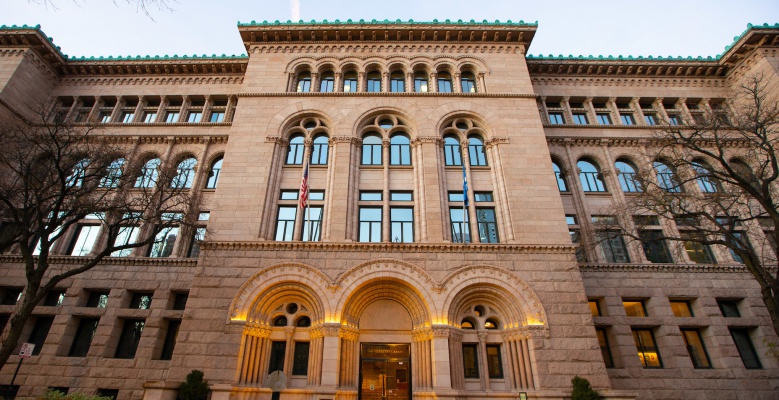
The Newberry Library in Chicago has announced that it will reopen on 18 January, following a temporary closure due to the Omicron wave of Covid.
The Newberry Library states: “We look forward to welcoming you back to the Newberry starting Tuesday, January 18. We’ve updated our COVID-19 visitor policy, following new guidance from public health officials.”
Many undergraduate and graduate students in History, English, and other Humanities disciplines use Newberry collections in their research projects on a wide variety of subjects. The Newberry houses impressive collections of manuscripts, printed pamphlets, and rare books that support original research in history, literary studies, cartography, history of the book, history of science, history of medicine, and interdisciplinary Renaissance studies.
A number of doctoral candidates in History have pursued manuscript and rare books research in Renaissance studies and early modern history at the Newberry on topics such as armed clergy during the French Wars of Religion and information management in Louis XIV’s France. Other NIU students have used Newberry resources in their teaching and Digital Humanities projects on Illinois History, United States History, European History, and World History.
Faculty members and graduate students in History at NIU have actively participated actively in the seminars, conferences, and other programs of the Newberry Library’s research centers:
Food is Culture! This proclamation is a both a popular idea and a serious anthropological approach to food, cuisine, and agricultural production. Food historians take the cultural dimensions of food production and consumption seriously as revealing important social dynamics. Food is Culture has also become a slogan and is even being used as the title of a project by the Slow Food organization.
If food is culture, it is also a key battleground in the Culture Wars. Local and regional food producers have long attempted to distinguish their food products and market them on broader markets. These food producers often seek to establish rules on production to uphold standards and protect their techniques.
Many European food producers have been engaging in such trade regulation for centuries, although their “traditions” have often changed over time more than modern food producers would like to admit. The makers of Parmgiano Regiano, Roquefort, Camembert, and other cheeses have long tried to protect their products through regulations designating their specific geographic regions as the areas or approved production (essentially, making their products’ names into trademarks). Producers of Prosciutto di Parma, Speck Alto Adige, and Jamón Iberico have used similar geographic regulations on production. Lardo di Colonnata famously had to fight for European Union approval of its method of curing lard in marble tubs in order to maintain its status.
Yet, many of these products relying on geographic regions of production are protected by national or European Union regulations, not by international law, leading to food producers outside of Europe using their names on their products. The globalization of food cultures and tastes has made the protection of food production ever more complicated. The marketing of “European” food products made in Wisconsin, Maine, or California has fueled international competition and Food Culture Wars. European wine producers have also attempted to control the name of regional wines—such as Champagne, Chardonnay, Pinot Noir, and Bordeaux—with varying success.
The latest round in the Food Culture Wars is being fought in courts in the United States over Gruyère cheese, one of the most famous varieties of cheese in the world.
Swiss regulations insist that Gruyère cheese “must be made in the region around Gruyères, Switzerland, which has produced the cheese since the 12th century,” according to The New York Times.
“In the United States, however, gruyère can be made anywhere, according to a federal court ruling that was made public last week. It was the latest development in a long-running legal tangle between American cheese producers and producers in Switzerland and France over what makes gruyère gruyère.”
The New York Times reports on a court case in the United States concerning the use of the term “gruyère” by cheese producers in the U.S. “In the ruling last month in U.S. District Court for the Eastern District of Virginia, Judge T.S. Ellis III wrote, ‘Although the term gruyère may once have been understood to indicate an area of cheese production, the factual record makes it abundantly clear that the term gruyère has now, over time, become generic to cheese purchasers in the United States.’ Under U.S. law, trademarks cannot be given to generic terms.”
This decision clearly undermines the manufacture and sale of authentic cheeses from Gruyères, but also threatens local and regional food production in other areas of Europe and the world. Many local food products in Europe developed their specific identities in the early modern period (1500-1800), but often without clear legal designations or protections for their “traditional” methods of food production. Artisanal production and guild regulations provided certain types of control, but these were often only local in nature and later supplanted by municipal regulations and national laws. There is a long and complex history of regulations on food production, trade, and consumption.
Which local aspects of food production (water, soil, ingredients, implements, and techniques) can be legally protected? How can “traditional” food production be defined? These are highly contested issues and they are increasingly being fought out in courts of law in different nations.
As The New York Times points out, “in Europe, countries are staunchly protective over their culinary heritage. The European Union says it aims to protect the names of specific products to promote the unique characteristics that are linked to their geographical origin.”
The Culture Wars will undoubtedly continue and food is increasingly central to battles over who controls the production and consumption of food as culture.
The New York Times reports on “Is Gruyère Still Gruyère if It Doesn’t Come From Gruyères?”
Allen J. Grieco is one of the leading scholars of food history in Renaissance Italy and the early modern world. Grieco’s website lists numerous publications on Renaissance food history.
Author’s disclosure: I admit to having a strong bias on this issue, since Gruyère is definitely one of my favorite cheeses.
The National World War II Museum and the Society for Military History are co-organizing a Summer Seminar in Military History in Summer 2022.
This is a seminar for graduate students, post-doctoral researchers, and professors working on the history of war, culture, and society.
Here is the announcement from the Society for Military History:
The National World War II Museum and The Society for Military History invite applications to participate in “The Summer Seminar in Military History” from 12 June – 2 July 2022. This three-week, in-residence experience at the National World War II Museum in New Orleans is primarily intended for faculty and advanced graduate students who wish to enhance their ability to study and to teach both US and global military history. The program consists of a series of content and pedagogical seminars led by expert faculty and guest lecturers, as well as museum tours and battlefield staff rides. Lodging, meals, and a stipend are provided.
Applicants will be selected based upon their potential contributions to the field of military history and upon the contribution the program can make to their future teaching and research. Recent PhDs, advanced graduate students who have completed all requirements for their doctorate other than submission of the dissertation (ABD), and senior faculty members interested in working in military history but without a strong background in the field are eligible to apply. A selection committee will consider each applicant’s packet on its own merits.
Interested candidates should submit:
A completed application form
Curriculum vitae
One letter of recommendation that addresses both teaching and research abilities
The Renaissance Society of America is once again organizing its Digital Days of Learning workshops. These workshops offer introductions to Digital Humanities tools and techniques for students and scholars working in the field of Renaissance Studies.
I have participated in some of the previous Digital Days of Learning workshops dealing with paleography tools and digital mapping techniques. The workshops are normally very practical, providing hands-on experiences and guidance from trained users.
I would like to encourage graduate students in History at Northern Illinois University to participate in one of these Digital Days of Learning.
The announcement from the Renaissance Society of America is here below:
Registration is now open for our Day(s) of Digital Learning. The workshops will be held on several days throughout the two-week period spanning February 21–March 4, 2022.
The Day(s) of Digital Learning will feature a varied menu of sessions involving hands-on, participatory work with digital tools and resources. The events will be open to all RSA members without charge. More information can be found on the topics, schedule, and registration for the Day(s) of Digital Learning, by clicking here. Please email the RSA with questions.
The Center for Renaissance Studies at the Newberry Library will be hosting its annual Multidisciplinary Graduate Student Conference on 27-29 January 2022. The conference is normally held in person, but will be held online viz Zoom due to the current wave of Covid.
Graduate students in History, Art History, English, World Languages and Cultures, Music History, Religious Studies, and other disciplines who are interested in Renaissance Studies are invited to participate.
This conference has a great track record at providing opportunities for graduate students to present their research in Renaissance Studies and also learn about professional development issues in the field. The conference also allows graduate students from diverse humanities disciplines at different universities to share ideas and experiences.
I strongly encourage graduate students in History at Northern Illinois University to participate in this excellent conference. NIU is a member of the Center for Renaissance Studies Consortium.
Here is the announcement from the Center for Renaissance Studies:
CRS encourages all who are able to attend the all-virtual 2022 Multidisciplinary Graduate Student Conference.
This annual graduate student conference, organized and run by advanced doctoral students, has become a premier opportunity for emerging scholars to present papers, participate in discussions, and develop collaborations across all fields of medieval, Renaissance, and early modern studies. Participants from a wide variety of disciplines find a supportive and collegial forum for their work, meet future colleagues from other institutions and disciplines, and become familiar with the Newberry and its resources. Conference programming will include professionalization sessions and rare book presentations in addition to the workshops and conference panels.
Although the 2022 conference program had been scheduled to include both virtual and in-person sessions, the recent surge in Covid-19 cases has prompted us to shift all programming to a virtual format.
The 2022 Multidisciplinary Graduate Student Conference is free and open to the public. Registration is not required, and sessions will be accessible using the Zoom links in the posted schedule. Sessions without links included will be limited to conference participants only.









 Brian Sandberg: Historical Perspectives