Ancient Roman history is alive and well, and newsworthy.
An interview with Mary Beard, Professor of Classics at the University of Cambridge, in The New York Times highlights diverse ways in which Roman history is actively used in today’s society and political culture.
Mary Beard has expanded our perspectives through her decades of research on ancient Roman society and culture, published in numerous articles and books. She has stretched the boundaries of ancient history by probing issues of gender, empire, and power in Roman society in new ways.
Beard has brought ancient history to broader audiences through books such as Confronting the Classics: Traditions, Adventures, and Innovations (London: Liveright, 2013). She is also known for her work on BBC’s Civilizations television series (2018).
Northern Illinois University students in HIST 110 History of the Western World I will be interested in exploring Mary Beard’s works on Roman history.
Professor Beard’s interview on “Ancient Rome Will Never Get Old” is at The New York Times.
Professor Beard’s website is at the University of Cambridge.
Colonial Williamsburg, one of the most important sites for historical re-enactment in the United States, is increasingly stressing diversity issues in its historical interpretations of colonial American society.
The community of Williamsburg, Virginia, has been promoting building restoration and living history since the 1930s, and the colonial town and re-enactment site is managed by the Colonial Williamsburg Foundation. The Foundation’s historical interpretations of eighteenth-century life has evolved significantly over the decades, responding to new research, historiographical approaches, and social concerns.
African-American slaves formed the majority of colonial Williamsburg’s population, but slavery was not a focal point of re-enactments until relatively recently. African-American History, Women and Gender History, Atlantic World History, History of Slavery, and Early Modern World History seem to have transformed the historical approaches at Williamsburg.
The Washington Post reports on historical re-enactment at Williamsburg, focusing particularly on re-enactors (or interpreters) who now take on roles that represent the diversity of colonial Virginia.
“Stephen Seals, who heads community outreach and program development, plays James Lafayette, an enslaved Williamsburg man who served in the Continental Army under the Marquis de Lafayette. A longtime actor, Seals is a kind of archive unto himself, his psychic shelves stocked with knowledge about Colonial Williamsburg’s evolution. At one time, … the foundation did emphasize the working trades of the period. Those carpentry and gunsmithing shops are still popular, but there’s been an ever-evolving effort to reveal all facets of the community’s past.”
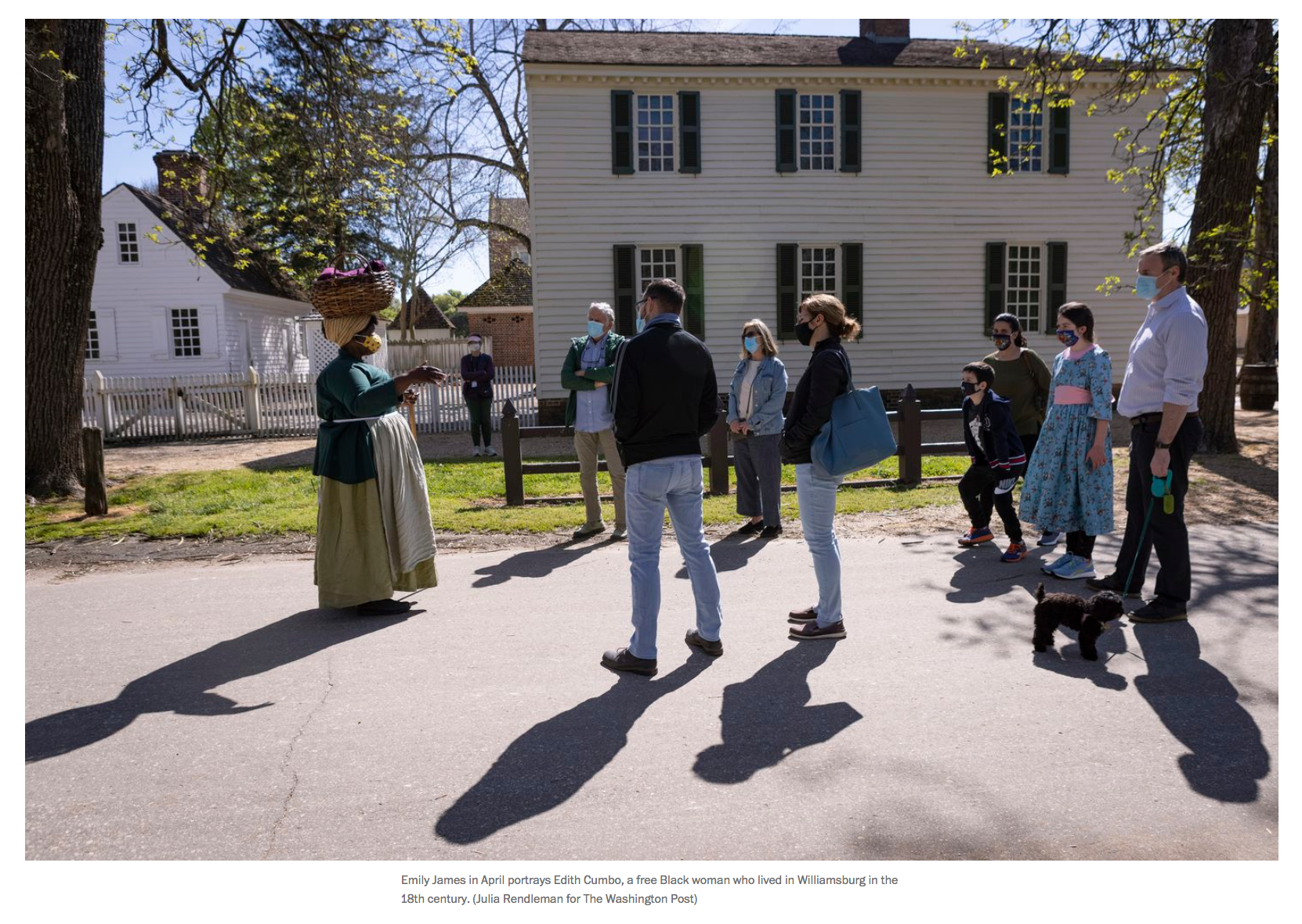
Another important part of the colonial community of Williamsburg were Free Blacks. “On the streets of Colonial Williamsburg — one of the world’s premier living-history museums — Emily James cuts a formidable figure. Portraying Edith Cumbo, a free woman of color who walked these byways in the 18th century, James tries daily to convey to tourists the humiliations and contradictions Cumbo lived with,” according to The Washington Post.
Theatrical presentations and plays complement the re-enactors’ character interpretations. Some of the new plays present diversity in gender and sexuality, including same-sex relationships.
I remember visiting Colonial Williamsburg in the 1980s and being captivated by the “feel” of eighteenth-century society. The historical buildings, costumes, horse-drawn carriages, and workshops allow visitors to experience the sights, sounds, and smells of premodern life. But, any encounters with the institution of slavery and the diverse people in Williamsburg society were limited at that time. I hope to visit Colonial Williamsburg again to observe the transformations of its historical re-enactment program.
The Fulbright Scholar Program of the United States Department of State is hosting a Fulbright U.S. Scholar: Spotlight on France Webinar on its research awards for U.S. scholars to travel to France to conduct research in various fields.
The Fulbright Research Scholar Awards provide vital support for scholars from the United States to pursue international research in nations around the world.
I have served as a Fulbright Research Scholar in France and in Belgium, allowing me to pursue archival research on religious violence, gender, and political culture in the French Wars of Religion and the Dutch Revolt.
I would encourage French historians and humanities scholars who are U.S. citizens and based at universities in the United States to consider applying for a Fulbright Research Scholar Award to conduct research in French archives and special collections.
The Fulbright Scholar Program has separate programs for U.S. scholars, international scholars, and other educators.
The Fulbright Student Program has various awards for graduate students and undergraduate students. Students at Northern Illinois University should contact their professors for advice on applying for a Fulbright Award.
The Fulbright U.S. Scholar: Spotlight on France Webinar will be held on 16 June 2021 from 2:00-3:00 (Eastern).
Here (below) is the Fulbright Scholar Program’s announcement:
Greetings from the Fulbright Program!
I hope you are doing well. Join us for an in depth look at the Fulbright U.S. Scholar Program opportunities in France. We will be joined by a State Department representative and a recent Scholar alum to highlight awards, offer general application guidance and answer questions from participants. Come prepared with your questions or simply listen along.
France offers 12 awards including:
French Studies (Arts, Humanities and Social Studies) Fulbright Award for Research in Eastern France (Grand Est) Fulbright Award for Research in Northern France (Hauts-de-France) Fulbright Award for Research in Southwestern France (Nouvelle-Aquitaine) Fulbright Postdoctoral Award in Social Sciences
For a full list of all the awards in France, click here.
The deadline to apply to the Fulbright U.S. Scholar Program 2022-2023 is September 15, 2021. U.S. citizenship is required.
The Newberry Library is currently showing an exhibition on ¡ Viva la Libertad ! Latin American and the Age of Revolutions.
¡ Viva la Libertad ! explores Latin American revolutions in the nineteenth century and their legacies for Central and South America.
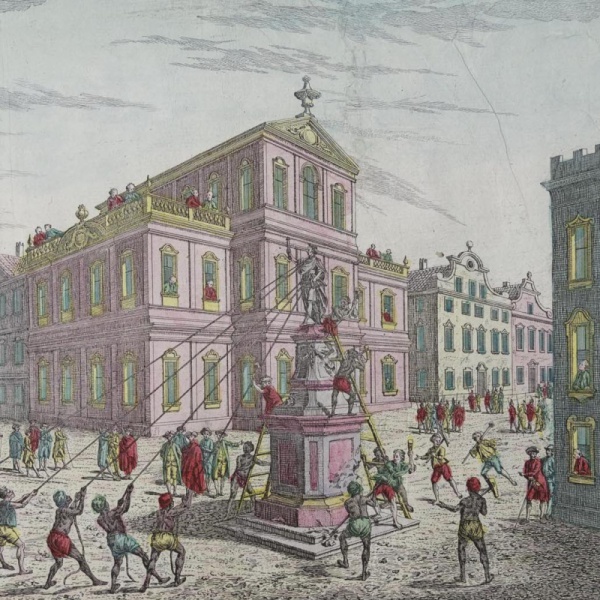
La Destruction de la Statue Royale a Nouvelle Yorck, ca. 1778, Ruggles 592, Newberry Library
The exhibition introduction reads: “As revolutions broke out in the United States, France, and Haiti, freedom movements took root in Latin America, where the colonies of Spain and Portugal fought for their own independence. In hindsight, it’s easy to assume the revolutionary floodgates opened and freedom spread inexorably throughout the hemisphere. But bitter independence struggles lasted decades.”
Undergraduate and graduate students studying Latin American History, Atlantic World History, Comparative Revolutions, Civil Wars, and related topics will want to view this exhibition. Northern Illinois University graduate students are especially encouraged to explore this exhibition and its research collections over the summer.
The Newberry Library has a website related to the exhibition. ¡ Viva la Libertad ! Latin American and the Age of Revolutions is open for in-person viewing from 2 April – 24 July 2021.
The Center for Renaissance Studies at the Newberry Library will be offering a research methods workshop on Word and Image in Print and Digital Archives this Fall on Friday 15 October 2021.
Graduate students in History and the Humanities at Northern Illinois University may be interested in this methods workshop.
Here (below) is the announcement from the Center for Renaissance Studies. Note that the registration deadline is 1 June 2021.
Word and Image in Print and Digital Archives
Led by Jennifer Waldron (University of Pittsburgh) and James A. Knapp (Loyola University Chicago
Friday, October 15, 2021 9:30 am – 4:30 pm
Registration Deadline: June 1, 2021
This research methods workshop takes a long view of the effects of technological change on word-image relations. Beginning with the print resources of the Newberry, we will ask the following questions: How were particular methods of visual and verbal representation key to the organization of knowledge in the early modern period? How did the spatial and temporal affordances of maps, atlases, and historical timelines contribute to emerging views of the “globe”? We will then turn to several of the most important digital archives for early modern studies, including “Digital Newberry.” How have digital tools altered the affordances of image-based archives? How has the reproduction and circulation of words and images shifted in relation to digital searchability, addressability, and information architecture? Finally, participants will be introduced to the process of publishing their archival research from the Newberry using digital tools relevant to work in public humanities, such as Omeka and Timeline JS. Participants will be encouraged to use these tools to produce a publishable timeline, digital archive, or story from the Newberry archive that will be shared on the Center for Renaissance Studies’s consortium blog: CRS Stories.
The New York Times has published an interactive reconstruction of the predominantly African American neighborhood of Greenwood and mapped the brutal violence of the armed White crowd that destroyed it during the Tulsa Race Massacre of 1921.
This is a powerful use of Digital Humanities techniques to reconstruct a community that was destroyed by racial violence. The article accompanying the model has a full discussion of the methodologies utilized in creating this multilayered reconstruction of the thriving African American neighborhood of Greenwood before and during the Tulsa Race Massacre.
On 31 May 1921, racial tensions in Tulsa led to a riot in the downtown area. An organized crowd of White militants attacked African Americans who were downtown and then marched to Greenwood—shooting Black residents, looting belongings, and burning buildings in a massacre that lasted two days.
The New York Times describes the horrifying violence against African Americans and the destruction of their neighborhood: “The numbers presented a staggering portrait of loss: 35 blocks burned to the ground; as many as 300 dead; hundreds injured; 8,000 to 10,000 left homeless; more than 1,470 homes burned or looted; and eventually, 6,000 detained in internment camps.”
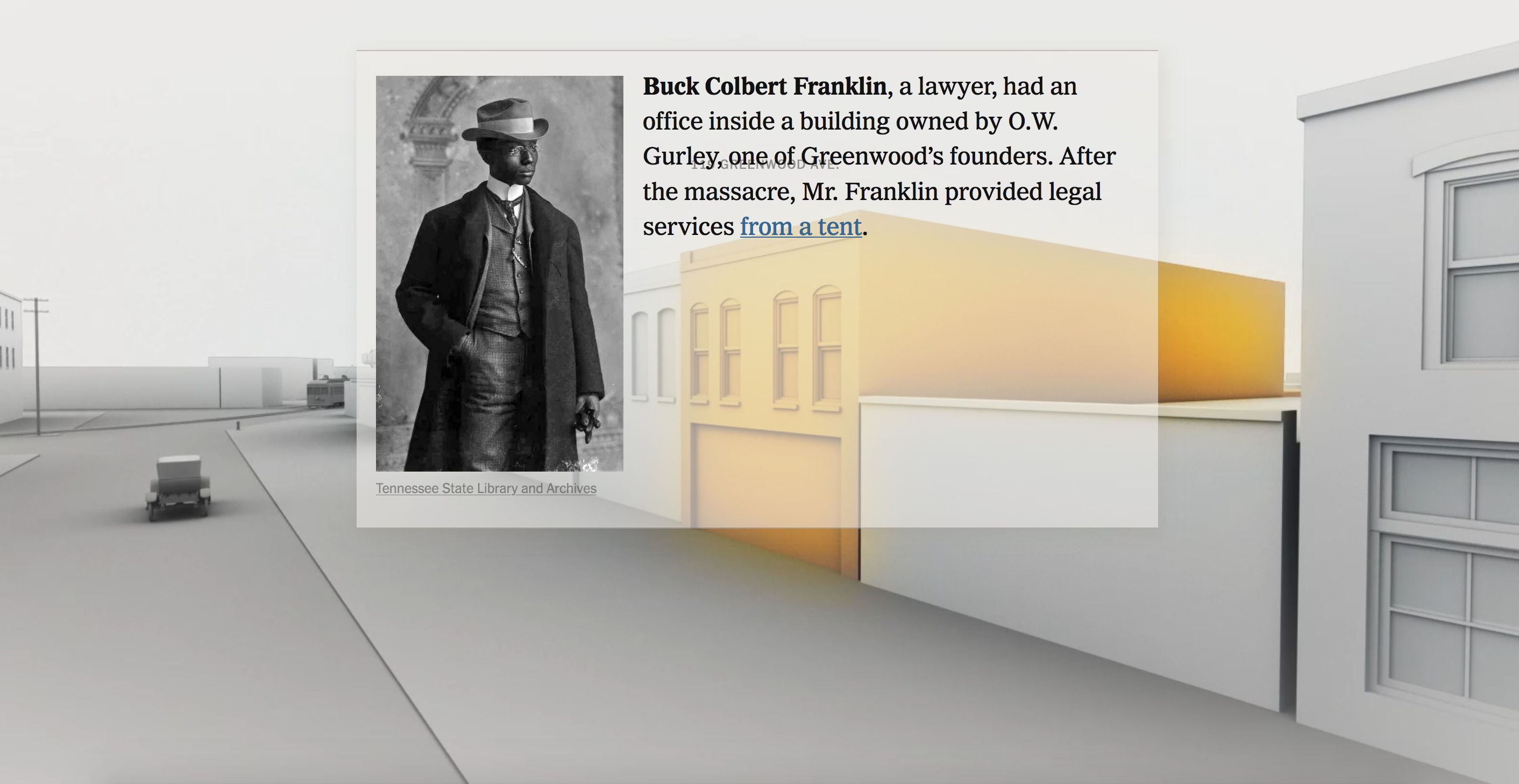
The interactive model provides detailed digital mapping and modeling to reconstruct the businesses and residences along Greenwood Avenue and the lives of Black entrepreneurs, workers, and residents of the neighborhood. The model incorporates photos, textual evidence, and census data to provide a rich description of some of the Black victims and survivors of the massacre.
Historians of African American studies, violence studies, crowd studies, urban history, and Digital Humanities will be interested in this model. University professors and high school teachers who offer courses on United States History, History of Race and Racism, Civil Conflict, Political Violence, Genocides, Massacres, Digital Humanities, and other subjects may consider using this model with their students.
For further reading on the Tulsa Race Massacre and racial violence in early twentieth-century United States, see:
Ellsworth, Scott. Death in a Promised Land: The Tulsa Race Riot of 1921. Baton Rouge, LA: Louisiana State University Press, 1982.
Franklin, John Hope and Scott Ellsworth, eds. The Tulsa Race Riot: A Scientific, Historical and Legal Analysis. Oklahoma City, OK: Tulsa Race Riot Commission, 2000.
Halliburton, R, Jr. The Tulsa Race War of 1921. San Francisco, CA: R and E Research Associates, 1975.
Krugler, David F. 1919, The Year of Racial Violence: How African Americans Fought Back. Cambridge: Cambridge University Press, 2015.
“Tulsa Race Riot: A Report by the Oklahoma Commission to Study the Tulsa Race Riot of 1921.” Oklahoma Commission to the Study of the Tulsa Race Riot of 1921, February 28, 2001.
The Society for Classical Studies is offering a prize for the best graduate research paper on multiculturalism in the ancient Mediterranean.
A number of graduate students at Northern Illinois University work on ancient, late antique, and early medieval history. Some of the graduate students in my recent HIST 790 Research Seminar on Religious Politics and Sectarian Violence may be interested in applying for this prize. Any NIU students who wish to apply for this prize should feel free to contact me for assistance in preparing their submissions.
Here is the call for submissions for the Gruen Prize from the Society for Classical Studies:
On behalf of the Society for Classical Studies (SCS), the Erich S. Gruen Prize Committee invites all graduate students in North America to enter the second annual competition for the best graduate research paper on multiculturalism in the ancient Mediterranean. This year the prize will be a cash award of $500.
The prize is intended to honor Erich S. Gruen, renowned ancient historian and long-time Gladys Rehard Wood Professor of History and Classics at the University of California, Berkeley. Professor Gruen was born in Vienna in 1935 and came to the United States in 1939. One of the most respected and beloved scholars in the field, he has made lasting contributions to our understanding of ethnicity, identity, and exchange in the multicultural ancient Mediterranean world. Professor Gruen has served on the dissertation committees of over one hundred Ph.D. students, and he continues to correspond with and support them long after graduation, as scholars and as people. He also touches the lives of countless other scholars across the world through his tireless traveling, mentorship, and service to the profession, including as president of the American Philological Association (now the Society for Classical Studies) in 1992.
In honor of all these achievements and with the help of his former students, the SCS Board has set up an award in order to celebrate Professor Gruen’s continuing contributions to the field. We therefore invite high-quality papers treating any aspect of race, ethnicity, or cultural exchange as it pertains to the ancient Mediterranean by any student currently enrolled in a North American graduate program, regardless of citizenship or immigration status. A Prize Committee has been charged with selecting the most original and well-argued research paper to receive a cash award and public recognition by SCS. Membership in SCS and/or attendance at the annual meeting are not expected or required of any applicant.
The 2021 Gruen Prize Competition Guidelines
The deadline for submissions is October 8, 2021. Essays must be work that can stand alone without requiring summaries of omitted sections. They should not exceed the length of 30 pages, including notes but excluding bibliography and illustrations or figures. Text must be double-spaced in 12-point font with 1-inch margins; notes may be single-spaced and must be displayed as footnotes. Authors must remove their names from essays. Electronic submission via Google form is required unless prior arrangements have been made for good reason with the committee. Essays should be submitted in PDF format by direct upload using the Google form found here.
The Gruen Prize is intended to encourage new avenues of intellectual development and the graduate-level mentorship that supports and nurtures it. Submissions should therefore not be previously published, in full or in part, and authors who already have Ph.D. in hand by October 8, 2021, are ineligible. SCS reserves the right not to confer the prize in any year in which no suitable candidate is found. The winner of the 2021 Gruen Prize will be selected by a jury. Please direct to both Nandini Pandey (nandini.pandey@wisc.edu) and Kristen Seaman (kseaman@uoregon.edu) remaining questions regarding eligibility, requirements, submission, or other matters.
The Medici Archive Project in Florence, Italy, is offering two Samuel H. Kress Fellowships for graduate students interested in pursuing archival research at the Archivio di Stato di Firenze and other Florentine archives.
These fellowships offer American graduate students a great opportunity for on-site training and practice in archival methods, manuscript studies, and paleography.
Graduate students in Renaissance Art History, Renaissance Italian History, Early Modern European History, Early Modern Mediterranean Studies, and Renaissance Studies may be interested in this opportunity.
Graduate students at Northern Illinois University and other universities affiliated with the Center for Renaissance Studies at the Newberry Library should contact their professors for advice on applications.
The Medici Archive Project is a research institute that promotes interdisciplinary Renaissance studies in Florence and worldwide. The Medici Archive Project has created online platforms for Renaissance archival collections in the Archivio di Stato di Firenze and sponsored various Digital Humanities projects. The Project also publishes a book series and hosts seminars, lectures, and conferences in interdisciplinary Renaissance studies.
Here is the Medici Archive Project’s call for applications:
Thanks to the continued support of the Samuel H. Kress Foundation, The Medici Archive Project is offering two fellowships for graduate and pre-doctoral students to undertake specialized archival research on-site at the Archivio di Stato as well as other archival collections housed in Florence and across Tuscany. These fellowships are especially aimed to provide graduate students in art and architectural history with the opportunity to examine original source materials, receive scholarly guidance from MAP Staff, present their findings at MAP-sponsored conferences and workshops, and enroll in MAP’s Paleography and Archival Studies Seminar.
Both fellowships must take place within a period of no less than three months from 23 August 2021 to 23 December 2021. The stipend is USD 8,000. Fellows will be responsible for their travel and accommodations in Florence. Eligible candidates must either have American citizenship or be enrolled in graduate programs at universities in the United States.
There is no application form for this fellowship. Instead, suitable candidates are invited to send via email to education@medici.org, the following documents in a single PDF by 15 June 2021:
A cover letter.
A short essay (no more than two pages) on how the candidate’s topic will benefit from archival research.
A curriculum vitae.
The name and email address of a scholar in the field, preferably the candidate’s supervisor, who can comment on the applicant’s qualifications and the merits of the research proposal (please do not include letters of recommendation with the application).
To apply for these fellowships, the following material should be sent electronically to education@medici.org. Please do not include supplementary material (publications, papers, syllabi, etc.). All materials must be submitted in English. For further information, contact education@medici.org.
Europeans are celebrating Europe Day today, 9 May 2021. Europe Day is an annual holiday in the European Union.
A Conference on the Future of Europe is coordinated to coincide with Europe Day this year. The conference organizers explain that “The Conference on the Future of Europe is a unique and timely opportunity for European citizens to debate on Europe’s challenges and priorities. No matter where you are from or what you do, this is the place to think about what future you want for the European Union. The European Parliament, the Council and the European Commission have committed to listen to Europeans and to follow up, within their sphere of competences, on the recommendations made.”
Euronews explains the significance of Europe Day: “The date marks the anniversary of the Schuman Declaration, which proposed the creation of a European Coal and Steel Community, the forerunner to the European Union. Europe Day intends to ‘celebrate peace, solidarity, diversity and unity in Europe,’ according to EU institutions. But it is also an opportunity for European citizens to find out more about what the EU does and to debate the issues that will shape its future.”
The Schuman Declaration arguably laid the political and economic groundwork for the European Union, which emerged later. European Union politicians and historians consider Robert Schuman one of the key architects of European integration. The Schuman Declaration has thus become integral to the historical narrative of the European Union’s formation.
Euronews summarizes the significance of the Schuman Declaration: “In a historic speech in Paris in 1950, Robert Schuman, who was France’s foreign minister at the time, set out his idea for a new form of political cooperation in Europe, which would make war between Europe’s nations unthinkable. Schuman proposed that the community’s founding members – France, Germany, Italy, the Netherlands, Belgium and Luxembourg – would pool their coal and steel resources and create a common market by lifting import and export duties. The idea was partly economic: Schuman’s proposal came just five years after World War II that left the continent devastated. But it was also political. The idea was that by merging the economic interests of France and Germany together, it would reduce the risk of conflict in the future.”
Celebrations of Europe Day are being held online this year, due to the ongoing Covid-19 pandemic. A Music Europe Day is being broadcast online.
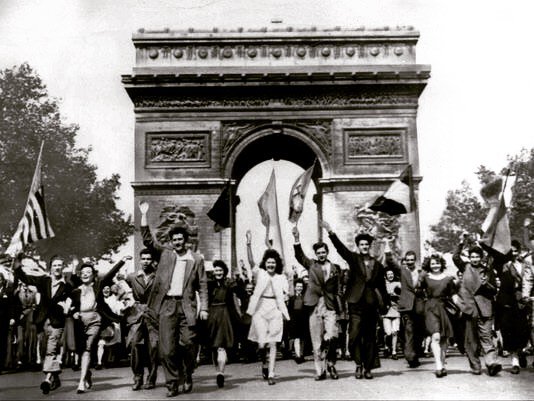
Today, Europeans are celebrating the anniversary of the end of the Second World War in Europe and the collapse of the Nazi regime in Germany. The surrender of Nazi Germany on 8 May 1945 prompted spontaneous celebrations by Allied troops and war-weary Europeans.
Civilians in the United States, United Kingdom, Soviet Union, and other Allied nations took to the streets to celebrate Victory in Europe Day (VE Day). The Second World War would continue for several more months in Asia and the Pacific, but the fighting in Europe was over.
Today, governments and heads of state across Europe are celebrating Victory in Europe Day once again, as are leaders of the Allied powers that triumphed over Nazi Germany and Fascist Italy in 1945. The celebrations have been rather muted this year, due to the ongoing novel coronavirus pandemic. VE Day celebration organizers in 2020 also had to cope with coronavirus restrictions and lockdowns, but were able to commemorate the 75th anniversary of the end of the Second World War.
The public celebration of VE Day is more complicated in reunified Germany, despite its status as arguably leading power of the European Union.
“Victory in Europe Day, the anniversary of Nazi Germany’s military capitulation to the Allies on May 8, 1945, is an occasion of unreserved celebration across much of the continent, observed with colorful parades and national holidays. For Germans, it is understandably fraught. For a long time, the anniversary was largely defined in Germany by ambivalence. How, after all, could the vanquished celebrate their surrender? Now Germans are increasingly grappling with a thornier question: How could they not?”
Euronews reports on the celebrations of Victory in Europe Day. The Telegraph reports on the history of VE Day celebrations in the United Kingdom. Stars and Stripes reports on celebrations in the United States. The New York Times reports on commemorations in Germany.










 Brian Sandberg: Historical Perspectives