Seminar on Latin Sources in the Archives of the Crown of Aragon

Graduate students interested in medieval history, and particularly those wanting to learn how to use Latin sources in medieval archives, may be interested in an upcoming Mediterranean Summer Skills Seminar: Introduction to the Archive of the Crown of Aragon (documents in Latin to ca. 1350).

Northern Illinois University graduate students in Medieval and Early Modern History may be able to apply for funding to participate in archival skills seminars.

Here is the announcement from the Mediterranean Seminar and CU Mediterranean Studies Group:

The Mediterranean Seminar/ CU Mediterranean Studies Group is offering a second iteration of the virtual Summer Skills Seminar,  “Introduction to the Archive of the Crown of Aragon (documents in Latin to ca. 1350)”  to be held via Zoom from Monday 17 May 2021 through Thursday, 21 May 2021, from 10am to noon and 1–3pm MST.

Overview
The Archive of the Crown of Aragon (ACA) in Barcelona contains one of the largest and richest archival collections relating to medieval Europe, comprising hundreds of thousands of documents, most from the twelfth to fifteenth centuries, and including financial records, royal letters, administrative documents, trial records, treaties, and many other genres and types. The documentation can be used for a whole range of topics including social, economic, political, institutional, gender, diplomatic, cultural and religious history. 

The territories of the Crown of Aragon included much of the Iberian Peninsula, parts of southern France, Sicily and southern Italy, parts of Tunisia and Greece, the Balearics, Sardinia and other Mediterranean islands. It had a large and diverse urban population, was highly integrated into Mediterranean and European trade systems, and had significant populations of Muslims and Jews. It developed one of the earliest and most robust chanceries of medieval Europe; the collections of which have weathered the vicissitudes of history all but intact. Much of the documentation has yet to be used by modern historians. The skills seminar will focus on the Latin-language documentation (from the eleventh to the mid-fourteenth centuries) in the archive’s collections.

This four-day intensive skills seminar will provide participants with an overview of the collections of the ACA, including access to online resources and reproductions, and focus on a hands-on introduction to reading unedited documents from a variety of the archive’s fonds. 

Other topics will include: manuscript abbreviations, dating systems, place and personal names, and research resources and techniques. As much as possible the content will be catered to participants’ interests and needs. Medievalists of all disciplines, graduate students, and qualified undergraduate students, as well as library and archival professionals are encouraged to apply. 

The goal is to provides attendees with a solid preparation for conducting work remotely via the PARES web portal and on-site at the ACA. This will not only aid their research but provide them with a bona fide (in the form of a certificate of completion for those who attend the full seminar), which may be advantageous in securing grants or other funding for research and travel. The ability to do archival research with unedited documents is a skill relatively few doctoral students master, and it enhances the research profile and CV of academic job-seekers.

Participants will find the skills and techniques which the course focuses on useful not only at the Archive of the Crown but at other medieval archives across Spain and Europe.

Applicants should have at least an intermediate level of reading Latin. Those wishing to bone-up on their Latin fluency in advance of the course are encouraged to read the Latin Vulgate and review declensions and conjugations. 

This Summer Skills Seminar builds on the experience of earlier editions, which participants signaled as “transformative” in terms of their research, and which provided them with an opportunity to network and lay the foundations for future collaborations. For information and participant reviews of our former Skills Seminars (Ladino/Judezmo & Aljamiado) including the first edition of this course, go here.

Cost
The cost of the course is: $1000 for Full Professors, Librarians,  Professionals, Independent Scholars; $750 for tenured Associates; $500 for non-tenured Associates and Assistants & Graduate and Undergraduate students; $350 for Adjuncts, Lecturers & Contingent faculty. Members of supporting University of Colorado departments are eligible for a 50% discount. The cost may be tax deductible. Those who pay for the online course will be entitled to attend an in-person iteration planned for May 2021. Faculty and students from low per capita-GDP countries can apply for a bursary for partial or full remission of fees.

Program
The course will be held 17-21May 2020 from 10am to noon and 1-3pm Mountain TImevia ZOOM.
For further program information and for sample documents, together with transcriptions clickhere

Faculty
The course will be conducted by Prof. Brian A. Catlos (Religious Studies, CU Boulder). A graduate of the University of Toronto’s Centre for Medieval Studies (Phd, 2000) and now a historian of pre-Modern Spain and the Mediterranean, Catlos has been using the collections of the ACA since 1995, primarily for research into the social and economic history of the Crown of Aragon and Muslim-Christian-Jewish relations. 

Important dates:
Application deadline: 1 March 2021
Registration confirmation: 7 March 2021
Tuition deposit (50%) 15 March 2021
Tuition balance:1 May 2021

Apply via this form

For further information or inquiries, contact Brian Catlos (brian.catlos@colorado.edu; subject: “Summer Skills Information”)

This program is organized by the CU Mediterranean Studies Group under the aegis of the Mediterranean Seminar and is made possible thanks to the support of the University of Colorado Boulder.

Posted in Archival Research, Cultural History, Early Modern Europe, Early Modern World, European History, Graduate Work in History, History of the Western World, Lectures and Seminars, Manuscript Studies, Material Culture, Medieval History, Mediterranean World, Religious History | Leave a comment

Instant History: Archiving Political Slogans and Symbols

Historians and museum curators are already hard at work preserving the history of the Storming of the Capitol in Washington, D.C., on 6 January 2021.

“A sign that reads, ‘Off with their heads — stop the steal’ and a small handwritten poster with the words ‘Trump won, swamp stole’ are among dozens of objects and ephemera from pro-Trump rallies and the Capitol takeover Wednesday that are heading to the National Museum of American History, collected by curators from the division of political and military history,” according to The New York Times.

Photo: Frank Blazich

Curators and staff members of the National Museum of American History, a branch of the Smithsonian Institution, collected discarded signs and banners from the National Mall for inclusion in the museum’s collections and are continuing to search for political ephemera.

Anthea M. Hartig, Director of the National Museum of American History, issued a statement about the Storming of the Capitol: “For the first time since the War of 1812, the United States Capitol in Washington, D.C., was seriously breached, on Jan. 6, this time by domestic rioters (some would say insurrectionists and/or seditionists). An angry, violent mob broke up the constitutionally mandated session of Congress meeting to ratify the 2020 election results. Fraudulent claims and conspiracy theories challenging the legitimacy of the election results fueled these scenes.”

The New York Times reports that Hartig emphasized that “as an institution, we are committed to understanding how Americans make change.” Hartig stressed that “this election season has offered remarkable instances of the pain and possibility involved in that process of reckoning with the past and shaping the future.”

History students interested in archival work and public history will be interested in following the National Museum of American History’s project to collect political ephemera from the Storming of the Capitol.

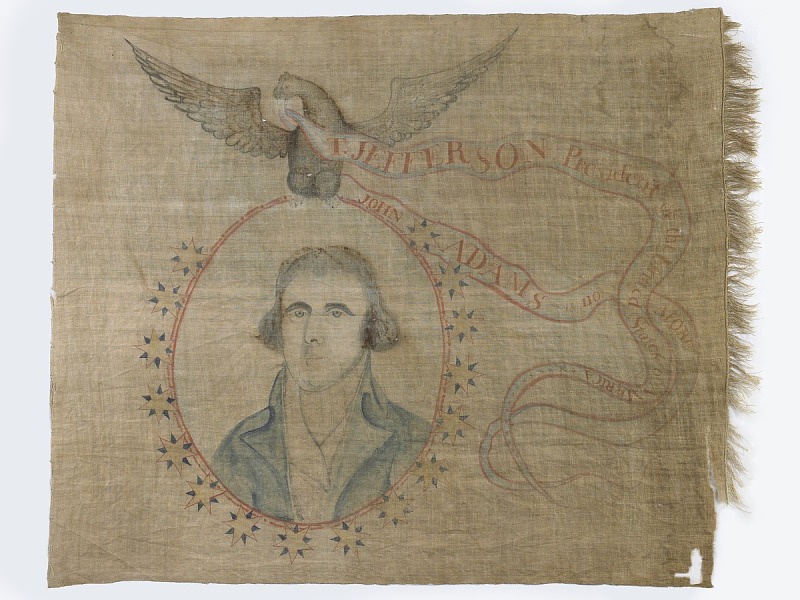
The museum houses political ephemera from throughout the history of the United States, including the famous Jefferson Banner, celebrating Thomas Jefferson’s electoral victory over John Adams in 1800.

Banner. PL*227739.1800.C01. Jefferson. National Museum of American History.

Northern Illinois University’s Department of History actively trains M.A. and Ph.D. students in historical research, archival methods, and public history. Many of our students are interested in archival collections and the construction of historical memory. So, I anticipate discussing this archiving initiative with my undergraduate and graduate students this semester.

The National Museum of American History’s website provides information on its collections and has posted a statement by Director Hartig regarding the Storming of the Capitol.

The New York Times reports on the National Museum of American History’s collecting efforts.

Posted in Archival Research, Civil Conflict, Comparative Revolutions, Cultural History, Current Research, History in the Media, History of Violence, Information Management, Material Culture, Museums and Historical Memory, Northern Illinois University, Political Activism and Protest Culture, Political Culture, Revolts and Revolutions, United States History and Society | Leave a comment

Storming of the Capitol

I am appalled by the storming of the Capitol and the violent attack on the U.S. Congress and its members by armed insurrectionists of the pro-Trump “Stop the Steal” movement, who intended to disrupt the certification of the Electoral College vote through coercion and political violence.

Demonstrators walk through the U.S. Capitol after breaching barricades to the building during a protest outside of in Washington, D.C., U.S., on Wednesday, Jan. 6, 2021. The U.S. Capitol was placed under lockdown and Vice President Mike Pence left the floor of Congress as hundreds of protesters swarmed past barricades surrounding the building where lawmakers were debating Joe Biden’s victory in the Electoral College. Photographer: Victor J. Blue/Bloomberg

I am glad to hear that my Congressional representatives have signed on to the Articles of Impeachment against President Trump for Incitement of Insurrection and Abuse of Power. I urge members of the House of Representatives to proceed with Impeachment in order to severely censure President Trump’s illegal incitement of violence and to ban him from holding office at any point in the future.

This form of political violence represents an act of rebellion against the legitimate representative government of the United States of America and must not be allowed to stand as a precedent.

President Trump, any members of Congress who colluded with him, and the insurrectionists should all be prosecuted to the full extent of federal and state laws on treason and sedition. The culture of impunity that has encouraged and allowed these acts of political violence must end.

I appreciate the active engagement of the Senators and many Representatives of Illinois in pursuing vigorously abusers of power and violent extremists.

Posted in Civil Conflict, Comparative Revolutions, Crowd Studies, History of Violence, Political Activism and Protest Culture, Political Culture, Revolts and Revolutions, United States History and Society | Leave a comment

Position in Early Modern and Modern French History

Kenyon College in Ohio is currently searching for an Assistant Professor of History with a specialization in Early Modern France and the French Empire.

This is a great opportunity for recent Ph.D.s in Early Modern French and Francophone History.

Here is the full ad from Kenyon College:

Assistant Professor in History of Europe and the French Empire

The History Department at Kenyon College, a highly selective, nationally-ranked liberal arts college in central Ohio, invites applications for a tenure-track position in the history of France and the Francophone world, beginning 1 July 2021. We seek applicants who are able to engage in both regional and global aspects of French history from 1600-1870. Area of specialization is open. Candidates whose research and teaching expertise include both Europe and a strong global focus are especially welcome. Candidates should be prepared to teach survey courses on the early modern period in Europe and on French history, and they must be interested in developing intermediate and upper-level seminars in their area of interest. The History Department maintains a strong honors program and there are opportunities to mentor students in these related fields.

The History Department is comprised of a dozen historians with diverse thematic and geographic specializations, and it values both excellence in undergraduate education and high-quality research. Candidates should have a record of excellent teaching and a Ph.D. in hand or be near completion by the beginning of the appointment (July 2021).

Applications should include 1) a letter of application, 2) a curriculum vitae and 3) a list of names and contact information of three (3) references. Cover letter should discuss teaching experience, with specific examples of innovative assignments and approaches; information on ways that issues and practices related to diversity, inclusion, and equity have been or will be included in teaching and advising; and candidate’s research agenda, including current and future projects. More materials-letters of recommendation, writing sample, unofficial transcript, and teaching philosophy-will be requested of candidates who advance to the review stage.

To apply, candidates should visit the online application site found at http://careers.kenyon.edu. Review of application will begin on January 21, 2021, and continue until the position is filled.

For more information, see the full job ad on H-Net.

Posted in Early Modern Europe, Early Modern World, Empires and Imperialism, European History, French History, Jobs and Positions | Tagged , , , | Leave a comment

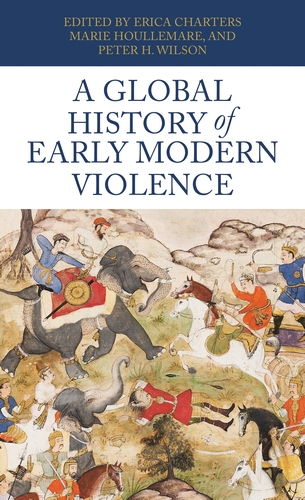
A Global History of Early Modern Violence

A new book on A Global History of Early Modern Violence, edited by Erica Charters, Marie Houllemare, and Peter H. Wilson, has been published by Manchester University Press.

The book description at Manchester University Press’s website reads: “This is the first extensive analysis of large-scale violence and the methods of its restraint in the early modern world. Using examples from Asia, Africa, the Americas and Europe, it questions the established narrative that violence was only curbed through the rise of western-style nation states and civil societies. Global history allows us to reframe and challenge traditional models for the history of violence and to rethink categories and units of analysis through comparisons. By decentring Europe and exploring alternative patterns of violence, the contributors to this volume articulate the significance of violence in narratives of state- and empire-building, as well as in their failure and decline, while also providing new means of tracing the transition from the early modern to modernity.”

This collective volume grew out of a conference on early modern violence at All Souls College, Oxford University in the summer of 2017.

I was pleased to have the opportunity to participate in the conference and to publish a chapter in the collective volume.

My essay in the volume is: Brian Sandberg, “Ravages and Depredations: Raiding War and Globalization in the Early Modern World,” in A Global History of Early Modern Violence, ed. Erica Charters, Marie Houllemare, and Peter H. Wilson (Manchester: Manchester University Press, 2020), 88-102.

Manchester University Press provides further information about the book.

Posted in Early Modern Europe, Early Modern World, Empires and Imperialism, European History, Globalization, History of Violence, Maritime History, Renaissance Art and History, War and Society, War, Culture, and Society, Warfare in the Early Modern World, World History | Leave a comment

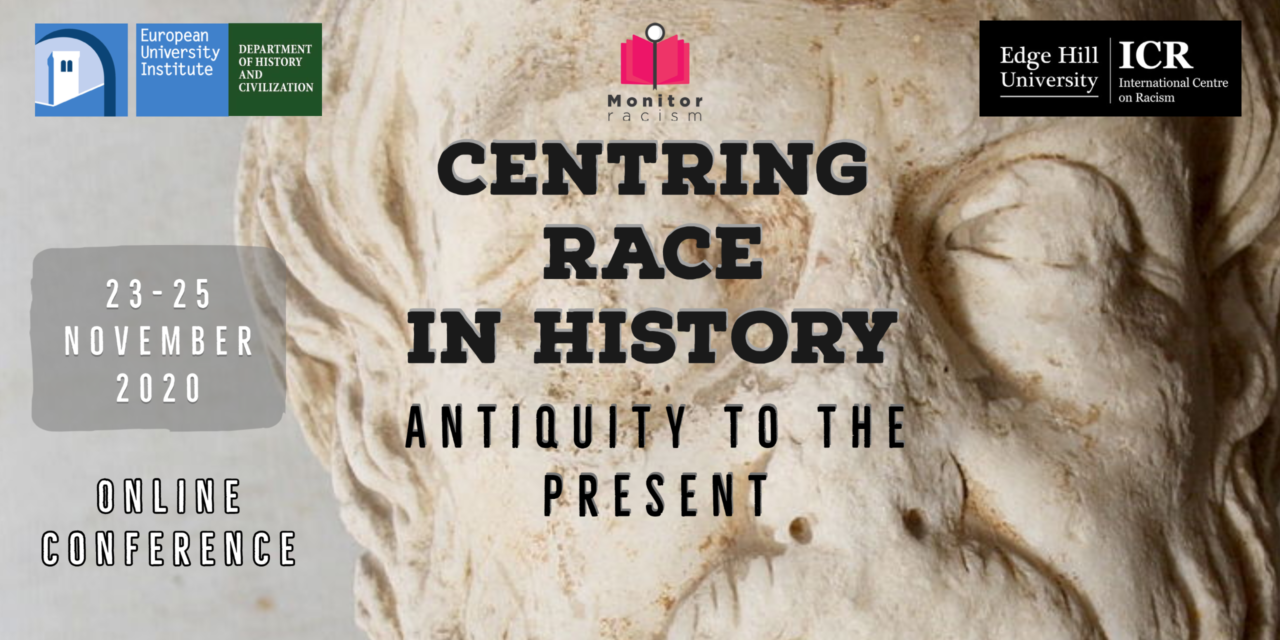
Centering Race in History Conference

An international conference on Centering Race in History: Antiquity to the Present was held online last week, co-sponsored by the Department of History and Civilization of the European University Institute, the International Centre on Racism at Edge Hill University, and Monitor Racism magazine.

The conference offered longue durée and comparative perspectives on the history of race and racism from antiquity to today. Presentations explored the history of race in ancient, medieval, early modern, modern, and contemporary contexts.

I was pleased to participate in the conference and to give a research presentation on race, violence, and slavery in the early modern Mediterranean world in a session on Early Modern Europe. My presentation, entitled “Against ‘Barbarous Dogs’ and ‘Rascals’: Race, Religion, and Empire in the Early Modern Mediterranean World,” focused on French and Francophone sources on race and violence in the early modern Mediterranean. All of the papers in the session worked well together and produced an interesting discussion.

I thought that the entire conference was very stimulating and produced some intriguing interchanges in some of the sessions.

The Centering Race in History conference program is available on the Monitor Racism website.

Posted in Atlantic World, Atrocities, Conferences, Cultural History, Early Modern Europe, Early Modern World, Empires and Imperialism, European History, Globalization, History in the Media, History of Race and Racism, History of Violence, Human Rights, Maritime History, Medieval History, Mediterranean World, War and Society, War, Culture, and Society, Warfare in the Early Modern World, World History | Leave a comment

Newberry Transcribe: Online Resource

The Center for Renaissance Studies at the Newberry Library recently launched a new online resource for transcriptions and translations of early modern sources.

Northern Illinois University students in HIST 420 The Renaissance and HIST 422 Early Modern Europe will be interested in this resource.

Here is the announcement from the Center for Renaissance Studies:

CRS is pleased to promote an exciting resource for instructors of French or Spanish languages, early American history, or Native American and Indigenous studies. 

Newberry Transcribe, the Newberry’s interactive transcription resource, has recently added hundreds of pages of pre-1800 French, Spanish, and English-language manuscripts for crowdsourced transcription and translation, all of which are ideal for the classroom. These resources present excellent opportunities for instructors to introduce digital humanities into the classroom, and for students to work with primary sources and experience authentic tasks. To view the documents, select “pre-1800” in the “Select a Decade” dropdown menu on the Newberry Transcribe homepage, or copy and paste this link: https://publications.newberry.org/transcribe/#/?date=1799

If you have any questions about the site, or if you would like a Newberry subject specialist and/or digital librarian to make a virtual visit to your class, send an email to renaissance@newberry.org or contact the Newberry’s Digital Initiatives and Services department at dis@newberry.org.

Posted in Uncategorized | Leave a comment

Netflix’s Barbarians Series and German History

A new Netflix series, entitled Barbarians, depicts warfare between the Roman Empire and Germanic peoples, culminating in the Battle of Teutoburg Forest.

According to The New York Times, “German nationalists, including the Nazis, have used the battle as an ideological rallying point — a supposed foundational moment for German civilization and proof of their superior pedigree and fighting skills. To this day, the battle, and the tribes’ leader in the fight, Arminius, remain sources of inspiration for far-right extremists, who regularly make pilgrimages to related sites.”

The filmmakers claim that Barbarians counters far-right depictions of German history and offers a different perspective on ancient history. The New York Times reports that “Arne Nolting, a writer and showrunner of the series, explained via Zoom last week that part of his inspiration for making a show about the Battle of Teutoburg Forest was a desire to reclaim a pivotal moment in European history from the far right. ‘We didn’t want to be scared away and leave the subject to those forces we detest,’ he said.”

The battle of Teutoburg Forest and the history of the ancient Germanic peoples have been repeatedly politicized and used by different political movements in modern Germany. Historians who study German Nationalism, Unification, and Nazism have demonstrated the close connections between political ideologies and historical narratives in German history. The New York Times recounts that “The battle has been a political flash point since the 19th century, when modern-day Germany was a fractured mosaic of smaller states. Nationalists embraced Arminius as a symbol of German identity in their push for unification. In 1875, four years after the German Empire’s founding, officials unveiled a colossal statue of Arminius in the Teutoburg Forest.”

The Nazis thoroughly repackaged ancient, medieval, early modern, and modern history—creating a powerful and dangerous narrative of Germanic purity and eventual dominance in the face of supposed contamination and betrayal. The New York Times emphasizes that “Under the Third Reich, the Nazi ideologue Alfred Rosenberg depicted Arminius as part of a ‘line of German ancestry’ leading to Adolf Hitler, and schoolbooks of the period claimed that he had saved ‘the purity of German blood.'”

The echoes of the Nazi narrative of German history can be seen in modern far-right movements’ depictions of Germany and its history. The New York Times reports that “In 2009, the far-right extremist National Democratic Party of Germany organized a “remembrance march” commemorating the battle, under the slogan ‘2,000 years of fighting against foreign infiltration.'”

It will interesting to see how the German public, historians, and international film critics respond to Barbarians.

The New York Times has already published a report on Barbarians. The new Netflix series coincides with an exhibition on “The Germanic Tribes” at the James Simon Gallery on the Museum Island in Berlin.

Northern Illinois University students in HIST 110 History of the Western World I and HIST 390 Film and History will be interested in this article and in the new series.

Posted in Cultural History, Empires and Imperialism, European History, European Union, Historical Film, History in the Media, History of the Western World, History of Violence, Idea of Europe, Museums and Historical Memory, War and Society, War in Film, War, Culture, and Society | Leave a comment

Doctoral Fellowships in European History

The European University Institute in Fiesole, Italy, is offering fully funded doctoral fellowships for students wishing to pursue Ph.D. studies in European history.

The European University Institute (EUI) is located on a majestic hill overlooking Firenze (Florence), Italy, an inspiring historic setting for studying medieval, Renaissance, and early modern history. The EUI is a major higher education institution of the European Union, with professors, postdoctoral fellows, and graduate students from all EU member states.

I held a Jean Monnet Postdoctoral Fellowship in the Department of History and Civilization at the European University Institute after completing my Ph.D. dissertation and I can highly recommend the History program at the EUI.

Here is the European University Institute’s announcement:

The call for applications for the European University Institute fully-funded four-year  Ph.D. programme will be launched on 1 November 2020. The EUI Department of History and Civilization offers exceptional opportunities to study global connections within early modern and modern European history.

You may find more information at the links below:

EUI History and Civilization Ph.D. programme;

EUI Ph.D. programme general information.

Deadline to submit applications: 31 January 2021

We are also organising a series of live interactive webinars in which prospective applicants will be able to find out more about the History and Civilization Ph.D. programme, by talking directly to our faculty and researchers. After a short introduction to the EUI and the Department, participants will be able to discuss and ask questions regarding the Ph.D., life at the EUI, living in Florence and more.

29 October at 11:00 CET with Professors Giorgio Riello and Lucy Riall (in English and Italian)

4 November at 15:00 CET with Professor Regina Grafe(in Spanish and English)

25 November at 15:00 CET with Professor Glenda Sluga(in Polish and English)

14 December at 15:00 CET with Professors Giancarlo Casale, Pieter M. Judson and Corinna Unger (in English and German)


Contact
For any questions about the webinar series, please contact Fabrizio Borchi, fabrizio.borchi@eui.eu

For any questions about the doctoral programme, grants, requirements, and/or application and selection procedures, please contact the EUI Admissions Office, applyres@eui.eu.

Posted in Cultural History, Early Modern Europe, Early Modern World, European History, European Union, Graduate Work in History, Grants and Fellowships, Idea of Europe, Italian History, Medieval History, Mediterranean World, Renaissance Art and History, Study Abroad | 1 Comment

Islamic Art History Resource

A new online resource for Islamic art history has just been launched online.

Northern Illinois University students in my HIST 110 History of the Western World I course are studying the expansion of Islam at this point in the semester and may want to explore this new online resource. Other NIU students in my upper-division course, HIST 422 Early Modern Europe, may find useful visual sources through this platform.

I also teach an upper-division course on HIST 458 Mediterranean World, 1450-1750 and graduate seminars on Early Globalization, and Religious Violence in Comparative Perspective, and this resource will certainly help support the teaching of those courses.

Here is the announcement from Khamseen: Islamic Art History Online:

New Resource: Khamseen: Islamic Art History Online

Announcing the launch of the Khamseen: Islamic Art History Online website, accessible here on October 20th, 2020. Khamseen: Islamic Art History Online is a free and open-access online platform of digital resources to aid the teaching of Islamic art, architecture, and visual culture. It is sponsored by the Digital Islamic Studies Curriculum (DISC) at the University of Michigan through the support of The Andrew W. Mellon Foundation.

Khamseen currently offers a collection of short-form video presentations on a range of topics in the scholarly discipline of Islamic art history. These presentations are intended to support educators, particularly those who face limited access to institutional and archival resources, and to bring new voices, perspectives, methodologies, artworks, and objects into classrooms. Besides catering to undergraduate and graduate students, the materials provided here are also intended to help educate and inspire interested audiences outside of academia. Through this platform, we seek to take the study of Islamic art out to the world, reaching a truly international level of engagement and learning thanks to the possibilities of integrated digital technologies.

Visit the Khamseen website and follow on: @khamseenislamicart (Instagram), @TeamKhamseen (Twitter), and @KhamseenIslamicArt (Facebook).

If you are interested in contributing to Khamseen, please submit your idea here.

Team Khamseen 

Christiane Gruber, Founding Director

Sandra Williams, Managing Director

Yasemin Gencer, Content Coordinator

Michelle Al-Ferzly, Special Projects Coordinator

Mira Xenia Schwerda, Production Manager

Bihter Esener, Digital Technologies Coordinator

Ani Kalousdian, Social Media Manager

Source: Michelle Al-Ferzly

Posted in Art History, Court Studies, Cultural History, Digital Humanities, Early Modern Europe, Early Modern World, European History, Globalization, History of Medicine, History of Science, History of the Book, Maritime History, Material Culture, Mediterranean World, Museums and Historical Memory, Religious History, Religious Politics, Religious Violence, Renaissance Art and History, Warfare in the Early Modern World | Leave a comment