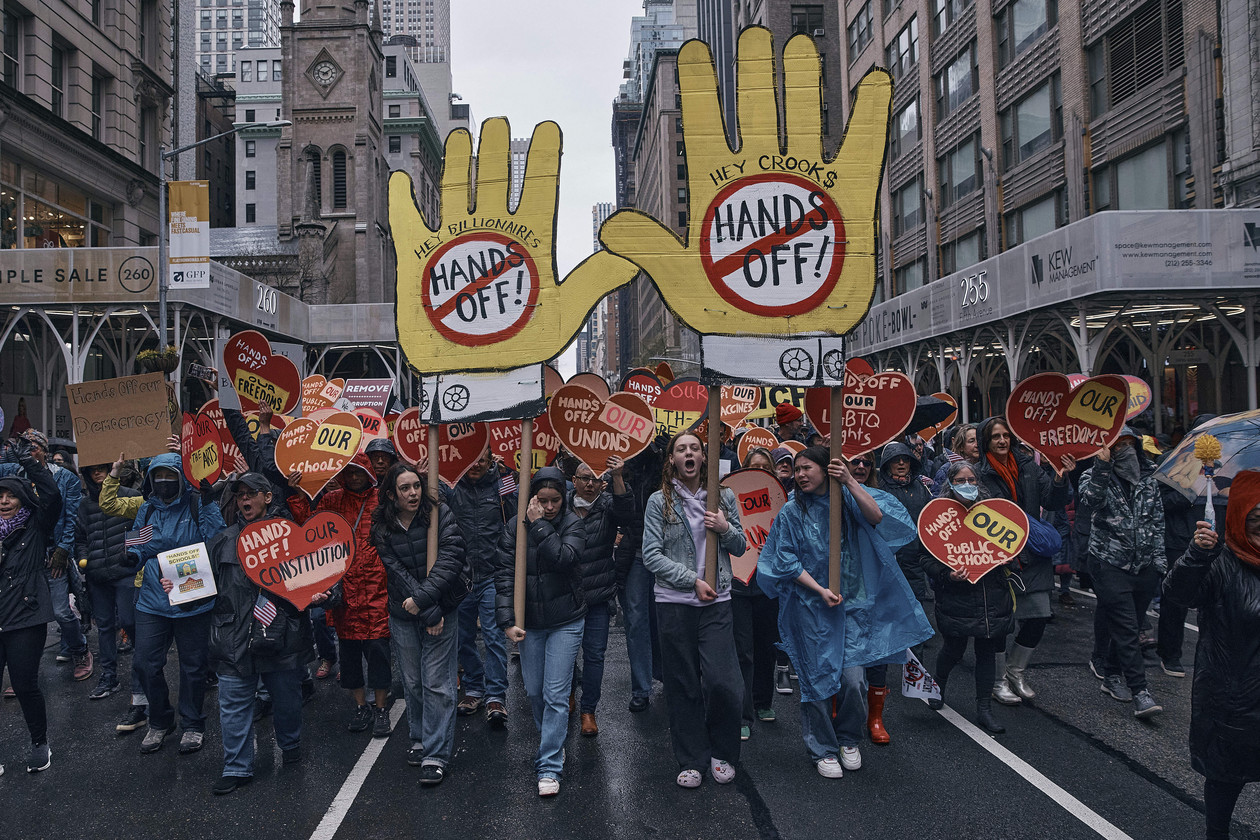
Hands Off! rallies were held in cities and towns across the United States this past weekend. Protesters demonstrated against the Trump administration’s policies and the massive cuts inflicted by Elon Musk’s DOGE team.
I participated in the Hands Off! rally in downtown Chicago and marched along with the crowd through the Loop. The most popular chants were “Hands Off!”and a call-and-response of “Show me what democracy looks like! This is what democracy looks like!”
I viewed an array of signs calling for defending education and libraries, ensuring medical and scientific research, saving Medicare and Medicaid, and preserving Social Security.
Federal workers, scientists, researchers, professors, teachers, and librarians who have been targeted by the DOGE team were highly visible in the crowd in Chicago.
Massive crowds marched through the streets of New York City, Washington, D.C., and many other cities across the nation.
“Crowds of people angry about the way President Donald Trump is running the country marched and rallied in scores of American cities Saturday in the biggest day of demonstrations yet by an opposition movement trying to regain its momentum after the shock of the Republican’s first weeks in office,” according to Politico.
“So-called Hands Off! demonstrations were organized for more than 1,200 locations in all 50 states by more than 150 groups including civil rights organizations, labor unions, LBGTQ+ advocates, veterans and elections activists. The rallies appeared peaceful, with no immediate reports of arrests.”
“Protesters Tee Off Against Trump and Musk in “Hands Off!” Rallies Across the U.S.” Politico (5 April 2025).
Miller, Violet and Anna Savchenko. “Hands Off Protest in Downtown Chicago Draws Thousands Criticizing Trump’s Policies.” WBEZ (5 April 2025).
The Trump administration has clearly made a massive mistake in calculating its so-called “reciprocal” tariff rates, seriously damaging global economic systems in the process.
President Trump has blundered into a major trade war that is reckless and based on gross misreadings of the history of tariffs.
Brent Neiman, Edward Eagle Brown Professor of Economics at Chicago Booth School of Business (University of Chicago), analyzes macroeconomics, financial, and trade issues and has previously served in the United States Department of the Treasury.
In an essay entitled “The Trump White House Cited My Research to Justify Tariffs. They Got It All Wrong,” published today in The New York Times, Neiman wonders how exactly the Trump administration came up with its so-called “reciprocal” tariff rates.
“My first question, when the White House unveiled its tariff regime, was, ‘How on earth did they calculate such huge rates?’ Reciprocal tariffs, after all, are supposed to treat other countries the way they treat us, and foreign tariffs on American goods are nowhere near these levels.”
“The next day it got personal,” Neiman relates. “The Office of the U.S. Trade Representative released its methodology and cited an academic paper produced by four economists, including me, seemingly in support of their numbers. But they got it wrong. Very wrong. I disagree fundamentally with the government’s trade policy and approach. But even taking it at face value, our findings suggest the calculated tariffs should be dramatically smaller — perhaps one-fourth as large.”
Neiman and his economist colleagues had argued that any new tariffs should be much, much lower—roughly 25 percent of what the Trump administration has already announced.
And, the Trump administration seems poised to jack up tariff rates on China and other nations even higher as the trade war widens.
Where is the “reciprocity” in such skewed tariff rates?
Neiman goes on his essay to examine the false premises and flawed calculations of the Trump administration.
Illustration for Brent Neiman’s essay. Image: The New York Times.
For a deeper history of tariffs, see the work of my friend and historian colleague, John E. Moser, Professor of History (Ashland University). He will be joining the Institute of American Civics at the University of Tennessee at Knoxville in Fall 2025.
Moser’s The Global Great Depression and the Coming of World War II (2015) analyzes the ways in which international competition during the Global Great Depression produced the Second World War.
Here is the book description at Routledge’s website:
“The Global Great Depression and the Coming of World War II demonstrates the ways in which the economic crisis of the late 1920s and early 1930s helped to cause and shape the course of the Second World War. Historian John E. Moser points to the essential uniformity in the way in which the world s industrialized and industrializing nations responded to the challenge of the Depression. Among these nations, there was a move away from legislative deliberation and toward executive authority; away from free trade and toward the creation of regional trading blocs; away from the international gold standard and toward managed national currencies; away from chaotic individual liberty and toward rational regimentation; in other words, away from classical liberalism and toward some combination of corporatism, nationalism, and militarism. For all the similarities, however, there was still a great divide between two different general approaches to the economic crisis. Those countries that enjoyed easy, unchallenged access to resources and markets the United States, Great Britain, the Soviet Union, and France tended to turn inward, erecting tariff walls and promoting domestic recovery at the expense of the international order. On the other hand, those nations that lacked such access Germany and Japan sought to take the necessary resources and markets by force. The interplay of these powers, then, constituted the dynamic of international relations of the 1930s: have-nots attempting to achieve self-sufficiency through aggressive means, challenging haves that were too distrustful of one another, and too preoccupied with their own domestic affairs, to work cooperatively in an effort to stop them.”
See also a number of academic journal articles on tariffs, protectionism, the Great Depression, and the Great Recession in The Economic History Review, The International History Review, The Journal of Economic History, History of Economic Ideas, and the Journal of Modern European History.
Sources
Moser, John E. The Global Great Depression and the Coming of World War II. London: Routledge 2015.
Moser, John E. The Great Depression and the New Deal: A Concise History. Ashbrook Press 2023.
Neiman, Brent. “The Trump White House Cited My Research to Justify Tariffs. They Got It All Wrong.” The New York Times (7 April 2025).
On Thursday night, the Trump administration placed 80 percent of National Endowment for the Humanities (NEH) staff members on administrative leave and blocked its grants to state humanities councils. The entire NEH is effectively being dismantled.
I deplore these actions and stand with the staff of the National Endowment for the Humanities.
Research in history, art history, music history, literary studies, and interdisciplinary humanities also depends fundamentally on grants and fellowships from the NEH.
I personally know many professors and researchers whose NEH grants for humanities research and programming were frozen on Thursday night. These blocks on current grants are improper and illegal, since the federal funds have been allocated by the U.S. Congress to the NEH, and then granted by the agency to humanities researchers and programs through competitive and peer-reviewed grant processes.
“In a university setting, the term generally refers to subjects like history, religion, philosophy, literature and art. In the context of the public humanities, the definition can be harder to pin down,” according to Margaret Renkl in an essay published in The New York Times.
For this reason, each state’s humanities council creates programs and competitive proposal processes to distribute the public humanities funding that it receives from the NEH.
Museum exhibitions, book fairs, film festivals, public lectures, storytelling programs, and other cultural events in every state depend on federal funds distributed by the National Endowment for the Humanities.
Many auditoriums across the nation may soon be empty.
“The N.E.H. is one of the least-known of the federal agencies, but its work reaches a huge number of Americans, including those in Republican districts. It awards grants that fund research fellowships, programs at museums and historic sites, website development and documentary filmmaking, among a host of other projects related to the public humanities. But it also disburses a great chunk of its appropriation — some $65 million of an annual budget of roughly $210 million — directly to nonprofit humanities councils in all 50 states, the District of Columbia and five territories,” according to Margaret Renkl.
“These independent affiliates of the N.E.H. then reallocate those funds to programming tailored to the people of their own state. Through the work of the state humanities councils, in other words, the N.E.H. is doing exactly what Republicans have always said they wanted to do with federal funds: It gives federal money back to the states.”
Renkl argues that “we need to tell the people who represent us a story — a true story — that reminds them of our shared humanity. Because the concept of a shared humanity is something too many of them, and too many of us, have lately all but forgotten.”
Renkl, Margaret. “The N.E.H. Does What Republicans Always Wanted. DOGE Slashed It Anyway.” The New York Times (7 April 2025).
The Illinois Humanities Council website provides information on public humanities in the State of Illinois, where I live.
“Soon after the new administration arrived, things began to go missing from the White House website,” according to The New York Times.
“They weren’t just the partisan policy platforms that typically disappear during a presidential transition. Informational pages about the Constitution and past presidents, up in various forms since President George W. Bush was in office, all vanished.”
The New York Times reports that “Thousands of other government web pages had also been taken down or modified, including content about vaccines, hate crimes, low-income children, opioid addiction and veterans, before a court order temporarily blocked part of the sweeping erasure. A Justice Department database tracking criminal charges and convictions linked to the Jan. 6, 2021, attack on the Capitol was removed. Segments of data sets are gone, some of the experts who produced them were dismissed, and many mentions of words like ‘Black,’ ‘women’ and ‘discrimination’ have evaporated.”
These moves are part of the Trump administration’s attacks on Diversity, Equity, and Inclusion initiatives, but are also part of the much broader Culture Wars.
The Trump administration seeks to control current data and information, in addition to altering the historical record to suit its political aims. This is a major reason why the National Archives, Smithsonian Institute, Institute for Museum and Library Services, National Endowment for the Humanities, Fulbright Program, and research universities are under direct attack by Elon Musk’s so-called DOGE team and the entire Trump administration.
“President Trump’s team is selectively stripping away the public record, reconstructing his preferred vision of America in the negative space of purged history, archivists and historians said. As data and resources are deleted or altered, something foundational is also at risk: Americans’ ability to access and evaluate their past, and with it, their already shaky trust in facts.”
“‘This is not a cost-cutting mechanism,’ said Kenny Evans, who studies science and technology policy at Rice University’s Baker Institute for Public Policy and runs the White House Scientists Archive at the school. ‘This slide toward secrecy and lack of transparency is an erosion of democratic norms.'”
Non-governmental organizations are attempting to preserve government data that was previously available on the internet. The Data Rescue Project, Internet Archive, and other organizations are seekign to preserve data and information and make it accessible to the public.
The New York Times reports on these efforts to preserve data and information.
Hsu, Tiffany. “The White House Frames the Past by Erasing Parts of It.” The New York Times (5 April 2025).
The Organization of American Historians (OAH) is meeting in Chicago this week and many historians have been addressing the Trump administration’s attacks on education in the United States.
The OAH is the premier academic association of historians who work on the History of the United States.
On Thursday, the OAH held a plenary session on “Historians and the Attacks on Education”
The OAH describes the session: “An informal and free-wheeling discussion about the attacks on history, libraries, federal agencies, museums, the National Park Service and education generally at the university, college and k-12 levels. As a profession we have rarely faced such a withering assault on the very purpose of what we do in research, teaching, preservation, and exhibiting American history. Nor has there ever been such a well-funded assault on public schools. The panel will probe the scope and meaning of the current attacks, examine them through historical comparison, and discuss what is to be done.”
Panelists:
Chair: David W. Blight, Yale University, author of Frederick Douglass, current president, OAH,
Joshua Cowen, Michigan State University, Educational Policy and Law, author of The Privateers.
Panelists: Nancy McClean, Duke University, author of Democracy in Chains and many other works on the American Right.
David Pepper, Fellow, Kettering Foundation; Saving Democracy and Laboratories of Autocracy; Adjunct Professor (Voting Rights and Election Law), University of Cincinnati School of Law
Leslie Harris, Northwestern University, author of Shadow of Slavery and Slavery and the University, public historian.
Johann Neem,Western Washington University, author of Democracy’s Schools.
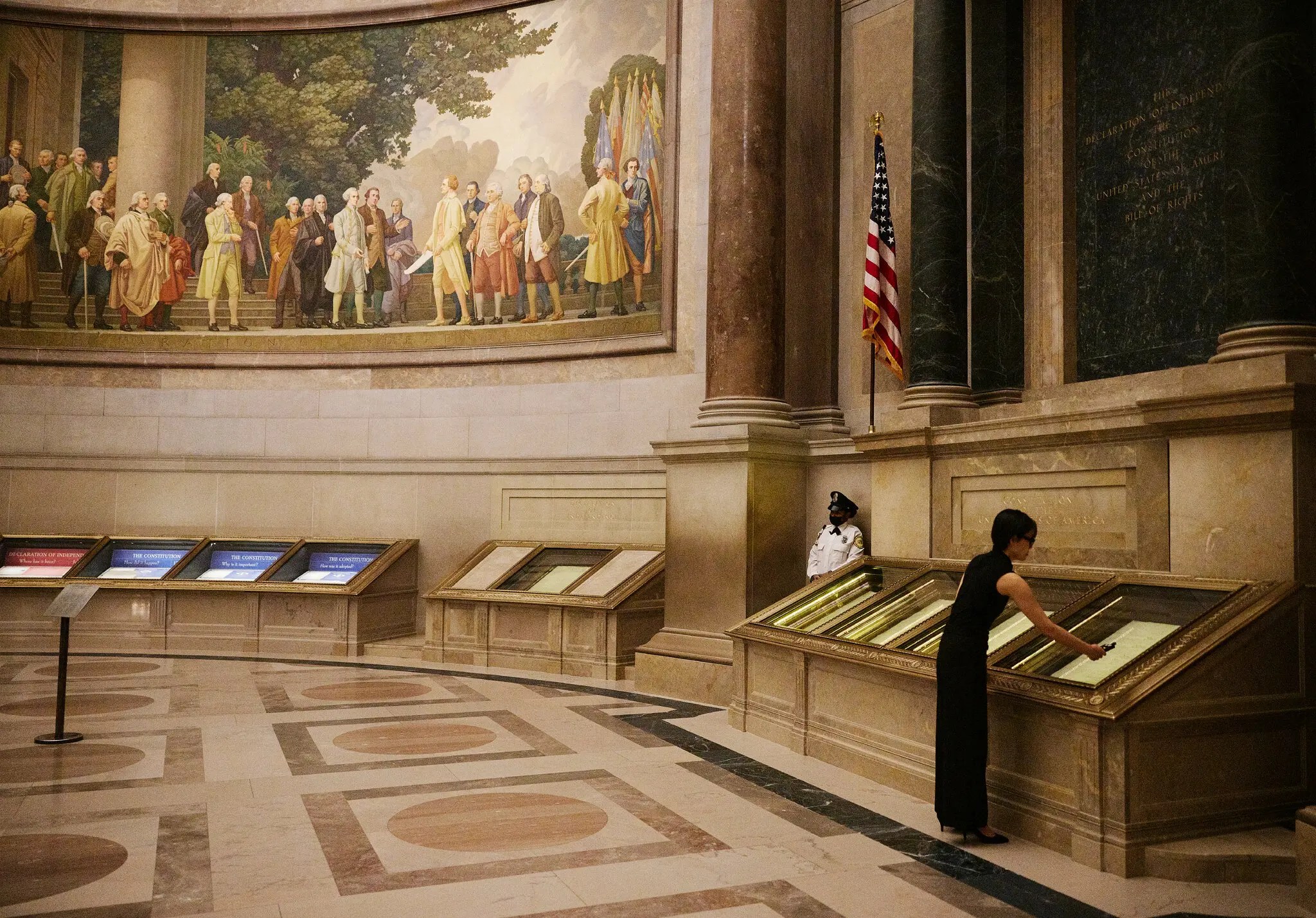
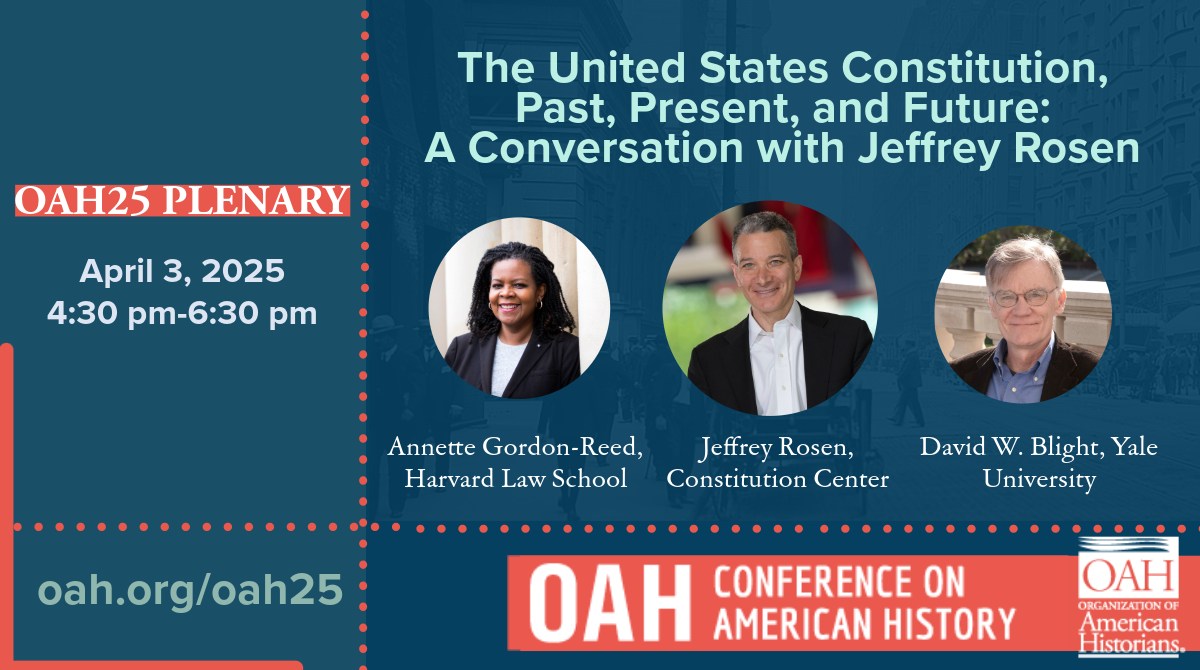
Another plenary is being held at the OAH on the history of the United States Constitution.
“Defend History!” buttons are available at the OAH conference and are visible on social media feeds.
The Trump administration’s war on knowledge and education continues to widen, as attacks on academic freedom extend to libraries, museums, and universities across the nation.
Trump administration members are attempting to control library and museum content and dictate what types of research can be carried out by researchers and professors in the fields of science, medicine, social sciences, education, arts, and humanities.
As part of this broad assault on knowledge and academic freedom, book bans are being implemented at research and university libraries.
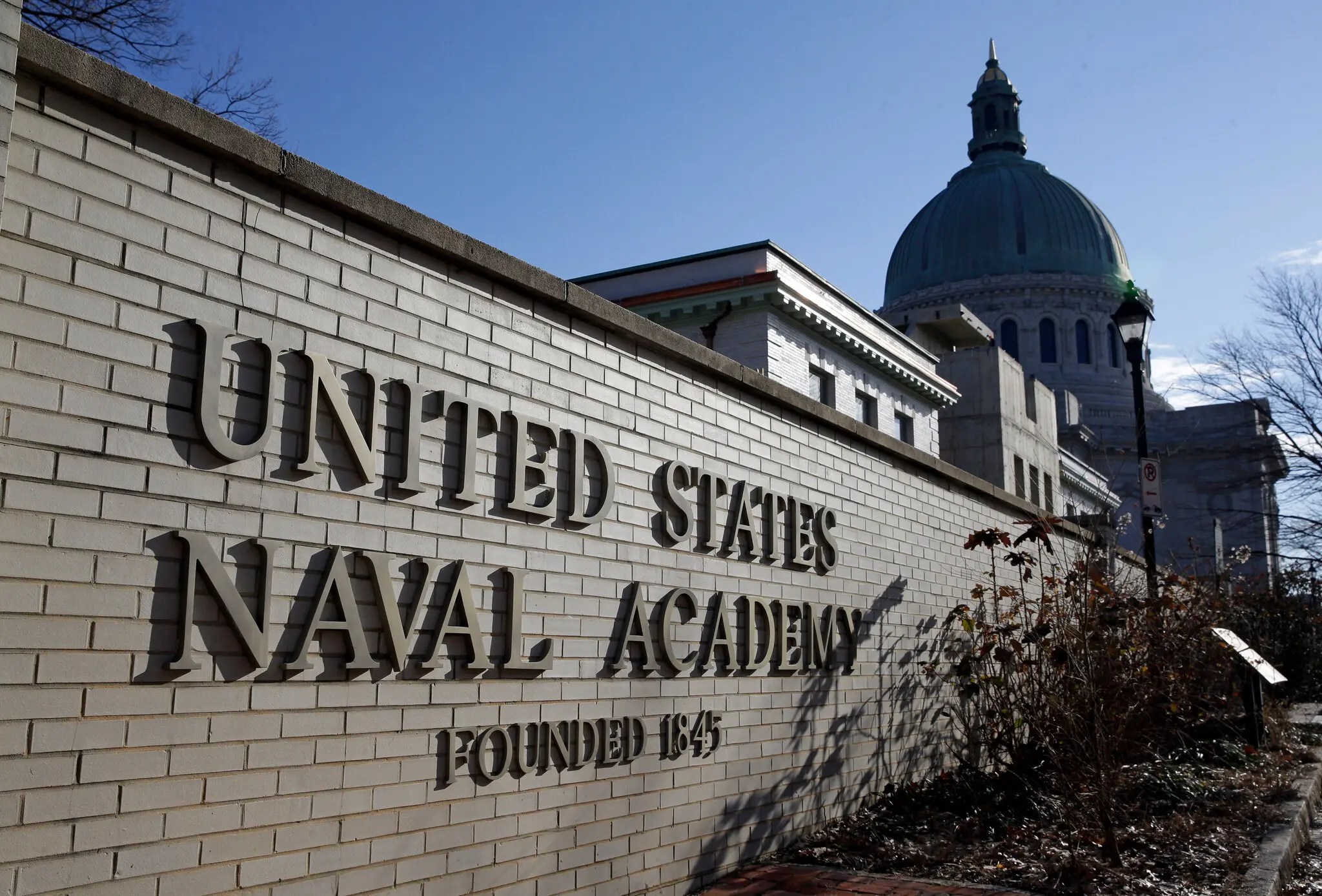
Secretary of Defense Pete Hegseth has ordered the U.S. Naval Academy to remove 381 books from Nimitz Library, the main library for this institution of higher education.
The list reveals a clear far-right ideological agenda at work by Secretary Hegseth. Of course, this is not surprising if you have heard Hegseth’s previous news media appearances that promote racist and sexist policies. There is nothing “conservative” about this far-right agenda.
In removing book titles discussing systemic racism from the Nimitz Library, Hegseth’s book ban demonstrates (once again) precisely how systemic racism works.
The book ban has already been carried out, with Navy officials removing the books prior to the secretary’s visit to the U.S. Naval Academy.
“The Navy released the titles of 381 books on Friday evening that were removed from the U.S. Naval Academy’s Nimitz Library on the Annapolis, Md., campus this week because their subject matter was seen as being related to so-called diversity, equity and inclusion topics,” according to The New York Times.
“President Trump issued an executive order in January that banned D.E.I. materials in kindergarten through 12th grade education, but the office of Defense Secretary Pete Hegseth informed the Naval Academy on March 28 that he intended the order to apply to the school as well, even though it is a college.“
The New York Times reports: “First on the list is ‘How to Be Anti-Racist”’ by Ibram X. Kendi. Also listed are ‘The Making of Black Lives Matter,’ by Christopher J. Lebron; ‘How Racism Takes Place,’ by George Lipsitz; ‘The Fire This Time,’ edited by Jesmyn Ward; ‘The Myth of Equality,’ by Ken Wytsma; studies of the Ku Klux Klan, and the history of lynching in America.”
I have been thinking about book bans and censorship in comparative contexts. I was recently in Paris and visited the exhibition on « L’art « dégénéré » : Le procès de l’art moderne sous le nazisme » (“‘Degenerate’ art. Modern art on trial under the Nazis”) at the Musée Picasso.
Viewing banned artworks and books that the Nazis deemed “degenerate” is always depressing, and I have seen several previous special exhibitions on this theme in Berlin and elsewhere.
But viewing these so-called “degenerate” artworks and books once again during Trump administration’s far-right assault on research, education, art, and history in the United States is truly shocking.
Ismay, John. “These Are the 381 Books Removed From the Naval Academy Library.” The New York Times(4 April 2025).
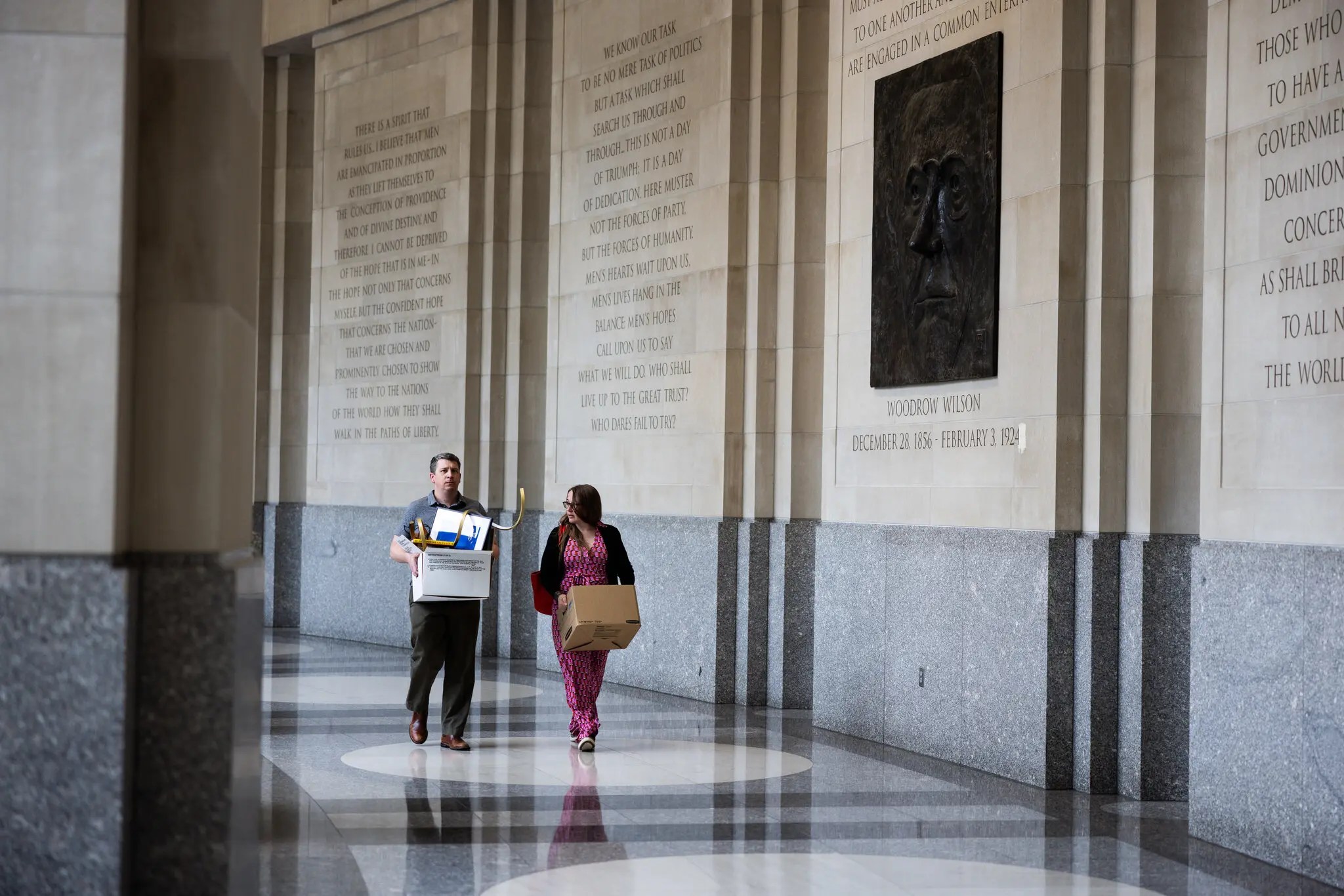
Elon Musk and his so-called DOGE team are attacking another federal institution, this time it is the Wilson Center in Washington, D.C., that is being illegally dismantled.
The Wilson Center explains its mission on its website: “The Wilson Center occupies a unique place in US foreign policy—we are congressionally chartered, scholarship driven, and fiercely nonpartisan. It is our mission to help policymakers and stakeholders make sense of global developments. We are driven to offer the insights and analysis that can inform decision-making and forge a stronger America and more secure world.”
The Wilson Center researchers have long provide expert analyses of foreign policy and international relations issues via workshops, conferences, and publications. They have provided expert briefings to members of the U.S. Congress and to officials in federal institutions and the military.
The Wilson Center has also provided fellowships to researchers who work on foreign policy, international relations, and security issues.
However, President Trump apparently does not want any foreign policy advice. Nor does Trump want the United States to have any independent researchers on international relations issues who might be capable of critiquing his foreign policies.
So, Elon Musk and his DOGE team are unlawfully shutting the Wilson Center down.
“Almost all the employees of the Wilson Center, a prominent nonpartisan foreign policy think tank in Washington, were placed on leave on Thursday and blocked from their work email accounts as Elon Musk’s task force quickly shut down most of the center,” according to The New York Times.
The DOGE team followed its now familiar playbook of occupying a federal institution and taking over its computers, then ordering federal employees out of their offices.
“About 130 employees received orders telling them not to return to the office after the end of the day, according to an email reviewed by The New York Times and people with direct knowledge of the actions.”
“The Wilson Center employees are to be paid while on leave but will be fired soon, in line with what has happened at other institutions that Mr. Musk’s workers have dismantled in recent weeks.”
“Only five employees will remain — a president, two federal employees and two researchers on fellowships. Those positions are mandated in the center’s congressional charter. The cuts align with an executive order President Trump signed in March.”
“Private donations to the center will be returned to the donors, according to a person familiar with the center who spoke on the condition of anonymity to avoid retribution. It was not clear what would be done with the center’s endowment.”
“On Thursday afternoon, dozens of employees carried boxes and bags filled with papers, plants and posters out of the center’s offices in the Ronald Reagan Building, which houses several government agency offices.”
All of these actions seem illegal and unconstitutional, since the Wilson Center is chartered by the United States Congress.
Shockingly, the U.S. Congress has apparently taken no actions to defend the Wilson Center.
Kavi, Aishvarya and Edward Wong. “Workers Forced to Leave Foreign Policy Center as Trump Presses Shutdown.” The New York Times (3 April 2025).
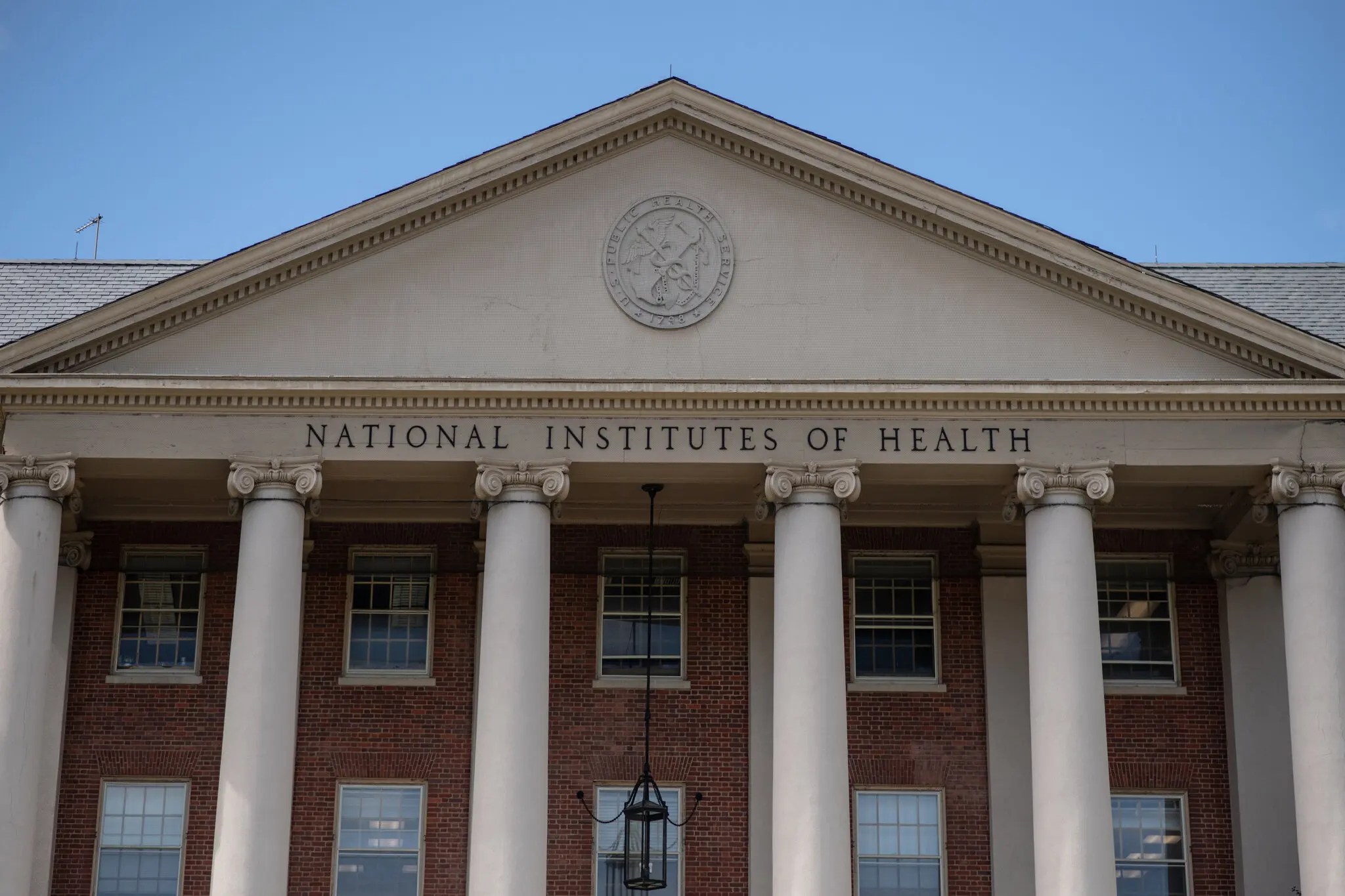
Sixteen states have sued the Trump administration to restore research funding in biomedicine and public health that has been suspended or blocked by officials at the National Institutes of Health (NIH).
The New York Times reports that “California, Massachusetts and 14 other states sued the Trump administration on Friday for withholding grant funding from public health and medical research institutions, cuts that have forced universities to curtail research and to delay the hiring of new staff.”
“The National Institutes of Health is the world’s leading public funder of biomedical research, supporting studies on aging, substance abuse and other major issues. More than 80 percent of the agency’s $47 billion budget goes to outside researchers — grant funding that in recent weeks has been eliminated, paused or delayed by the Trump administration in a ‘concerted, and multi-pronged effort to disrupt NIH’s grants,’ according to the lawsuit.”
The New York Times emphasizes that “Cuts and delays to N.I.H. funding have crippled research teams in universities across the country and halted studies midstream, setting back work on diseases like cancer and diabetes and plunging American medical research into crisis. The attorneys general are asking the courts to restore pulled grant funding and to allow pending grant applications to be evaluated and approved fairly.”
The state attorneys general bringing this lawsuit argue that the Trump administration’s actions are illegal.
“‘In their unlawful withholding and terminating of medical and public health research grants, the Trump Administration is upending not only the critical work being done today, but the promise of progress for future generations,’ Rob Bonta, the attorney general of California, said in a statement,” according to The New York Times.
Attorney General Laetitia James (State of New York) indicates that the other states joining the lawsuit are: Arizona, California, Colorado, Delaware, Hawai’i, Maryland, Massachusetts, Minnesota, Nevada, New Jersey, New Mexico, Oregon, Rhode Island, Washington, and Wisconsin.
I wonder why the attorney general of the State of Illinois has apparently not yet joined this lawsuit?
In a separate lawsuit, the American Civil Liberties Union (ACLU) is suing the Trump administration over the its ideological blocking of federal research grants in biomedical and public health research.
NBC News reports that “The American Civil Liberties Union filed a lawsuit Wednesday alleging that the National Institutes of Health has conducted an ‘ongoing ideological purge of critical research projects’ that violates federal law and is unconstitutional.”
“The lawsuit, filed in Massachusetts district court on behalf of four researchers and three unions with members who rely on NIH funding, says that the federal science agency ‘abruptly cancelled’ hundreds of research projects ‘without scientifically-valid explanation or cause.'”
According to NBC News, “The lawsuit says NIH has justified its cancellations with ‘ideological purity directives’ about research related to diversity, equity and inclusion (DEI), vaccine hesitancy and gender identity, among other topics.”
“‘The new arbitrary regime is not codified in any law or policy,’ the lawsuit says, adding that NIH has ‘failed to develop any guidelines, definitions or explanations’ that explain ‘the parameters of the agency’s prohibitions against research with some connection to DEI, gender, and other topics that fail Defendants’ ideological conformity screen.'”
“The new lawsuit lists the NIH; its director, Jay Bhattacharya; the U.S. Department of Human and Health Services; and its director, Robert F. Kennedy Jr., as defendants. Both federal agencies said they would not comment on pending litigation.”
Karlamangla, Soumya and Benjamin Mueller. “16 States Sue to Restore N.I.H. Funding.” The New York Times (4 April 2025).
Bush, Evan. “ACLU Sues National Institutes of Health for ‘Ideological Purge’ of Research Projects.” NBC News (2 April 2025).
Attorney General Laetitia James (State of New York) has issued a statement on the attorneys general lawsuit.
Elon Musk may exhibit highly erratic and volatile behavior, but he espouses a coherent Technocratic and Fascist ideology that was articulated in the 1930s.
Jill Lepore, Professor of History and Law (Harvard University), traces the history of Elon Musk’s grandfather, Joshua Haldeman, and his role in the development of the Technocracy and Fascist movements of the 1930s.
Lepore writes that “I was again struck at how little of what Mr. Musk proposes is new and by how many of his ideas about politics, governance and economics resemble those championed by his grandfather Joshua Haldeman, a cowboy, chiropractor, conspiracy theorist and amateur aviator known as the Flying Haldeman. Mr. Musk’s grandfather was also a flamboyant leader of the political movement known as technocracy.”
According to Jill Lepore, “Leading technocrats proposed replacing democratically elected officials and civil servants — indeed, all of government — with an army of scientists and engineers under what they called a technate. Some also wanted to annex Canada and Mexico. At technocracy’s height, one branch of the movement had more than a quarter of a million members.”
“Under the technate,” she explains, “humans would no longer have names; they would have numbers. One technocrat went by 1x1809x56. (Mr. Musk has a son named X Æ A-12.) Mr. Haldeman, who had lost his Saskatchewan farm during the Depression, became the movement’s leader in Canada. He was technocrat No. 10450-1.”
After the Technocratic movement splintered and Haldeman’s political career in Canada failed, he moved to South Africa in 1950, excited to join the fledgling Apartheid state just being constructed there.
“Much that Mr. Musk has attempted to do at DOGE can be found in the technocracy manuals of the early 1930s,” according to Jill Lepore.
Lepore documents Musk’s fascination with his grandfather Joshua Haldeman’s Technocratic ideology and his application of its ideas and principles.
“Mr. Musk’s possible departure from Washington will not diminish the influence of Muskism in the United States. His superannuated futurism is Silicon Valley’s reigning ideology. In 2023 the venture capitalist Marc Andreessen, who helped staff DOGE, wrote ‘The Techno-Optimist Manifesto,’ predicting the emergence of ‘technological supermen.’ It consists of a list of statements:
We can advance to a far superior way of living and of being. We have the tools, the systems, the ideas. We have the will. … We believe this is why our descendants will live in the stars. … We believe in greatness. … We believe in ambition, aggression, persistence, relentlessness — strength.
“Mr. Andreessen cited, among his inspirations, Filippo Tommaso Marinetti, who in 1909 wrote ‘The Futurist Manifesto,’ which glorified violence and masculine virility and opposed liberalism and democracy. It, too, is a list of statements:
We want to sing the love of danger, the habit of energy and rashness. We want to exalt movements of aggression, feverish sleeplessness, the double march, the perilous leap, the slap and the blow with the fist. … We want to sing the man at the wheel. … We want to demolish museums and libraries, fight morality, feminism. … Standing on the world’s summit, we launch once again our insolent challenge to the stars!
“Ten years after Mr. Marinetti wrote ‘The Futurist Manifesto,’ fists raised to the stars, he co-wrote the founding document of the movement led by Mussolini: ‘The Fascist Manifesto.'”
Marinetti’s influence on Mussolini’s Fascist ideology has long been analyzed by Italian historians studying Fascist Italy.
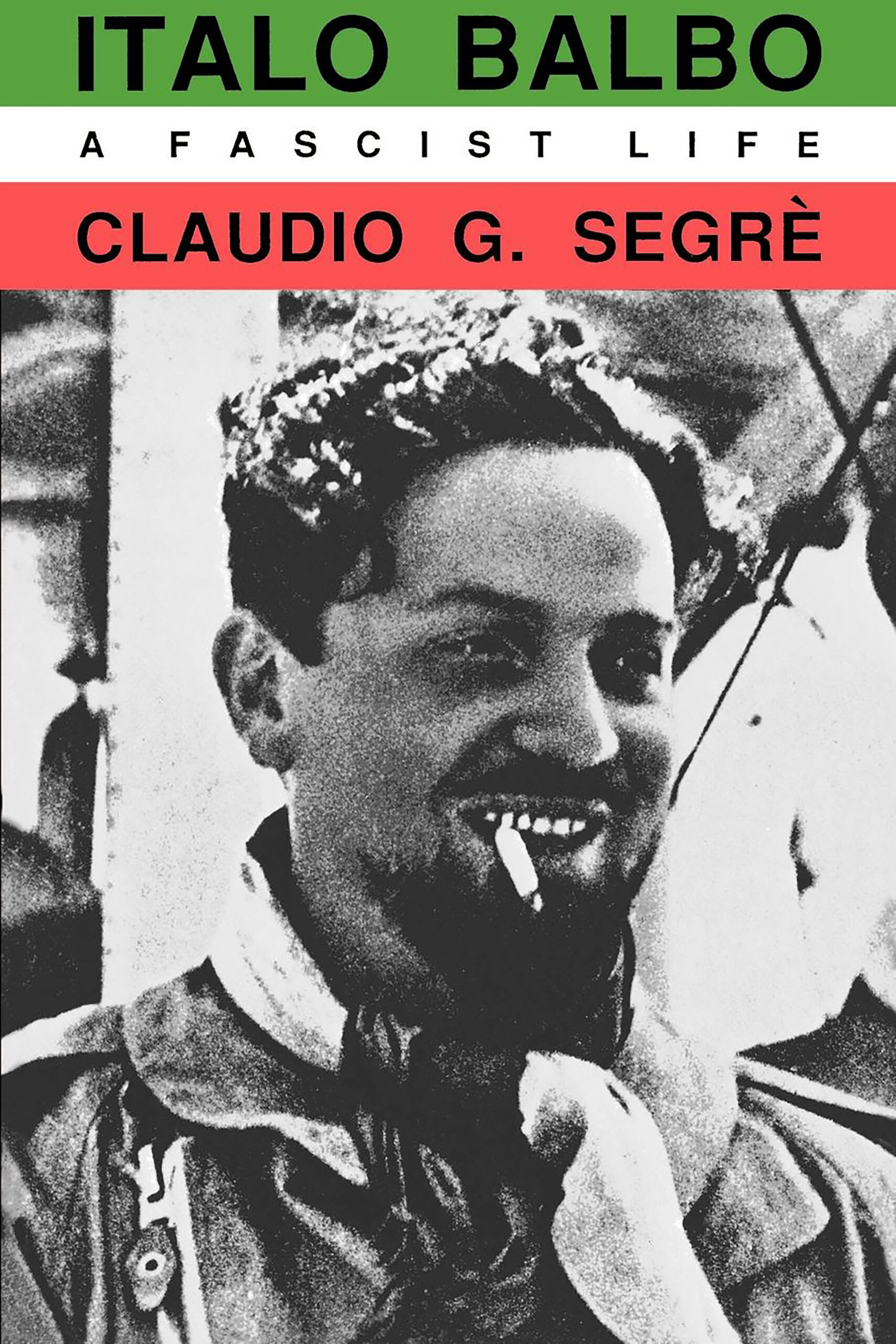
One of my personal favorites in this line of historical work is Claudio Segrè’s Italo Balbo: A Fascist Life (1990). I studied with Claudio Segrè as an undergraduate History major at the University of Texas at Austin.
The book description reads: “Pioneering aviator, blackshirt leader, colonial governor, confidante and heir-apparent to Benito Mussolini, the dashing and charismatic Italo Balbo exemplified the ideals of Fascist Italy during the 1920s and 30s. He earned national notoriety after World War I as a ruthless squadrista whose blackshirt forces crushed socialist and trade union organizations. As Minister of Aviation from 1926 to 1933, he led two internationally heralded mass trans-Atlantic flights. When his aerial armada reached the U. S., Chicago honored him with a Balbo Avenue, New York staged a ticker-tape parade, and President Roosevelt invited him to lunch. As colonial governor from 1933 to 1940, Balbo transformed Libya from backward colony to model Italian province. To many, Italo Balbo seemed to embody a noble vision of Fascism and the New Italy. Pioneering aviator, blackshirt leader, colonial governor, confidante and heir-apparent to Benito Mussolini, the dashing and charismatic Italo Balbo exemplified the ideals of Fascist Italy during the 1920s and 30s. He earned national notoriety after World.”
Claudio Segrè’s fascinating portrait of Italo Balbo reveals the melding of Futurism and Fascism in the aviation culture in Fascist Italy in the 1920s and 1930s.
“Muskism isn’t the beginning of the future,” Jill Leporte insists. “It’s the end of a story that started more than a century ago, in the conflict between capital and labor and between autocracy and democracy. The Gilded Age of robber barons and wage-labor strikes gave rise to the Bolshevik Revolution, Communism, the first Red Scare, World War I and Fascism. That battle of ideas produced the technocracy movement, and far more lastingly, it also produced the New Deal and modern American liberalism. Technocracy lost because technocracy is incompatible with freedom.”
Lepore concludes that “That is still true, but unlike his forefathers, Mr. Musk does have a theory for the assumption of power. That theory is to seize power with the dead robotic hand of the past. It remains for the living to wrest free of that grip.”
Lepore, Jill. “The Failed Ideas That Drive Elon Musk.” The New York Times (4 April 2025).
Segrè, Claudio. Italo Balbo: A Fascist Life (Berkeley, CA: University of California Press, 1990).
The American Historical Association (AHA) is organizing actions to defend the National Endowment for the Humanities (NEH) and historical researchers affected by the Trump administration’s and so-called DOGE’s teams attacks on the NEH.
Trump administration members illegally halted payments on many active NEH grants yesterday (see my previous post on this issue) and seems to have suspended current and future grant competitions.
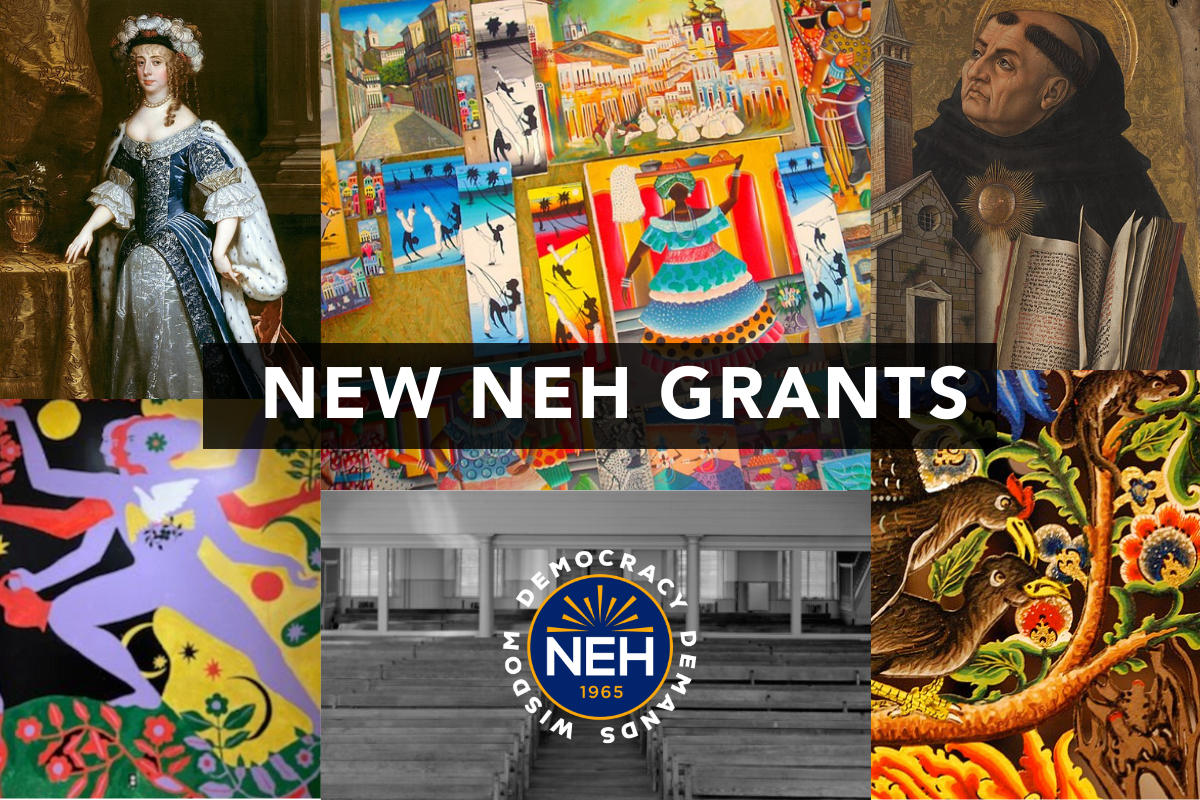
The National Endowment for the Humanities has a regular annual cycle of grant competitions, subject to peer review and evaluation. The latest NEH grants were announced in January 2025.
Trump administration officials have now improperly and illegally blocked the grant payments on those legitimately issued grants.
State Humanities Councils, local museums, libraries, universities, and researchers are all affected by the suspensions of active grants. I personally know of many institutions and researchers who have already received improper notifications that their current grants are cancelled.
The entire research infrastructure in the United States has been disrupted by the illegal and anti-constitutional actions of the Trump administration. The so-called DOGE team’s actions also violate principles of academic freedom, scientific integrity, research ethics, civil rights, and human rights.
National Endowment for the Humanities banner announcing its new grants in January 2025. Image: NEH.
I am a member of the American Historical Association and actively support its efforts to save the National Endowment for the Humanities.
“The American Historical Association has released a statement condemning the evisceration of the National Endowment for the Humanities, as the current administration’s Department of Government Efficiency has terminated hundreds of grants and put 75% of staff on leave. ‘The NEH and the grants it administers nourish our democracy through research, education, preservation, institutional capacity building, and public programming in the humanities for the benefit of the American people,’ the statement reads. ‘This frontal attack on the nation’s public culture is unpatriotic, anti-American, and unjustified.’
“We encourage our members to contact your congressional representatives today through the National Humanities Alliance’s action alert, and urge them to save the NEH. The NHA is also collecting information about current grants that have been canceled since March 31, 2025.”
For the full text of the American Historical Association’s statement, see the AHA website.










 Brian Sandberg: Historical Perspectives