M. Gessen has published a new essay on the Trump administration’s war on universities and knowledge itself.
“Almost three months into the Trump administration’s war on universities, and a year and a half into the Republican Party’s organized campaign against the presidents of top colleges, it is clear that antisemitism and D.E.I. are mere pretexts for these attacks. Like much of what this administration does, the war on higher education is driven by anti-intellectualism and greed. Trump is building a mafia state, in which the don distributes both money and power. Universities are independent centers of intellectual and, to some extent, political power. He is trying to destroy that independence.”
According to Gessen, “There is a way for universities to fight back. It requires more than refusing to bend to Trump’s will, and it requires more than forming a united front. They must abandon all the concerns — rankings, donors, campus amenities — that preoccupy and distract them, and focus on their core mission: the production and dissemination of knowledge. Intellectuals have adopted this strategy to fight against autocrats in other countries. It works. …”
“So this is my radical proposal for universities: Act like universities, not like businesses. Spend your endowments. Accept more, not fewer students. Open up your campuses and expand your reach not by buying real estate but by bringing education to communities. Create a base. Become a movement.”
Gessen, M. “This Is How Universities Can Escape Trump’s Trap, If They Dare.” The New York Times (14 April 2025).
Trump officials in the U.S. Department of State are calling for employees to report incidents of supposed “anti-Christian bias.” The pressure campaign seems intended to intimidate non-Christians working in the Department of State, potentially violating workers’ civil rights and constitutional rights.
“As the Christian world commemorates Holy Week leading up to Easter Sunday, the State Department has issued an appeal for its employees to report instances of alleged anti-Christian bias, including formal or informal actions due to opposition to vaccines or personal pronoun choice, that may have occurred during the Biden administration,” according to the Associate Press (AP).
“The call comes amid heightened fear and anxiety in the American diplomatic corps, which is bracing for a new update on the Department of Government Efficiency-inspired budget and staff cuts that is due to be presented to the White House on Monday. That update is expected to include the State Department’s latest estimates of voluntary retirements and separations and how those will affect potential future layoffs to meet benchmarks from Elon Musk’s DOGE and the government’s human resources agency, according to officials familiar with the process.”
“While foreign and civil service employees await word on their futures, the State Department has moved ahead with an initiative aimed at rooting out religious bias in its policies and hiring practices with a specific emphasis on anti-Christian activity that may have occurred under President Joe Biden.”
This bias-hunting aim seems blatantly political and anti-constitutional. If there were actual documented reports of bias, why would the State Department limit itself to reviewing actions only during the Biden administration? This seems more like a fishing expedition.
If the supposed bias actually had occurred, why investigate only alleged anti-Christian bias, rather than potential biases against any religious faith or organization?
“There is no immediate indication that such discrimination, as defined by President Donald Trump’s State Department, took place under Biden,” according to the AP.
“In a cable sent Friday to all U.S. diplomatic missions, Rubio asked that staffers report any perceived discriminatory actions taken against Christians or employees advocating on their behalf between January 2021 and January 2025. The cable, copies of which were obtained by The Associated Press, says that all reported allegations will be investigated by a government-wide task force on anti-Christian bias and if discrimination is found the culprits may be disciplined. It also makes clear that allegations can be submitted anonymously.”
These actions clearly violate the establishment clause of the Constitution of the United States and its provisions for a separation of church and state.
Lee, Matthew. “State Department Wants Staff to Report Instances of Alleged Anti-Christian Bias during Biden’s Term.” Associated Press (13 April 2025).
Gedeon, Joseph. “State Department Staff Told to Report Colleagues for ‘Anti-Christian Bias.'” The Guardian (1a April 2025).
Gramer, Robbie and Nahal Toosi. “State tells employees to report on one another for ‘anti-Christian bias.'” Politico (11 April 2025).
International students at state universities in Illinois and across the nation are being improperly and unlawfully targeted by the Trump administration for visa revocation.
Last week, the Trump administration revoked the visas of five international students at Northern Illinois University, where I am a professor.
Students from the University of Illinois at Urbana-Champaign, University of Illinois at Chicago, Illinois State University, Southern Illinois University, and other state universities were also targeted.
The Trump administration’s authoritarian actions violate these students’ First Amendment rights to freedom of speech and freedom of assembly. Revoking students’ visas without cause or due process unjustly deprives international students of access to education, violating their civil rights and human rights.
Further, these actions constitute attacks on public education, academic freedom, faculty governance, and university autonomy. State universities are under a widespread and coordinated attack by the Trump administration.
“The federal government has revoked the visas of some international students studying at universities across Illinois, but college administrators are sharing few details, including how many students have been impacted,” Capitol News Illinois reports.
“A spokesperson for the University of Illinois Urbana-Champaign this week confirmed that some of its students are affected, but did not disclose a number. U of I ranks sixth nationally in the size of its international student body at over 15,000.
“‘Out of student privacy concerns, we are not sharing specific information, but we are working directly with affected students to help them connect with appropriate resources and understand their options,’ said Robin Kaler, a university spokesperson. Kaler declined to provide more details, though multiple sources familiar with the situation at U of I, who asked that their names not be used because they are not authorized to speak on the matter, say the number of students whose visas have been revoked is at least several dozen — and likely growing.
“The revocations are part of a broader federal crackdown playing out on campuses across the country. International students have faced abrupt visa cancellations in recent weeks, as the Trump administration’s sweeping immigration dragnet ensnares college students, federal officials claim have violated visa rules, though the reasons for the revocations are not always made clear. In many cases, students have also lost their status in the Student and Exchange Visitor Information System, SEVIS, which allows them to legally stay in the U.S. while enrolled in school.
“Across its vast network of public and private colleges and universities, Illinois hosts one of the largest international student populations in the nation, ranking fifth, with more than 55,000 international students, according to a 2024 Open Doors report. …”
“As university leaders try to balance student concerns, fears of retaliation in an increasingly fraught political climate and growing demands for transparency, some say they feel left in the dark. And they worry the lack of transparency could conceal the full scope of the federal government’s actions against international students nationwide.”
“‘What is deeply distressing about the news — that an international student’s visa was revoked — is the chilling silence around it, which only adds to the sense that we are powerless in the face of multiple attacks on the very existence of universities as places of learning, questioning and nurturing the next generation,’ said Jyotnsa Kapur, a professor in cinema and media studies and the director of the University Honors Program at SIU Carbondale.”
Brandhorst, Jackson. “‘Chilling silence’: Waves of Illinois’ International University Students Lose their Visas.” Capitol News Illinois (10 April 2025).
“The Visas of Five International Students at NIU Have Been Revoked.” NPR (10 April 2025).
Last week, hundreds of active grants that were already awarded by the National Endowment for the Humanities (NEH) after rigorous peer review were unlawfully cancelled by Trump administration officials.
Many professors, researchers, and graduate students in History and the Humanities have been directly affected by these cancellations. Their ongoing research is now suspended or completely unfunded. Some researchers will lose their grant-funded positions, while others will be unable to pay for essential research materials, travel, and support that was already planned and allocated.
I personally know dozens of professors and researchers who have had their grants improperly and unlawfully cancelled.
Now, Trump-appointed leaders of the NEH indicate that some of these funds will be unlawfully diverted to one of President Trump’s political pet projects, a so-called National Garden of American Heroes. This illegitimate award of NEH funds will apparently happen without any grant competition or peer review process.
The Trump administration is attempting to transform the National Endowment for the Humanities into a political funding stream in a perversion of academic and research standards in History and the Humanities.
These unlawful and unethical actions are being done in order to implement President Trump’s personal and highly politicized vision of history.
“The National Endowment for the Humanities intends to redirect some of its funding to build President Trump’s proposed National Garden of American Heroes, as part of a reorientation toward the president’s priorities of celebrating patriotic history, according to three people who attended a meeting on Wednesday where the plans were discussed,” according to The New York Times.
“Last week, the agency, the main federal funder of the humanities, abruptly canceled more than 85 percent of its existing grants, which support museums, historical sites and scholarly and community projects across the country. The moves outraged supporters of the humanities, and stirred speculation about whether the agency would survive.”
The New York Times reports that “At the meeting on Wednesday, the agency’s acting chair, Michael McDonald, told its 24-member advisory council that the endowment would pivot to supporting the White House’s agenda, according to the three attendees, who were granted anonymity because they were not authorized to describe a confidential meeting. In particular, they were told, the agency would support Mr. Trump’s planned patriotic sculpture garden and the broader celebration of the 250th anniversary of American independence on July 4, 2026.”
President Trump is clearly preparing to make the 250th Anniversary of the United States his own personal celebration.
Schuessler, Jennifer. “Canceled Humanities Grants to Help Pay for Trump’s ‘Garden of Heroes.'” The New York Times (10 April 2025).
President Trump is abusing powers that he doesn’t even have.
Article I, Section 8 of the Constitution of the United States indicates that the U.S. Congress—not the President—has the power to set tariffs.
“The Congress shall have Power To lay and collect Taxes, Duties, Imposts and Excises, to pay the Debts and provide for the common Defence and general Welfare of the United States; but all Duties, Imposts and Excises shall be uniform throughout the United States….”
“If the on-again, off-again tariff announcements by President Trump have struck you as unusual, that’s for good reason. Nothing like this has ever happened before,” according to Jeff Sommers in The New York Times.
“That’s the estimation of Douglas Irwin, a Dartmouth economic historian whose 2017 book, Clashing Over Commerce: A History of US Trade Policy, is the leading work on the subject. I called him for perspective. He told me that what we were experiencing was way outside the historical norm. One man alone has risked the first global trade war since the 1930s by raising tariffs to levels unseen for more than a century. The president’s actions, he said, represent a ‘big break with history.'”
“Even if Mr. Trump removes the tariffs — he announced a 90-day pause for some of the highest ones on Wednesday, while keeping a 10 percent base line for virtually all imports from around the world — his go-it-alone stance is a major departure. However the trade saga develops from here, the first skirmishes in a trade war, a dreaded relic of the Great Depression, have begun in the 21st century,” Sommers argues.
“The consequences are still unfurling, but the stakes are high. They include the possibility of a global recession and geopolitical shifts that may not be in the interests of the United States — all occurring because of the swiftly shifting decisions by the president of the United States.”
President Trump is clearly abusing the power that Congress has unconstitutionally delegated to him.
Jeff Sommer argues that “The U.S. presidency has always been powerful, but in the past, presidents were hemmed in by law, custom and politics. As the wild swings of recent days show, however, Mr. Trump is unaffected by most of those restraints. More than in the past, the direction of the markets and the global economy depends on the mood of the president.”
Further, President Trump has been accused of using his tariff decrees to manipulate global markets in corrupt ways that may benefit himself and his associates.
“Accusations of insider trading, market manipulation and corruption more broadly are being levelled at the White House as Trump switches tactics,” according to The Guardian.
“The timing of the US president’s social media posts and the subsequent huge share jumps has sparked accusations of market manipulation.”
The Guardian reports that “Trump said it was a ‘great time to buy’ just hours before he made a dramatic retreat on his trade war that led to big rises in stock markets around the world.”
“The Democratic senator Adam Schiff has called for an investigation, saying: ‘These constant gyrations in policy provide dangerous opportunities for insider trading.'”
“Schiff said he wanted to know who in the administration knew about the latest tariff ‘flip-flop’.”
“Thousands of investors are dedicated to tracking short-term movements in prices and it is theoretically possible that many close to key members of the Trump administration have made a profit from advanced knowledge of the president’s plans. However, no hard evidence has yet emerged that this is the case.”
Since the Trump administration controls all federal agencies that might investigate these accusations, we may never know. There was a sharp exchange during a Congressional hearing, however:
“The Nevada representative Steven Horsford questioned the US trade representative, Jamieson Greer, asking the representative during a committee hearing whether the climbdown was market manipulation,” according to The Guardian.
“‘How is this not market manipulation?’ Horsford asked, to which Greer responded: ‘No.’
“‘If it was always a plan, how is this not market manipulation?’ Horsford asked again.
“‘Tariffs are a tool, they can be used in the appropriate way to protect US jobs and small businesses, but that’s not what this does,’ Horsford said. ‘So if it’s not market manipulation, what is it? Who’s benefiting? What billionaire just got richer?'”
In a previous post, I provided some sources on the history of tariffs in the United States.
Sommer, Jeff. “How This Trade War Is Different From All Other Trade Wars.” The New York Times (11 April 2025).
Betts, Anna and Lauren Aratani. “US Stocks Fall Again as Ex-Fed Chair Decries ‘Self-Inflicted Wound’ of Trump’s Tariffs.” The Guardian (10 April 2025).
Inman, Phillip. “Why did Trump Retreat on Tariffs and is the Market Reaction Justified?” The Guardian (10 April 2025).
Irwin, Douglas. Clashing Over Commerce: A History of US Trade Policy. Chicago, IL: University of Chicago Press, 2017.
I am dismayed to report that the Trump administration is now attacking international students at Northern Illinois University.
The Northern Star reports that “Five international students have had their visas revoked according to NIU officials.”
I send my compassion and support to all international students and researchers at Northern Illinois University.
“The university confirmed the visa revocations in a statement to the Northern Star.
“‘The university is working directly with each student to ensure they understand their rights, options and resources to support them as they navigate the significant disruption to their daily lives and future plans,’ a statement from the University said.
“NIU said it will not release identifying information about those affected out of respect for their privacy.
“This follows the revocation of hundreds of international student visas across the country by the Trump administration.”
I deplore the Department of State’s actions to rescind student and researcher visas for individuals across the United States.
These are coercive and unlawful actions of an unconstitutional regime that is violating free speech, freedom to assemble, academic freedom, and international human rights.
The U.S. Department of State has been unlawfully revoking visas of international students, recent graduates, and faculty members across the United States in an aggressive campaign intended to terrorize international students and faculty.
The Trump administration’s targeting of international students and researchers is part of its broader authoritarian attack on higher education and research.
I am sending strength and courage to all international students and researchers everywhere….
Lamb, Austin. “5 NIU International Student Visas Revoked, University Officials Confirm.” The Northern Star (10 April 2025).
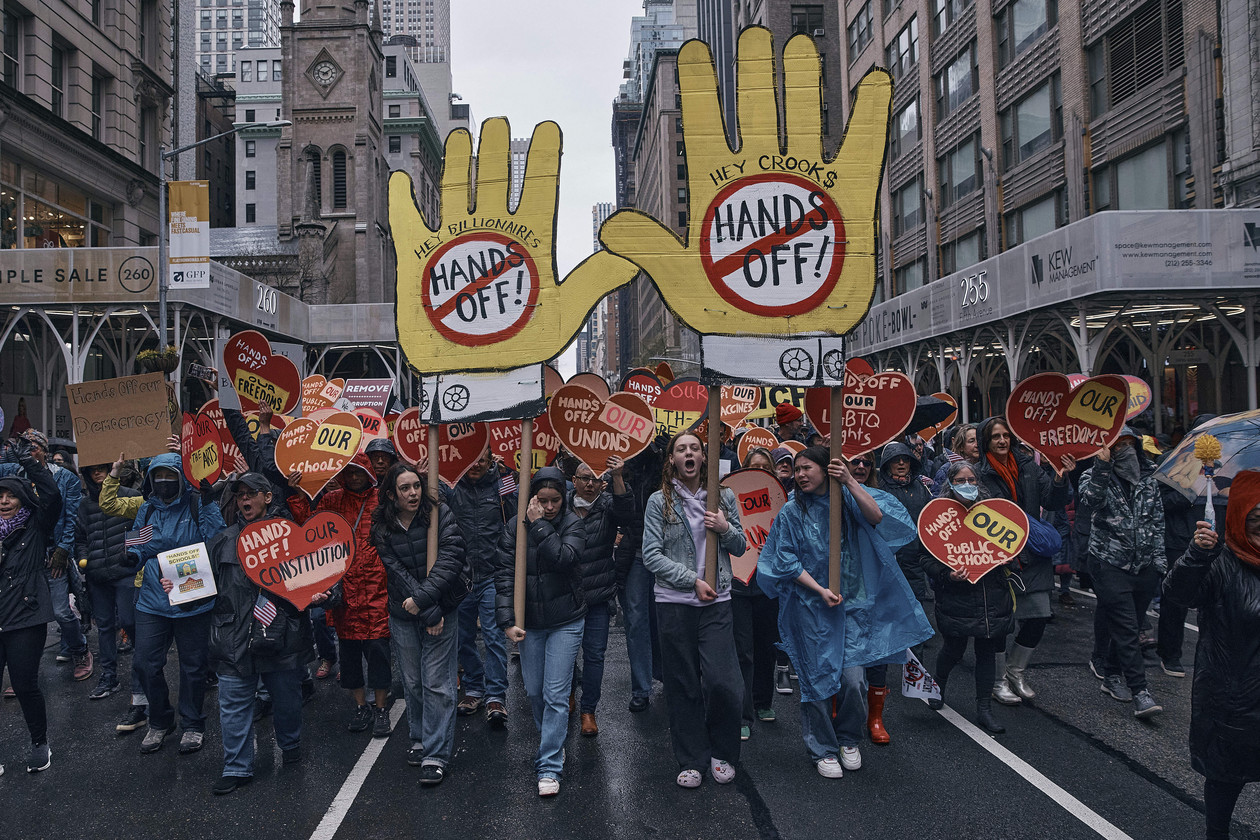
Hands Off! rallies were held in cities and towns across the United States this past weekend. Protesters demonstrated against the Trump administration’s policies and the massive cuts inflicted by Elon Musk’s DOGE team.
I participated in the Hands Off! rally in downtown Chicago and marched along with the crowd through the Loop. The most popular chants were “Hands Off!”and a call-and-response of “Show me what democracy looks like! This is what democracy looks like!”
I viewed an array of signs calling for defending education and libraries, ensuring medical and scientific research, saving Medicare and Medicaid, and preserving Social Security.
Federal workers, scientists, researchers, professors, teachers, and librarians who have been targeted by the DOGE team were highly visible in the crowd in Chicago.
Massive crowds marched through the streets of New York City, Washington, D.C., and many other cities across the nation.
“Crowds of people angry about the way President Donald Trump is running the country marched and rallied in scores of American cities Saturday in the biggest day of demonstrations yet by an opposition movement trying to regain its momentum after the shock of the Republican’s first weeks in office,” according to Politico.
“So-called Hands Off! demonstrations were organized for more than 1,200 locations in all 50 states by more than 150 groups including civil rights organizations, labor unions, LBGTQ+ advocates, veterans and elections activists. The rallies appeared peaceful, with no immediate reports of arrests.”
“Protesters Tee Off Against Trump and Musk in “Hands Off!” Rallies Across the U.S.” Politico (5 April 2025).
Miller, Violet and Anna Savchenko. “Hands Off Protest in Downtown Chicago Draws Thousands Criticizing Trump’s Policies.” WBEZ (5 April 2025).
The Trump administration has clearly made a massive mistake in calculating its so-called “reciprocal” tariff rates, seriously damaging global economic systems in the process.
President Trump has blundered into a major trade war that is reckless and based on gross misreadings of the history of tariffs.
Brent Neiman, Edward Eagle Brown Professor of Economics at Chicago Booth School of Business (University of Chicago), analyzes macroeconomics, financial, and trade issues and has previously served in the United States Department of the Treasury.
In an essay entitled “The Trump White House Cited My Research to Justify Tariffs. They Got It All Wrong,” published today in The New York Times, Neiman wonders how exactly the Trump administration came up with its so-called “reciprocal” tariff rates.
“My first question, when the White House unveiled its tariff regime, was, ‘How on earth did they calculate such huge rates?’ Reciprocal tariffs, after all, are supposed to treat other countries the way they treat us, and foreign tariffs on American goods are nowhere near these levels.”
“The next day it got personal,” Neiman relates. “The Office of the U.S. Trade Representative released its methodology and cited an academic paper produced by four economists, including me, seemingly in support of their numbers. But they got it wrong. Very wrong. I disagree fundamentally with the government’s trade policy and approach. But even taking it at face value, our findings suggest the calculated tariffs should be dramatically smaller — perhaps one-fourth as large.”
Neiman and his economist colleagues had argued that any new tariffs should be much, much lower—roughly 25 percent of what the Trump administration has already announced.
And, the Trump administration seems poised to jack up tariff rates on China and other nations even higher as the trade war widens.
Where is the “reciprocity” in such skewed tariff rates?
Neiman goes on his essay to examine the false premises and flawed calculations of the Trump administration.
Illustration for Brent Neiman’s essay. Image: The New York Times.
For a deeper history of tariffs, see the work of my friend and historian colleague, John E. Moser, Professor of History (Ashland University). He will be joining the Institute of American Civics at the University of Tennessee at Knoxville in Fall 2025.
Moser’s The Global Great Depression and the Coming of World War II (2015) analyzes the ways in which international competition during the Global Great Depression produced the Second World War.
Here is the book description at Routledge’s website:
“The Global Great Depression and the Coming of World War II demonstrates the ways in which the economic crisis of the late 1920s and early 1930s helped to cause and shape the course of the Second World War. Historian John E. Moser points to the essential uniformity in the way in which the world s industrialized and industrializing nations responded to the challenge of the Depression. Among these nations, there was a move away from legislative deliberation and toward executive authority; away from free trade and toward the creation of regional trading blocs; away from the international gold standard and toward managed national currencies; away from chaotic individual liberty and toward rational regimentation; in other words, away from classical liberalism and toward some combination of corporatism, nationalism, and militarism. For all the similarities, however, there was still a great divide between two different general approaches to the economic crisis. Those countries that enjoyed easy, unchallenged access to resources and markets the United States, Great Britain, the Soviet Union, and France tended to turn inward, erecting tariff walls and promoting domestic recovery at the expense of the international order. On the other hand, those nations that lacked such access Germany and Japan sought to take the necessary resources and markets by force. The interplay of these powers, then, constituted the dynamic of international relations of the 1930s: have-nots attempting to achieve self-sufficiency through aggressive means, challenging haves that were too distrustful of one another, and too preoccupied with their own domestic affairs, to work cooperatively in an effort to stop them.”
See also a number of academic journal articles on tariffs, protectionism, the Great Depression, and the Great Recession in The Economic History Review, The International History Review, The Journal of Economic History, History of Economic Ideas, and the Journal of Modern European History.
Sources
Moser, John E. The Global Great Depression and the Coming of World War II. London: Routledge 2015.
Moser, John E. The Great Depression and the New Deal: A Concise History. Ashbrook Press 2023.
Neiman, Brent. “The Trump White House Cited My Research to Justify Tariffs. They Got It All Wrong.” The New York Times (7 April 2025).
On Thursday night, the Trump administration placed 80 percent of National Endowment for the Humanities (NEH) staff members on administrative leave and blocked its grants to state humanities councils. The entire NEH is effectively being dismantled.
I deplore these actions and stand with the staff of the National Endowment for the Humanities.
Research in history, art history, music history, literary studies, and interdisciplinary humanities also depends fundamentally on grants and fellowships from the NEH.
I personally know many professors and researchers whose NEH grants for humanities research and programming were frozen on Thursday night. These blocks on current grants are improper and illegal, since the federal funds have been allocated by the U.S. Congress to the NEH, and then granted by the agency to humanities researchers and programs through competitive and peer-reviewed grant processes.
“In a university setting, the term generally refers to subjects like history, religion, philosophy, literature and art. In the context of the public humanities, the definition can be harder to pin down,” according to Margaret Renkl in an essay published in The New York Times.
For this reason, each state’s humanities council creates programs and competitive proposal processes to distribute the public humanities funding that it receives from the NEH.
Museum exhibitions, book fairs, film festivals, public lectures, storytelling programs, and other cultural events in every state depend on federal funds distributed by the National Endowment for the Humanities.
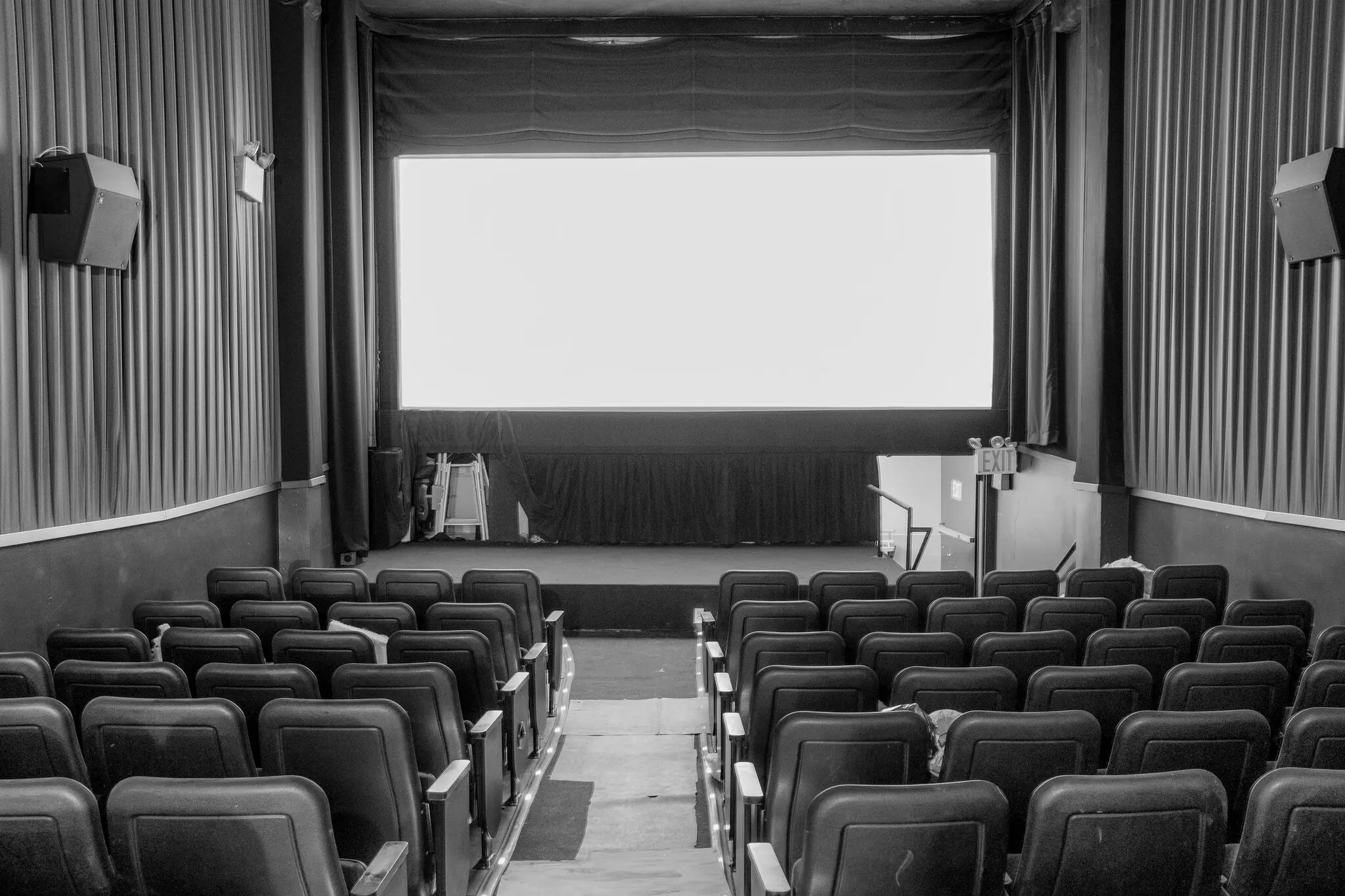
Many auditoriums across the nation may soon be empty.
“The N.E.H. is one of the least-known of the federal agencies, but its work reaches a huge number of Americans, including those in Republican districts. It awards grants that fund research fellowships, programs at museums and historic sites, website development and documentary filmmaking, among a host of other projects related to the public humanities. But it also disburses a great chunk of its appropriation — some $65 million of an annual budget of roughly $210 million — directly to nonprofit humanities councils in all 50 states, the District of Columbia and five territories,” according to Margaret Renkl.
“These independent affiliates of the N.E.H. then reallocate those funds to programming tailored to the people of their own state. Through the work of the state humanities councils, in other words, the N.E.H. is doing exactly what Republicans have always said they wanted to do with federal funds: It gives federal money back to the states.”
Renkl argues that “we need to tell the people who represent us a story — a true story — that reminds them of our shared humanity. Because the concept of a shared humanity is something too many of them, and too many of us, have lately all but forgotten.”
Renkl, Margaret. “The N.E.H. Does What Republicans Always Wanted. DOGE Slashed It Anyway.” The New York Times (7 April 2025).
The Illinois Humanities Council website provides information on public humanities in the State of Illinois, where I live.
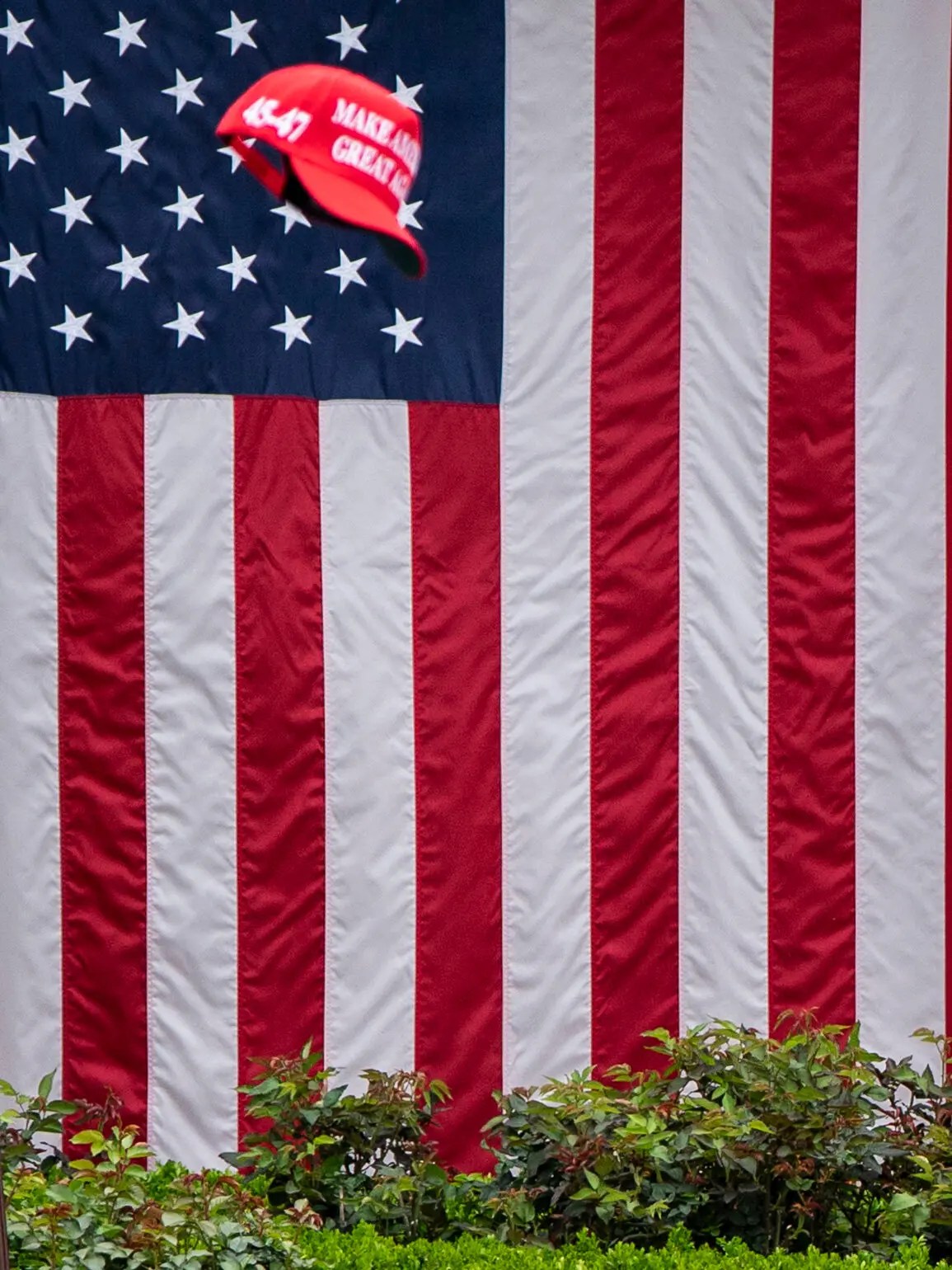
“Soon after the new administration arrived, things began to go missing from the White House website,” according to The New York Times.
“They weren’t just the partisan policy platforms that typically disappear during a presidential transition. Informational pages about the Constitution and past presidents, up in various forms since President George W. Bush was in office, all vanished.”
The New York Times reports that “Thousands of other government web pages had also been taken down or modified, including content about vaccines, hate crimes, low-income children, opioid addiction and veterans, before a court order temporarily blocked part of the sweeping erasure. A Justice Department database tracking criminal charges and convictions linked to the Jan. 6, 2021, attack on the Capitol was removed. Segments of data sets are gone, some of the experts who produced them were dismissed, and many mentions of words like ‘Black,’ ‘women’ and ‘discrimination’ have evaporated.”
These moves are part of the Trump administration’s attacks on Diversity, Equity, and Inclusion initiatives, but are also part of the much broader Culture Wars.
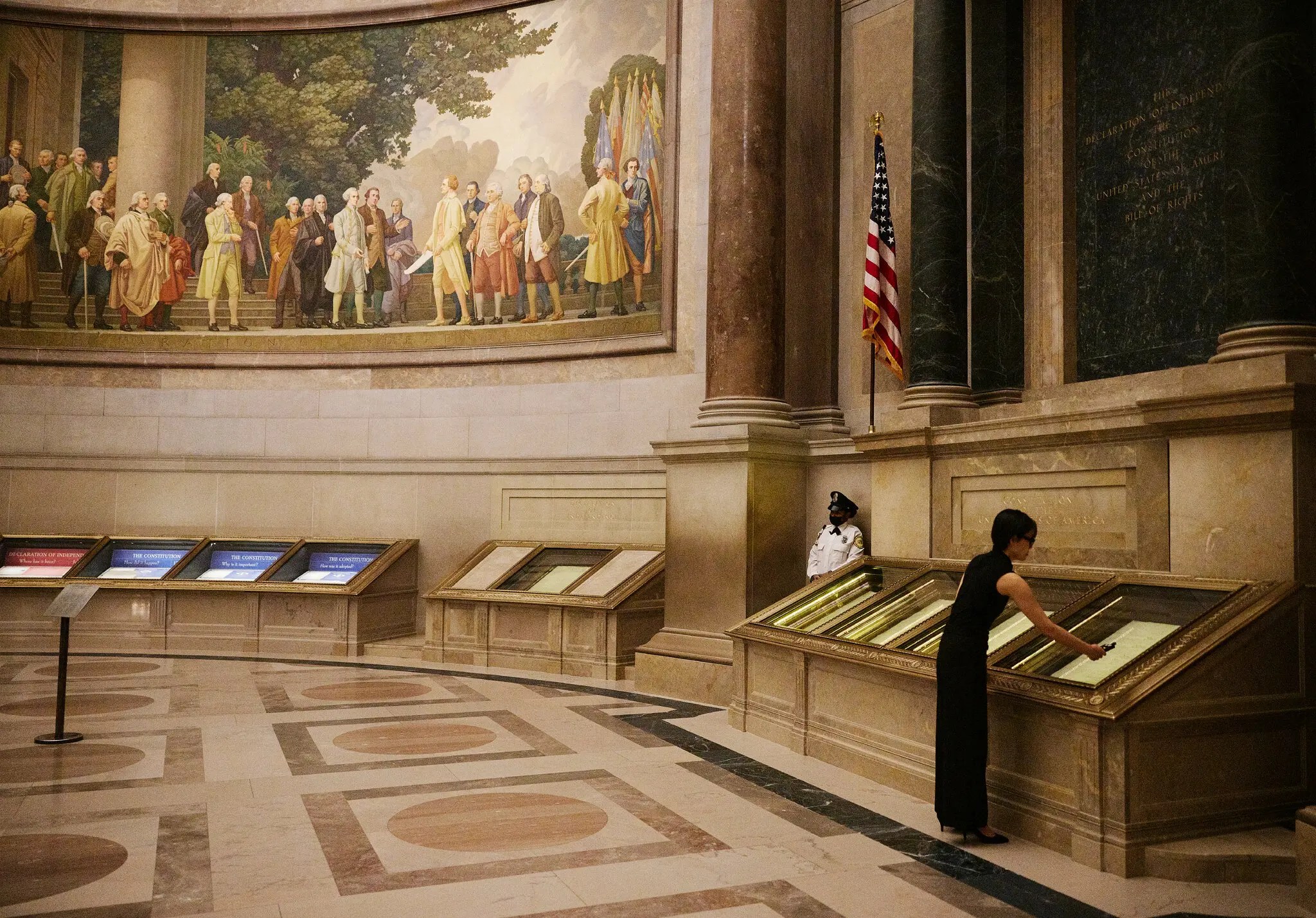
The Trump administration seeks to control current data and information, in addition to altering the historical record to suit its political aims. This is a major reason why the National Archives, Smithsonian Institute, Institute for Museum and Library Services, National Endowment for the Humanities, Fulbright Program, and research universities are under direct attack by Elon Musk’s so-called DOGE team and the entire Trump administration.
“President Trump’s team is selectively stripping away the public record, reconstructing his preferred vision of America in the negative space of purged history, archivists and historians said. As data and resources are deleted or altered, something foundational is also at risk: Americans’ ability to access and evaluate their past, and with it, their already shaky trust in facts.”
“‘This is not a cost-cutting mechanism,’ said Kenny Evans, who studies science and technology policy at Rice University’s Baker Institute for Public Policy and runs the White House Scientists Archive at the school. ‘This slide toward secrecy and lack of transparency is an erosion of democratic norms.'”
Non-governmental organizations are attempting to preserve government data that was previously available on the internet. The Data Rescue Project, Internet Archive, and other organizations are seekign to preserve data and information and make it accessible to the public.
The New York Times reports on these efforts to preserve data and information.
Hsu, Tiffany. “The White House Frames the Past by Erasing Parts of It.” The New York Times (5 April 2025).





 Brian Sandberg: Historical Perspectives