Le genre et la guerre : Les femmes, la virilité, et la violence

Le genre et la guerre : Les femmes, la virilité, et la violence

Journée d’étude, 8 juin 2015

GenreetGuerre-poster

Le but de cette  journée d’études est de discuter la qualité intrinsèquement masculine de la guerre.

La guerre a été le plus souvent conçue comme une activité humaine essentiellement masculine mais de récentes études ont montré que les femmes ont été fortement impliquées dans les activités militaires du passé. Les historiens des femmes ont souligné l’émergence des femmes soldats dans les armées modernes, en démontrant les rôles importants qu’elles ont joué dans les combats, dans les hôpitaux militaires, dans les services logistiques de l’armée ou encore au front. Les chercheurs ont retrouvé dans les archives un grand nombre de “guerrière exceptionnelles”, de femmes fortes et de travesties qui étaient engagées dans des conflits à diverses périodes historiques. D’autres ont exploré les étroites connections entre la culture militaire et les expressions belliqueuses de virilité  qui façonnent souvent les grandes nations. Les dynamiques guerrières libèrent la violence sexuelle et une coercition de genre, en créant des blessures physiques pérennes et des traumas psychologiques pour les victimes, les auteurs et les témoins de cette violence. La guerre permet de changer radicalement les relations de genre dans les sociétés, en altérant les rôles sexués, les structures familiales, les modèles de mariage, les pratiques professionnelles, les lois et les attitudes culturelles. Les études de genre traitant de la violence organisée, se sont souvent et utilement, concentrées sur les contextes de coups d’état, de ruptures sociales et de bouleversements politiques, périodes clés de changement dans les discours de genre.

Cette journée d’étude se déroulera sous forme de tables rondes dans l’ambition de présenter de nouvelles recherches et de poser des questions méthodologiques inédites sur le genre et la guerre dans l’histoire européenne et mondiale de 1500 à nos jours. Les études de genre de Natalie Zemon Davies, Sonya O.Rose, Karen Hagemann, Susan R. Grayzel et d’autres, offrent des modèles utiles pour développer la recherche sur le genre et la guerre. Le livre de Joshua S. Goldstein, War and Gender: How Gender Shapes the War System and Vice Versa (Cambridge: Cambridge University Press, 2003), interpelle les chercheurs pour qu’ils examinent « comment le genre façonne la guerre et comment la guerre façonne le genre ». Les participants de cette journée d’étude profiteront de cette confrontation entre genre et guerre, en considérant les diverses possibilités d’intervention des femmes dans la guerre et en réexaminant les thèmes « genrés » tels que les femmes dans la guerre, les corps disciplinés, le combat et le genre, l’honneur masculin, les communautés de campagne, le travail en temps de guerre, les agressions et émotions, la culture et la violence sexuelles, la prostitution militaire, le viol de masse, et les corps brisés.

Site internet de la journée d’étude : http://paris-iea.fr/evenement/le-genre-et-la-guerre-les-femmes-la-virilite-et-la-violence
Posted in Conferences, Early Modern Europe, French History, Gender and Warfare, History of Violence, War, Culture, and Society, Warfare in the Early Modern World, Women and Gender History | Leave a comment

Roger Chartier Lecture at DHIP

Roger Chartier (EHESS) presented a lecture yesterday on “Traduire l’intraduisible. L’homme de cour chez Baltasar Gracián, Amelot de la Houssaie et Norbert Elias,” at the Institut Historique Allemand de Paris (DHIP).

The lecture explored translations and appropriations of Baltasar Gracián’s writings on prudence and comportment, as well as Norbert Elias’s use of the French translation of Gracián by Amelot de la Houssaie as a key source in his models of the court society and the civilizing process.

The DHIP provides an abstract of the lecture:

“Le livre de Baltasar Gracián L’homme de cour est la référence essentielle utilisée par Norbert Elias pour définir »la psychologie de cour«. Mais le jésuite espagnol Gracián a-t-il écrit un livre intitulé L’homme de cour et l’ouvrage qu’il a publié en 1647 à Huesca, sous le nom de son frère Lorenzo et avec le titre de Oráculo manual y arte de prudencia, a-t-il pour destinataire ou modèle le courtisan? Norbert Elias n’a-t-il pas lu la traduction française du livre, publiée par Amelot de la Houssaie en 1684 et intitulée L’Homme de Cour, en croyant lire Gracián ? S’il en est bien ainsi, il n’est pas le seul à avoir ignoré la profonde transformation de la nature du texte impliquée par les choix du traducteur et d’une traduction qui sera à son tour traduite dans les langues européennes). Cette conférence entend porter l’attention sur les effets de la traduction dans la réception et l’interprétation des œuvres en même temps qu’elle espère éclairer l’importance de la référence à Gracián dans l’œuvre d’Elias.”

For more information, see the DHIP website.

Posted in Cultural History, Early Modern Europe, European History, Historiography and Social Theory, History of the Book, Noble Culture and History of Elites, Political Culture, Translations | Leave a comment

Digital Humanities Experiments

A conference on Digital Humanities Experiments #dhiha6 will be held in Paris on 11-12 June 2015.  The conference is sponsored by the European Science Foundation – Scientific Review Group HUM and the Institut d’études avancées (IEA) de Paris.

The conference is organized by Mareike König, Suzanne Dumouchel, Lisa Bolz (all DHIP), Claudine Moulin (IEA/University Trier), Pierre Mounier (OpenEdition), and Anne Baillot (Humboldt University of Berlin).

The conference website explains the aims of the event: “This conference addresses the gap between the research culture with which Digital Humanists are equipped via their disciplinary backgrounds and the research culture they foster in this field. Why does experimentation play a crucial role in Digital Humanities? How does it contribute to define the relationship between method and research questions? Can we identify barriers which currently prevent Digital Humanities from developing their full potential, leaving little room for iteration, comparison or failure? The conference itself is conceived as an experimental set-up with labs, data experiments and round tables.”

I will be participating in the conference and leading a round table on “Interdisciplinary Experimentations.”


The Digital Humanities Experiments #dhiha6 program is available online.

Posted in Conferences, Digital Humanities, Humanities Education, Information Management | Leave a comment

Gender and War Workshop

Le genre et la guerre : Les femmes, la virilité, et la violence

Marion Trévisi and I are organizing a workshop on Gender and War at the Institut d’Études Avancées de Paris on 8 June 2015.

Interested scholars and graduate students are invited to attend the workshop.  The program and registration form is now available online at the IEA de Paris website.

Le but de cette  journée d’études est de discuter la qualité intrinsèquement masculine de la guerre.

La guerre a été le plus souvent conçue comme une activité humaine essentiellement masculine mais de récentes études ont montré que les femmes ont été fortement impliquées dans les activités militaires du passé. Les historiens des femmes ont souligné l’émergence des femmes soldats dans les armées modernes, en démontrant les rôles importants qu’elles ont joué dans les combats, dans les hôpitaux militaires, dans les services logistiques de l’armée ou encore au front. Les chercheurs ont retrouvé dans les archives un grand nombre de “guerrière exceptionnelles”, de femmes fortes et de travesties qui étaient engagées dans des conflits à diverses périodes historiques. D’autres ont exploré les étroites connections entre la culture militaire et les expressions belliqueuses de virilité  qui façonnent souvent les grandes nations. Les dynamiques guerrières libèrent la violence sexuelle et une coercition de genre, en créant des blessures physiques pérennes et des traumas psychologiques pour les victimes, les auteurs et les témoins de cette violence. La guerre permet de changer radicalement les relations de genre dans les sociétés, en altérant les rôles sexués, les structures familiales, les modèles de mariage, les pratiques professionnelles, les lois et les attitudes culturelles. Les études de genre traitant de la violence organisée, se sont souvent et utilement, concentrées sur les contextes de coups d’état, de ruptures sociales et de bouleversements politiques, périodes clés de changement dans les discours de genre.

Cette journée d’étude se déroulera sous forme de tables rondes dans l’ambition de présenter de nouvelles recherches et de poser des questions méthodologiques inédites sur le genre et la guerre dans l’histoire européenne et mondiale de 1500 à nos jours. Les études de genre de Natalie Zemon Davies, Sonya O. Rose, Karen Hagemann, Susan R. Grayzel et d’autres, offrent des modèles utiles pour développer la recherche sur le genre et la guerre. Le livre de Joshua S. Goldstein, War and Gender: How Gender Shapes the War System and Vice Versa (Cambridge: Cambridge University Press, 2003), interpelle les chercheurs pour qu’ils examinent « comment le genre façonne la guerre et comment la guerre façonne le genre ». Les participants de cette journée d’étude profiteront de cette confrontation entre genre et guerre, en considérant les diverses possibilités d’intervention des femmes dans la guerre et en réexaminant les thèmes « genrés » tels que les femmes dans la guerre, les corps disciplinés, le combat et le genre, l’honneur masculin, les communautés de campagne, le travail en temps de guerre, les agressions et émotions, la culture et la violence sexuelles, la prostitution militaire, le viol de masse, et les corps brisés.

Posted in Civil Conflict, Civilians and Refugees in War, Conferences, European History, Gender and Warfare, War, Culture, and Society, Warfare in the Early Modern World, Women and Gender History | Leave a comment

Strategies of Religious Warfare at EUI

I enjoyed visiting Firenze earlier this week to give a presentation on “Strategies of Religious Warfare: Historical Reflections on Contemporary Religious Violence” at the European University Institute.

Professor Olivier Roy (Robert Schuman Centre for Advanced Studies, EUI)and Jean Monnet Fellow Nadia Marzouki kindly invited me to discuss issues of religious violence with their working group, ReligioWest.

Professor Dirk Moses (History and Civilization, EUI) served as discussant, providing useful criticism and suggestions for incorporating additional theoretical and comparative sources when I revise this paper for publication.

Here is an abstract for my presentation:

“Strategy is often thought of exclusively in terms of politics, based on Clausewitz’s closely linked definitions of war and strategy. Beatrice Heuser’s The Evolution of Strategy: Thinking War from Antiquity to the Present (Cambridge: Cambridge University Press, 2010) has questioned this linkage, however, in one of the most important recent studies of strategic formulation. Heuser suggests that strategies are socially and culturally produced: ‘When implicit assumptions in the literature on Strategy are rendered explicit through textual and contextual analysis, we find revealing indicators of social institutions and norms, of the writers’ perceptions and understanding of politics and relations between political entities . of their values, ideologies and passive and active culture more generally.’ In this paper, I aim to build on this insight to develop an analysis of the formation of strategy in religious warfare. I will attempt to discern historical strategies of religious warfare and consider their potential relevance for contemporary conflicts with religious dimensions.”

It was fabulous to revisit the European University Institute, where I served as a Jean Monnet Fellow from 2002-2003.

Posted in Civil Conflict, Current Research, European History, European Union, European Wars of Religion, History of Violence, Lectures and Seminars, Political Culture, Religious History, Religious Politics, Religious Violence, War and Society, Warfare in the Early Modern World | Leave a comment

Newberry Graduate Scholars-in-Residence

The Newberry Library is once again seeking ABD doctoral candidates in the humanities for its Graduate Scholar-in-Residence program.

Greg Bereiter and Bob Fulton, doctoral candidates from Northern Illinois University, have recently served as graduate scholars-in-residence at the Newberry and had very rewarding experiences. This is a great opportunity for advanced graduate students in the humanities at NIU and other Chicago-area universities.

The Newberry Library announcement reads:

“We invite graduate students who have advanced to PhD candidacy to apply for this status for the 2015-16 academic year. Preference will be given to candidates whose dissertation projects are well advanced (within a year of completion) and who demonstrate a need for the Newberry collection. The students who are selected will be provided with research carrels, access to the Newberry during extended hours, and opportunities to present their work-in-progress to the Newberry’s community.”

The deadline for applications is May 1, 2015.

More information is available at: http://www.newberry.org/graduate-scholar-residence-program.

Posted in Archival Research, Early Modern Europe, European History, Graduate Work in History, Grants and Fellowships, Renaissance Art and History | Leave a comment

Early Modern Workshop in Chicago

Demystifying the Archives

Monday, April 13

The Early Modern Workshop at the University of Chicago is hosting a panel discussion concerning “the process of archival research in a graduate student’s career.”

According to the workshop’s announcement, “The aim of this workshop is to demystify the archives and provide graduate students who are preparing for archival research an opportunity to ask questions about the process and share their experiences with fellow students.”

Panelists

-Elisa Jones, History
Dissertation Title : “Exile and Freedom of Conscience: The Boundaries of Being French, 1562 – 1629”

-Maura Capps, History
Dissertation Title: “All Flesh Is Grass: A Political Ecology of Agrarian Improvement in Britain’s Settler Empire, 1780-1850”

-Tessa Murphy, History
Dissertation Title: “The Creole Archipelago: Colonization, Experimentation, and Community in the Southern Caribbean c. 1700 – 1795”

The announcement indicates that “Each of our three presenters will speak for about 10-15 minutes about their respective topics and their experience at the various research archives they have visited.The remaining hour will be dedicated to a discussion based on the attendees’ interest. In past years students asked about how to prepare for a research visit, how to manage one’s time in the archives, how to navigate specific bureaucratic procedure etc.”

The Workshop will take place on 13 April 2015 at 12pm in the John Hope Franklin Room (SSRB 224) at the University of Chicago.

Posted in Archival Research, Early Modern Europe, Early Modern World, European History, European Wars of Religion, French History, French Revolution and Napoleon, Graduate Work in History, Lectures and Seminars, Material Culture, Reformation History | Leave a comment

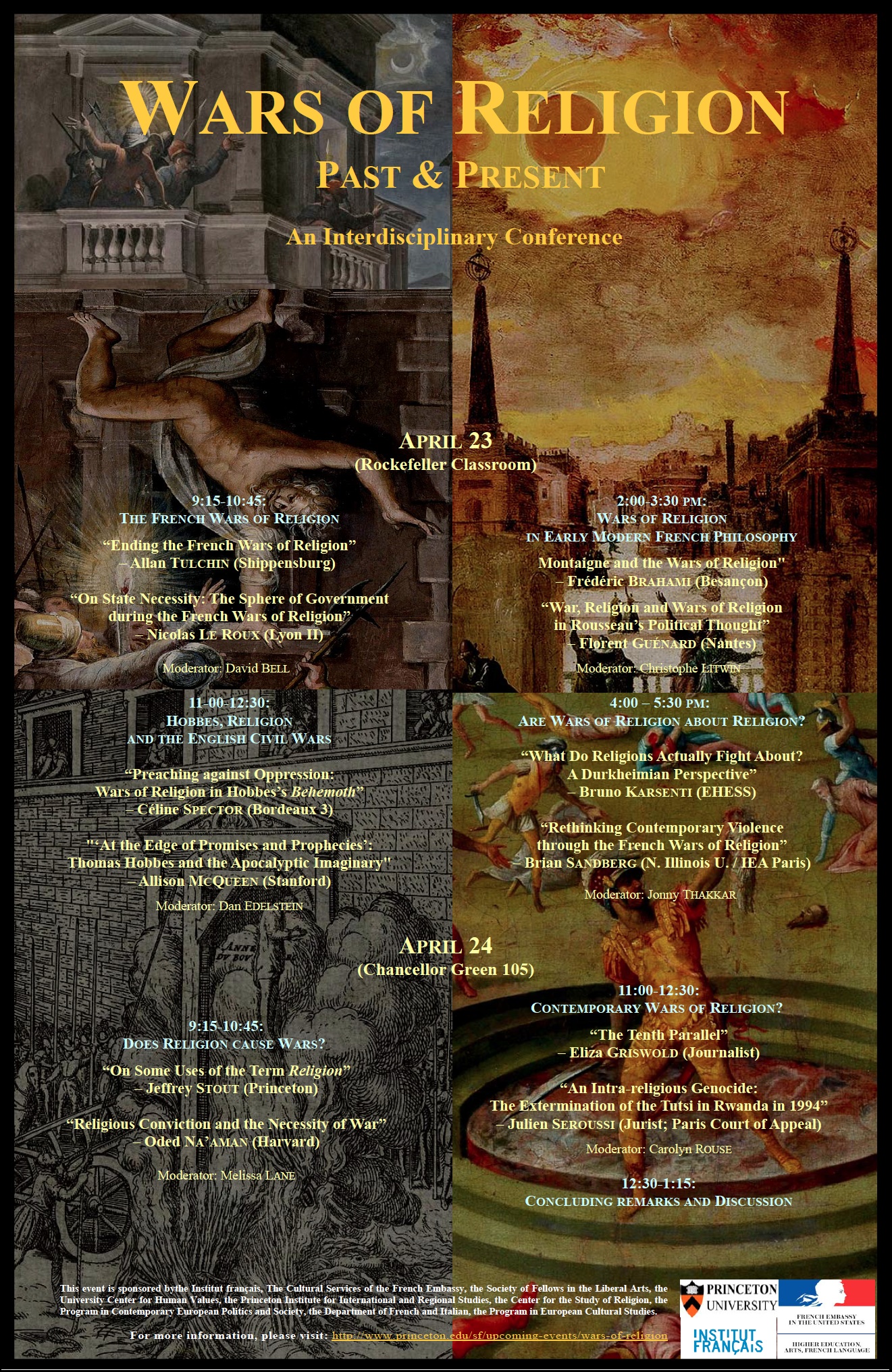
Wars of Religion: Past and Present

I will be participating in an upcoming conference on Wars of Religion: Past and Present at Princeton University on 23-24 April 2015. The conference is organized by the Society of Fellows in the Liberal Arts at Princeton and includes researchers and analysts from various disciplines.

WarsofReligion-poster

I will be presenting a paper on “New Wars of Religion: Rethinking Contemporary Violence through the French Wars of Religion.”

I look forward to discussing the problem of religious warfare in detail with other conference participants and colleagues at Princeton.


Posted in Conferences, Early Modern Europe, Early Modern World, European History, European Wars of Religion, History of Violence, Political Culture, Religious History, Religious Politics, Religious Violence, War, Culture, and Society | 1 Comment

Renaissance Society of America – Berlin

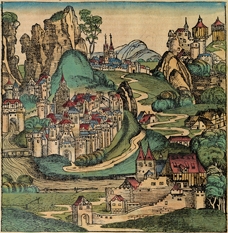
I just returned from the huge Renaissance Society for America [RSA] conference in Berlin, where over 3000 Renaissance studies scholars gathered for an intense conference on early modern history.

nuremberg_chronicle_berlin

I presented a research paper on siege warfare and war news, entitled “‘The Clamors of His Afflicted People’: Sensory Experiences of the City under Siege during the French Wars of Religion,” in a session on News and Conflict.

In addition, I chaired a session on “Networks and Connectivity in the Irano-Mediterranean Frontier Zone II: Texts and Individuals,” which was part of a five-session workshop on Mediterranean Networks within the broader RSA conference.

I was also able to attend several additional sessions on gender, violence, political culture, and chronicles in the early modern period. A roundtable discussed Guido Ruggiero’s new book, which provides a macrohistorical essay on the Italian Renaissance.

The RSA included an opening reception at the Bode Museum and a closing reception at the Gemäldegalerie, both of which included museum visits. I got to spend one morning at the Deutsches Historische Museum, focusing on their fabulous Renaissance, Reformation, and Thirty Years’ War collections. Then, I explored the contemporary art collections of the Hamburger Bahnhof Museum with a friend.

For more information on the conference, see the RSA website.

The full program of the RSA conference in .pdf format is available here.

Posted in Conferences, Early Modern Europe, Early Modern World, European History, European Wars of Religion, French History, French Wars of Religion, History of the Book, Italian History, Mediterranean World, Museums and Historical Memory, Reformation History, Renaissance Art and History, Warfare in the Early Modern World | Leave a comment

Paleography Seminar at the Medici Archive Project

Seminar on Paleography and Archival Studies

May 25 – June 6, 2015

Florence, Italy

For the fifth consecutive year, the Medici Archive Project (MAP) will be offering a two-week intensive seminar on archival research. For the first time, MAP will partner with the Archvio di Stato di Firenze, the Amici dell’Archivio di Stato di Firenze and the Biblioteca Domenicana di Santa Maria Novella “Jacopo Passavanti”.

The principal aim of this seminar is to provide an introduction to Italian archives (with particular emphasis on Florentine archival collections); to examine in-depth various documentary typologies; to read diverse early modern scripts; and to learn how to plan research in Italian archives and libraries.

Especially relevant for advanced graduate students studying Renaissance and early modern topics, this seminar is taught by a team of current and former MAP scholars, as well as university professors, MAP-affiliated researchers, and professional archivists at the Archivio di Stato in Florence.

Participating students will be taught at the Biblioteca Dominicana di Santa Maria Novella and the Archivio di Stato in Florence. Two visits to private archives are also planned. In addition, participants are encouraged to spend their mornings at the MAP office at the Archivio di Stato in Florence in order to work on their projects alongside current MAP fellows and scholars.

The seminar will run for two weeks, composed of twelve three-hour lessons (on average), and is limited to fifteen scholars (so that each participant will receive personal guidance).

Prospective applicants should send a one-page CV and a brief statement explaining how this course will benefit one’s current research to seminar@medici.org and ebrizio@medici.org by May 15, 2015. A working knowledge of Italian is required. Please note, as space is strictly limited, places will be offered on a first-come-first-served basis. The tuition fee for this seminar is US $1000, payable via PayPal upon acceptance (room and board are not included).

Lectures

1. Manuscripts and Documents

2. Archives in Florence

3. History of the Medici Archive

4. The Mediceo del Principato: Organization and Structure

5. Letters: Production, Reception, Dissemination, Form and Content

6. The Guardaroba Medicea and Florentine Inventories

7. Heraldry and Related Resources

8. Legal Archives

9. Financial Archives

10. Notarial Archives: Contracts and Wills

11. Religious Archives: Churches, Convents and Confraternities

12. Archival Research and History of Medicine

13. Avvisi and Early Modern News Networks

14. Early Modern Digital Archives

Posted in Archival Research, Art History, Digital Humanities, Early Modern Europe, Early Modern World, European History, Graduate Work in History, History of the Book, Italian History, Renaissance Art and History | Leave a comment