“Hammer Man” Attacks Historical Plaque in Cartegena

Historical commemorations can certainly be controversial. Some historical anniversaries and commemorative displays produce repeated political battles and widespread controversy. In other cases, new additions to ceremonies or historical sites can produce fresh wounds and localized resistance.
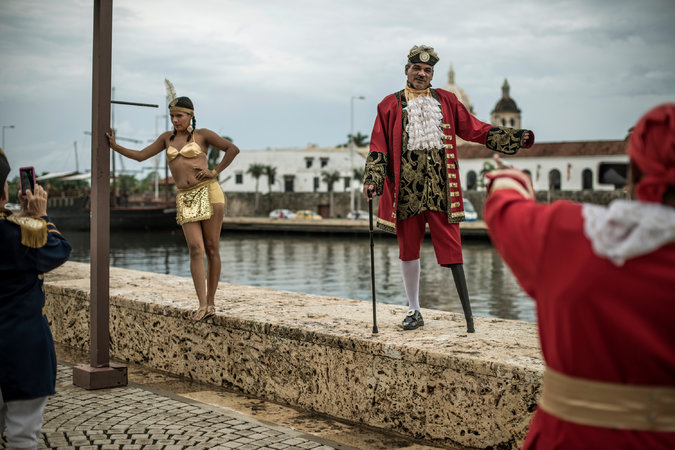
Cartegena-independenceday

An incident this week involving a historical plaque in Cartegena, Colombia, has created a new controversy over how to commemorate an eighteenth-century amphibious attack on the city. In 1741, British naval and military forces under Admiral Vernon landed and besieged the Spanish imperial city of Cartegena during the War of the Austrian Succession (sometimes referred to as the War of Jenkin’s Ear).

A new plaque commemorating the soldiers killing in the fighting apparently offended many local Colombians. A Cartegenan man, who is now being called the “hammer man,” wielded a sledgehammer to attack the plaque and garnered widespread support.

Colombian political culture can apparently simultaneously celebrate Colombian independence from Spain and still celebrate aspects of its Spanish imperial heritage, including antipathy toward Spain’s eighteenth-century enemies.

This incident is a good reminder of the potential of historical commemorations to produce unexpected controversies and political situations.

The New York Times reports on the controversy in Colombia.
Posted in Cultural History, Early Modern Europe, Early Modern World, Empires and Imperialism, European History, Globalization, History in the Media, Maritime History, Museums and Historical Memory, Political Culture, War, Culture, and Society, Warfare in the Early Modern World | Leave a comment

Women in Positions of Power at the UN

More women are in positions of power at the United Nations than ever before. The UN, once an all-male club now has numerous women acting as ambassadors, diplomats, and official representatives of nations. Many more women are present in United Nations administrative and staff roles.

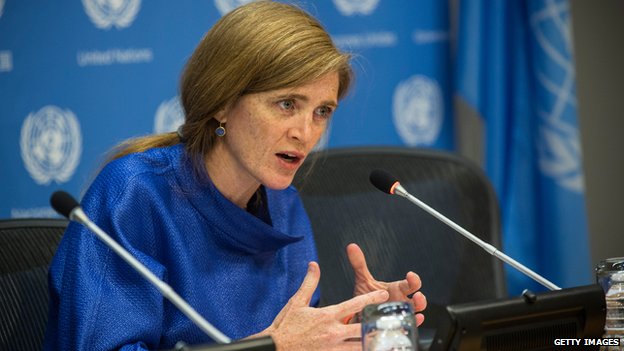
SamanthaPower

Samantha Power, the United States Ambassador to the United Nations, is certainly one of the most visible female diplomats at the UN.

According to the BBC, “there are 31 female permanent representatives, a record number in the history of the UN. More significantly, women also occupy six seats at the horseshoe table of the Security Council – those belonging to Argentina, Jordan, Lithuania, Luxembourg, Nigeria and the US. That again is a record-breaking number for the UN’s most important decision-making body.”

The BBC reports on women at the UN. Scholars working on women and gender studies, and especially those dealing with women’s roles in politics, may be interested in this story.

Posted in Human Rights, Political Culture, Strategy and International Politics, Women and Gender History | Leave a comment

Marketing Napoleon

Napoleon’s stock value is rising as we near the bicenntenial of the battle of Waterloo in 2015.

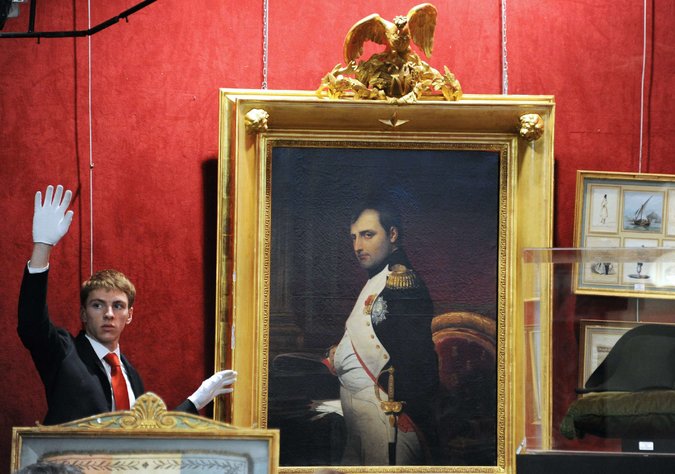
A cache of Napoleonic memorabilia went on auction this weekend near the château de Fontainebleau. “Nearly 1,000 objects were for sale, including weapons, portraits, letters, the emperor’s cologne bottles, a knife used in a foiled assassination attempt and even his stockings,” according to The New York Times.

Napoleon-auction

One of the most prized objects for sale was one of Napoleon’s signature bicorn hats.

The auction should further fuel excitement among Napoleonic history enthusiasts, many of whom are already preparing to participate in a reinactment of the battle of Waterloo next summer.

The New York Times reports on the auction.


Posted in Art History, Early Modern Europe, Early Modern World, Empires and Imperialism, French History, French Revolution and Napoleon, Museums and Historical Memory, War, Culture, and Society, Warfare in the Early Modern World | Leave a comment

Cost of Living is the Big Problem Facing College Students

The rising cost of living, not tuition and fees, is the big problem facing most college students in the United States.

“Living expenses are an ‘under discussed’ aspect of college affordability,” according to an article entitled “Forget the Rise in Tuition and Fees, What About Living Expenses?” in The Chronicle of Higher Education.

No kidding.  Most articles on college affordability in the mainstream media completely conflate tuition and fee rates with the “sticker price” (which often includes room and board, along with tuition and fees).

At my own university, Northern Illinois University, the current rates for 2014-2015 are the following:

NIU in-state tuition and fees: $11,992

NIU room and board: $11,790

So, the “sticker price” at NIU would be $22,782.  The problem with this “sticker price” is that most students do not live on campus (or even in the town of DeKalb) and do not pay room and board. Many NIU students live at home with their parents or, alternatively, live with their husbands/wives and families. For these “commuter” students, room and board is not part of the college experience.

But, journalists continue frequently to refer to the “sticker price” as tuition and fees. To add to the confusion, many articles do not explain that many students actually pay full tuition and fees, since they qualify for merit-based or need-based financial aid (scholarships, fellowships, and grants) from their states or from the federal government.

Data on the increasing room and board costs are difficult to ascertain, especially over time, since these rates have not been tracked as consistently as tuition and fee rates. But, the construction of increasingly fancy dorm and dining facilities certainly suggests that room and board costs have been rising substantially over the past generation.

Tuition and fees are rising, too, but they seem to be less of a problem than room and board costs, at least at public universities.

The Chronicle of Higher Education reports on room and board costs. For figures on tuition and fee rates and room and board costs, see the Chronicle’s database.

See also previous posts on this subject in the category “Education Policy.”

Posted in Education Policy, Humanities Education, Undergraduate Work in History | Leave a comment

Warburg Institute Saved by Court Ruling

The famed Warburg Institute in London has been saved by an English court ruling.

According to a press release by the Warburg Institute: “To the benefit and relief of scholars worldwide, the High Court has rejected the University of London’s claims that all additions to the Warburg Institute since 1944 belong to the University, and instead agreed that they form part of the Institute. Furthermore, the judge, Mrs Justice Proudman, held that the University is obliged to provide funding for the activities of the Warburg Institute.”

The Warburg Institute is one of the most important research centers in art history, Renaissance studies, and interdisciplinary humanities.

The Warburg Institute website provides a brief institutional history of its collections: “The Institute grew out of the private library of the art historian Aby Warburg (1866-1929), who collected books in art history, literature, intellectual history, religion and the history of science and magic. As a Jewish institution based in Germany, the Institute was forced to close, and its very existence was threatened by the Nazi-organised book-burnings of April 1933. To escape destruction, the entire library of 60,000 books, as well as photographs, papers and furniture, were shipped to the safe-haven of London in December 1933. Many of the Institute’s staff also transferred to London.”

Humanities scholars worldwide mobilized over the past year with petitions and protests in opposition to the University of London’s attempt to de-fund and/or break up the collections of the Warburg Institute.

Read more about the story on the website of the Warburg Institute.

Posted in Art History, Early Modern Europe, Early Modern World, Education Policy, European History, History in the Media, History of Medicine, History of Science, History of the Book, Humanities Education, Italian History, Mediterranean World, Museums and Historical Memory, Noble Culture and History of Elites, Renaissance Art and History | Leave a comment

Assessing the State of Digital Humanities

A new review article assesses the current state of the field Digital Humanities (DH) from the perspective of book history. This is an interesting angle to consider the state of DH, since so many DH projects deal with document digitization and dissemination.

If accessibility to information is the key goal, the field of DH seems to be doing very well indeed. Historical museums and other humanities institutions have embraced digital education and presentation initiatives. Many humanities conferences have adopted poster sessions and digital presentation of research, even if this often amounts to merely digital slideshows and graphs.

Less apparent in discussions of DH are explorations of digital methods for analyzing text and information in entirely new ways. The growing field of information management studies offers some models that humanities scholars may wish to consider. Perhaps a “state of the field” article such as this can help generate more sustained discussion of what we mean by Digital Humanities and how DH methods can be transformative for doing humanities research.

The citation for the article is: Matthew G. Kirschenbaum and Sarah Werner, “Digital Scholarship and Digital Studies: The State of the Discipline” Book History 17 (2014) pp 406-458;

The review article in Book History is available online through a link on Sarah Werner’s blog, Wynken de Worde.

Humanities scholars and graduate students working with Digital Humanities methods will be interested in this piece, especially since DH is becoming increasingly important for graduate students in History and other humanities fields.

Posted in Archival Research, Current Research, Digital Humanities, Graduate Work in History, History in the Media, Information Management, Museums and Historical Memory | Leave a comment

Italian and Mediterranean Art History Position

Job: Italian and Mediterranean Art (Florence)

The Kunsthistorisches Institut in Florenz – Max-Planck-Institut (KHI) invites applications for the post of research collaborator at the pre-doctoral level (Wissenschaftliche Assistentin / Wissenschaftlicher Assistent) for three years in the department of Prof. Dr. Gerhard Wolf.

The position is intended for excellent young scholars interested in pursuing research for their dissertation at the institute as well as in collaborating in its ongoing or future projects. The KHI is a Max-Planck-Institute focused on investigating the history and theory of Italian and Mediterranean art, architecture and object culture in their global connections. Doctoral students from all disciplines engaging with these fields from Antiquity to the present are encouraged to apply. What is important is the quality and originality of the project proposal.
Part of the collaborator’s time will be committed to directed research in the projects and activities of Professor Wolf’s department (for a list, see: http://www.khi.fi.it/en/forschung/index.html#wolf). We seek an independent, creative-thinking scholar with an interest in collaborative research.

Requirements:
Applicants must be enrolled in a Ph.D. program and demonstrate proficiency in two foreign languages. The research collaborator is expected to reside in Florence and fully participate in the activities and intellectual life of the KHI. The position is awarded without regard to nationality.

The application (in English, Italian, German) must include:

– a cover letter, which includes goals and motives for applying;
– the names and contact details of two referees;
– a dissertation proposal (max 100 words);
– a curriculum vitae;
– a summary of the master’s thesis (max 500 words)
– two letters of referees

The Max Planck Society is an equal opportunity employer and encourages applications from disabled individuals.

Applicants are required to merge all the documents in a single PDF (max. 2 MB) and submit it via e-mail to dirwolf@khi.fi.it by 8 December 2014.

Posted in Art History, Early Modern Europe, Early Modern World, Graduate Work in History, Jobs and Positions, Renaissance Art and History | Leave a comment

Female Warriors and the Myth of the Amazons

Female warriors certainly are media friendly, with numerous films, television series, video games, books, and comic books dedicated to Amazons, Jeanne d’Arc, medieval warrior queens, and fantasy warrior princesses.

Historians are struggling to compete with this avalanche of imagery of female warriors at a time when women are increasingly serving as soldiers in modern armies around the world. Women and war has now become a major field of research in history and the humanities.

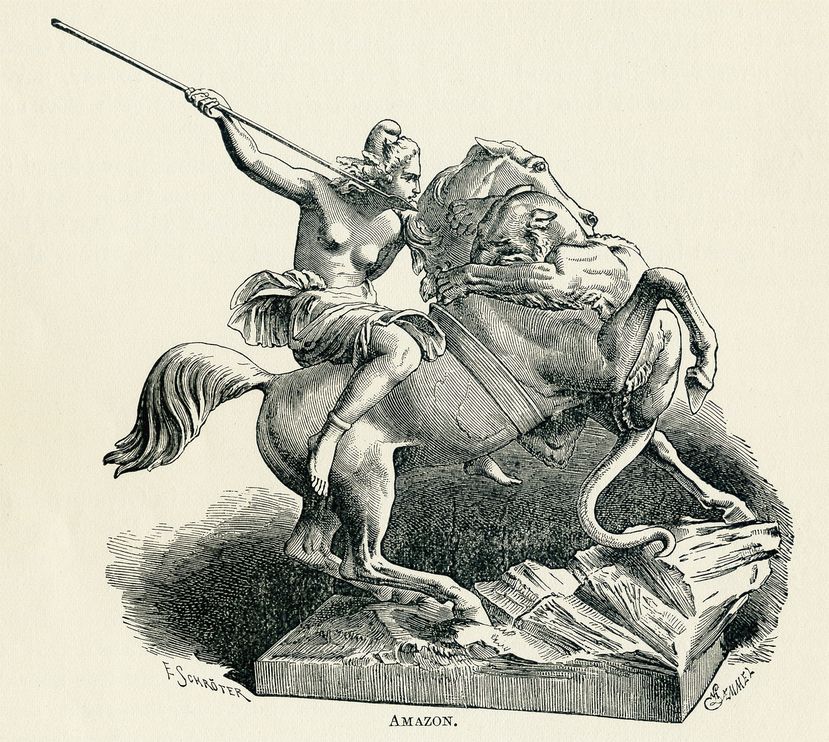
Schroter-Amazon

National Geographic recently published an interview with Adrienne Mayor, author of a new book on Amazon warriors entitled, The Amazons: Lives and Legends of Warrior Women across the Ancient World (Princeton University Press, 2014).

Adrienne Mayor’s website at Stanford University states that: “Adrienne Mayor is an independent folklorist/historian of science who investigates natural knowledge contained in pre-scientific myths and oral traditions. Her research looks at ancient ‘folk science’ precursors, alternatives, and parallels to modern scientific methods. Mayor’s latest book, The Amazons: Lives and Legends of Warrior Women across the Ancient World, analyzes the historical and archaeological evidence underlying myths and tales of warlike women.”

A Stanford Report article features Mayor’s work on Amazon warriors.

As a historian working on gender and violence in the French Wars of Religion, I look forward to reading Adrienne Mayor’s new book and considering the latest research on female warriors in the ancient world.

Posted in European History, Gender and Warfare, History of Violence, Museums and Historical Memory, War, Culture, and Society, Warfare in the Early Modern World, Women and Gender History | Leave a comment

The Duke of Wellington’s Library and the Circulation of Military Knowledge

A recent blog post by Dr. Huw J. Davies contemplates the Duke of Wellington’s understanding of military affairs.  How did Wellington learn the “art of war” and how did military knowledge circulate in the late eighteenth and early nineteenth centuries?

Early modern historians of warfare are increasingly exploring such questions.

Professor Hervé Drévillon is currently organizing a conference at the Université de Paris I on the issue of the circulation of military information and learning.

Dr. Davies’s post, entitled “What did officers read before Clausewitz?”, is available online.

Posted in Conferences, Cultural History, Early Modern Europe, Early Modern World, European History, French Revolution and Napoleon, Warfare in the Early Modern World | Leave a comment

EUI Doctoral Program

The application period for the European University Institute’s (EUI) Doctoral Programmes in Economics, History and Civilization, Law and Political and Social Sciences is now open. The deadline for submitting applications for the next academic year is 31 January 2015.


Posted in European History, European Union, Graduate Work in History, Grants and Fellowships | Leave a comment