Reparations to Caribbean Nations for Slavery

Some European nations are considering offering reparations for their involvement in the Trans-Atlantic slave trade and Caribbean plantation slavery during the early modern period.

Dubois-illustration

Sir Hilary Beckles, a historian and university president in Barbados, and Jamaican historian Verene Shepherd have helped to organize a Caribbean movement to obtain reparations for slavery in the region.

The Caribbean Community (Caricom), composed of 15 member states, is pushing for “Britain, France and the Netherlands to pay an undefined amount of reparations for slavery and the slave trade,” according to historian Laurent Dubois. “The group plans to file suit in national courts; if that fails, it will go to the International Court of Justice.”

Laurent Dubois, who is a prominent historian of the Haitian Revolution, published an op-ed in the New York Times this week about the new reparations movement, emphasizing that “in Barbados and throughout the Caribbean, slavery remains a vivid and potent metaphor, and a cultivated memory.”

“In 2001 France decreed slavery a ‘crime against humanity,’ and the U.S. Congress formally apologized in 2008 for the ‘enslavement and racial segregation of African Americans,'” Dubois indicates. “But only reparations can reverse the long-term harm.”

Students in HIST 111 Western Civilization, 1500-1815 at Northern Illinois University will be interested in this op-ed since we are currently discussing Robert Harms, The Diligent: A Voyage through the Worlds of the Slave Trade.

Posted in Atlantic World, Early Modern Europe, Early Modern World, Empires and Imperialism, European History, European Union, French History, French Revolution and Napoleon, History of Violence, Human Rights | Leave a comment

Graduate Fellowships at the Medici Archive Project

The Medici Archive Project is offering graduate fellowships.

See the announcement below:

SAMUEL FREEMAN CHARITABLE TRUST
Five Short-Term Graduate Fellowships (2014)

The Medici Granducal Archive (Mediceo del Principato), comprising over four million letters dating between 1537-1743, provides the most complete record of any princely regime in early modern Italy as well as an extraordinarily rich historical reservoir of European history. This collection offers an incomparable panorama of human history, expressed through the words of the people most immediately involved, opening new windows onto the political, diplomatic, gastronomic, economic, artistic, scientific, military and medical culture of early modern Tuscany and Europe.
The Medici Archive Project (MAP) wishes to provide graduate and doctoral students from diverse disciplines with the opportunity to have exposure to original source materials and training in their use. For this reason MAP is offering five short-term fellowships sponsored by the SAMUEL FREEMAN CHARITABLE TRUST (SFCF) for graduate students in any field of the humanities or social sciences who are in the early stages of their dissertation work. The SFCF fellowships have been developed to enable students working on their dissertations to conduct primary research using the Mediceo del Principato and other collections housed in the Archivio di Stato in Florence.
This scholarly residence will be of considerable benefit in helping the students to gain the necessary skills, experience and confidence to continue independent academic research in the later stages of their graduate trajectory. While undertaking primary research for their dissertation in the Florentine state archives, the Fellows will benefit from the supervision of the MAP Staff, academics drawn from a variety of disciplines who are experts in archival research, paleography and the digital humanities. The Fellows will also have the opportunity to expand their academic networks through contact with the many international scholars who regularly visit and collaborate with MAP. Finally, Fellows will be enrolled in the annual MAP Archival Studies Seminar.
The fellowships last for an uninterrupted period of two-and-a-half months, taking place at any point between 1 January 2014 and 15 July 2014. The SFCT Fellows will undertake their dissertation research on-site in the Archivio di Stato.
The candidates will have the following qualifications: a completed M.Phil (or equivalent) in any field of early modern humanities and fluency in English and Italian. Preference will be given to those applicants whose dissertation topic is immediately relevant to the content of these archives.
The stipend is $5,000 plus an allowance for travel expenses. To apply for this fellowship, the following material should be sent electronically to Elena Brizio (ebrizio@medici.org):

1) A copy of the candidate’s dissertation proposal (or a final draft).
2) A short essay (two pages maximum) on how a candidate’s topic will benefit from archival research.
3) A complete and up-to-date curriculum vitae.
4) The name and email address of one scholar, preferably the candidate’s supervisor, who can comment on the applicant’s qualifications and the merits of the research proposal (please do not include letters of recommendation with the application).

The application deadline is: 15 December 2013 at noon.
Please note:
1) All materials submitted by the applicant should be in English.
2) All materials should be in a single .pdf file.
3) Please do not include supplementary material (publications, papers, etc.).

FOR FURTHER INFORMATION CONTACT:
Dr. Elena Brizio
Vice Director
The Medici Archive Project
ebrizio@medici.org

Posted in Digital Humanities, Early Modern Europe, Early Modern World, European History, Graduate Work in History, Grants and Fellowships, Italian History, Renaissance Art and History | Leave a comment

Re-enactment of the Battle of Leipzig

Some 6,000 historical re-enactors took over the battlefield of Leipzig in Germany this past week to commemorate the bicentennial of the 1813 battle in which Prussian, Austrian, Russian, and allied forces defeated the imperial army of Napoleon. The clash became known as the “battle of the Nations” and has been celebrated by some German nationalists as the basis of modern German patriotism.

Leipziginfantry

According to the BBC, “Tens of thousands of spectators are attending the reconstruction, described as a ‘reconciliation.’ However, Church leaders object to the battle being turned into a game.”

The BBC reports on the re-enactment of Leipzig and provides pictures.

Posted in Early Modern Europe, French History, French Revolution and Napoleon | Leave a comment

A CEO’s Advice: Study History

So you want to be a CEO? Study History.

That’s the advice of a former CEO of the Seagram Corporation. Edgar M. Bronfman studied History at Williams College and McGill University before launching a career in business.

Bronfman argues that Liberal Arts degrees provide an excellent training for future business leaders: “My advice, however, is simple, but well-considered: Get a liberal arts degree. In my experience, a liberal arts degree is the most important factor in forming individuals into interesting and interested people who can determine their own paths through the future.”

Inside Higher Ed published Bronfman’s essay online.

Posted in Uncategorized | Leave a comment

War and Disease

Disease almost always accompanies warfare. Historians of the European Wars of Religion, the Napoleonic Wars, and the First World War have studied the connections between warfare and epidemic disease in great detail.

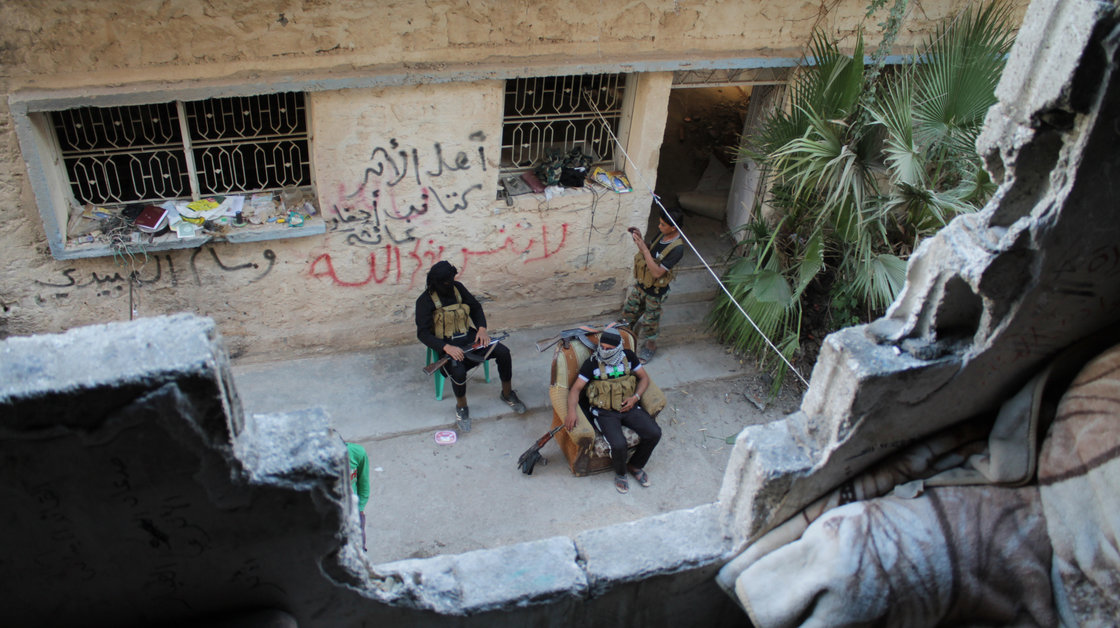
The Syrian Civil War is now producing a health crisis in Syria. Polio seems to have re-emerged in the country amidst the ongoing fighting.

Syrianoppositionfighters

NPR reports that “The World Health Organization is investigating a cluster of possible polio cases in an eastern province of Syria. If the cases are confirmed, they’d be the first ones in the war-torn nation in more than a decade. The country eliminated polio in 1999.”

NPR reports on polio in Syria.

Posted in Civil Conflict, Civilians and Refugees in War, History of Medicine, History of Science, History of Violence, Human Rights, War, Culture, and Society | Leave a comment

A Botched Hanging and the History of Executions

A convicted drug smuggler is facing a second execution in Iran, after surviving his first execution.

The BBC reports that “the condemned man, named as Alireza M, was found alive in a morgue after being hanged at a jail in the north-eastern city of Bojnord last week. He is now being nursed to recovery in preparation for his repeat execution.”

IranianGallows

Alireza “was left to hang for 12 minutes, after which a doctor declared him dead,” according to the BBC. “But when the prisoner’s family went to collect his body from the prison morgue the next day, they found he was still breathing.”

Amnesty International has called on the Iranian government to halt the second execution, calling it inhumane punishment.

Students in my HIST 111 Western Civilization 1500-1800 course will be interested in this story, since botched executions figured significantly in one of the books we discussed this semester. Joel F. Harrington, The Faithful Executioner: Life and Death, Honor and Shame in the Turbulent Sixteenth Century (New York: Farrar, Strauss and Giroux, 2013), presents a microhistory of a Nuremberg executioner, Franz Schmidt, in the late sixteenth and early seventeenth centuries. Although Franz strove to uphold his community’s ideals of justice through his professional conduct and moral behavior, several of the executions he performed were botched, with horrifying results. The book raises important questions about the death penalty and its application in the early modern period, as well as today.

BBC reports on the botched execution and the condemned Iranian man.

Posted in Early Modern Europe, Early Modern World, European History, European Wars of Religion, History of Violence, Human Rights | 2 Comments

Another Disaster in the Central Mediterranean

Another boat filled with at least 200 African migrants has wrecked in the central Mediterranean, this time off the island of Malta. At least 33 people are reported dead in this latest tragedy. Maltese forces rescued 147 migrants by boat and helicopter, and Italian forces have also saved some of the migrants.

Malta-rescue

The Prime Minister of Malta accused the European Union of inaction, stating that: “I don’t know how many more people need to die at sea before something gets done. … As things stand we are building a cemetery within our Mediterranean Sea.”

The BBC reports on the boat capsize off Malta.

This boat wreck follows on the recent disaster off the nearby island of Lampedusa. See my recent post on that wreck.

Posted in European History, European Union, Human Rights, Italian History, Maritime History, Mediterranean World | Leave a comment

Tragic Boat Wreck off Lampedusa

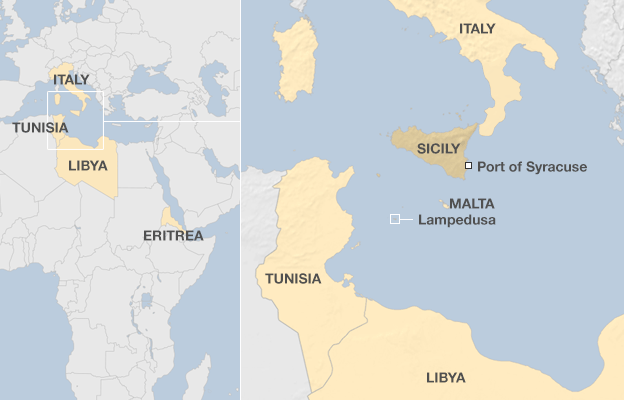
A week ago, a boat carrying African migrants heading for Sicily wrecked off the small island of Lampedusa in the central Mediterranean. The boat, apparently carrying more than 500 people, became disabled and then began to capsize merely 800 meters from shore. When a fire broke out on board, many of the migrants jumped into the sea.

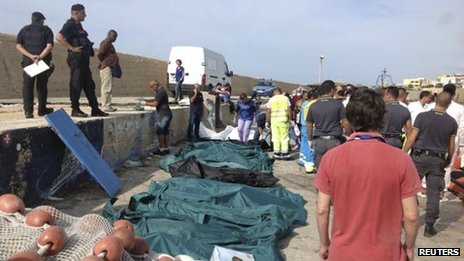
Lampedusa-victims

Local fishermen and the Italian Coast Guard rescued 155 migrants off Lampedusa, but 311 people died in the shipwreck. Another 50 or more passengers are still missing, according to the latest report from the BBC.

The BBC reported the wreck on 3 October and subsequently on the rescue and recovery operations of the Italian Coast Guard and other forces. Bodies have been laid out in Lampedusa, amid local anger at Italian officials, as the BBC reports.

Lampedusa-Mediterranean-map

This disaster demonstrates once again the human rights debacle in the Mediterranean. Desperate Africans are taking enormous risks to reach European shores, despite or because of European policies. The BBC reports on the failure of European migrant policies in the Mediterranean, which have been accused of violating human rights statutes.

Posted in European History, European Union, Human Rights, Italian History, Maritime History, Mediterranean World | Leave a comment

Preaching and Snake-Handling

briansandberg's avatarCluster for the Study of Religious Violence

Pentacostal Christian churches in the Appalachian Mountains are known for their snake-handling preachers and congregants.

Snake-HandlingPreachers

Several famous anthropological and sociological studies have been done on the Appalachian Pentacostals and their devotional practices.

A new National Geographic documentary will explore the religious world of Pentacostal faith.

NPR reports on the snake-handling preachers.

View original post

Posted in Uncategorized | Leave a comment

Journal of Religion and Violence Special Issue

briansandberg's avatarCluster for the Study of Religious Violence

The Journal of Religion and Violence recently published a special issue on René Girard’s mimetic theory.

Here is the table of contents:

1:2 – Table of Contents

SPECIAL ISSUE: René Girard’s Mimetic Theory and its Contribution to the Study of Religion and Violence

Introduction, Wilhelm Guggenberger and Wolfgang Palaver

Religion and Violence: A Girardian Overview, Nikolaus Wandinger

René Girard and Raymund Schwager on Religion, Violence, and Sacrifice: New Insights from Their Correspondence, Mathias Moosbrugger

Taming Violence, Wilhelm Guggenberger

Terrorism versus Non-Violent Resistance, Wolfgang Palaver

The Power of the Zealots: Religion, Violence, and International Relations, Jodok Troy

Modernity as Revelation: René Girard’s Imagination of the Worst, Stephen L. Gardner

For more information, see the Journal of Religion and Violencewebsite.

View original post

Posted in Uncategorized | Leave a comment