The Politics of Ark Building

briansandberg's avatarCluster for the Study of Religious Violence

Replicas of Noah’s Ark are being built in various locations around the world. The ark-building movement is related to a particular form of Christian politics and Creationism.

NoahsArk-Netherlands

The Creation Museum in Kentucky is building an ark as part of its Creationist theme park. “The museum has raised more than half the money needed for its $24.5 million Ark Encounter project,” according to NPR. “The Creation Museum’s mission is to show the feasibility of biblical stories. So with the Ark Encounter, they’re also setting out to show what day-to-day life would have been like for Noah.”

Another ark theme park, the Hidden Ark, is being built in Florida.

Meanwhile, arks have already been built in China and Europe. Johan Huibers constructed a 450-foot long ark recently in the Netherlands.  NPR reports that “a hundred thousand people have come to see Huibers’ ark. His goal is to spread his faith, but…

View original post 96 more words

Posted in Uncategorized | Leave a comment

Twilight of Berlusconi?

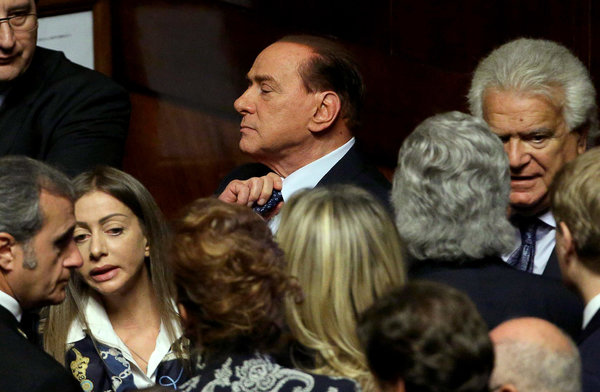
Silvio Berlusconi tried, but failed, to topple the coalition government of Italy this week. A threatened mutiny in his own party forced him to reverse his position and back the government of Enrico Letta during a vote of confidence on Wednesday 2 October.

Berlusconi-failure

According to the New York Times, “Mr. Berlusconi’s attempt to bring down the government was intended to resuscitate his endangered political career as he faces a pending prison sentence, analysts say. Instead, it fractured his center-right movement in Italy, which was threatened with a wave of defections. Standing in the Senate, Mr. Berlusconi, 77, was forced to reverse himself and pledge his party’s support for the same government that he had failed to topple.”

Roberto D’Alimonte, a political analyst, commented that: “We are seeing the long twilight of the Berlusconi era.” Certainly, many Italian citizens and people throughout Europe  hope that this prediction is correct.

The New York Times, Corriere della Sera, and La Repubblica report on Berlusconi’s failed political maneuver.

Posted in European History, European Union, Italian History, Political Culture | Leave a comment

NIU Joins Council for European Studies

Northern Illinois University recently joined the Council for European Studies.

“Northern Illinois University has been approved for membership to the Council for European Studies (CES) Academic Consortium, an international coalition of universities, centers and other organizations dedicated to furthering the study of Europe,” according to NIU Today.

“U.S. institutions that are counted among the CES members consist primarily of elite private or state flagships universities. In Illinois, only two other public institutions – the University of Illinois at Urbana-Champaign and University of Illinois at Chicago – are among the council’s current 84 members.”

NIU’s membership in the CES should present NIU faculty, graduate students, and undergraduate students with new possibilities for collaborative research and study abroad.

Mary Quinlan, professor of Art History at NIU, led the initiative to join the CES.

NIU Today reports on NIU’s membership in the CES.

Posted in European History, European Union, Graduate Work in History, Northern Illinois University, Study Abroad, Undergraduate Work in History | Leave a comment

Changing Organization of Al-Shabab

briansandberg's avatarCluster for the Study of Religious Violence

The al-Shabab organization has clearly been evolving over the past months, perhaps leading to its spectacular attack on Westgate Mall in Nairobi, Kenya, last week.

Westgate Mall-destroyed

Analysts who study terrorist organizations and religious violence have been tracking the changing profile of al-Shabab. Ahmed Abdi Godane seems to have taken control of the al-Shabab in June 2013 in a move that has been described as a “coup” by some.

A number of leaders and long-time members of al-Shabab were ousted from the organization during the summer and had to flee for their lives. Sheikh Hassan Dahir Aweys, a spiritual leader of al-Shabab, fled and was arrested by government troops in Somalia. Abu Mansoor al-Amriki (the American) and another former al-Shabab leader were later killed by al-Shabab militants.

Bruce Hoffman, professor at Georgetown University and an expert on terrorism, was interviewed by NPR on the attack at Westgate Mall. Hoffman argues that al-Shabab…

View original post 66 more words

Posted in Civil Conflict, Civilians and Refugees in War, History of Violence, Religious Politics, Religious Violence, Terrorism, War, Culture, and Society | Leave a comment

Is Violence Contagious?

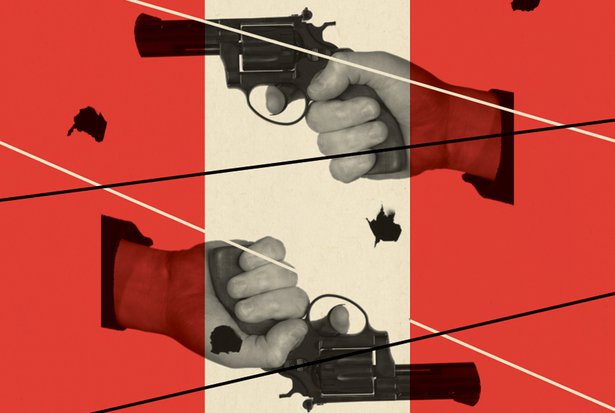
A new article in The Atlantic provocatively states that “Violence is Contagious.” Drawing on recent sociological and psychological studies, the article suggests that violence spreads like an epidemic.

violence-contagious

Certainly, metaphors frequently compare violence to a disease. Waves of violence are often referred to as a “plague” of violence. Political leaders and police officers refer to “epidemics” of urban gun violence. Rebellion is often described as an “infection” or a  “cancer.” Violent attacks may “go viral,” although this phrase now evokes computer viruses more than diseases.

All of these colorful metaphors describe the feelings of fear produced by patterns of  violence. Observers of a series of violent acts liken their fear of spreading violence to the fear of contagion.

It is something very different to argue that violence actually is contagious, as the article in The Atlantic suggests. I have not yet read the studies cited in the article, but I am skeptical about this claim.

The Atlantic published “Violence is Contagious” online.

Posted in Arms Control, Civil Conflict, Civilians and Refugees in War, History of Violence, Religious Violence, Revolts and Revolutions, Terrorism, War, Culture, and Society | Leave a comment

Artiste nel chiostro

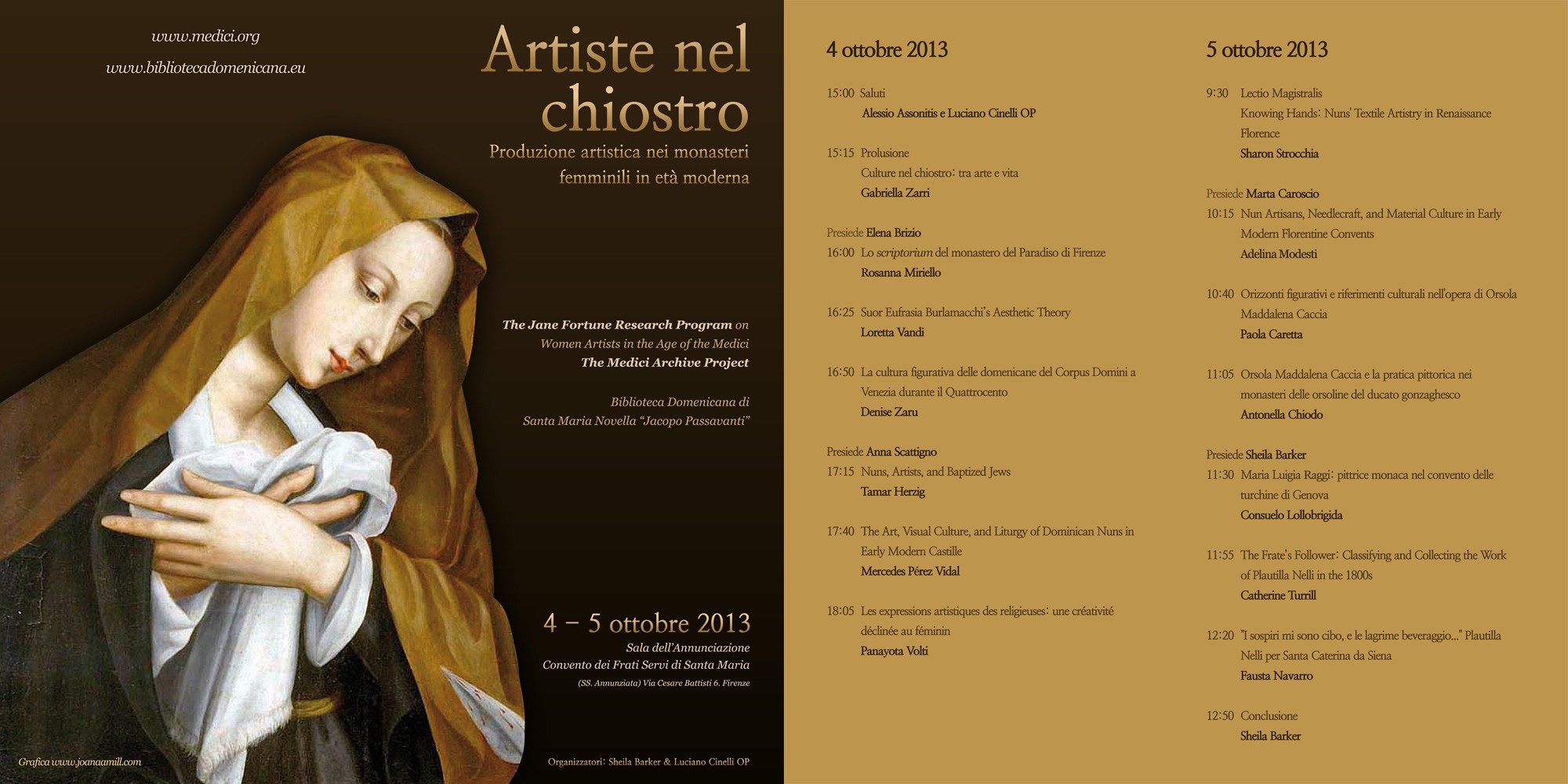
A conference on Ariste nel chiostro (Artists in the Cloister), is being held on 4-5 October 2013 in Firenze.
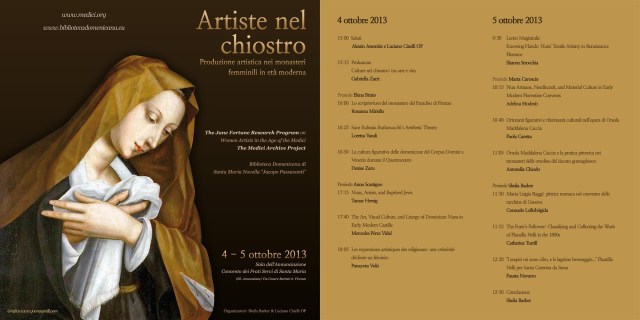
artisteNelChiostro_invito

In 1938, Giovanna Pierattini published her groundbreaking study on nun artist Suor Plautilla Nelli in the journal Memorie Domenicane. To mark the 75th anniversary of this occasion, the Provincia Romana di S. Caterina da Siena, the Medici Archive Project’s Jane Fortune Research Program on Women Artists, and the Biblioteca Domenicana of Santa Maria Novella are co-sponsoring a conference on nun artists to be held in the convent of the SS. Annunziata on Friday, October 4th, and Saturday, October 5th. During these two days, twelve scholars from Italy, the United States, Israel, France, Switzerland, and Spain will present new research on nun artists and the conditions of artistic production in female monastic communities from the early Renaissance through the eighteenth century, in Italy as well as Spain, France, and Germany.

This conference investigates a specific group of Renaissance and Baroque women artists who are lesser known today, yet who were often celebrated in their own era, as in the case of Plautilla Nelli, a nun painter praised in Vasari’s 1568 Lives of the Artists.  Nun artists worked in painting, sculpture, and printmaking, as well as in overlooked areas such as embroidery and manuscript illumination–media in which women often obtained great renown, but which are today (unfairly) undervalued as modes of artistic expression. In their own era, the nun artists were recognized by their secular contemporaries for their piety, industry and talent, even becoming points of pride for their local communities. Recent research on the history of women’s convents has revealed their prominent place in the patronage networks and economies of the early modern state, and in the politics and spiritual life of the Church.

Art historians have been slow to accept nun artists into the mainstream history of Italian art, even when women’s art is their focus.  Among the reasons for this are the art market’s deep-rooted bias against so-called primitive styles, even when these styles were willfully cultivated; the art historian’s reluctance to deal with anonymous artworks and minimally documented artists; and the museum’s tendency to separate textiles, books, prints and paintings into distinct departments and display areas, thus disassociating the interrelated varieties of figurative expression produced by a single convent.

Some of the questions the speakers will tackle during the conference include the following: What role did looking at art play in the spiritual life of nuns? Were creativity and artistic talent in conformity with the nuns’ religious priorities?  Did the physical process of making art play a role in the nuns’ spiritual devotions? Were ornamental objects made by nuns valued and appreciated differently than those made by secular (and usually male) artisans and artists? Why were the arts practiced and taught in convents–were the motives purely economic? How were the nuns’ workshops organized and how did they differ from the workshops of  male professionals? Who taught the nuns such skills as painting and what materials and models were available to them?  How does the art of feminine monastics differ from order to order, from place to place (not only within Italy but across Europe), and over the centuries?

The conference, which is free and open to the public, will take place  October 4 and 5, in the “Sala dell’Annunciazione,” Convento dei Frati Servi di Santa Maria (SS. Annunziata), via Cesare Battisti 6. The entrance is to the left of the facade of the Basilica of the SS. Annunziata.

For more information on this conference, see the Medici Archive Project website. My colleague, Sheila Barker, at the Medici Archive Project has organized this interesting conference program.

Posted in Art History, Conferences, Early Modern Europe, Early Modern World, Italian History, Mediterranean World, Noble Culture and History of Elites, Religious History, Renaissance Art and History, Women and Gender History | 1 Comment

European War and Society Position

The Department of History at Sam Houston State University invites applications for a tenure-track assistant or associate professorship in European military history with a start date in August 2014. Ph.D. required by the time of appointment. In addition to the world history survey and offerings in one’s specialty, the successful candidate will teach the department’s course in World War II. SHSU is on a 3/3 teaching load, including undergraduate, graduate, and on-line courses.
Review of applications will begin on November 25, 2013 and continue until the position is filled.

To apply, upload a letter of application (addressed to Prof. Nancy E. Baker, Chair of Search Committee, Sam Houston State Univ., Huntsville TX 77341), curriculum vitae, and two sample syllabi (one upper-level undergraduate and the other graduate, each engaging some aspect of European military history). The two sample syllabi should be uploaded under the “Writing Sample” option. In addition, three letters of reference are to be sent to this email address: histsrch@shsu.edu. Review of applications will begin November 25, 2013.

For more information, see the job ad on H-Net.


Posted in Careers in History, European History, History of Violence, War, Culture, and Society | Leave a comment

History and Politics in France

History and politics are often closely entwined in France. Even academic historians sometimes engage directly in social commentary and political activity, sometimes referred to as histoire engagé. Some historians have taken engagement a step further to become local or national leaders of activist movements and political parties.

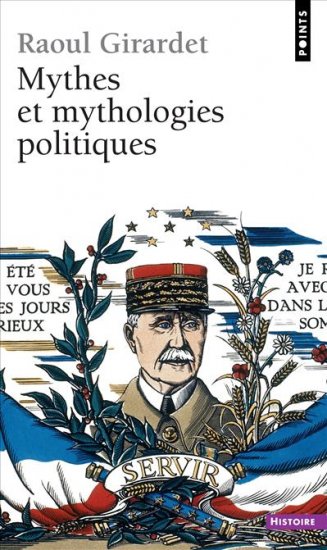
One of the most famous politically active historians in France, Raoul Girardet, died last week. Raoul Girardet was a Professeur at the Institut d’études politiques de Paris (IEP), also known as Sciences Po. A dedicated nationalist, Girardet was involved in the right-wing Action française in the 1930s, then in the French Resistance during the Second World War, and later in a militant anti-Gaullist movement in the 1960s.

Girardet-Mythes

Girardet’s historical work focused on French nationalism, colonialism, and political mythologies. His books include:

  • Le nationalisme français, 1871-1914 (Paris: A. Colin, 1966).
  • L’idée coloniale en France de 1871 à 1962 (Paris: La Table Ronde, 1972).
  • Mythes et mythologies politiques (Paris: Seuil, 1986).

Girardet also engaged in autobiographical historical writing, participating in a volume on ego-histoire by Pierre Nora. On ego-histoire, see:

Pierre Nora, Essais d’ego-histoire (Paris: Gallimard, 1987).

Jeremy D. Popkin, “Ego-Histoire and Beyond: Contemporary French Historian-Autobiographers,” French Historical Studies 19, Special Issue: Biography (Autumn 1996): 1139-1167.

English translations of some of Girardet’s books are available. See WorldCat.org for listings.

Le Monde published an obituary for Raoul Girardet.

Posted in European History, European Union, French History, Paris History, Political Culture | Leave a comment

Al-Shabab Attack in Nairobi

briansandberg's avatarCluster for the Study of Religious Violence

The militant group Al-Shabab has claimed responsibility for an attack by multiple gunmen at a shopping mall in Nairobi known as the Westgate centre.

Nairobimall-seekingsafety

The BBC reports that “The attackers entered the Westgate centre at about 12:00 local time (09:00 GMT), throwing grenades and firing automatic weapons. Dozens of shoppers fled; many were trapped inside. Officers have been going from shop to shop to secure the area. Some seven hours after the assault began, al-Shabab said on Twitter that its fighters were still battling Kenyan security forces inside the Westgate centre.”

Nairobi mall

Many people fled from the shopping mall as security forces tried to subdue the militants.

According to the BBC, “some witnesses said the gunmen had told Muslims to leave and said non-Muslims would be targeted.” A witness named Elijah Lamau stated that: “They came and said: ‘If you are Muslim, stand up. We’ve come to rescue you.'” Lamau…

View original post 118 more words

Posted in Civil Conflict, Civilians and Refugees in War, History of Violence, Religious Politics, Religious Violence, Terrorism | Leave a comment

Mediterranean World Workshop Events

The Mediterranean World Workshop at Northern Illinois University participated in two events on campus this week.

Members of the Mediterranean World Workshop attended a public lecture by Julia Clancy-Smith (Professor, University of Arizona) on “From Sidi BouZid to Sidi Bou Sa`id: Reflections on the North African Revolutions.”  The lecture was held on Friday 20 September 20 at 1:00 p.m. in Altgeld Hall, Room 315.

Julia Clancy-Smith, Professor of History at the University of Arizona, is the author of: Mediterraneans: North Africa and Europe in an Age of Migration, c. 1800-1900 (Berkeley: University of California Press, 2010), which won the 2011 French Colonial Historical Society Book Award and the 2011 Phi Alpha Theta History Honor Society Award for the Best Subsequent Book, and Rebel and Saint: Muslim Notables, Populist Protest, Colonial Encounters (Algeria and Tunisia, 1800-1904) (Berkeley: University of California Press, 1994), which received three book awards.  

The Mediterranean World Workshop also attended a presentation by NIU Assistant Professor of History Ismael Montana, celebrating the recent publication of his book, The Abolition of Slavery in Ottoman Tunisia. This book talk was held on 20 September at 2:30 p.m. in the Thurgood Marshall Gallery, Swen Parson Hall.

Posted in Early Modern World, Graduate Work in History, Lectures and Seminars, Mediterranean World, Northern Illinois University | Leave a comment