Digital Tools in Archival Research

Historians have been using digital tools in archival research for some time now, but news media are finally beginning to pay attention to digital humanities.

An article in the New York Times reports on historians’ use of digital cameras in the archives. The story discusses historians’ strategies of taking digital photos to shorten their archival trips, as well as archivists’ concerns about conserving documents that are being photographed. Nothing in this story will seem new to today’s historians, but perhaps this story will stimulate more awareness in the public of historians’ research methods.

How are historians using digital cameras and other tools in the archives?

Comment on your own methods of digitizing sources and using digital humanities resources below….

Thanks to Jennifer Wegmann-Gabb, a History student at Northern Illinois University, for sharing this article.

Posted in Archival Research, Digital Humanities, Graduate Work in History, History in the Media, Humanities Education, Information Management, Undergraduate Work in History | Leave a comment

Saving Manuscripts in Timbuktu

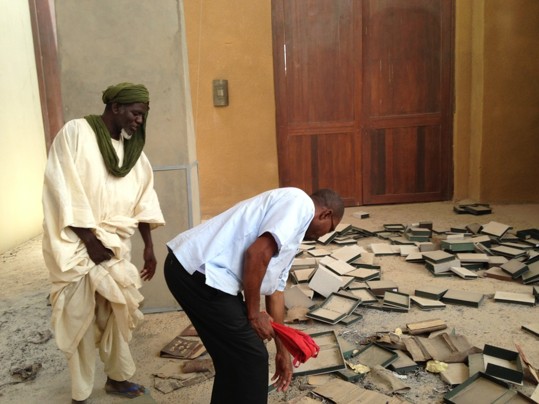
When Malian rebels and Islamist militants took control of Timbuktu last year, they targeted Sufi shrines and cultural heritage sites they viewed as idolatrous. They also aimed to destroy medieval manuscripts that they consider heretical and secular.

Most of Timbuktu’s manuscripts at the Ahmed Baba Institute and other archives were saved by intrepid Malians who took enormous risks to protect their historical heritage.

timbuktu

Photo credit: Sudarsan Raghavan, Washington Post

A new report in the Washington Post details one of the remarkable stories of saving manuscripts in Timbuktu.

Posted in Archival Research, Civil Conflict, Civilians and Refugees in War, Museums and Historical Memory, Religious Violence, Revolts and Revolutions, War, Culture, and Society | 1 Comment

Interactive ebooks

A new generation of ebooks have arrived: interactive ebooks. Readers who remember the Choose Your Own Adventure children’s books and other interactive books of the 1980s will get the idea.

An interactive ebook of The Thirty-Nine Steps, a classic spy novel, was recently launched.

London Book Fair 2013

NPR and the Guardian report on The Thirty-Nine Steps ebook.

Posted in Digital Humanities, History in the Media, History of the Book | Leave a comment

Global Tourism and Graffiti

Global tourism is putting increasing pressure on historical sites and monuments, as growing numbers of tourists visit major cultural tourist locations around the world.

High standards of living, lengthy vacations, and relatively affordable flights have allowed many Western Europeans, Canadians, Americans, and Australians to participate in global tourism since the 1950s. Mass tourism now involves large groups that are transported locally by cruise ships and buses and that can overwhelm port cities, small towns, and remote villages that have cultural sites. Latin Americans, Eastern Europeans, and Russians have become mass tourism customers since the 1990s. Increasing numbers of Indians and Chinese are now joining the expanding wave of global tourism.

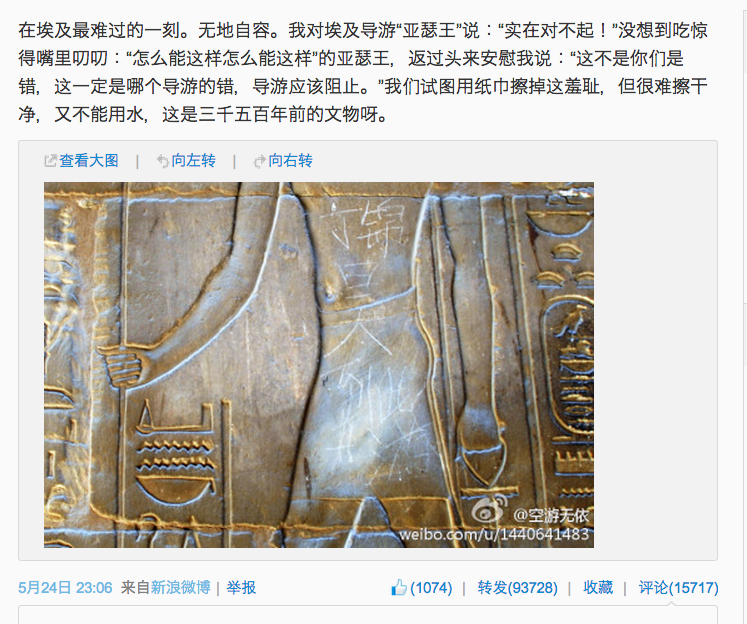
Graffiti is now one of the biggest problems associated with mass tourism. An incident of graffiti vandalism by a Chinese teenager at Luxor, Egypt, has apparently led to a debate about graffiti and tourism in China.

graffiti-Luxor

Le Monde reports on the debate in China.

Tourist graffiti has a long history, however. The early modern form of mass tourism, the noble grand tour, sometimes involved leaving graffiti on monuments visited. I have personally seen eighteenth-century graffiti at monuments in southern France and Italy.

On graffiti and tourism, see: Andrea Mubi Brighenti, ed., The Wall and the City/Il muro e la città/Le mur et la ville (2009).

Graffiti and mass tourism are major concerns in European and Mediterranean nations with historical sites that are popular tourist destinations.

Posted in Art History, Early Modern Europe, Early Modern World, European History, European Union, Globalization, Mediterranean World, Museums and Historical Memory | Leave a comment

Gender Studies Under Fire in France

The academic field of gender studies is under attack in France. The debate over gay marriage has prompted many French conservative politicians and Catholics to severely criticize gender studies for undermining family relations and traditional society. Conservative political and religious groups in France have organized massive protests against the Mariage pour tous (Marriage for All) campaign.

These critics claim that biological differences between males and females are indeed real and the gender theories of the social and cultural construction of gender categories are nothing but ideologies.

antigenre

According to Le Monde, the Union nationale inter-universitaire (UNI), a right-wing student association recently founded l’Observatoire de la théorie du genre, aiming to “ouvrir les yeux sur la théorie du genre”, which it calls an “idéologie […] qui vise à remettre en cause les fondements de nos sociétés ‘hétéro centrées’, de substituer au concept marxiste de la lutte des classes, celui de la lutte des sexes.”

Le Monde reports on the attack on gender studies in France.

I would note that based on my own experience in French universities and archives, many French academics view gender studies as an American import. Although I do not have access to statistics on this issue, professors of gender studies seem relatively few in number in French universities. The French professors of gender history I have spoken with feel marginalized within the French higher education system.

So, despite the recent legalization of gay marriage in France, religious politics continues to threaten gender studies and broader notions of academic freedom in France.

Posted in Academic Freedom, Education Policy, European History, European Union, French History, Humanities Education, Political Culture, Religious Politics, Women and Gender History | Leave a comment

A New Curator at the Biennale di Venezia

The Biennale di Venezia, one of the most famous international annual art exhibitions, has a new curator this year. Massimiliano Gioni, an Italian-born curator who is currently a director at the New Museum in New York, is curating the Biennale, which is preparing to open.

Gioni-BiennalediVenezia

The New York Times reports on Gioni and the Biennale di Venezia.

Posted in Art History, European History, European Union, Museums and Historical Memory | Leave a comment

Digital Humanities and the History of the Internet

Historians are working to study the development of the internet and the World Wide Web, as well as to preserve digital history.

Digital humanities needs to grapple with issues of digital preservation and conservation, key aspects of any notion of digital history.

Preserving the constantly changing digital universe of the World Wide Web is an impossibility. Websites are continually updated, meaning there is no stable web universe, even for a moment.

webscreenshot1993

A more reasonable goal for digital historians is to preserve the earliest versions of the World Wide Web. Historians and computer techs are now attempting to reconstruct the earliest webpages and preserve the earliest web servers.

first-www-computer

NPR reports on these attempts.

Posted in Digital Humanities, Globalization, Humanities Education, Information Management | Leave a comment

The Political and Corporate Interest in MOOCs

The biggest proponents of Massive Open Online Courses (MOOCs) are not professors, but politicians and business leaders. These cheerleaders for MOOCs present university and college faculty members as conservative detractors of their forward-looking plans.

The agendas of the political and corporate interests who are backing MOOCs need to be examined closely. Concerned citizens do not have to look hard to find ample evidence of the agendas driving MOOC development, which is part of a broader drive to advance for-profit education.

A new article by former Florida Governor Jeb Bush and educational corporate leader Randy Best sets forth their political-corporate agenda. Their vision of education would be one of corporate training for future corporate workers. This article is part of a much broader political-corporate movement for “disruptive education” that envisions destroying research integrity, academic excellence, faculty autonomy, and curricular innovation through a corporate model of education.

For-profit universities, for-profit educational publishers, and for-profit MOOC providers have aligned in an assault on private and state universities in the United States. They claim that they will cut tuition rates, save students money, and streamline time-to-degrees (all without affecting academic standards).

Don’t believe it.

Note that many corporate leaders in this movement (such as Randy Best) present themselves as “philanthropists,” but actually still own or have investments in educational corporations that would profit from the initiatives they promote.

Politicians and their corporate allies are pushing their own agenda in a bid to transform all of higher education into a for-profit industry.

Parents of today’s middle school and high school students should be very concerned about these trends. Your sons and daughters may end up being degree-purchasing consumers instead of college students.

Inside Higher Ed publishes Jeb Bush and Randy Best’s essay.


Posted in Digital Humanities, Education Policy, Globalization, Humanities Education, Information Management, Undergraduate Work in History | Leave a comment

What MOOCs Can and Cannot Do

The intense debate about the role of Massive Open Online Courses (MOOCs) in higher education continues. Proponents and administrators tout the potential of MOOCs to transform universities, while skeptics question the benefits of these online courses and critics highlight the threats they pose to student-faculty interaction, curricular design, and faculty autonomy.

A new article in the Chronicle of Higher Education surveys reactions to MOOCs by students who have taken a number of the online courses. Although the article presents the students’ comments in terms of feedback for professors who are teaching online courses, the students’ reactions are very revealing about the real uses of MOOCs.

One of the most powerful potential of MOOCs is to reach international students who want to do introductory studies in English language. The Chronicle article cites the example of “Markus Lauer, a 32-year-old Ph.D. student at Saarland University, in Germany, who has completed more than 28 MOOCs through Coursera.”

But, this same student indicates the basic nature of the MOOC information. According to the Chronicle, “the online courses have been a great way for him to get a quick introduction to new fields in a way books usually can’t provide. But to really learn any of those subjects in depth, he says, he’d have to hit the books in a more traditional way.” MOOC students seem to believe that the courses only offer basic introductory material.

MOOCs may be able to replace formal classroom lectures. MOOC users stressed the importance of professors’ “passion” for their subject as being key to their success as MOOC instructors. I would argue that this is identical to on-campus teaching. 

Formal classroom lectures have already been abandoned except in the largest 100-level lecture courses at many universities, however. Most history and humanities professors I know stress discussion over lecture, or at least blended lecture/discussions. So, perhaps MOOCs have the potential to replace 100-level introductory survey courses, but they will have to compete simultaneously with AP courses and community college survey offerings which are already replacing 100-level offerings at many universities.

MOOCs clearly do not replace books. The Chronicle article reports that “When the only materials are lecture videos, it can be hard to go back and study for quizzes or exams, several of the students say. Since the videos aren’t searchable in most MOOCs, students aren’t sure where in the video to look for a given concept they are reviewing.” One of the students questioned commented that: “I would really love that every course have some comparative set of reading materials.”

Unfortunately, some students follow MOOCs because they seem unable or unwilling to crack the cover of a book. The Chronicle reports: “Consider Anna Nachesa, a 42-year-old single mother in a village near Amsterdam who logs on to MOOCs for several hours each night after dinner with her teenage kids. She has always found TV boring, she says, and for her, MOOCs replace reading books. She is a physicist by training, with a degree from Moscow State University, and she works as a software developer.” MOOCs here serve as an alternative to TV, simply providing intellectual evening entertainment.

MOOCs could effectively compete with educational television programming, I imagine, but their production costs would have to approach those of PBS, BBC, and other educational television producers.

MOOCs currently seem to be a form of online educational entertainment. The Chronicle article points out that “The term ‘MOOCs’ is meant to parallel the video-game acronym ‘MMOGs,’ or massively multiplayer online games—collaborative worlds, like World of Warcraft, that have attracted millions of devoted players around the world. So perhaps it is no surprise that some MOOC students are driven to win as many certificates as possible and treat online lectures as a consuming pastime that keeps them from going outside to hang out with friends.” MOOC students then would represent educational gamers.

The strongest potential of MOOCs seems to be as a platform for professors to reach this broad public audience of educational gamers and become celebrities. MOOCs can serve as extended TED talks. The Chronicle article indicates that “When the students talked about the MOOCs they’ve taken, they usually mentioned the professor first. They sometimes couldn’t remember the name of the university offering the course.”

Professors are the “stars” and their digital courses are coming soon to a gamebox near you.

The Chronicle of Higher Education reports on MOOC students’ reactions to their online courses.

Posted in Digital Humanities, Education Policy, Humanities Education, Information Management, Undergraduate Work in History | Leave a comment

Debate Over Guns on College Campuses

A growing area of the gun control debate concerns the presence of guns on college campuses. Many colleges and universities have long had bans on the possession of guns on their campuses, but pro-gun political action groups would like to change that.

collegesmajorfrontguns

Pro-gun groups claim that allowing faculty and/or students to carry concealed handguns would improve campus safety and save lives. Gun control groups dispute this, claiming that colleges and universities are safer without guns on their campuses.

A mass shooting on 14 February 2008 on my campus at Northern Illinois University suggests the limitations of arms in protecting professors and students. When a former graduate student burst into a classroom and began shooting, there was no time for a reaction from professor and students. NIU Police, who were armed, responded immediately to the sound of gunfire, arriving within minutes.  But, the gunman had already completed his shooting spree and had shot himself.

The New York Times reports on the push by gun advocates to allow guns on campus.

Posted in Arms Control, Education Policy, History of Violence, Human Rights, Political Culture, Uncategorized | Leave a comment