Mediterranean Seminar Workshop

The University of California at Santa Cruz will be hosting the Mediterranean Seminar’s Spring Symposium and Workshop this week on 2-4 May 2013.

Print

I am excited to be attending the Symposium and participating in the Workshop this year. I am presenting a pre-circulated draft chapter, entitled “‘Moors Must Not Be Taken for Black’: Islamic / French Cultural Translations Across the Early Modern Mediterranean.” This chapter is based on a shorter conference paper that I wrote several years ago.

The Mediterranean Seminar website has the program for the Spring Symposium and Workshop.

Posted in Conferences, Early Modern World, Maritime History, Mediterranean World, Uncategorized | 1 Comment

The Cost of MOOCs

Lost in all the excitement about Massive Open Online Courses [MOOCs] is the cost of development, maintenance, and teaching the online courses.

A number of universities and colleges have already partnered with edX, Coursera, and other MOOC provider companies. Many people seem to assume that MOOCs provided by these institutions will be free and that they will necessarily save students money on tuition and fees. But, these universities and colleges are investing enormous financial resources in the MOOC provider companies.

MOOCuniverse

An article in the Chronicle of Higher Education points out that “Offering MOOCs through edX is hardly free. There are options available to institutions that want to build their own courses on the edX platform at no charge, but for partners who want help developing their courses, edX charges a base rate of $250,000 per course, then $50,000 for each additional time that course is offered; edX also takes a cut of any revenue the course generates.”

Most MOOC enthusiasts are administrators rather than faculty members and they seem to be failing to understand the costs associated with academic labor. The Chronicle of Higher Education reports that “there are also significant labor costs that come with offering MOOCs. A recent Chronicle survey found that professors typically spent 100 hours, sometimes much more, to develop their massive online courses, and then eight to 10 hours each week while the courses were in session. This commitment amounted to a major drain on their normal campus responsibilities.”

The survey cited in this quote included mostly science and mathematics courses. Professors in the humanities and social sciences probably spend well more than 8-10 hours per week in preparing courses and assessing student written work.

Of course, the most serious cost of MOOCs is the cost in learning. Numerous studies demonstrate that students learn more effectively in small classroom environments. For this reason, colleges and universities have long measured their student-to-faculty ratios, loudly advertising their low ratios whenever possible.

MOOC reverse the ratio, touting the most students “served” by single faculty members. Many MOOCs implicitly incorporate a corporate model of higher education, treating students as “customers” and “consumers” rather than as students engaged in learning.

The costs and limitations of MOOCs are not being taken seriously by tech-happy administrators and MOOC enthusiasts.

The Chronicle of Higher Education reports on some colleges’ refusals to partner with MOOC providers.

Update: A separate article reports on Duke University faculty’s recent rejection of 2U’s proposal to offer for-credit MOOCs.

Update: The Chronicle of Higher Education also reports on San José State University partnership with edX, which has prompted questions from the faculty. The Department of Philosophy at SJSU have decided not to use a Harvard professor’s course on “Justice” which is provided through edX. The letter by the faculty of the SJSU Department of Philosophy makes an important statement about the problems of MOOCs in higher education.


Posted in Academic Freedom, Digital Humanities, Education Policy, Humanities Education, Information Management, Undergraduate Work in History | 3 Comments

Political Violence in Italy

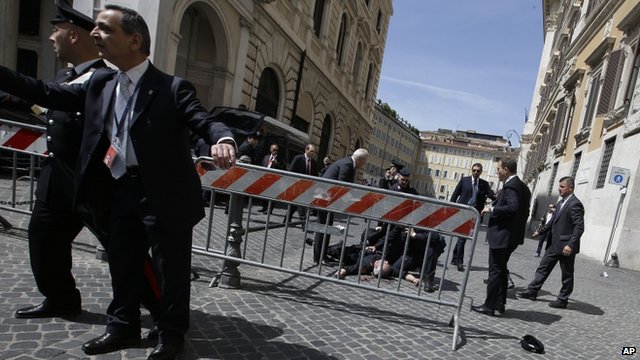
A Calabrian man attempted to shoot Italian politicians being sworn into office in Rome today. The gunman failed to reach politicians, but wounded several police officers before being apprehended.

italygunman

Italy has a long history of political turmoil related to ideological disputes and party rivalries. The anni di piombo (years of lead) of the 1970s and early 1980s involved massive political violence, including numerous shootings and bombings by right-wing and left-wing militant groups.

Over the past twenty years, there have been changes of government and constitutional crises, but little political violence.

The most recent parliamentary elections in Italy created a confused situation of heightened tensions, with no party able to form a government. This constitutional crisis was apparently resolved this week by the creation of a grand coalition government.

The violence today may be an act of desperation by a lone gunman, but the possibility of organized political violence will surely be considered by suspicious Italians and their security forces.

Repubblica and the BBC report on the shooting.

Posted in Civil Conflict, European History, European Union, History of Violence, Italian History, Terrorism | Leave a comment

Early Modern Atlantic World: Slavery, Race, Governance

The Center for African American History at Northwestern University held a conference this weekend on “The Early Modern Atlantic World: Slavery, Race, Governance.”

slaverinafrica

I was able to attend two sessions of the conference and heard some fascinating presentations by Kristin Huffine, Nancy van Deusen, Susan Deans-Smith, and other scholars. Kristin Huffine, who presented on Jesuit theories of cosmography and human origins, is one of my colleagues in the Department of History at Northern Illinois University.

Many of the papers at the conference dealt with the early modern Spanish empire, including European and Mediterranean contexts such as indios and moriscos in Iberia.

Almost all of the papers treated the concepts of race and racism in various ways. Susan Deans-Smith provided an excellent critical response in the first session on the debates over the concept of race, arguing that there are currently three main approaches to race in the early modern period (historicized race, indigenous literacies, and ethnic identities).

My Mediterraneanist colleagues would be interested in most of the papers from this conference, since they deal with categories operative in Mediterranean World studies as well as Atlantic World studies.

The conference program is available as a .pdf file on Northwestern’s website. For additional information, see the website Center for African American History.

Posted in Atlantic World, Civilians and Refugees in War, Conferences, Early Modern Europe, Early Modern World, European History, History of Violence, Human Rights, Mediterranean World, War, Culture, and Society | 1 Comment

Faculty Governance and MOOCs

The faculty of Amherst College have voted to reject a proposal to join edX in providing Massive Open Online Courses (MOOCs).

Professors across the United States can appreciate this rare instance of faculty empowerment that affirms the principle of faculty governance at Amherst College.

According to Inside Higher Ed, “Amherst President Carolyn (Biddy) Martin left the final decision about the deal in the hands of her faculty. She expressed public support for working with edX but said she saw risks either way. After months of deliberation on campus, the faculty met Tuesday night to decide if Amherst should join edX. The administration said it would respect the faculty vote. The faculty voted on a substitute motion offered by an opponent of the edX deal that concluded Amherst should chart its own course rather than join edX. Seventy faculty members then voted to formally approve that motion, 41 voted against and five abstained.”

It is refreshing to see a College President who is willing to empower faculty members to study a problem seriously and then vote on college policy.

The Amherst faculty examined edX’s proposal and wrote a report on their findings. Inside Higher Ed indicates that faculty members “expressed broader concerns about the direction in which edX and others like it are taking higher education.” In particular, professors pointed out that “edX wants to offer its users completion certificates bearing Amherst’s name. This worried some faculty, as well as Martin.”

This highlights one of the main potential threats of MOOCs for higher education in the United States: that new MOOC-providing companies will appropriate university’s credentials and use them to pass off MOOC courses as equivalent to face-to-face education in on-campus courses.

MOOCs do not seem particularly relevant for humanities disciplines, many of which rely on classroom discussion and interactive learning, rather than on a lecture-driven format.

Inside Higher Ed reports on this story.

Posted in Digital Humanities, Education Policy, Humanities Education, Information Management, The Past Alive: Teaching History, Undergraduate Work in History | Leave a comment

Graduate Student Research Revises Economic Advice

Graduate student research ideally develops new analysis and criticism by employing new evidence and/or new methods.

Thomas Herndon, a graduate student in Economics at the University of Massachusetts-Amherst, recently made a finding that has major significance for economic policies worldwide.

Studentresearcher-Herndon

Herndon discovered an error in economic data that seemed to show that austerity measures are necessary when a nation’s debt exceeds 90% of that nation’s GDP.

The statistical data that Herndon critiques was produced by professors Carmen Reinhart and Ken Rogoff and presented in a 2010 paper entitled “Growth in a Time of Debt.” According to the BBC, their paper’s findings indicated that “economic growth slows dramatically when the size of a country’s debt rises above 90% of Gross Domestic Product, the overall size of the economy.”

Reinhart and Rogoff’s data has been used by politicians and policy-makers to argue for massive budget cuts and austerity measures in the United States and in a number of European Union (EU) countries.

Herndon discovered that Reinhart and Rogoff had made a serious miscalculation in averaging GDP growth for nations that have high public debt.

This finding removes one of the main pieces of statistical data that has been used by advocates of austerity measures to support their arguments. Economic historians, European historians, and historians of globalization will be interested in this story.

This case shows the importance of graduate work in questioning established findings critically and in performing original research.

The BBC reports on this story.

Posted in Academic Publishing, European History, European Union, Globalization, Graduate Work in History, Historiography and Social Theory, Information Management, Political Culture | Leave a comment

Blogs about War and Society

It is sometimes difficult to find an audience for academic blogs and internet resources amid the vast blogosphere.

I am pleased to find that this blog has been featured in an article on blogs that deal with war and society issues.

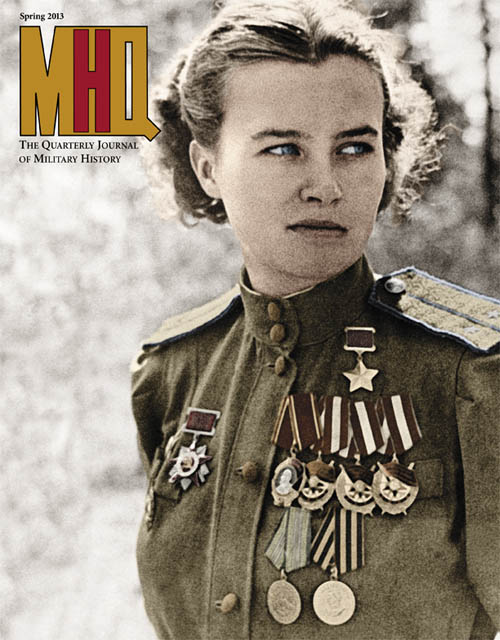
Mark Grimsley, Professor of History at Ohio State University, reviews several academic blogs in a piece entitled “Blogs: Professors of War,” MHQ Magazine 25 (Spring 2013): 90.

SubCvr

Incidentally, this issue of MHQ Magazine also includes an article on women in the Second World War, as this brilliant cover image suggests.

Posted in Digital Humanities, Gender and Warfare, History of Violence, Humanities Education, Information Management, War, Culture, and Society, Warfare in the Early Modern World, Women and Gender History | Leave a comment

Rape in the Syrian Civil War

Sexual assault often accompanies military conflict. In many wars, some soldiers use their armed power to inflict sexual violence on prisoners and civilians. Sexual violence can at times become systematic, targeting specific groups of combatants or civilians to intimidate and humiliate them.

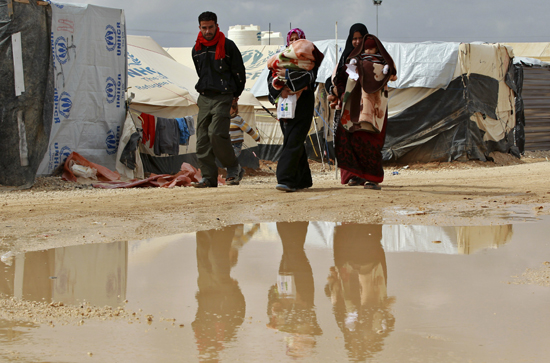
Many Syrian civilians have been caught in the midst of fighting, while millions of others have fled their homes as refugees—both within Syria and in neighboring countries. All civilians risk detention, interrogation, and violence at the hands of the soldiers who are waging civil warfare.

Syrian women, who are refugees, carry their children as they walk with a man at Al- Zaatri refugee camp, in the Jordanian city of Mafraq, near the border with Syria

Recent reports from Syria indicate that rape is being employed as a weapon in the fierce fighting of the Syrian Civil War.

The Atlantic provides data on reported incidents of sexual violence against female and male victims in the following table:

syrianrape-table

The International Rescue Committee (IRC) has published a report on the conditions of Syrian refugees, which discusses the problem of rape in the conflict. The Washington Post and the Guardian also report on rape in the Syrian Civil War.

Posted in Civil Conflict, Civilians and Refugees in War, Gender and Warfare, History of Violence, Human Rights, War, Culture, and Society, Women and Gender History | Leave a comment

The Danger of Pre-emptive Strikes

With tensions already running high on the Korean peninsula, many American policy-makers and advisers are talking tough.

Now historian Jeremi Suri has weighed in, arguing in an op-ed in the New York Times that “the Korean crisis has now become a strategic threat to America’s core national interests.” Suri, Professor of History at the University of Texas at Austin, provides a recommendation on how best to handle this crisis: “The best option is to destroy the North Korean missile on the ground before it is launched. The United States should use a precise airstrike to render the missile and its mobile launcher inoperable.”

northkoreanmissile

The legal justifications for pre-emptive strikes under international law are weak and highly contested, however. There are certainly numerous historical precedents for pre-emptive strikes, including the United States invasion of Iraq in 2003, the Israeli airstrike on the Osirak nuclear reactor in Iraq in 1981, the Six-Day War of 1967.

Pre-emptive strikes are extremely risky, since they often fail to achieve their objectives or produce unintended consequences. The 2003 invasion of Iraq succeeded in toppling Saddam Hussein’s regime, but produced a serious civil conflict that continues today.

More distant historical cases also suggest the dangers of pre-emptive strikes. A few examples from European history illustrate this point.

King Charles IX and his advisers launched a pre-emptive strike to destroy the leadership of the Huguenot nobility gathered in Paris in August 1572, but the resulting Saint Bartholomew’s Day Massacre gravely damaged the monarch’s reputation, reignited religious warfare across France, and deepened animosities between French Catholics and Calvinists for decades.

A decade later, another Valois king launched another pre-emptive strike in France. King Henri III ordered his bodyguard to assassinate the duc de Guise and the cardinal de Guise, the leaders of the Catholic League, during a meeting of the Estates-General at Blois in 1588. The assassinations provoked outrage by devout Catholics throughout France. A year later, Henri III would be killed by a Catholic Leaguer assassin.

In the seventeenth century, King Louis XIV launched an invasion of the Netherlands in 1672, intending to deliver a knockout blows against his Dutch rivals. The pre-emptive strike failed when the Dutch opened dikes and flooded the countryside, leading to a protracted war. Again in 1688, Louis XIV attempted a pre-emptive strike, but France ended up embroiled in a Nine Years’ War. Historian John A. Lynn refers to the “phantom of the short war” to describe the illusion that a quick military strike can eliminate an enemy or deliver a knockout blow. Lynn argues that “again and again, Louis naively accepted the promise of a short war.”

The German offensive on Belgium and France in 1914 can be considered a pre-emptive strike which failed to deliver a quick victory. Instead, a French counter-offensive blunted the invasion, ultimately leading to prolonged entrenchments and a brutal war of attrition.

Before committing to a pre-emptive military strike against North Korea, American policy-makers should carefully consider the chimera of the short war.

The New York Times published Jeremi Suri’s op-ed on 12 April 2013.

The historical, military, and legal literature on pre-emptive strikes and the laws of war is vast, so I cannot provide a full bibliography here.

For the material on Louis XIV’s wars, see: John A. Lynn, “A Quest for Glory: The Formation of Strategy under Louis XIV, 1661-1715,” in The Making of Strategy: Rulers, States, and War, ed. Williamson Murray, MacGregor Knox, and Alvin Bernstein (Cambridge: Cambridge University Press, 1994), 178-204.

Northern Illinois University students in History will be interested in examining the historical cases cited in the policy debates on the current Korean crisis.

Posted in Early Modern Europe, Empires and Imperialism, European History, European Wars of Religion, French History, French Wars of Religion, History of Violence, Human Rights, Laws of War, Political Culture, Strategy and International Politics, War, Culture, and Society, Warfare in the Early Modern World | 1 Comment

Pseudo-Academia

An alternate universe of Pseudo-Academia has appeared and it is rapidly growing.

Many researchers and authors, including myself, are excited about the possibilities of open access publishing. Open access models have the potential to increase accessibility to new research, to facilitate the dissemination of new ideas, to expand audiences for publications, and to enhance scholarly exchanges.

Serious readers who have used Wikipedia and other open access online resources are familiar with some of the problems of open access publishing: unreliability, inaccuracy, and instability. New dangers of open access publishing are now appearing in the academic world, leading Stanford professor Steven Goodman to refer to “the dark side of open access.”

Predatory pseudo-academic conferences and journals are increasingly preying on graduate students and professors who aim to present and publish their findings using new media. A number of scholars have “stumbled into a parallel world of pseudo-academia, complete with prestigiously titled conferences and journals that sponsor them. Many of the journals and meetings have names that are nearly identical to those of established, well-known publications and events,” according to an article in the New York Times.

pseudo-academia

Librarian Jeffrey Beall maintains a blacklist of “predatory open-access journals.” According to the New York Times, “There were 20 publishers on his list in 2010, and now there are more than 300. He estimates that there are as many as 4,000 predatory journals today, at least 25 percent of the total number of open-access journals.”

The New York Times reports on pseudo-academic journals in the sciences, but there are also pseudo-academic publishers and conference organizers in the humanities and social sciences.

Posted in Academic Freedom, Academic Publishing, Current Research, Digital Humanities, Education Policy, Humanities Education, Information Management | Leave a comment