Mapping the Mediterranean Conference

Call for Papers – “Mapping the Mediterranean: Space, Memory, and the Long Road to Modernity” – 11-12 October 2013. University of Michigan, Ann Arbor

Proposals for papers are being accepted for: “Mapping the Mediterranean: Space, Memory, and the Long Road to Modernity” to be held at the University of Michigan, Ann Arbor on 11-12 October 2013.

Keynote Panel: “The Present and Future of Mediterranean Studies”
Yasser Ellhariry*, Dartmouth College*
Gail Holst-Warhaft*, Cornell University*
Sharon Kinoshita*, University of California, Santa Cruz*
Karla Mallette*, University of Michigan (chair)

The Mediterranean served as a site of transit, exchange, and interaction
for well over two millennia, demonstrating tendencies towards both
unification and dispersion. With the onset of modernity, however,
linguistic, ethnic, and national boundaries solidified across the region.
Language, history, memory, and space itself were literally reshaped by the
tools of archaeology, architecture, tourism, mass print, national
education, and transportation.

In recent years, scholarship has begun to excavate past connections and
exchanges that belie our modern conception of the region, mapping out a
diverse – yet united – series of Mediterranean identities centered on the
connecting sea.

Mediterranean Topographies, the University of Michigan’s Interdisciplinary
Workshop on Mediterranean Studies, is pleased to announce its second
conference for graduate students and young faculty. Our symposium attempts
to bring this new model – one that is deeply transnational and
cross-cultural, yet situated primarily within the ancient, pre- and
early-modern periods – into meaningful dialogue with modernity. We will
engage the space of the Mediterranean through the cityscape, as seen
through the lenses of literature, history, anthropology, cultural studies,
architecture, and urban planning. Areas of focus will include (but not be
restricted to):

* cartography and spatiality, city planning and historical narrative,
architecture and collective memory;
* ideologies of the urban, relationships between city and peripheries
(hinterlands, islands, deserts etc.);
* mobility, emigration, immigration, class-stratification, ghettoization,
tourism;
* material history, consumption, trade, manufacturing, commodification,
fashion;
* remembering the city, memoir, nostalgia;
* gendering and queering the city;
* (de)/(re)colonizing the city;
* and, in general, the destruction, re-construction, and re-imagining of
the Mediterranean city space after the spread of nationalism.

Using these foci, we will explore the multiple Mediterraneans that have
been built up and torn down since the onset of modernity. In short, this
symposium will attempt to address the ways in which pre- and early-modern
interconnectivities – both real and imagined – were destroyed, kept alive,
or modulated over the long passage into modernity. Although our focus will
be upon transitions stretching from the early modern to modernity (c. 1500
to today), we nonetheless encourage work that treats these same issues of
urban transformation in the ancient world, especially within a diachronic,
comparative framework. We also encourage contributions that focus on
methodological debates and innovations for mapping and studying
Mediterranean cities.

We seek to bring together work in the humanities, arts, and social
sciences. We invite abstracts ranging from 200-250 words that relate to or
expand upon the topics suggested above. Submissions are especially
encouraged from disciplines such as literature, the history of art,
history, anthropology, sociology, architecture and urbanism, gender and
women’s studies, queer studies, African studies, and religious studies.
Along with your abstract please suggest the category or categories to which
you feel your submission is best suited. Please provide your institutional
affiliation and mailing address, as well as telephone number. Indicate
whether a/v equipment will be needed.

The presentation should be in English, twenty minutes in length (i.e., 10
double-spaced pages) and may address a topic from any relevant period(s) or
discipline(s). Deadline for abstract submission: May 15, 2013.

Please direct questions and submissions to the Meditopos symposium
co-chairs, Harry Kashdan and Will Stroebel, at kashdan@umich.edu and
stroebel@umich.edu.

Posted in Conferences, Early Modern Europe, Early Modern World, Graduate Work in History, Mediterranean World, Museums and Historical Memory | Leave a comment

Medici Archive Project Archival Studies Seminar

The Medici Archive Project – Seminar on Paleography and Archival Studies 2013

archivalstudies

For the third consecutive year, the Medici Archive Project will be offering a two-week intensive seminar on archival research especially intended for advanced graduate students in Renaissance and early modern studies. This seminar will be team-taught by current MAP staff. Course participants will have the opportunity to work directly with original documents and will visit a number of Florentine archives.

The seminar aims to teach scholars to navigate Italian archives (with particular emphasis on Florentine collections), to examine in depth various document typologies, to read the documents, to identify paleographic conventions, and to apply this research to their scholarly pursuits. Class-size is restricted to twelve, so that each participant will receive personal guidance.

The seminar will run from Monday, June 10 to Saturday, June 22, 2013. The tuition for this course is US $ 700, payable by PayPal upon acceptance.

For further information, or to apply, contact Dr. Elena Brizio at ebrizio@medici.org. To apply, please send a CV and a brief statement explaining how this course will benefit your current research project by May 1, 2013.

For a seminar description, see the Medici Archive Project website.

Posted in Archival Research, Digital Humanities, Early Modern Europe, Early Modern World, European History, Graduate Work in History, Grants and Fellowships, Humanities Education, Italian History | Leave a comment

Inside the Syrian Civil War

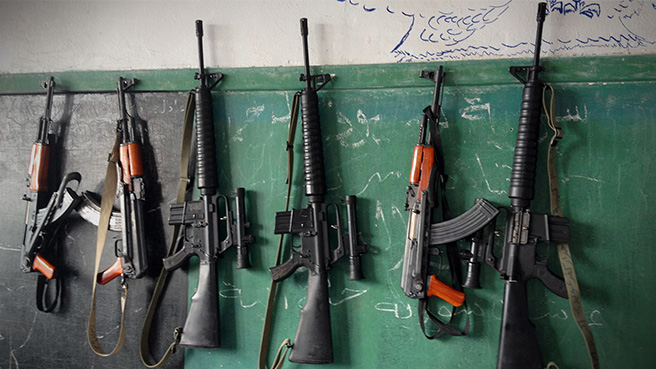
The Syrian Civil War continues to rage. Approximately 70,000 Syrians have already been killed and an estimated 4 million Syrians have fled their homes as refugees.

rebelarms

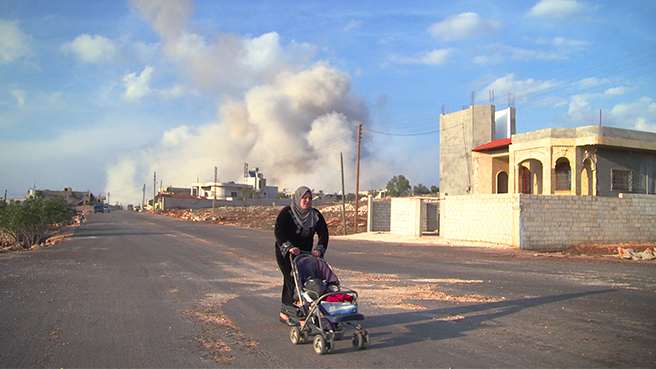
PBS’s Frontline recently aired a gripping documentary on “Syria Behind the Lines.” The documentary follows the lives of a Syrian Army lieutenant, rebel fighter, and  civilians in the Orontes river valley. The film reveals the sectarian and political motivations of the combatants and the brutality of the conflict. The filmmaker also shows the fragility of the life of refugee civilians caught in the midst of the fighting.

syria-bombing

Scholars and students studying civil violence and religious violence will find this documentary fascinating, but also disturbing.

NIU students in HIST 390 History and Film: War in Film will be particularly interested in this documentary film.

Posted in Civil Conflict, Civilians and Refugees in War, Gender and Warfare, History of Violence, Religious Violence, Revolts and Revolutions, War in Film, War, Culture, and Society | Leave a comment

Depardieu and French Film

Gérard Depardieu has significantly shaped international experiences of French film over the past generation. His recent departure from France has triggered a series of reflections on his impact on French cinema and French identity.

depardieu-police

Film critic Richard Brody argues that Depardieu “really does seem to bear on his shoulders the burden of French history, and it’s his very ability to signify something essentially French to the French that has both made him such a favorite actor among audiences and auteurs alike—and that’s why his planned fiscal self-exile has become such a big national affaire. But the public display of his frustrations, resentments, and pleasures is built on the superb work that he has done onscreen in movies that are enduring classics.”

Richard Brody offers a reflection on Depardieu’s significance in the New Yorker.

Posted in European History, European Union, French History, Historical Film | Leave a comment

I Quit: A Teacher’s Resignation

Another veteran history teacher has resigned.

In his letter of resignation, this high school teacher laments that “I am not leaving my profession, in truth, it has left me. It no longer exists.”

i-quit

Gerald J. Conti, a social studies teacher at Westhill High School in Syracuse, NY, for twenty-seven years, resigned recently. His letter of resignation is a condemnation of the hijacking of public education by political and business forces that are subverting its educational mission.

Conti writes that “to me, history has been so very much more than a mere job, it has truly been my life. … With regard to my profession, I have truly attempted to live John Dewey’s famous quotation (now likely cliché with me, I’ve used it so very often) that ‘Education is not preparation for life, education is life itself.'” Conti complains that “I now find that this approach to my profession is not only devalued, but denigrated and perhaps, in some quarters despised.”

What are the forces that are disrupting historical and social science education in public schools?  According to Conti: “STEM rules the day and ‘data driven’ education seeks only conformity, standardization, testing and a zombie-like adherence to the shallow and generic Common Core, along with a lockstep of oversimplified so-called Essential Learnings.”

As a result, Conti claims, “creativity, academic freedom, teacher autonomy, experimentation and innovation are being stifled in a misguided effort to fix what is not broken in our system of public education and particularly not at Westhill.”

The Washington Post published Conti’s letter of resignation. Thanks to artist Terry Swafford for sharing this link and alerting me to this story.

History majors and aspiring social science teachers should read Conti’s letter. While the letter may at first seem depressing to a future teacher, Conti’s letter can also be read as a call to action to protect humanities and social sciences in public education. As a former “normal school” and an important center for secondary education training, Northern Illinois University is closely involved in the transformations and trends in public education discussed by Conti in his resignation letter.

Posted in Careers in History, Education Policy, Humanities Education, The Past Alive: Teaching History, Undergraduate Work in History | Leave a comment

NIU Study Abroad Program in Southern France

Southern France – History and Literature in Bordeaux
IMG_1121
Register Now to Study Abroad in Southern France in Summer 2013!
Earn 6 credits in History and/or French!

Register at the Study Abroad Office
417 Williston Hall
Northern Illinois University

Registration is open for Northern Illinois University’s Study Abroad Program in Southern France, based in Bordeaux during Summer 2013.  Earn 6 credits in History and/or French Literature while experiencing Southern France!

PROGRAM OVERVIEW: This is the first year of a new collaborative study abroad program in France sponsored by the Northern Illinois University’s College of Liberal Arts and Sciences, Department of History, and Department of Foreign Languages and Literatures. The program is coordinated by NIU’s Study Abroad Office and the Division of International Programs. This program will include visits to historical and cultural sites in Bordeaux such as Cathedral Saint-André, the Grand Théâtre, the Palais de la Bourse, and Museum of Aquitaine. Participants will also make excursions in the surrounding region of Aquitaine to explore medieval castles, Renaissance châteaux, picturesque villages, and the vineyards of the Bordeaux wine country.

The program in History and Foreign Languages will be led by co-directors, professors Brian Sandberg (History) and Elizabeth Erbeznik (Foreign Languages and Literatures).

Undergraduate, Honors, and Graduate Credit is available for this Study Abroad Program.

The Program Description is available online at the NIU Study Abroad Office website.

Students may register for the program at the Study Abroad Office on campus at NIU. For further information on the program, please contact professors Elizabeth Erbeznik or Brian Sandberg (bsandberg@niu.edu) by email.

Posted in Early Modern Europe, European History, European Union, French History, Graduate Work in History, Languedoc and Southern France, Northern Illinois University, Study Abroad, Undergraduate Work in History | Leave a comment

New Digital Humanities Approaches

New digital humanities approaches are transforming the ways in which historians and other humanities scholars conduct research.

This spring, I am offering a series of workshops on “New Digital Humanities Approaches to Renaissance Studies: Manuscript Imaging and Research Outsourcing in the Florentine Archives using the Bía Platform” on behalf of the Medici Archive Project. The workshops offer a discussion of some of the new possibilities of digital humanities research through a demonstration of capabilities of the Medici Archive Project’s new Bía platform.

map-biaviewer

The Medici Archive Project describes the Bía platform on its website:

Over the past two years the IT team at the Medici Archive Project has been working on developing a new innovative digital platform, with generous support from the Andrew W. Mellon Foundation. At the 2012 Renaissance Society of America conference in Washington DC, MAP unveiled the new platform, which is called BIA. The name means “force” in in ancient Greek. We chose this name because we like to think it is representative of the power and strength that the digital humanities bring to scholarly research. white”>We also chose it because Bia was the name Cosimo I’s illegitimate daughter and the subject of one of Bronzino’s most beautiful portraits.

Now in the final stages of development, these are some of the most important elements of BIA:

  • Preservation of documents with digitized images online
  • Enhanced Research possibilities through outsourcing
  • Involving the world in scholarly discourse

The Bía platform thus offers humanities scholars working on subjects in the Renaissance and early modern periods of Italian, European, and World history a unique research tool.

The Medici Archive Project and the Mellon Foundation have asked former postdoctoral fellows with the Medici Archive Project, such as myself, to present a series of workshops across North America to showcase the possibilities of the Bía platform as a research tool and as a model for future digital humanities projects.

Workshops are being held at the Newberry Library in Chicago, the University of Michigan at Ann Arbor, the University of Wisconsin at Madison, and other midwestern universities.

A description of the workshop by the Office of Research Cyberinfrastructure at the University of Michigan shows the interest in this type of presentation for specialists in computing and internet applications, as well as humanities faculty and students.

If your research center or university is interested in hosting a digital humanities workshop, contact me at bsandberg@niu.

Posted in Archival Research, Current Research, Digital Humanities, History in the Media, Humanities Education, Information Management, Italian History, Renaissance Art and History | 2 Comments

Roger Ebert and the Art of Film Reviewing

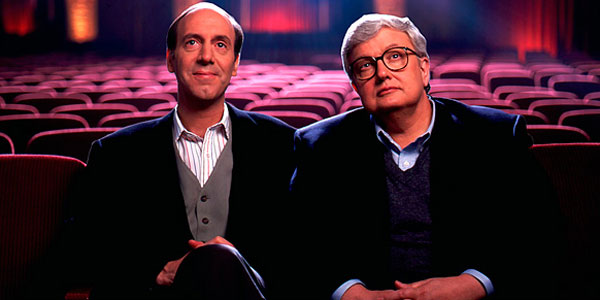
Pulitzer prize-winning film critic Roger Ebert has died following a battle with cancer. Ebert was the film critic for the Chicago Sun-Times for more than three decades, as well as co-host of the popular television show At the Movies.

Siskel-and-Ebert

Ebert got his start as a writer for the News-Gazette in Champaign-Urbana, then served as journalist and editor-in-chief of the Daily Illini while a student at University of Illinois at Urbana-Champaign in the 1960s.

A great promoter of journalism and film, Ebert later spearheaded a fundraising campaign for the Daily Illini and launched a film festival in Champaign-Urbana.

I write this post on a break from proofing my own latest book review. Although I primarily write reviews for academic journals, my own approaches to reviewing historical books and films certainly owes something to Siskel and Ebert’s film reviews.

Siskel and Ebert were sometimes criticized for simplifying their criticisms of films, especially with their trademarked thumbs up, thumbs down judgments. But, they often presented brilliant analysis and criticisms of the acting, characterization, enplotment, cinematography, and directing in independent and foreign-language films that were otherwise ignored by mainstream publications. And, refreshingly, the two critics’ analyses often diverged significantly.

Both Siskel and Ebert departed too soon, but they left behind an impressive legacy in the fields of film, criticism, and journalism.

NPR remembers Roger Ebert’s career and influence in film criticism. Chicago’s WBEZ aired a show celebrating Ebert’s life and has podcast it. The Gene Siskel Film Center in Chicago offers a remembrance of Ebert, who was Siskel’s long-time sparring partner and collaborator. The Daily Illini also provides a remembrance.

Roger Ebert delivered his own living testament on The 11th Hour on PBS. His own website at the Chicago Sun-Times provides information on all of Ebert’s journalism and activities.

Northern Illinois University students in HIST 390 History and Film may be interested in following the stories about Roger Ebert’s career as a film critic, as well as reading some of his reviews of historical films.

Posted in Academic Publishing, Historical Film, History in the Media, Humanities Education, Writing Methods | Leave a comment

Age of Christian Martyrs Questioned

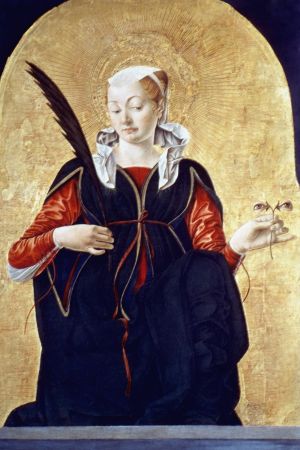
New research challenges the idea of an Age of Christian Martyrs during the early centuries of Christian expansion in the Mediterranean world.

Candida Moss, Professor of New Testament and Early Christianity at the University of Notre Dame explains: “For the first three hundred years of its existence, tradition maintains, Christianity was a persecuted and suffering religion. Members were hunted down and executed, their property and books burned by crusading emperors intent on routing out the new religion. Women and children were thrown to the lions and boiled alive in caldrons, as maddened crowds bayed for blood. Jesus, Stephen, and the Apostles were only the beginning.”

SaintLucy

Moss sketches out how the notion of an Age of Christian Martyrs coalesced. “As Christianity grew, so did the ranks of martyrs,” she states. “According to the fourth-century historian Eusebius, early Christians were racked, whipped, beaten, and scourged. Tens of thousands were condemned to the amphitheaters to face wild animals, forced to fight gladiators, beheaded, strangled quietly in jail, or burned publicly as a mark of shame.”

By the end of the Fourth Century CE, stories of numerous martyred saints were circulating in Christian texts throughout the Mediterranean.

“The history of early Christianity, as we have received it, is a history of victimization and pain,” Moss indicates. “It underwrites the idea that Christians are at odds with their world, engaged in a continuing struggle between good and evil.”

However, “that narrative has very little basis in the documentary record,” she argues. “There is almost no evidence from the period before Constantine, traditionally called the Age of Martyrs, to support the idea that Christians were continuously persecuted.”

The Chronicle of Higher Education has published an article by Candida Moss that appears to be an excerpt from her forthcoming book, The Myth of Persecution: How Early Christians Invented a Story of Martyrdom (Harper Collins).

NIU students in HIST 640 Religious Violence in Comparative Perspective will be interested in this article.

Posted in European History, Gender and Warfare, History in the Media, History of Violence, Mediterranean World, Religious History, Religious Violence | Leave a comment

Rachel Maddow on the Importance of History

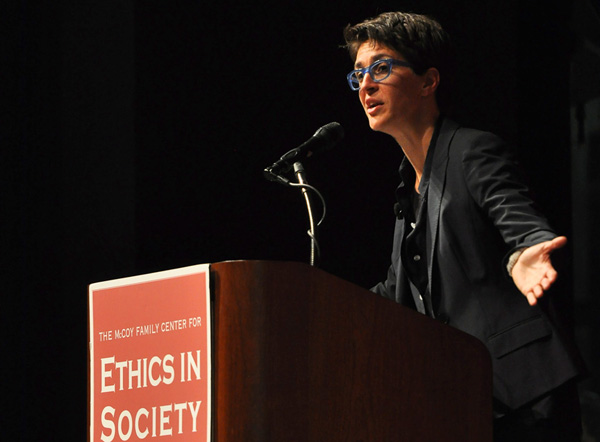
Rachel Maddow recently spoke at Stanford University. According to the Stanford Report, “Asked by students what kind of major she looks for in a successful job candidate, Rachel Maddow, the popular television host and best-selling author, did not hesitate in her answer.”

Maddow responded: “I look for people who have done mathematics. Philosophy. Languages. And really,” she emphasized, “History is kind of the king.”

maddow-stanford

It is certainly refreshing to hear a journalist and activist stressing the importance of History and the humanities in forming citizens—and job applicants—who can master argumentation and writing.

The Stanford Report indicates that only 9 percent of Stanford undergraduates currently choose a major in a humanities field, yet “Stanford alumna and MSNBC television host Rachel Maddow insists that an education in the humanities is a crucial asset in today’s job market, illustrating with her own story how the ability to make good arguments and write well powered her career in advocacy, activism and the national media.”

In making this argument, Maddow questions the stress that many politicians and business leaders place on technological education. Maddow states: “I need good writers rather than good web designers. And they are much harder to find.”

See the Stanford Report for the full story about Rachel Maddow’s on-campus visit. Stanford’s Center for Ethics in Society has posted video of Maddow’s talk on YouTube.


Posted in Careers in History, Digital Humanities, Education Policy, History in the Media, Humanities Education, Political Culture, Undergraduate Work in History | Leave a comment