Tulsi Gabbard (Director of National Intelligence) and John Ratcliffe (Director of the Central Intelligence Agency) testified yesterday to the Senate Intelligence Committee that there were no classified details in the text communications in the Signal group formed by Michael Waltz (National Security Advisor).
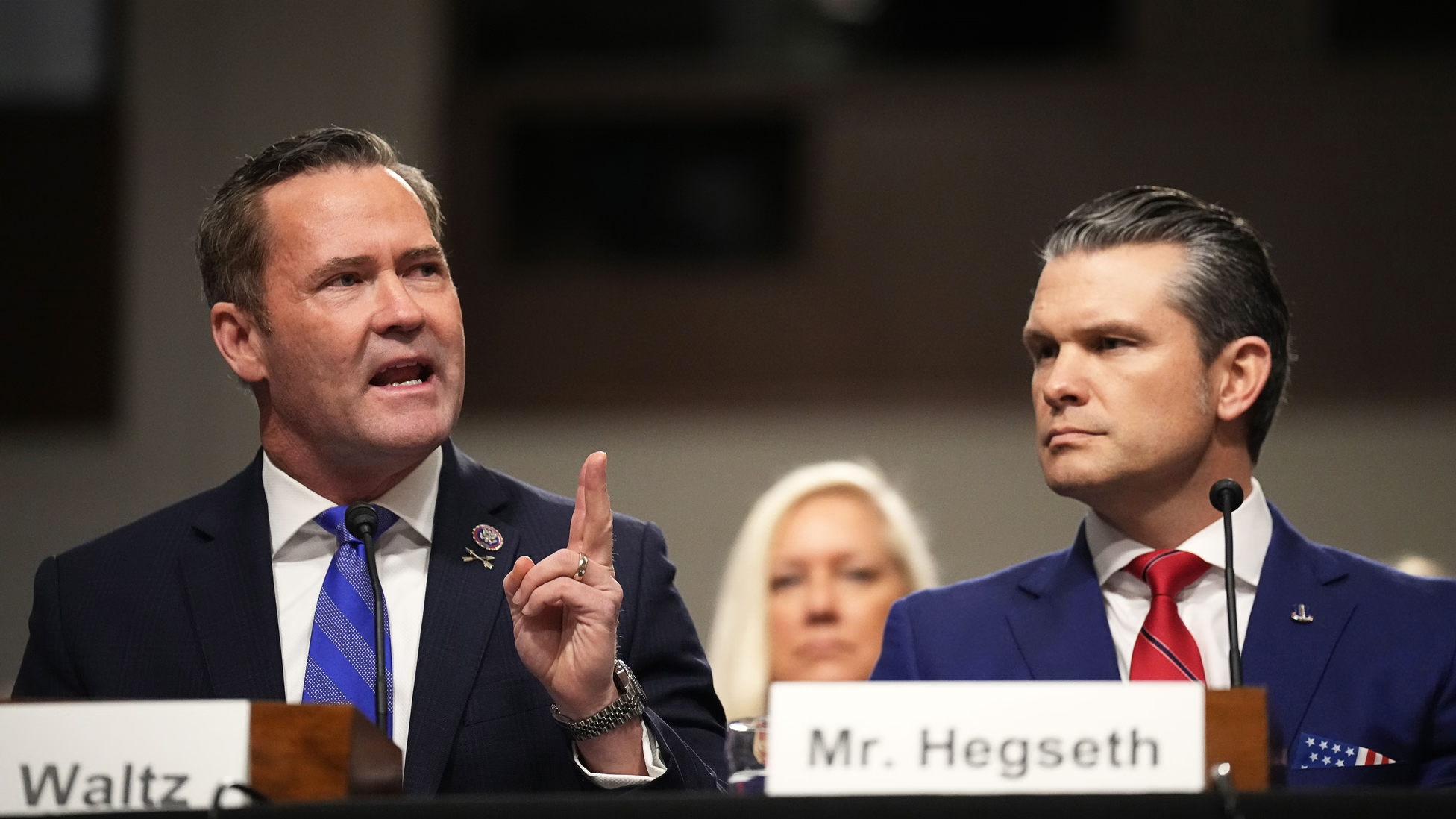
Pete Hegseth (Secretary of Defense) and other Trump administration officials who were involved in this Signal group claimed yesterday on national television that no classified information had been exchanged and that national security interests were not harmed. Hegseth claimed: “Nobody was texting war plans. And that’s all I have to say about that.”
Michael Waltz wrote in response on X: “No locations. No sources & methods. NO WAR PLANS. Foreign partners had already been notified that strikes were imminent. BOTTOM LINE: President Trump is protecting America and our interests.”
They lied.
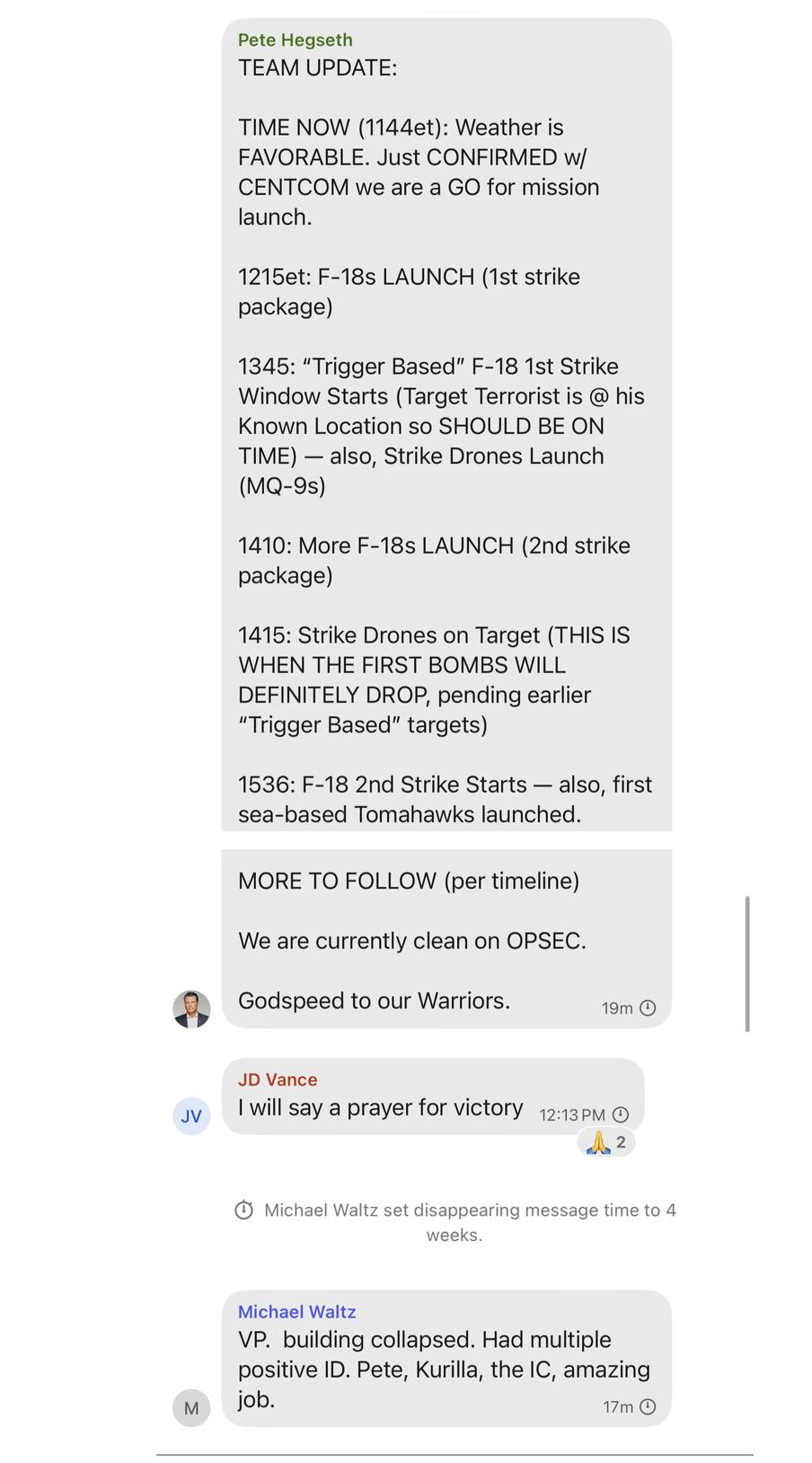
The Atlantic has now published additional texts from the Signal group that reveal the details of the military operations and tactics that senior Trump administration officials discussed via text messages on a commercial platform. Here is some key exchanges from the longer thread, as published by The Atlantic today:
Trump officials have absolutely no plausible deniability here. They openly discussed detailed attack plans via text messages with a journalist that they accidentally included in their Signal group. This reckless conduct exposed U.S. military operations in real time and undermined U.S. national security.
When Jeffrey Goldberg and The Atlantic revealed the Trump officials’ serious errors, many of them lied and attempted to discredit the journalist and his news magazine.
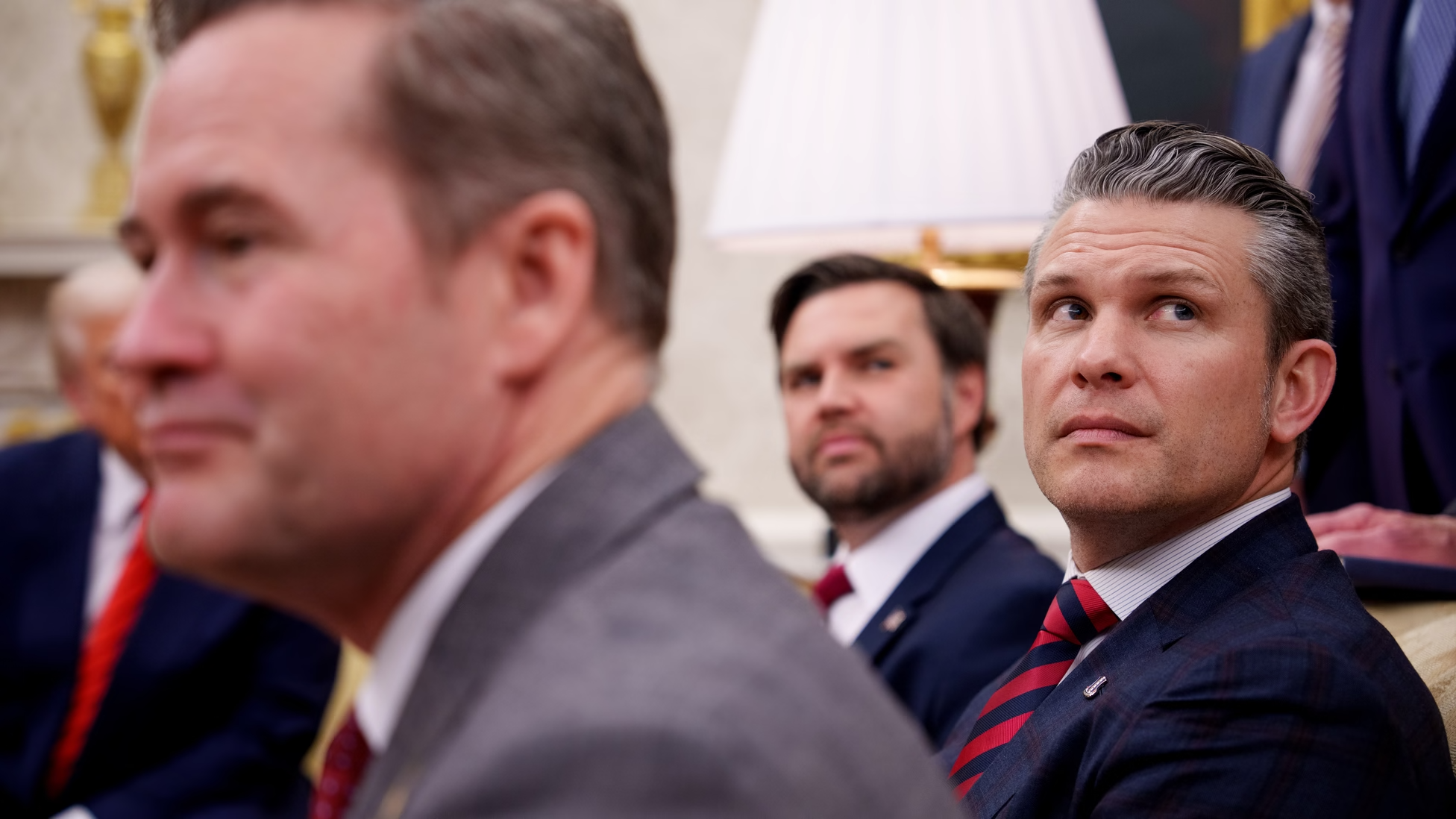
Michael Waltz, Pete Hegseth, and other Trump officials involved in the Signal group must now resign over their blatant recklessness in discussing military operations via text message on an unsecured platform.
They should also be investigated for potentially criminal conduct under the Espionage Act.
Tulsi Gabbard and John Ratcliffe who lied under oath to the Senate Intelligence Committee yesterday must also resign.
Historians of war and society are following the developing story on the breach of national security with dismay. This incident shows a serious erosion in civil-military relations and national security institutions within the United States.
As an academic historian of war and society and a longtime member of the Society for Military History, I deplore the reckless conduct of the National Security Advisor, Secretary of Defense, and other senior members of the Trump administration who clearly do not have sufficient experience or ethical responsibility to be involved in military policy discussions, much less leading military policy.
This post has been updated to include additional sources.
Goldberg, Jeffrey and Shane Harris. “Here Are the Attack Plans That Trump’s Advisers Shared on Signal.” The Atlantic (26 March 2025).
Bazail-Eimil, Eric. “The Atlantic Releases Screenshots of Timing, Weapons Used in Yemen War Plans Signal Chat.” Politico (26 March 2025).
“The Leaked Signal Chat, Annotated.” The New York Times (26 March 2025).
“President Trump has declared that this country’s leading universities are sites of ‘anti-American insanity.’ He has tried to cut their funding for scientific research. His administration has announced investigations into diversity programs and floated new taxes on university endowments. Brown and Columbia have had faculty members or former students detained and threatened with deportation. On Thursday the administration suspended $175 million of funding to the University of Pennsylvania over its policies on transgender athletes,” according an opinion essay published yesterday in The New York Times.
Charlie Eaton, Associate Professor of Sociology (University of California, Merced), comments that “fearing sanction or retribution, universities have begun to placate the administration, banning diversity statements in faculty hiring or weighing whether to strip trigger words like “diverse” from their hospital systems’ websites. In doing so, they risk abandoning their roles as centers of free speech and critical debate in the name of appeasement.”
Eaton argues that “top universities must instead exercise the financial independence afforded by their endowments, which are commonly valued in the tens of billions. Their leaders should collectively declare they will not suppress lawful free speech, diversity programs or campus research to appease any president. The wealthiest universities, in particular, must pledge to use all available endowment funds as a backstop for any federal funding cuts to research, educational programs or student financial aid at their schools, barring any donor restrictions. Endowments could even fund legal defense for students and scholars who are threatened with deportation.”
“Thus far, university presidents have largely kept their heads down instead of uniting to oppose Mr. Trump’s assault. That is a mistake. A key authoritarian strategy is to single out prominent individuals or institutions for repression so that others, afraid, forgo legitimate criticism of the authoritarian leader. Often universities are some of the first institutions that authoritarians attack. Make no mistake: The Trump administration’s punitive cuts to federal research grants and detention of university students or faculty members, couched in the president’s grievances over diversity programs and campus protests, are early signs of this strategy at work in America.”
State universities and liberal arts colleges often have small endowments, so they do not have the same ability to resist federal government threats and defend academic freedom.
So, Charlie Eaton is correct that elite private universities and flagship state universities need to play a leadership role for higher education institutions in resisting the many unconstitutional and illegal actions instigated by the Trump administration and the so-called DOGE team.
Eaton, Charlie. “$15 Billion Is Enough to Fight a President.” The New York Times (25 March 2025).
High-ranking Trump administration officials seem to have committed a severe breach of U.S. national security protocols by sharing United States military plans over an internet app. In doing so, they have potentially violated the Espionage Act.
Jeffrey Goldberg, Editor of The Atlantic, reports that “U.S. national-security leaders included me in a group chat about upcoming military strikes in Yemen. I didn’t think it could be real. Then the bombs started falling.”
Goldberg reports that he received a Signal contact request from someone claiming to be Michael Waltz, President Donald Trump’s National Security Adviser. This contact led to Goldberg’s inclusion in a Signal group in which included Vice President Vance, Defense Secretary Hegseth, Secretary of State Marco Rubio, Presidential Advisor Miller, and other national security officials in the Trump administration.
These high-ranking Trump administration members allegedly used this Signal group to discuss national security issues and detailed military plans to bomb the Houthis in Yeman, as well as the motives for, justification of, and timing of the attacks.
Goldberg indicates that “I have never seen a breach quite like this. It is not uncommon for national-security officials to communicate on Signal. But the app is used primarily for meeting planning and other logistical matters—not for detailed and highly confidential discussions of a pending military action. And, of course, I’ve never heard of an instance in which a journalist has been invited to such a discussion.”
“Conceivably, Waltz, by coordinating a national-security-related action over Signal, may have violated several provisions of the Espionage Act, which governs the handling of ‘national defense’ information, according to several national-security lawyers interviewed by my colleague Shane Harris for this story. Harris asked them to consider a hypothetical scenario in which a senior U.S. official creates a Signal thread for the express purpose of sharing information with Cabinet officials about an active military operation. He did not show them the actual Signal messages or tell them specifically what had occurred,” according to Goldberg.
“All of these lawyers said that a U.S. official should not establish a Signal thread in the first place. Information about an active operation would presumably fit the law’s definition of ‘national defense’ information, according to Goldberg. “The Signal app is not approved by the government for sharing classified information. The government has its own systems for that purpose. If officials want to discuss military activity, they should go into a specially designed space known as a sensitive compartmented information facility, or SCIF—most Cabinet-level national-security officials have one installed in their home—or communicate only on approved government equipment, the lawyers said. Normally, cellphones are not permitted inside a SCIF, which suggests that as these officials were sharing information about an active military operation, they could have been moving around in public. Had they lost their phones, or had they been stolen, the potential risk to national security would have been severe.”
Jeffrey Goldberg concludes that “Waltz and the other Cabinet-level officials were already potentially violating government policy and the law simply by texting one another about the operation. But when Waltz added a journalist—presumably by mistake—to his principals committee, he created new security and legal issues. Now the group was transmitting information to someone not authorized to receive it. That is the classic definition of a leak, even if it was unintentional, and even if the recipient of the leak did not actually believe it was a leak until Yemen came under American attack.”
This severe security breach clearly warrants both FBI investigation and Congressional hearings.
Historians of war and society and of U.S. national security issues will be following this developing story closely. I will be eager to see how professors and researchers in the Society for Military History respond to this news.
U.S. Representatives and Senators are now responding to the news of these shocking leaks.
“‘I am horrified by reports that our most senior national security officials, including the heads of multiple agencies, shared sensitive and almost certainly classified information via a commercial messaging application, including imminent war plans,’ Democratic Rep. Jim Himes of Connecticut, the ranking member on the House Intelligence Committee, said in a statement,” according to Foreign Policy.
“‘If true, these actions are a brazen violation of laws and regulations that exist to protect national security, including the safety of Americans serving in harm’s way,’ Himes added.”
“Himes emphasized the ‘calamitous risks of transmitting classified information across unclassified systems’ and said he intended to get answers from intelligence officials at a committee hearing scheduled for Wednesday.”
Foreign Policy reports that “Democratic Rep. Gregory Meeks of New York, the ranking member on the House Foreign Affairs Committee, in a statement called for an immediate hearing on ‘what might be the most astonishing breach of our national security in recent history, where top leadership from DOD, State, Treasury, the CIA and even the VP himself used a commercial messaging app—Signal—to communicate U.S. war plans, all the while unaware that a journalist was included in the group chat.'”
“Meeks said that Republicans have ‘regularly contrived security ‘scandals’ to attack their political opponents with years of nakedly partisan hearings and investigations,’ adding that the Trump administration ‘proves yet again that hypocrisy and cynical politics aren’t the only defining characteristics of today’s GOP; rank incompetence is front and center.'”
“Democratic Sen. Elizabeth Warren of Massachusetts, who sits on the Senate Armed Services Committee, in a post on X decried the administration’s reported actions as ‘blatantly illegal and dangerous beyond belief,'” according to Foreign Policy.
“‘Our national security is in the hands of complete amateurs,’ Warren wrote. ‘What other highly sensitive national security conversations are happening over group chat? Any other random people accidentally added to those, too?'”
Goldberg, Jeffrey. “The Trump Administration Accidentally Texted Me Its War Plans.” The Atlantic (24 March 2025).
Haltiwanger, John. “‘Horrified’: Trump Cabinet Accidentally Leaking War Plans Prompts Alarm in Washington.” Foreign Policy (24 March 2025).
Cooper, Helen and Eric Schmitt. “Hegseth Disclosed Secret War Plans in a Group Chat.” The New York Times (24 March 2025).
For broader context on the Red Sea situation, see:
I participated in the Renaissance Society of America Conference in Boston over the extended weekend.
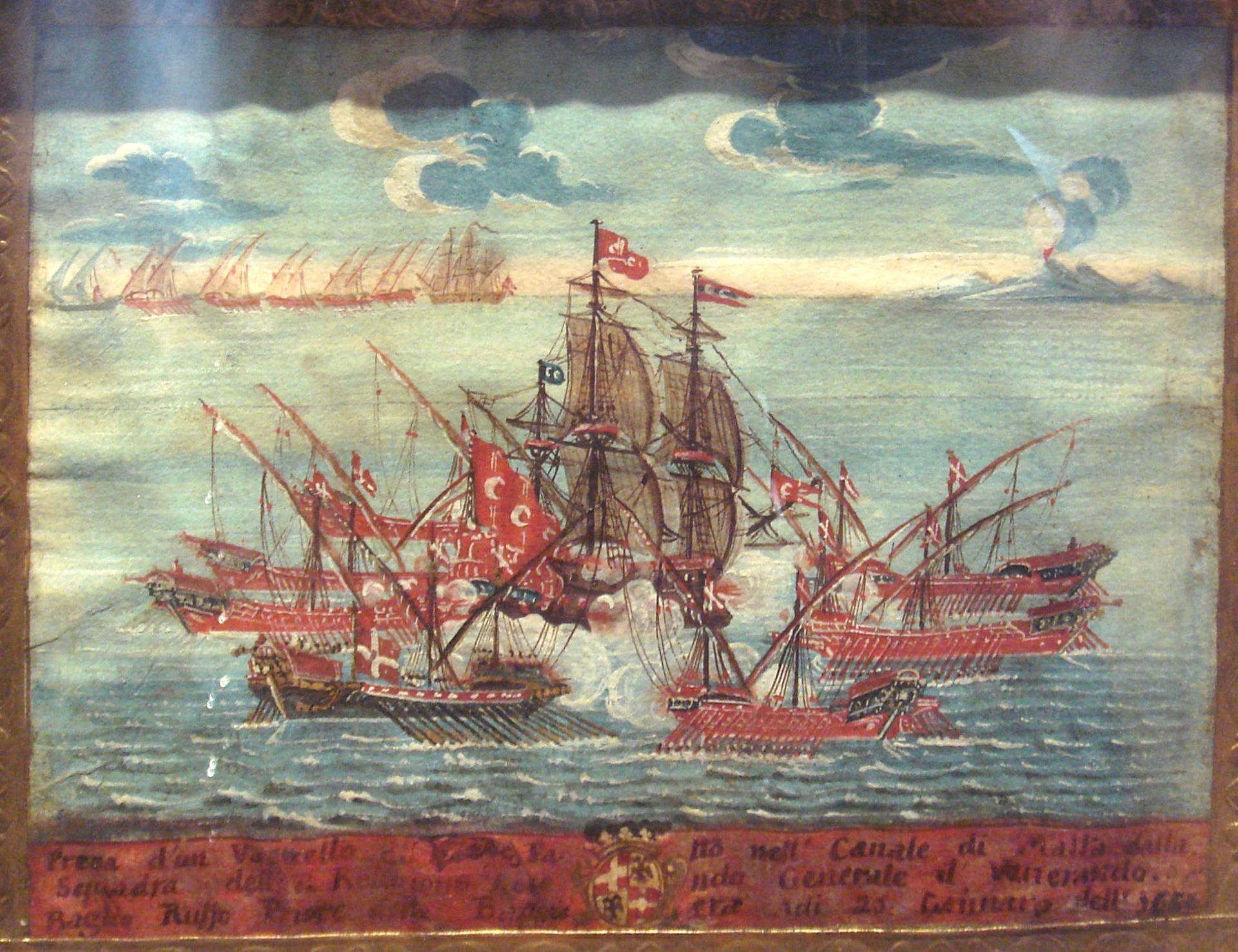
I enjoyed participating in a panel on “Piracy and Privateering in the Early Modern Mediterranean.”
I gave a paper on Marseille as a base for maritime violence and slave-taking in a Michael Martoccio (University of Wisconsin at Madison) presented his latest research on maritime violence in Genoa and the ceremonial, logistical, and legal aspects of the organization of the port facilities there. Ali Atabey (University of Texas at San Antonio) discussed Ottoman enslaved persons and their experiences of ransoming and reintegration (or not!) into Ottoman society. The panel was absolutely fascinating!
I also chaired a session on “Gender, Households, and Homicide in Europe, 1450-1700.” Mireille Juliette Pardon presented on complicity in Flemish homicide cases from the late fifteenth and early sixteenth centuries. Sara Beam’s paper focused on judicial violence and prosecution of homicide in sixteenth-century Geneva. Amanda Grace Madden offered a paper on gender and violence in domestic spaces in early modern Venice. The session was well attended and had a robust discussion.
I attended numerous panels at the conference and heard presentations of the latest research on Renaissance studies. I learned about Renaissance art, architecture, ceremonies, literature, theater, Medici princely rule, Niccolò Machiavelli’s model for militias, Michel de Montaigne’s essay writing, the ducal armory in Venice, Mediterranean slavery, maritime commerce and the circulation of goods, anatomical theaters, history of science, sensory perceptions, gardens, print culture, and other topics.
In addition, I got to see lots of Renaissance studies friends and colleagues over coffee breaks, lunches, receptions, and dinners.
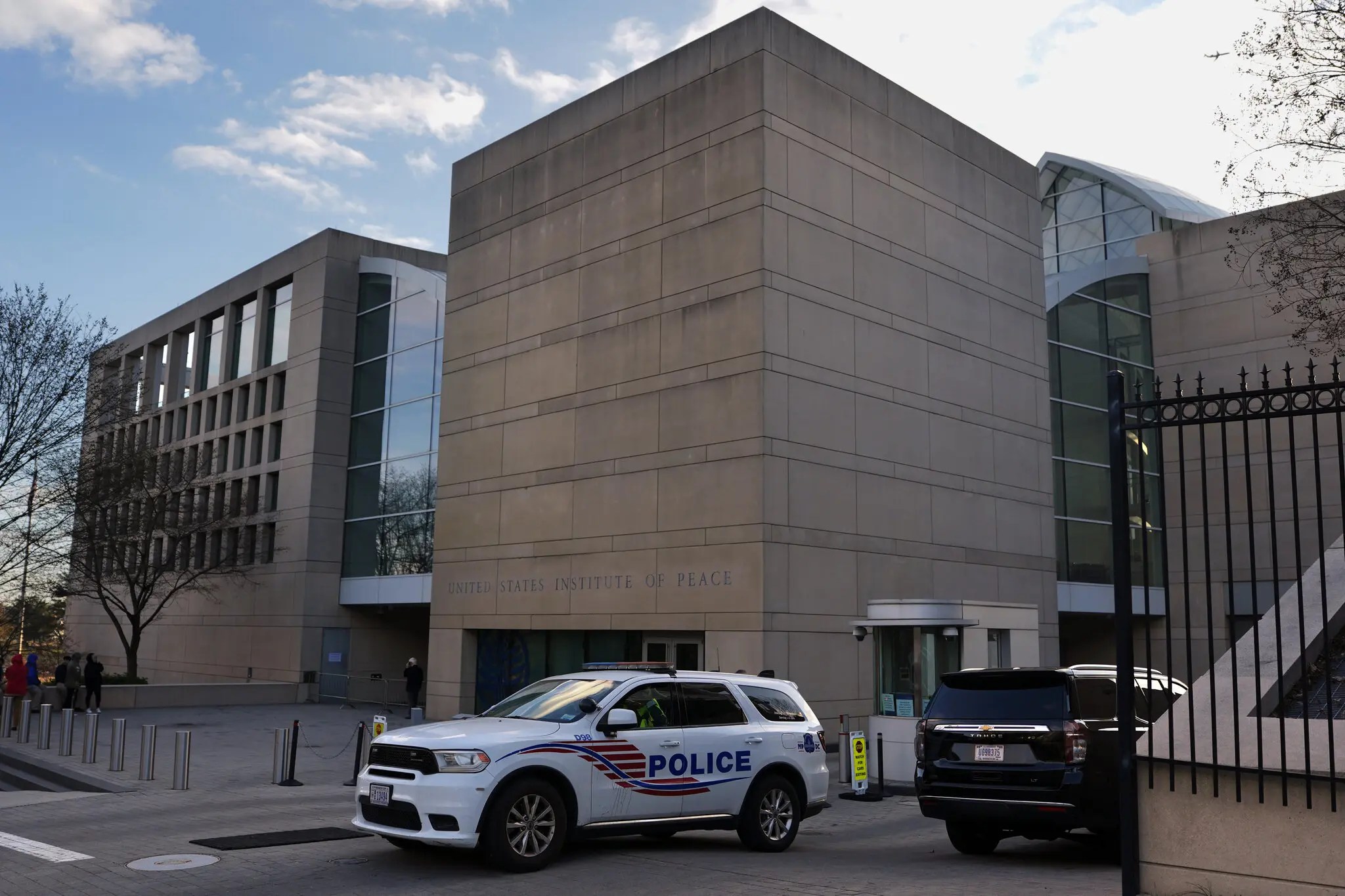
Elon Musk’s so-called DOGE unit has occupied the U.S. Institute of Peace, an independent research institute established by the United States Congress.
The U.S. Institute of Peace (USIP) is one of the leading non-profit research institutes for peace studies in the world.
When USIP leaders and staff denied DOGE entry to their building, DOGE called in Washington, D.C., Metropolitan Police to force their way into the institute’s building.
“For nearly five hours last Monday, Elon Musk’s government cost-cutting team joined with private security and with law enforcement authorities for an extraordinary showdown at an iconic building alongside the National Mall,” according to The New York Times.
“They were demanding access to the U.S. Institute of Peace. The group, a nonprofit created by Congress 41 years ago, supports diplomatic solutions to global conflicts, but on this day it became the hub of a bitter dispute with implications for U.S. constitutional law.”
The New York Times reports that “the confrontation stemmed from the White House’s decision this month to orchestrate the ouster of the institute’s president and top staff. When they refused to leave, a State Department official, alongside Mr. Musk’s team, the Department of Government Efficiency, moved to take control. By the end of the night, the office was occupied by new staff and a president backed by the Trump administration.”
NPR reports that a judge failed to reverse DOGE’s occupation of the U.S. Institute of Peace. Meanwhile, the United States Institute of Peace website has been taken down, presumably by DOGE.
As a historian of peace and conflict studies, I deplore the illegal and anti-constitutional occupation of the U.S. Institute of Peace.
Kavi, Aishvarya. “Showdown at the Institute of Peace.” The New York Times (24 March 2025).
Feng, Emily and Ryan Lucas. “Judge Declines to Immediately Reverse Trump moves at U.S. Institute of Peace.” NPR (19 March 2025).
“Doge Occupies US Institute of Peace Headquarters after White House Guts its Board.” The Guardian (17 March 2025).
The American Federation of Teachers (AFT), the American Association of University Professors (AAUP), and two public school districts in the state of Massachusetts have filed a lawsuit to block the Trump administration’s attempts to dismantle the Department of Education.
The United Faculty Alliance (UFA), my faculty union at Northern Illinois University, is affiliated with the AFT and the AAUP and I support their lawsuit.
“The Trump administration’s campaign to dismantle the Education Department drew a court challenge on Monday, as opponents called the plan an attempt to evade congressional authority.
“The lawsuit was filed in federal court in Massachusetts by the American Federation of Teachers, the American Association of University Professors and a pair of public school districts in Massachusetts. It comes four days after President Trump signed an executive order that directed the education secretary, Linda McMahon, to ‘take all necessary steps to facilitate the closure of the department.’
“The day after the order, Mr. Trump announced that the Small Business Administration would assume control of the government’s $1.6 trillion student loan portfolio, and that the Health and Human Services Department would oversee nutrition programs and special education services.
“The Education Department, created in 1979, cannot be closed without Congress’s consent. The lawsuit argues that moves by the Trump administration since it came to power in January, including an effort to roughly halve the department’s work force, ‘will interfere with the department’s ability to carry out its statutorily required functions.’
“Ilana Krepchin, chairwoman of the Somerville, Mass., school committee, which is a plaintiff in the case, said that the Education Department is a ‘cornerstone of equitable public education.’
“‘Dismantling it would cause real harm — not only to our students and schools, but to communities across the country,’ Ms. Krepchin said.”
Blinder, Alan and Michael C. Bender, “Trump Administration Is Sued Over Push to Shut Education Department.” The New York Times (24 March 2025).
For more information on the lawsuit, see the AFT and AAUP websites.
I participated in a workshop on Guerres de Religion et Changement Climatique (Religious Wars and Climate Change) at the IMéRA (Institute for Advanced Study) in Marseille, France, on 11 March 2025. This was a workshop that I co-organized with Jérémie Foa, Maître de conférences habilité à diriger des recherches (Aix-Marseille Université).
The conference went very well and we had great discussions of connections between climate change, disasters, social crises, and religious conflicts in France and Europe during the period of the Little Ice Age of the sixteenth and seventeenth centuries. Presentations focused on historical evidence of climate change, natural disasters, war zones, siege warfare, wolf populations, and recurrent plague epidemics. We also considered the plight of women and children as non-combatants and refugees during the religious wars.
Unfortunately, this is precisely the sort of research that is currently under attack by the Trump administration in the United States.
Climate history, environmental history, social history, cultural history, women’s history, gender history, migration history, and other forms of historical studies are being targeted for restricted funding or elimination by an administration that is using unconstitutional means to intervene in fundamental research and curricular programs at universities in the United States.
These interventions make clear that academic freedom, scientific research, and democratic education are under direct assault in the United States.
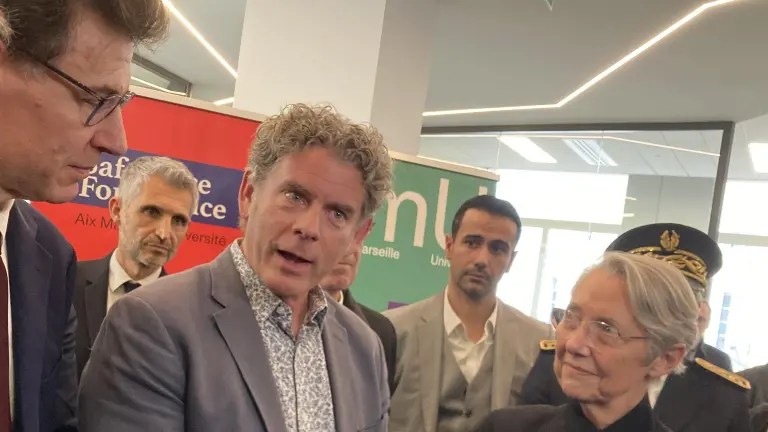
Following our workshop on Guerres de Religion et Changement Climatique, I was asked by the administrators of the IMéRA research institute to participate in a discussion of the state of higher education and research in the United States, held at the la Cité de l’Innovation et du Savoir Aix-Marseille (CISAM).
I had an opportunity to meet with Elisabeth Borne (Minister of Education) and Philippe Baptiste (Minister for Higher Education and Research), as well as the President of Aix-Marseille Université and the research administrative team of the university.
In the discussions at CISAM, I offered the perspective of an American professor and researcher who has engaged in sustained research collaborations with French researchers and universities. I spoke for myself as a professor and researcher, but I provided context on the situation of professors, postdocs, graduate students, undergraduate students in History and the Humanities during the press conference and following interviews.
The discussion at CISAM was held in part because Aix-Marseille Université has just launched a Safe Place for Science initiative to recruit scientists from the United States to join French laboratories and research teams in Marseille.
Aix-Marseille Université indicates the goals for this initiative: “At a time when academic freedom is sometimes called into question, Aix-Marseille Université is launching the Safe Place For Science program, offering a safe and stimulating environment for scientists wishing to pursue their research in complete freedom. In a context where some scientists in the United States may feel threatened or hindered in their research, our university is announcing the launch of the Safe Place For Science program, dedicated to welcoming scientists wishing to pursue their work in an environment conducive to innovation, excellence and academic freedom. As a major player in European research, Aix-Marseille University offers cutting-edge infrastructures, major international collaborations and strong support for scientists working on groundbreaking, forward-looking themes. The AMIDEX foundation will support the funding of research positions, particularly in the fields of climate, environment, health and human and social sciences (SHS).”
I also participated in several interviews during my research trip to Marseille, including with Chloé Leprince, a reporter with France Culture, and with a documentary film-making team.
The website for the Guerres de Religion et Changement Climatique (Religious Wars and Climate Change) workshop is at the IMéRA (Institute for Advanced Study) in Marseille, France.
Elziere, Loïs. « Trump menace la science : des dizaines de chercheurs américains postulent à Marseille ». Made in Marseille (14 March 2025).
Laferté, Colombe. « “La souveraineté, ce n’est pas que la défense, c’est aussi la recherche ” assure Elisabeth Borne ». La Tribune (13 March 2025).
Leprince, Chloé. « Recherche aux États-Unis : “Même des mots comme ‘historique’ ou ‘socio-économique’ sont rayés” ». L’Info de France Culture (15 March 2025).
Vanderheyden, François-Samuel. « Une attaque sans précédent contre la recherche et l’éducation ». La Marseillaise (14 March 2025).
Jérémie Foa (Maître de conférences habilité à diriger des recherches à Aix-Marseille Université) and I are co-organizing a workshop on Guerres de Religion et Changement Climatique at the IMéRA in Marseille, France, on 11 mars 2025.
Jérémie Foa has definitely taken the lead in organizing this workshop, but I am very pleased to have been involved in ongoing discussions to develop this line of research. I look forward to presenting new historical research at the workshop and to building research collaboration on the religious wars and climate change in the early modern period.
Guerres de Religion et Changement Climatique
“Si les guerres de religion françaises (1562-1598), sont bien connues des chercheurs, on sait moins en revanche que les contemporains de ces événements dramatiques ont connu un changement climatique soudain : en quelques années, au milieu des années 1560, le climat s’est brusquement refroidi, avec l’apogée du « petit âge glaciaire ». Aux hivers rigoureux succèdent des étés maussades, entraînant famines, pestes et effondrements de population.
“À travers des études de cas sur les loups, le siège de la Rochelle ou encore la peste, l’enjeu de cette journée d’études sera de considérer les guerres de religion comme une crise globale, et pas seulement politico-religieuse. Quels ont été les effets des désordres environnementaux sur les enjeux politiques, et réciproquement ? Comment les contemporains se sont-ils adaptés à ces changements, comment ont-ils vécu et interprété le gel soudain des rivières, l’inondation de leurs villages, les assauts répétés des loups ?”
11 mars 2025 – Salle de conférence de la Maison des Astronomes, IMéRA, Marseille
9h30 : Zoé Esclavissat-Lopez (amU, TELEMMe) : « La malice du temps continuant si longtemps : France et Angleterre face aux troubles environnementaux et religieux (1560-1588) ».
10h30 : Ariane Godbout (UQaM) : « Une histoire environnementale du grand siège de La Rochelle (1627-1628) ».
11h30 : Brian Sandberg (Northern Illinois Univ) : « ‘La misère de ce temps’ : Souffrir de privation et de la famine pendant les dernières guerres de Religion (1588-1629) ».
Pause déjeuner
14h : Jean-Marc Moriceau (Université de Caen Normandie) : « Entre l’homme et le sauvage : l’apogée des attaques de loups (1560-1610) ? ».
15h : Jérémie Foa (amU, TELEMMe) : «La peste au temps des guerres de Religion »
For more information, see the workshop webpage at the IMéRA website.
“As Mr. Trump admonished President Volodymyr Zelensky and warned him that ‘you don’t have the cards’ to deal with President Vladimir V. Putin of Russia, and as Vice President JD Vance dressed down the Ukrainian leader as being ‘disrespectful’ and ungrateful, it was clear that the three-year wartime partnership between Washington and Kyiv was shattered,” according to The New York Times.
“But the larger truth is that the venomous exchanges — broadcast not only to an astounded audience of Americans and Europeans who had never seen such open attacks on each other, but to Mr. Putin and his Kremlin aides — made evident that Mr. Trump regards Ukraine as an obstacle to what he sees as a far more vital project.”
David E. Sanger emphasizes that “What Mr. Trump really wants, one senior European official said this week before the blowup, is a normalization of the relationship with Russia. If that means rewriting the history of Moscow’s illegal invasion three years ago, dropping investigations of Russian war crimes or refusing to offer Ukraine long-lasting security guarantees, then Mr. Trump, in this assessment of his intentions, is willing to make that deal. …”
Sanger assesses President Trump’s radical changes in the direction of U.S. foreign policy: “Mr. Trump makes no secret of his view that the post-World War II system, created by Washington, ate away at American power.”
“Above all else, that system prized relationships with allies committed to democratic capitalism, even maintaining those alliances that came with a cost to American consumers. It was a system that sought to avoid power grabs by making the observance of international law, and respect for established international boundaries, a goal unto itself.”
“To Mr. Trump, such a system gave smaller and less powerful countries leverage over the United States, leaving Americans to pick up far too much of the tab for defending allies and promoting their prosperity.”
Many news analysts have been debating whether the blowup in the Oval Office was spontaneous, partially prepared, or completely orchestrated by Trump and Vance.
Tom Nichols, Professor Emeritus of National-Security Affairs (U.S. Naval War College), argues that: “All of the ghastliness inflicted on Zelensky today should not obscure the geopolitical reality of what just happened: The president of the United States ambushed a loyal ally, presumably so that he can soon make a deal with the dictator of Russia to sell out a European nation fighting for its very existence.”
Nichols concludes that “today’s meeting and America’s shameful vote in the United Nations on Monday confirmed that the United States is now aligned with Russia and against Ukraine, Europe, and most of the planet. I felt physically sick watching the president of the United States yell at a brave ally, fulminating in the Oval Office as if he were an addled old man shaking his fist at a television. Zelensky has endured tragedies, and risked his life, in ways that men such as Trump and Vance cannot imagine. (Vance served as a public-relations officer in the most powerful military in the world; he has never had to huddle in a bunker during a Russian bombardment.) I am ashamed for my nation; even if Congress acts to support and aid Ukraine, it cannot restore the American honor lost today.”
In the aftermath of the press conference, President Trump has complained that Zelensky should have been more deferential to him, saying “I just think he should be more appreciative.”
President Trump indeed seems to have planned the ambush in the Oval Office precisely in order to prepare a complete abandonment of Ukraine and a realignment with Putin’s Russia.
And, Trump has now completely suspended U.S. military aid to Ukraine.
Green, Erica L., Eric Schmitt, David E. Sanger, and Julian E. Barnes. “Trump Suspends Military Aid to Ukraine After Oval Office Blowup.” The New York Times (3 March 2025).
Nichols, Tom. “It Was an Ambush.” The Atlantic (28 February 2025).
Sanger, David E. “Behind the Collision: Trump Jettisons Ukraine on His Way to a Larger Goal.” The New York Times (28 February 2025).
For international coverage, see:
“Donald Trump gèle brutalement l’aide militaire à l’Ukraine pour soumettre Volodymyr Zelensky à sa volonté.” Le Monde (3 March 2025).
Starcevic, Sev. “Trump and Zelenskyy’s White House clash a ‘deliberate escalation’ by US, says Germany’s Merz.” Politico.eu (3 March 2025).
“Trump Halts Military Aid to Ukraine.” Politico.eu (3 March 2025).
The University of Glasgow is hosting a History International Summer School during Summer 2025.
History students at Northern Illinois University interested in the Glasgow program or other study abroad programs should contact me via email.
Here is the announcement from the University of Glasgow:
It is a six week, credit bearing, programme where undergraduate students complete a personal research project associated with a list of topics which changes every year.
Students who successfully complete the summer school will be eligible for an alumni discount for postgraduate study at Glasgow.
This year we have a range of courses relating to Poland, Russia, Byzantium, Britain / Scotland, Slavery Studies, Medieval Queenship, Animal Studies.
A Collective Biography of Scotland in the First World War
Britain’s Toy Soldiers: Representations of War and Conflict
‘A New System of Slavery’? Unfree Labour after Abolition in the British Empire
The Reports of the Protectors of Slaves: Enslaved Life in British Guiana, 1819-1834
A Person-centred Approach to Examining Slavery in the British Caribbean.
When Scots Returned from India: Wealth, Race and Cultural Strategies, 1757-1820
Russian Autocracy: Ideology and Praxis, 1682-1906
Golden Liberty: Polish Political Thought from 1385 to 1795, and Beyond
Human and Animal Relationships in Early Modern Scotland, c.1500-1700
Witch Trials and the Belief in Witchcraft in Early Modern England and Scotland
Echoes of Empire: Byzantine Culture and the Palaeologan Renaissance, 1261-1453
Gender and Politics in Medieval England: Three Generations of Political Turmoil
Medieval London and Queenship: The Cartulary of the Priory of Holy Trinity Aldgate
Full details and descriptions can be found at the link below (dropdown menu “Research Projects 2025”).
Please note, early applications are encouraged. We will try to accommodate as many people as possible but places are limited and will be allocated on a first-come first-serve basis. If demand exceeds capacity, a waiting list will be created.








 Brian Sandberg: Historical Perspectives