France Loses AAA Credit Rating

France has lost its AAA credit rating as Standard & Poor’s cut its rating a notch to AA+.

Eleanor Beardsley of NPR reports that “Standard & Poor’s downgraded the sovereign debt of France, Italy, Spain and six other European countries on Friday. The move was highly expected, but it’s still a blow to France and sending shock waves across Europe. France is the eurozone’s second-largest economy, and its downgrade could even threaten Europe’s master plan to stop its debt crisis.”

The credit rating downgrade is expected to play a role in the French 2012 Presidential Election, but President Nicolas Sarkozy is trying to spin the news to strengthen his campaign’s position.

NPR provides coverage online.

Posted in European Union, French History, Political Culture | Leave a comment

New Diplomatic History and Neorealism

Historians of the “new” Diplomatic History tend to clash with Political Science approaches to International Relations, and especially with Neorealists—who often depict states as “billiard balls” acting against each other on a global pool table.

Paul W. Schroeder, a prominent historian of the Habsburg Empire and European international relations, has heavily criticized Neorealism’s problematic vision of “great power politics” and structural anarchy.  Other “new” diplomatic historians stress the importance of the cultural and social production of information and diplomatic activity.  Diplomacy, they argue, must be understood through its gendered, religious-inflected, and culturally-bound languages, texts, and practices.

Yet, Neorealists forge ahead with their theories of “pure” nation-state politics, assuming that internal political and social changes are irrelevant.  Neorealists largely believe that non-state actors (within, beyond, or between states) have no real influence on global diplomacy.

A recent Atlantic article by Robert D. Kaplan reassesses the legacy of one of the most important lines of Neorealist international relations theory: that of John J. Mearsheimer, Professor of Political Science at the University of Chicago. Mearsheimer has been heavily criticized in the media over the past year or so, in response to his co-authored book on the “Israel Lobby,” but Kaplan focuses instead on Mearsheimer’s broader international relations work in this piece.  Kaplan largely praises Mearsheimer’s theories in an uncritical article that lacks serious analysis of Mearsheimer’s arguments or his detractors’ serious criticisms.

Nonetheless, historians of diplomacy will be interested in this piece and its attempt to bolster Mearsheimer’s reputation and establish his legacy in international relations.

Posted in European History, Globalization, Political Culture, State Development Theory, War, Culture, and Society | Tagged , , | Leave a comment

Anti-French Attitudes and American Politics

French historians and literary scholars are all too aware of the anti-French attitudes in American society.  Anti-French references have long been rife in American popular culture, but took on new virulence in the wake of Franco-German opposition to the Bush administration’s plan to invade Iraq in 2003.  References to “Old Europe”, “freedom fries”, and “cheese-eating surrender monkeys” became mainstays of American humor during the Iraq War, as American politicians and journalists fueled Anti-French sentiments. Opponents of John Kerry attacked his supposed Frenchness during the 2004 United States Presidential Election, perhaps contributing to his defeat.

Anti-French attacks are back again in the current Republican Primaries. A new political ad entitled “The French Connection” produced by Newt Gingrich’s campaign compares Mitt Romney to John Kerry on the basis of their alleged Frenchness. According to the BBC, “Correspondents say the highlighting of Mr Romney’s alleged French-language skills is an attempt to portray him as an elitist, European-style liberal wimp.”

The BBC reports on the Gingrich ad and anti-French attitudes.  The BBC story also has a link to the Gingrich ad, which condemns Romney’s Frenchness by asserting: “He speaks French, too.”

There are, of course, deep historical roots for anti-French attitudes in American popular and political culture.  Despite their common experiences of Revolution, their shared histories of the “Sister Republics”, and their strong alliance through two World Wars, France and the United States have repeatedly clashed over political and cultural issues.  Legacies of Anglo-French rivalry, French defeat in the Seven Years’ War, French intervention in the American War of Independence, the postwar status of Loyalists, and the creation of a bilingual Canada produced anti-French sentiment that was revived in the Quasi-War and the broader Napoleonic Wars.  The Indochina War, French withdrawal from NATO, and the Vietnam War all created serious tensions between France and the United States in the 1950s and 1960s.  Competing cultural trends and models of democracy have led Americans and French people to be wary of their perceived rivals. Richard Pell, Richard Kuisel, Jean-Philippe Mathy, and other historians have investigated the long history of the complex Franco-American relationship.

Posted in Comparative Revolutions, French History, History in the Media, Political Culture | Leave a comment

Negotiating Peace in Afghanistan

There have been numerous reports of United States diplomatic discussions with the Taliban to negotiate an end to the Afghan War. Almost all wars end with negotiated settlements, so U.S. negotiations with the Taliban are hardly surprising.

But, as the specter of the Vietnam War has hung over the waging of the Afghan War, memories of the U.S.-North Vietnamese negotiations in the early 1970s are informing the negotiating process in Afghanistan.

James Dobbins, an analyst who previously served as a United States envoy to Afghanistan, now openly frames negotiations for an end to the Afghan War in terms of avoiding repeating the end of the Vietnam War. Dobbins’s new book, Afghan Peace Talks: A Primer, examines the peace process in Afghanistan.  I have not yet had a chance to read the book, but hope to get a copy of it soon.

Dobbins provides a summary of his book’s arguments in a Washington Post op-ed.

Posted in Civil Conflict, History in the Media, History of Violence, War, Culture, and Society | Leave a comment

Archivists, Historians, and the “Archival Divide”

Archivists and historians sometimes seem to be operating across an “archival divide”, with differing understandings of documentary collections and highly divergent agendas for those collections. Historians who have worked in archives in foreign nations will be acutely aware of the “culture shock” of working in archives with state officials, nationalist historiographies, and patrimonial agendas.  The presumed divisions between archivists and historians can seem all too real to history graduate students struggling with language and bureaucratic barriers while working in distant archival collections.

The American Historical Association (AHA) Annual Meeting in Chicago, which just concluded, included a session entitled Archivists, Historians, and the Future of
Authority in the Archives, that dealt precisely with the “archival divide” issue.  I was unfortunately unable to attend the panel due to my other commitments at the conference.

Luckily, Kate Theimer, one of the participants, posted her written comments on her Archives Next blog.

Archivists’ perspectives are important for graduate students to consider as they train to work in historical archives and as they consider avenues of professional development in the broader discipline of history. I would encourage my graduate students in History at Northern Illinois University to read some studies written by archivists in their own research subfields to gain an appreciation of archivists’ goals and approaches to documentary collections and archival studies.

Posted in Archival Research, Conferences, Graduate Work in History, Humanities Education | Leave a comment

New Directions in Graduate Teaching

One of the issues to emerge from the run-up to this year’s American Historical Association (AHA) Annual Meeting, which concluded last weekend in Chicago, is the need for reform in graduate training in history and the humanities.

Successive articles by outgoing AHA President Anthony Grafton and by AHA Executive Director Jim Grossman, including one co-written piece, have argued that historians need to prepare graduate students for public history and non-history jobs, in addition to research and teaching positions.  These calls for reform provoked quite a debate in the blogosphere before the AHA and several sessions at the conference deepened the discussion.

An article in Chronicle of Higher Education outlines the current state of the debate over new directions in graduate teaching in history.


Posted in Conferences, Graduate Work in History, Humanities Education | Leave a comment

Turning a Dissertation into a Book

American Historical Association (AHA) conferences usually include practical sessions on professional development issues, which are intended to assist graduate students and junior faculty members in becoming productive historians.  One of the most useful of these sessions is always the panel on turning a dissertation into a book.

This year’s AHA had a dissertation-to-book panel including: Aaron W. Marrs (Office of the Historian, U.S. Department of State), Timothy J. Gilfoyle (Loyola University Chicago) , Laurie Matheson (University of Illinois Press), Thomas J. Sugrue, (University of Pennsylvania), and D. Bradford Hunt (Roosevelt University).

I was unable to participate in this particular session, but it was clearly well attended.  For more information, see the AHA Today story on the panel.

Posted in Academic Publishing, Conferences, Graduate Work in History, Writing Methods | Leave a comment

Article Prize in European History

The Council for European Studies (CES) seeks nominations for its inaugural European Studies First Article Prize. The First Article Prize honors the writers of the best first articles on European studies published within a two-year period and will be awarded to two scholars, one working in the humanities and one in the social sciences.

A multi-disciplinary First Article Prize Committee appointed by the Council’s Executive Committee will choose the winner. Each prize winner will receive $500 and public recognition in Council publications and on our website.

Deadlines:
The submission period is open now and ends February 15, 2012. Nominees will be notified of the Committee’s decision no later than May 15, 2012.

Eligibility:
Each nominated article must meet the following criteria:
– Be the first article published by the nominee in the field of European Studies in a peer-reviewed journal;
– Be published between January 1, 2010 and December 31, 2011;
– Be the work of one author only or be an article on which the nominee is the first author;
– Be authored by a member of the Council for European Studies or a faculty/student of an institution that is a member.

Nominations may be submitted by the publisher, editor, author, or an admiring colleague, and must be accompanied by a nomination form and digital copy of the article. Paper submissions will not be accepted.

To nominate a title for the CES First Article Prize, complete the CES First Article Prize Nomination form here: http://www.councilforeuropeanstudies.org/grants-and-awards/first-article-prize/74

For more information about the prize and more details about the Committee’s definitions of “humanities” and “social sciences,” visit
http://www.councilforeuropeanstudies.org/grants-and-awards/first-article-prize.

If you have any questions about this prize or the Council, please contact ces@columbia.edu.

Corey Fabian Borenstein
Council for European Studies
Columbia University
420 West 118th Street, MC 3307
New York, NY 10027
Email: ces@columbia.edu

Visit the website at http://www.councilforeuropeanstudies.org/grants-and-awards/first-article-prize

Posted in Academic Publishing, European History, Graduate Work in History, Grants and Fellowships | Leave a comment

AHA 2012

The gargantuan American Historical Association (AHA) 2012 conference has now wrapped up, and numerous journalists and historians are providing assessments of the conference and the state of the discipline of history. An estimated 4,700 historians (including professors, instructors, public historians, and graduate students) attended the conference in Chicago last week.

The AHA Today website, History News Network, Chronicle of Higher Education, WGN, and Chicago Tribune all provide coverage of AHA 2012. An article in the New York Times reported on a session dealing with archives and government secrecy in the United States.

I would especially point to an article by Jennifer Howard in the Chronicle of Higher Education and an article by Ron Grossman in the Chicago Tribune, which also features a rare photo of ongoing interviews in the “job pit” at AHA:

Many universities and colleges hold their candidate interviews in hotel suites to avoid the cramped environment and general din of the “job pit”, but the suites are more expensive and some university administrators refuse to pay for better interviewing spaces. I was pleased that Northern Illinois University was able to conduct candidate interviews for all three of its searches in suites rather than in the “job pit”.

The AHA conference included numerous panels on new research, teaching techniques, digital humanities, and professional issues. I chaired a panel on “Creating Communities through Coercion in Seventeenth-Century France,” with presentations by Elizabeth Churchich, Jim Coons, and John McCormack. The session was well attended and the presentations provoked an excellent discussion with interventions by Orest Ranum, Jonathan Dewald, and others.  I was only able to make it to one other panel this year: “New Frontiers in the Environmental History of the Renaissance,” a fascinating session on environmental history in early modern Italy, Spain, and England.

The Book Exhibit is always a highlight of an AHA conference, allowing graduate students and professors to see the new books out in their research and teaching fields. Advanced dissertators and assistant professors often seek out editors from university presses at the Book Exhibit, hoping to attract interest in their book manuscripts. Instructors and professors browse the presses’ displays, considering books for adoption in their courses.

AHA is also somewhat of a class reunion for professors, who attend receptions hosted by specialized historical associations and universities.  I was able to attend the reception of the Society for Italian Historical Studies on Saturday evening to see some of my Italianist friends and colleagues from Firenze.  I also saw many of my peers from the graduate program of University of Illinois at Urbana-Champaign, where I did my doctoral work.

I was glad to see that a number of graduate students from Northern Illinois University were able to attend the AHA and get a glimpse into the inner workings of the historical profession.

Posted in Conferences, Graduate Work in History, History in the Media, Humanities Education, Renaissance Art and History | 1 Comment

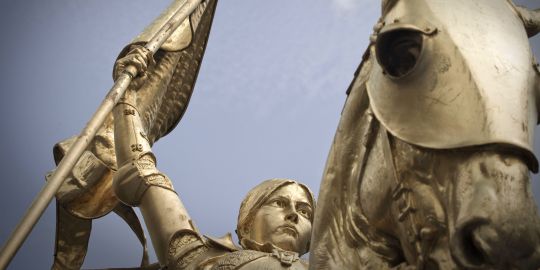
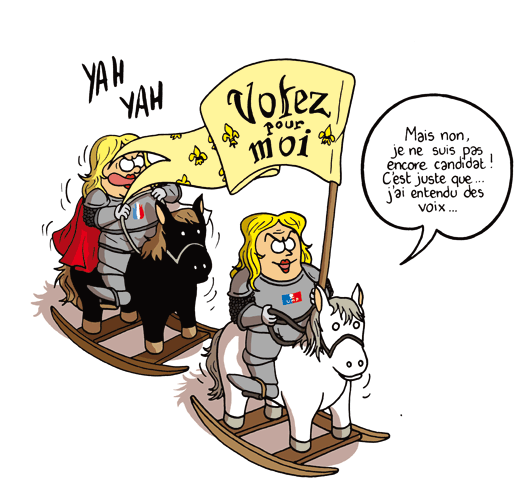
Contested Figure of Jeanne d’Arc

The image and historical legacy of Jeanne d’Arc (Joan of Arc) continues to be highly contested in France.  The 2012 Presidential Election in France is now fueling a new round of debates about the figure of Jeanne d’Arc and the place that the “maid of Orléans” should occupy in French history. Conservative Catholics and Front National politicians have long claimed Jeanne d’Arc as a devout and nationalist leader of France. Other social and political groups have also tried to claim to represent the legacy of Jeanne d’Arc.

Jeanne d’Arc provides an important model of gender and violence in French history. The religious dimensions of Jeanne d’Arc’s political agenda and military campaigns make her case significant for students of comparative religious violence and civil warfare.

Le Monde reports on current uses of the image of Jeanne d’Arc by French politicians, historians, and popular writers during the 2012 elections so far.  [Follow sidebar links for related articles on politicians’ use of Jeanne d’Arc.]

Posted in Civil Conflict, French History, Gender and Warfare, Political Culture, Religious Violence, Women and Gender History | Leave a comment