U.S. Army Releases Iraq War Study

The United States Army has released its highly anticipated study of the Iraq War (2003-2011), entitled The U.S. Army in the Iraq War (2 vols.) (United States Army War College Press, 2019).

This internal U.S. Army study was commissioned by the former Army Chief of Staff, General Ray Odierno in 2013 and authored by a team of U.S. Army colonels and lieutenant colonels.

A draft of the study was apparently completed two years ago in 2016. The draft study reportedly includes criticism of policymakers and commanders, generating controversy and delaying the study’s release.

The lengthy study has now been released, along with numerous declassified documents that were used in analyzing Iraq War strategies, operations, and tactics.

The U.S. Army in the Iraq War is organized into two volumes: Volume 1: Invasion, Insurgency, Civil War (2003-2006) and Volume 2. Surge and Withdrawal (2007-2011).

The United States Army War College has posted The U.S. Army in the Iraq War (2 vols.) in its entirety on its official Publications website.

The Wall Street Journal reports on the release of the study.

Students in HIST 384 History of War since 1500 at Northern Illinois University may be interested in exploring this study.

Posted in Civil Conflict, History of Violence, War and Society, War, Culture, and Society | Leave a comment

The World of the Siege

A new volume on The World of the Siege: Representations of Early Modern Positional Warfare will soon be published by Brill in its History of Warfare series.

This collective volume is edited by Anke Fischer-Kattner and Jamel Ostwald and includes diverse essays on early modern siege warfare. The volume grew out of a fascinating conference organized by Anke Fischer-Kattner at Duke University in 2014 on The World of the Siege. I participated in the conference and contributed a chapter on “‘The Enterprises and Surprises that They Would Like to Perform’: Fear, Urban Identities, and Siege Culture during the French Wars of Religion,” to the collective volume.


The World of the Siege examines relations between the conduct and representations of early modern sieges. The volume offers case studies from various regions in Europe (England, France, the Low Countries, Germany, the Balkans) and throughout the world (the Chinese, Ottoman and Mughal Empires), from the 15th century into the 18th. The
international contributors analyse how siege narratives were created and disseminated, and how early modern actors as well as later historians made sense of these violent events in both textual and visual artefacts. The volume’s chronological and geographical breadth
provides insight into similarities and differences of siege warfare and military culture across several cultures, countries and centuries, as well as its impact on both military combatants and civilian observers.”

The book description is available on the Brill website and the book is listed on Brill’s History of Warfare series site.

Posted in Civil Conflict, Civilians and Refugees in War, Early Modern Europe, Early Modern World, European History, History of Violence, Reformation History, Renaissance Art and History, War and Society, War, Culture, and Society, Warfare in the Early Modern World | Leave a comment

Generous Amazons Article in Spanish

I am excited to see that my “Generous Amazons” article on besieged women in the French Wars of Religion is now available in Spanish!

Antonio Escobar Tortosa has kindly translated the article and Revista Universitaria de Historia Militar (RUHM) has published the Spanish translation in its latest issue.

The full citation is: “‘Generosas amazonas acudieron a la brecha’: mujerees sitiadas, agencia y sujeción durante las Guerras de Religión en Francia,” Revista Universitaria de Historia Militar 7: 15 (2018): 213-245. The translation is available at the RHUM website.

The article was originally published in English in a special issue of the journal Gender & History: Brian Sandberg, “‘Generous Amazons Came to the Breach’: Besieged Women, Agency and Subjectivity during the French Wars of Religion”, Gender & History, 16:3 (2004), pp. 654-688. The special issue was later published as a collective volume on Violence, Vulnerability and Embodiment: Gender and History, ed. Shani D’Cruze and Anupama Rao.

Posted in Civil Conflict, Civilians and Refugees in War, Early Modern Europe, European History, European Wars of Religion, French History, French Wars of Religion, Gender and Warfare, History of Violence, Religious Violence, War and Society, War, Culture, and Society, Warfare in the Early Modern World | Leave a comment

The Antichrist and Apocalyptic Thinking Today

Apocalyptic thinking is alive and well in today’s world. The Patriarch of the Russian Orthodox Church has ignited controversy by prognosticating that the Antichrist will use the internet to gain control of humanity.

The BBC reports on the Patriarch’s apocalyptic thinking. “Speaking to Russian state TV, Patriarch Kirill said smartphone users should be careful when using the ‘worldwide web of gadgets’ because it represented ‘an opportunity to gain global control over mankind.'”

Image: Getty Images

The Patriarch claimed that “The Antichrist is the person who will be at the head of the worldwide web, controlling all of humankind.”

The Patriarch continued: “Every time you use your gadget, whether you like it or not, whether you turn on your location or not, somebody can find out exactly where you are, exactly what your interests are and exactly what you are scared of.”

Processes of secularization are relatively weak in many regions and the entire secularization narrative has been challenged over the past several decades.

Although news media have focused heavily on religious violence in the Muslim world in the 2000s and 2010s, we should remember that religious conflicts have arguably intensified since the 1990s. The breakup of Yugoslavia and the Bosnia War fueled religious violence, ethnic cleansing, and massacres.

The resurgence of Orthodox religiosity in areas of the former Soviet Union following the Fall of the Berlin Wall has encouraged new forms of religious politics in Russia, Ukraine, and Central Asia.

Religious politics is also contributing to the conflict between Ukraine and Russia and schism in Orthodox Christianity. The BBC reports that “On Saturday, the Orthodox Church of Ukraine split from the Russian Church following centuries of Russian leadership, formalising a decision announced in October. The move sparked a furious response in Moscow and deepened a split in the world wide Orthodox Church.”

Undergraduate students in my course on European Wars of Religion, 1520s-1660s, consider apocalyptic thinking through Andrew Cunningham and Ole Peter Grell’s Four Horsemen of the Apocalypse and articles on radical preaching and prognostication in early modern Europe.

Posted in Early Modern Europe, Early Modern World, Empires and Imperialism, European Wars of Religion, History of Violence, Religious History, Religious Politics, Religious Violence, War, Culture, and Society | Leave a comment

Religion, Politics, and Violence in Early Modern France at the ASCH 2019

Historians discussed religion, politics, and violence in early modern France at the American Society of Church History (ASCH) conference in Chicago this weekend.

The ASCH promotes the academic study of the history of Christianity and is one of the affiliated societies of the American Historical Association. The conference often hosts sessions on the history of Protestant and Catholic Reformations of the sixteenth century.

I was pleased to chair a session at the ASCH on “Failures of Religious Dialogue in Early Modern France.” John McCormack presented research on the Colloque of Poissy during the French Wars of Religion and Xavier Maréchaux offered a paper on refractory clergy during the French Revolution. The discussion developed around clergy, religious politics, and church-state relations in early modern France.

The conference program is available at the ASCH 2019 conference website.

Posted in Conferences, Early Modern Europe, European History, European Wars of Religion, French History, French Revolution and Napoleon, French Wars of Religion, Political Culture, Reformation History, Religious History, Religious Politics, Religious Violence | Leave a comment

American Historical Association Annual Meeting in Chicago

The American Historical Association 2019 Annual Meeting wrapped up yesterday.

Historians from across the United States (and beyond) met for four days in Chicago to discuss new research, graduate education, undergraduate education, professional concerns, and public history.


I attended sessions on French, Caribbean, Mediterranean, and Global history, learning about historical research. One of the highlights of the conference was Lauren Benton’s Toynbee Prize Lecture on “Law and Conquest in World History,” sponsored by the Toynbee Foundation.

I enjoyed meeting with numerous friends and colleagues in early modern history, historical publishing, and digital humanities. Many of my faculty and graduate student colleagues from Northern Illinois University were able to participate in the conference and I was able to reconnect with old friends at the reception hosted by the Department of History at the University of Illinois at Urbana-Champaign, my doctoral alma mater.

I was able to spend some time in the AHA book exhibit, examining potential course adoptions and gauging current trends in historical publishing.

Each year, the American Historical Association (AHA) organizes a series of sessions to provide historical perspectives on contemporary issues. Some of the current issues that historians considered this weekend included refugees, migration,  populist politics, and gender issues. Historian Rachel Van Bokkem provides a summary of a plenary session on displaced persons on AHA Perspectives.  Another panel on gender history at the conference is assessed elsewhere on AHA Perspectives.

Many professors and graduate students at AHA were discussing the state of the discipline and concerns about the recent nationwide decline in History majors. Liz Lehfeldt, my friend and early modernist colleague, responds to this discussion with an essay on “Why Study History?” in Inside Higher Ed.

Although academic job interviews are moving increasingly to video phone interviews at this point, some interviews are still held at the AHA. There are also numerous professional sessions at the AHA on the CV construction, interviewing skills, and professionalization issues, and the state of the job market in History. The Chronicle of Higher Education reports on the job market in the humanities fields, based on sessions at the AHA and the MLA last week.

This conference seems to have attracted fewer blog and twitter posts than previous conferences, perhaps due to the end of the AHA Today blog, which ceased activity in Summer 2018 and has been replaced by AHA Perspectives Daily. The twitter traffic can be found at hashtags #AHA19 and #AHA2019.

Posted in Careers in History, Conferences, Digital Humanities, Graduate Work in History, Historiography and Social Theory, Humanities Education | 1 Comment

First World War Soldiers in Color

Peter Jackson’s They Shall Not Grow Old has been released in the United States, with screenings in selected cities this month. I was lucky to get to view the film yesterday in Chicago and want to offer some initial responses here.
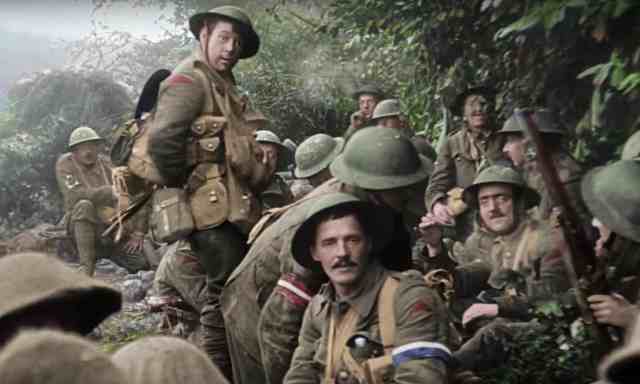
The New York Times states that “The documentary, which will screen nationwide Dec. 17 and Dec. 27, concentrates on the experiences of British soldiers as revealed in footage from the archives of the Imperial War Museum. Jackson and his team have digitally restored the footage, adjusted its frame rate, colorized it and converted it to 3-D. They chose not to add a host or title cards. Instead, veterans of the war ‘narrate’ — that is, the filmmakers culled their commentary from hundreds of hours of BBC interviews recorded in the 1960s and ’70s. The result is a transformation that is nothing less than visually astonishing.”
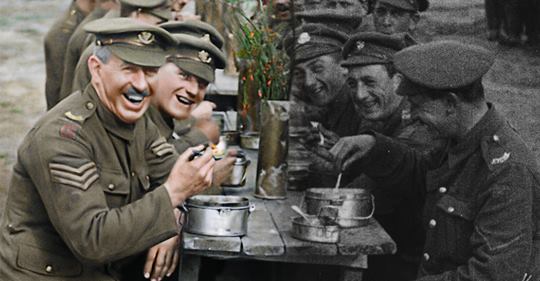
The restored film definitely offers amazing visuals! Jackson edited many of the original shots, zooming in for close-ups and panning for more active motion of the subjects. Jackson’s team colorized much of the footage, especially for scenes of soldiers’ life in the trenches on the Western Front. However, I often found the restored black-and-white film segments more effective than the colorized ones.
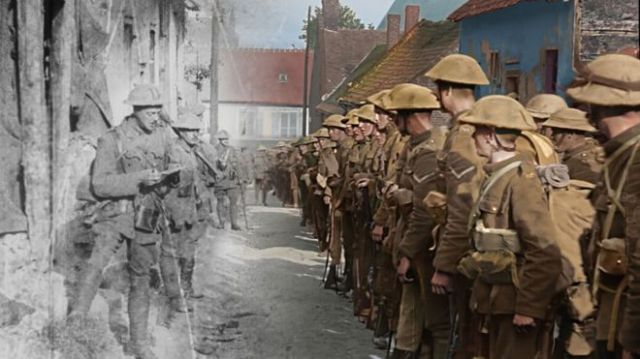
I saw the film in 3-D and found that aspect done well (not overdone). The “reconstructed” sounds are impressive and visceral, but will also be controversial.

Alice Kelly (Harmsworth Postdoctoral Fellow, University of Oxford) has reviewed the film for The Conversation, and I agree with her assessment: “What the reviews or the film’s billing don’t discuss is the implicit fictionalisation or ethics of Jackson’s method. Obviously all documentaries are fictionalised to some extent – created through editorial selections that have biases, both explicit and implicit. But I don’t think we should even be calling this a documentary; it’s really an artwork or a fictionalised feature film. ”

The film’s narrative is nonexistent, simply a mishmash of British front-line soldiers’ experiences on the Western Front, drawn mostly from BBC interviews with First World War veterans taped during the 1960s. Jackson’s “reconstruction” of the First World War focuses rather myopically on British experiences of trench warfare in Flanders in 1916, but extrapolated to encapsulate the entirety of the war. This creates a rather ahistorical approach to the First World War, reifying British mythologies of the Lost Generation.

In interviews, Peter Jackson has acknowledged leaving out British Imperial, French, Belgian, German, Austrian, Ottoman, Italian, Russian, Balkan, American, and colonial perspectives. The film concentrates exclusively on one section of the Western Front, excluding all other theaters of war. It is jarring to see First World War British soldiers (and some German prisoners-of-war) in color, and yet no “colored” soldiers here at all.

Jackson seems to dismiss concerns that his film largely ignores the home front, colonial forces, government propaganda, wartime politics, military industry, women and gender issues, non-combatants, disease, shell shock conditions, and post-war suffering.

Jackson’s reconstruction of the Western Front in the First World War, draws heavily on the British newsreal/propaganda film, Battle of the Somme (1916) and its outtakes. The British Topical Committee for War Film, a film production company sponsored by the War Office, sent film crews to the Western Front and other locations to film the British war effort during the First World War. Edited films such as Battle of the Somme were screened at movie cinemas in the United Kingdom during the war.
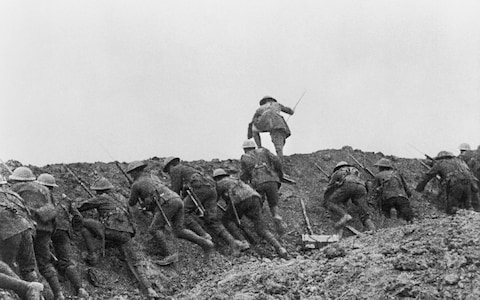
The film uses contemporary recruitment posters effectively to illustrate the excitement of soldiers’ wartime experiences, but the combat scenes rely too heavily on problematic propaganda drawings from War Illustrated magazine.

The New York Times reports on Peter Jackson’s They Shall Not Grow Old.

Alice Kelly’s review, entitled “They Shall Not Grow Old: World War I Film a Masterpiece of Skill and Artistry – Just Don’t Call it a Documentary,” is published by The Conversation (5 November 2018).

The Imperial War Museums website provides streaming access to the film, Battle of the Somme(1916).

Posted in Historical Film, History in the Media, History of Violence, War and Society, War in Film, War, Culture, and Society | Leave a comment

Frank Valadez AHA Spotlight

Frank Valadez, my friend and fellow UIUC graduate History alum, is featured in an American Historical Association spotlight today!

Frank is an amazingly flexible history thinker and practitioner who currently serves as  Director of the Division for Public Education at the American Bar Association. He pursued undergraduate studies in History at Northwestern University and then received an MA in History from the University of Illinois at Urbana-Champaign.

Graduate students in History will be interested in the broad range of positions that Frank has held as writer, editor, and educator. He has served in administrative and leadership roles in historical and humanities organizations such as the Newberry Library, Chicago Public Schools, and the Chicago Metro History Fair. Frank’s career trajectory demonstrates how historians can make a real difference in historical education and public humanities.
Frank’s spotlight is featured on the AHA Persectives website.

Posted in Careers in History, Education Policy, History in the Media, Humanities Education, The Past Alive: Teaching History | Leave a comment

Promoting Diversity in Undergraduate Admissions

Educational Evaluation and Policy Analysis has published an article presenting new research on diversity in undergraduate admissions.

The article considers the State of Texas’s 10 percent plan, which provides guaranteed admissions into state universities for the top 10 percent of high school graduates in the state. “For the study, Kalena E. Cortes, an associate professor of public policy at Texas A&M University, and Jane Arnold Lincove, an associate professor of public policy at the University of Maryland Baltimore County, looked at the records of 146,000 Texas public high school students who graduated in spring 2008 and spring 2009 and who applied to at least one four-year public university in Texas,” according to Inside Higher Ed.

The study finds that “the Texas 10 percent plan, one of the most prominent experiments in guaranteed admissions, made high-talent, low-income students more likely than they historically have been to apply to the flagship universities in Texas.”

Inside Higher Ed emphasizes that the study’s findings demonstrate that flagship state universities, such as the University of Texas at Austin and Texas A&M University, are able to attract more minority and underprivileged students with the 10 percent plan than they previously did. “So guaranteed admissions, the paper argues, can reduce the problem of ‘undermatching,’ in which talented, disadvantaged students apply to few if any competitive colleges — even though in many cases they would be admitted and awarded aid. Given the better graduation rates and (in many cases) significantly greater resources available at the more competitive colleges, many education experts see undermatching as a major problem.”

State universities with declining enrollments may wish to consider adopted guaranteed admission plans such as this to encourage high school graduates in economically distressed areas to apply for university admission. Private universities that have tried other plans for diversifying enrollments may also find the 10 percent plan an effective alternative approach.

The article by Cortes and Licove appears in Educational Evaluation and Policy Analysis. The American Education Resesarch Association (AREA) summarizes the study’s findings at its website. Inside Higher Ed reports on the study and the Texas 10 percent plan.

Posted in Education Policy, Humanities Education | Leave a comment

Femmes à la cour de France. Charges et fonctions, XVe-XIXe siècle

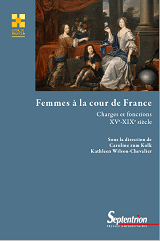
Femmes à la cour de France. Charges et fonctions (XVe – XIXe siècle), ed. Caroline zum Kolk, Kathleen Wilson-Chevalier (Villeneuve d’Ascq, Septentrion, 2018), ISBN-102757423614, has been released.

This collective volume on women at the royal court of France in the early modern period includes interdisciplinary studies in English and French languages on noblewomen and their households, their official and family roles, women and court politics, motherhood and parenting, mistresses and sexuality, and gender and court culture.

I contributed an essay on “« Je ne vis jamais cette cour plus pleine de tourment » : Montmorency Women and Confessional Politics at Court during the French Wars of Religion,” to the volume.

This collective volume is an outgrowth of an engaging conference on Femmes à la cour de France – charges et fonctions (Moyen Âge – XIXe siècle) that was organized by Caroline zum Kolk, Kathleen Wilson-Chevalier, Flavie Leroux, and Pauline Ferrier-Viaud, and held at the Institut d’Études Avancées de Paris in October 2015.

Scholars working on early modern women, gender, and sexuality will be interested in this volume, as will historians of the French court and early modern France.

Posted in Court Studies, Cultural History, Early Modern Europe, European History, European Wars of Religion, French History, French Wars of Religion, Noble Culture and History of Elites, Reformation History, Renaissance Art and History, Women and Gender History | Leave a comment