Summer Program in Early Modern Digital Humanities

A summer program in early modern digital humanities is being offered by the Folger Shakespeare Library.

“Following on the success of the first “Early Modern Digital Agendas” institute—an intensive survey of the most current resources and methods in digital research to be found in July 2013—”Advanced Topics” is a second three-week NEH institute to be hosted by the Folger Institute at the Folger Shakespeare Library. Jonathan Hope, Professor of Literary Linguistics at the University of Strathclyde, will direct an advanced exploration of data creation and management to be followed by various forms of hands-on investigation, including text analytics, social network analysis, dimensionality reduction, research process design, and even historical reflection on the nature of “exemplarity” claims in humanistic argument.

“The “Early Modern Digital Agendas: Advanced Topics” Institute will meet from 15 June through 1 July 2015, and admitted participants are expected to be in residence for the entire time. It will convene a technically advanced cohort of fifteen early modern digital humanists for scholarly assessment of the most effective tools by which data sets are gathered, curated, and analyzed. EMDA2015 will build in more time than its predecessor for application and experimentation with the tools to which its participants will be introduced; it will also encourage participants to bring their own data and, as often as is practical, process that data for analysis with the tools that the visiting faculty introduce. Details about the Institute’s curriculum are available.

“Participants will reflect on the ways DH expands the universe of possible questions that literary scholars can ask while new technologies produce exponentially larger bodies of evidence faster than ever before. Among the questions visiting faculty will pose and consider with the participants: What is “data”? What transformations lie behind statistical analysis? How is corpus-wide variation being treated? What are the principles of visualization? The aim is to enable participants not just to perform analysis, or curate data, but to understand the processes they engage in—where they enable, how they restrict, and how they might be improved. It remains the Folger’s goal to ensure that DH practitioners question not only what is possible with digital tools, but why one would put them to certain uses, and at what costs.”

For more information, see the Folger website for EMDA 2015.

Posted in Cultural History, Digital Humanities, Early Modern Europe, Early Modern World, European History, Graduate Work in History, Grants and Fellowships, History of the Book, Humanities Education, Information Management, Renaissance Art and History | Leave a comment

ReligioWest Research Program

briansandberg's avatarCluster for the Study of Religious Violence

The ReligioWest research program, based at the European University Institute, pursues research on issues of religious pluralism, secularism, religion and the law, religion in the political sphere, and religious violence.

The ReligioWest website indicates: “ReligioWest studies how different western states in Europe and North America are redefining their relationship with religions under the challenge  of increasing religious activism in the public sphere due to new religious movements and Islam. Although each country starts from very different and specific contexts of the relationship between state, religion and public sphere, this move seems to lead to a more uniform perception of what the relationship should be.”

For more information, see the ReligioWest page at the website of the European University Institute in Florence, Italy.

Graduate students working on devotional activism, sacred politics, religious conflict, and sectarian violence will be interested in this research project.

View original post

Posted in Uncategorized | Leave a comment

Fear and Racism in Film

Racism seems to feed on intense fears, portraying ethnic groups as representing an exaggerated threat to social order, employment, and family life.

For over a hundred years, films have played an important role in the construction of racial stereotypes, the expression of collective fears, and the articulation of racial politics.

A new BBC article considers how D.W. Griffith’s The Birth of a Nation altered racial politics in early twentieth-century society in the United States. This highly controversial film was much debated on its release and has become a classic case in film studies. The Birth of a Nation draws on well-established tropes of nineteenth-century racist politics, Southern historiography, and chivalric literature to present a powerful, shocking vision of racial conflict.

BirthofaNation-poster

The BBC article adds little to the scholarly work that has already been done on The Birth of a Nation. But, undergraduate students working on American history, European history, history of racism, and history of violence might find this article to be an interesting introduction to the film’s legacy.

The BBC article is available online.


Posted in Cultural History, European History, Historical Film, History of Violence, Human Rights, Noble Culture and History of Elites, Political Culture, Religious Politics, Religious Violence, War in Film, War, Culture, and Society | Leave a comment

Masters Program in Mediterranean Studies

There is a new call for applications to the Masters Program in Mediterranean Studies at NYU.  Here is the announcement:

The Center for European and Mediterranean Studies (CEMS) at New York University is pleased to announce a call for applications to its Masters in European and Mediterranean Studies program. Please forward this to any students you might think are interested.

Applications for Fall 2015 are being accepted and reviewed on a rolling basis. Applicants who apply before April 1, 2015 are eligible to receive significant financial aid packages to fund their studies. It is recommended to apply as soon as possible, as funds are limited.

The Master’s in European and Mediterranean Studies is an interdisciplinary program in the social sciences and humanities that is designed to prepare students for professions in the public, non-profit, or private sectors requiring an advanced understanding of Europe and the Mediterranean region. Our graduates also go on to pursue Ph.D. studies in history, political science, international relations, international development, and a range of other fields.

CEMS graduate students choose one of three tracks for specialization:

1. European Culture and Society
2. European Politics and Policy
3. Mediterranean Studies

In addition to courses offered by the CEMS Department, graduate students may take classes with a European/Mediterranean focus offered by other departments—including, but not limited to, history, politics, anthropology, cinema studies, French studies, Italian studies, Irish studies, and many other disciplines.  Students may also take courses at other NYU schools—such as the School of Law or Graduate School of Public Service—as well as at Columbia University, through a special Consortium agreement existing between the two institutions.  CEMS students have the advantage of being part of a small department with dedicated faculty, ensuring close access to professors, while being part of a large research institution with a wide variety of resources available to them. Additionally, if students wanted to gain more professional experience, they can take advantage of the many internship opportunities in New York City, most of them for academic credit.

Students can also broaden their studies with various opportunities abroad, and are encouraged to apply for summer grants to perform research, to work, or to study abroad. In the past, our candidates have received funding to study at one of our several NYU campuses abroad, to work at various NGOs, think tanks, and other European organizations, or to carry out research either independently or in the program of their own choosing.

For more information on NYU’s Center for European and Mediterranean Studies, please follow this link.

Students wishing to apply can follow this link.

For any inquiries, please email european.studies@nyu.edu or call 1.212.998.3838

Posted in Early Modern Europe, Early Modern World, European History, European Union, French History, Graduate Work in History, Italian History, Maritime History, Mediterranean World | Leave a comment

Beyond the Binary: Trans* History in Early America

Beyond the Binaries: On Gender History

Posted in Cultural History, Human Rights, Women and Gender History | Leave a comment

Renaissance History Postdoc

The University of Warwick has posted an announcement for a Renaissance history postdoctoral position.

Below is the announcement:

Research Fellow

£28,695 – £37,394 pa                                                                                                Ref: 75510-015

Fixed Term Contract for 36 months

Italian Studies at the University of Warwick is seeking a Research Fellow as part of the ERC-funded Starting Investigator Grant on ‘Aristotle in the Italian Vernacular: Rethinking Renaissance and Early-Modern Intellectual History (c. 1400-c. 1650)’. The project is a collaboration between the University of Ca’ Foscari, Venice (Dipartimento di Filosofia e Beni Culturali) and the University of Warwick (Italian Studies, School of Modern Languages and Cultures).

You will conduct research on topics related to the interpretation of Aristotle’s works in the Italian vernacular (roughly 1400–1650), with particular attention to Aristotelian poetics, rhetoric or moral philosophy. Your main activities will involve research, writing articles as the basis for a monograph, the organization of colloquia, the editing of colloquia proceedings, and other tasks as required. You will have opportunities to develop your professional and teaching profile. You will work under the direction of Dr David Lines and Professor Simon Gilson.

You will have a PhD or equivalent in Italian, Classics, Philosophy, Intellectual History, or a relevant field; an excellent knowledge of at least English, Italian and Latin; and first-hand familiarity with Medieval/Renaissance philosophy and the methods of research in Renaissance literature and/or intellectual history.

You are requested to submit a cover letter (outlining their interest in the position), academic CV (including list of publications and any awards received), sample of their written work (preferably one article in English; another in any other Western language) and three reference letters to Sharon.Murray@warwick.ac.uk, in addition to the application form.

For informal enquiries, please contact Dr David Lines, D.A.Lines@warwick.ac.uk, telephone +44 (0)24 7652 3250.

For further details and to apply online please visit the website below.

Closing date: 1 March 2015

www.warwick.ac.uk/jobs


Posted in European History, Grants and Fellowships, Information Management, Italian History, Jobs and Positions, Noble Culture and History of Elites, Renaissance Art and History | Leave a comment

Religious Fundamentalism and Terrorism

briansandberg's avatarCluster for the Study of Religious Violence

Olivier Roy (Professor at the European University Institute, Firenze) is giving a presentation on “Are terrorism and jihadism a consequence of a religious fundamentalist radicalization?”

The lecture will be held on 5 February 2015 at the University of Chicago Center in Paris.

The Chicago Center in Paris website indicates that: “Oliver Roy holds a Chair in Mediterranean Studies at the European University Institute in Florence. Roy is widely known for his works on Islamic fundamentalism and its consequences in Europe. He is the author, among other books, of The Failure of Political Islam (trans, 1994), Globalized Islam (2004), and Holy Ignorance (trans, 2010). Roy will be speaking at the University of Chicago Center in Paris on issues related to the Charlie Hebdo massacre, and will take audience questions following his talk.”

I will be attending the lecture and taking notes for my teaching of a graduate seminar on Religious Violence…

View original post 20 more words

Posted in French History, Lectures and Seminars, Paris History, Religious History, Religious Politics, Religious Violence, Terrorism | Leave a comment

Insurgencies Conference

Northwestern University is organizing a graduate conference on “Insurgencies” this spring.

The conference announcement reads: “This graduate conference to be held April 10, 2015 at Northwestern University aims to broaden historical understanding of insurgency. Insurgencies challenge legitimacy from below. Theorists often understand insurgencies as challenges to political and military authority, but insurgencies also arise against social, cultural, and economic authority. The concept of insurgency overlaps with concepts like revolution and rebellion, but it avoids the teleology inherent in those concepts by not presuming eventual success or a fixed time horizon. With its companion concept counterinsurgency, insurgency emphasizes the multi-directionality of power. This concept has prominently reemerged in recent years, and historians have much to gain by joining the conversation.”

“This conference provides an opportunity to reexamine the history of insurgency, drawing attention to insurgencies in previously under-examined domains such as culture and economics, periods such as medieval and early modern history, and modes such as transnational insurgency. It calls for papers on “insurgency” broadly construed.  Papers can address questions including (but not limited to): How have insurgencies shaped and reshaped political, social, and cultural institutions? What makes insurgencies succeed? What happens to insurgencies after they succeed? What happens to insurgencies that fail?  How does power reconstitute itself in wake of an insurgency? What is the life of an insurgent? What are the power dynamics within an insurgency? What are the dynamics of transnational insurgency?”

“This conference features keynote speaker Martin A. Miller of Duke University, author of The Foundations of Modern Terrorism: State, Society, and the Dynamics of Political Violence (Cambridge, 2013), and distinguished commentator Paul Thomas Chamberlin of the University of Kentucky, author of the The Global Offensive: The Palestinian Liberation Organization, and the Making of the Post-Cold War Order  (Oxford, 2012) and of the forthcoming The Cold War’s Killing Fields: The Human Tragedy of the Superpower Struggle (HarperCollins). Professors from the history department at Northwestern University will also participate.”

For more information on this conference, see the Northwestern University website.

Posted in Civil Conflict, Civilians and Refugees in War, Conferences, Empires and Imperialism, Graduate Work in History, History of Violence, Religious Violence, Revolts and Revolutions, State Development Theory, Strategy and International Politics, Terrorism, War, Culture, and Society | Leave a comment

Un Courage Viril

I am giving a presentation on “Un Courage viril. Le genre et la violence en France pendant les Guerres de religion, 1562-1629,” at the séminaire interne of the Institut d’Études Avancées de Paris on Tuesday 3 February 2015.

This presentation will introduce my book project on A Virile Courage: Gender and Violence in the French Wars of Religion, 1562-1629,  through a broader discussion of research methodologies on gender and violence.

Religious politics and civil warfare disrupted gender relations during the French Wars of Religion, allowing individuals to challenge gender stereotypes and transgress gender boundaries in new ways. Some “women warriors” engaging directly in violence during the religious wars that devastated France from 1562 to 1629. Religious divisions separated Calvinist and Catholic communities in early modern France, erecting confessional (or sectarian) boundaries and simultaneously establishing new gender distinctions in French society. Despite these social barriers, women were important historical actors in the religious wars, promoting various religious reforms and political agendas in the context of intense sectarian violence.

My book project, A Virile Courage: Gender and Violence in the French Wars of Religion, 1562-1629, examines the gendered nature of violence and political culture in early modern France. The book will provide a detailed examination of the roles that gender played in confessional politics and religious violence in early modern France, contributing new perspectives on the dynamics of religious activism and sectarian violence.

The IEA de Paris website provides more information on my book project.

Posted in Civil Conflict, Civilians and Refugees in War, Cultural History, Current Research, Early Modern Europe, European History, French History, French Wars of Religion, Gender and Warfare, History of Violence, Noble Culture and History of Elites, Political Culture, Reformation History, Religious History, Religious Politics, Religious Violence, War, Culture, and Society, Warfare in the Early Modern World, Women and Gender History | Leave a comment

Guerre, Circulations et Transferts Culturels

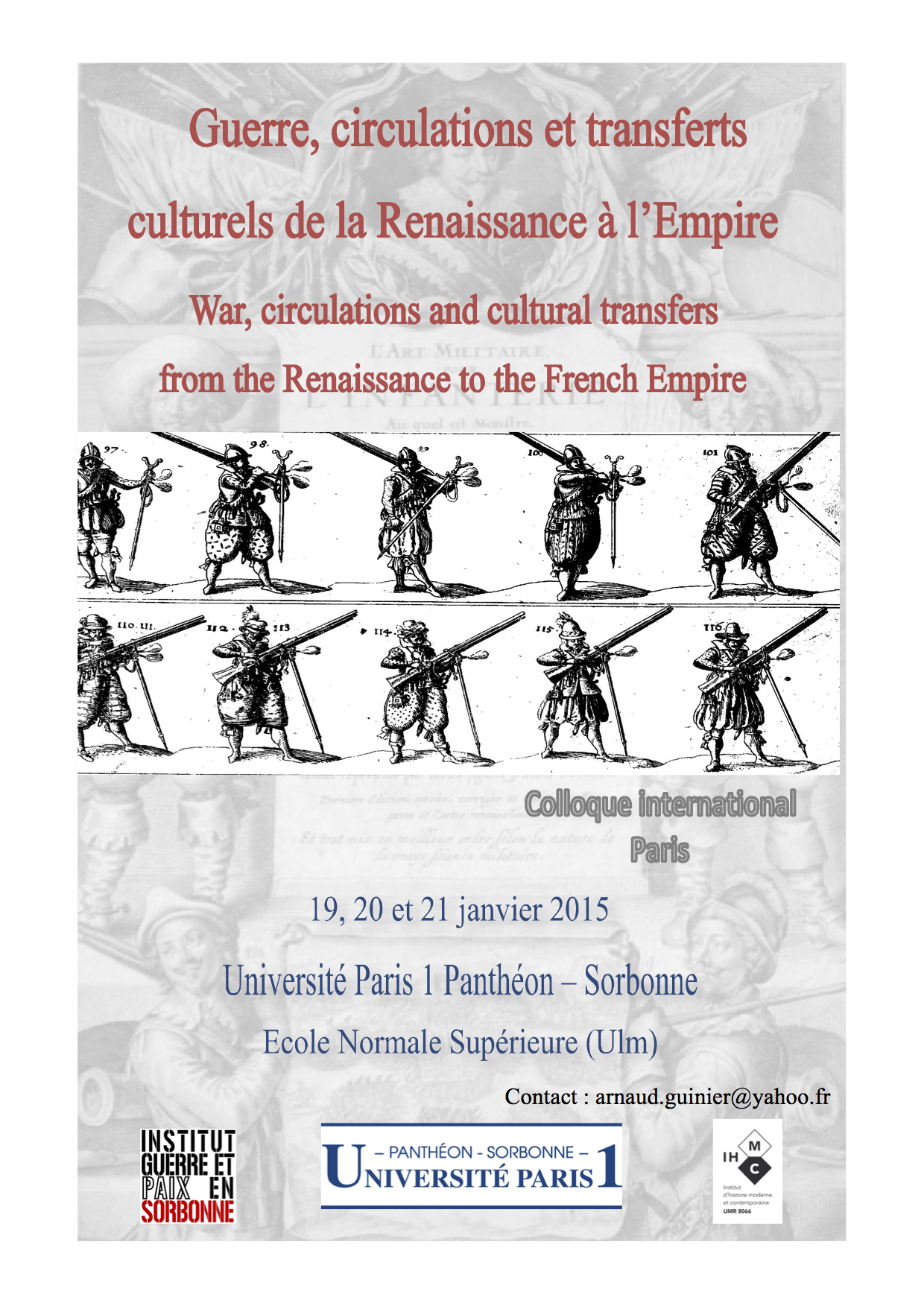
I recently participated in a fascinating conference in Paris on “Guerre, circulations et transferts culturels de la renaissance à l’Empire” (War, Circulation and Cultural Transfers from the Renaissance to the French Empire), organized by Hervé Drévillon and Arnaud Guinier. Conference participants presented new research on the circulation of war news, technical knowledge, and military intelligence in early modern and modern Europe. Papers explored diverse aspects of war reporting, military treatises, officer training, technical expertise, military migrants, historical memory, military espionage, and technology transfers.

GuerreCirculations-affiche

I offered a research paper in French on “‘Actions Héroïques et Dignes de Mémoire’ : Les nouvelles de guerre et la circulation des connaissances militaires pendant les Guerres de religion.” The title of my paper translates as: “‘Actions Heroïques et Dignes de Mémoire’ : War News and the Circulation of Military Knowledge during the Wars of Religion.”

The conference was sponsored jointly by the Institut d’Histoire Moderne et Contemporaine at the École Nationale Superieure and the Institut des Études sur la Guerre et la Paix en Sorbonne. Conference sessions were held at the Université de Paris I (Panthéon-Sorbonne) and at the ENS in rue d’Ulm.

The conference program is available at the website of the Institut des Études sur la Guerre et la Paix en Sorbonne and of the Institut d’Histoire Moderne et Contemporaine.


Posted in Conferences, Early Modern Europe, Early Modern World, European History, European Union, European Wars of Religion, French History, French Revolution and Napoleon, French Wars of Religion, Globalization, History of Science, History of Violence, Maritime History, Mediterranean World, Noble Culture and History of Elites, Religious Violence, War, Culture, and Society, Warfare in the Early Modern World | Leave a comment