Reenacting the War of 1812

The bicentennial of the War of 1812, which lasted from 1812 to 1815, continues to attract attention in parts of the United States and Canada.

Naval reenactors recently simulated the battle of Lake Erie, which was fought in September 1813 between the American squadron under Captain Oliver Hazard Perry and a British squadron. The Great Lakes had became a theater of naval and amphibious warfare during the War of 1812 and the battle of Lake Erie represented an important American victory during the conflict.

USS Niagara

A replica of the USS Niagara, a brig, was the centerpiece of the reenactment. Captain Perry transferred his battle flag, “Don’t Give Up The Ship,” to the Niagara at the height of the fighting at the battle of Lake Erie. Perry reported the victory, writing: “we have met the enemy and they are ours.”

NPR reports on the reenactment of the battle of Lake Erie. The organizers of the bicentennial of Lake Erie reenactment maintain a website.

Posted in Early Modern World, Empires and Imperialism, History of Violence, Maritime History, Museums and Historical Memory, War, Culture, and Society, Warfare in the Early Modern World | Leave a comment

McEducation: Franchising College eCourses

McEducation has arrived. Education corporations are seeking to franchise Massive Open Online Courses (MOOCs) and deliver electronic courses to college students across the nation and around the world.

The franchising process involves having the professors who create MOOCs license their courses for use by other colleges and universities (presumably for a payment and/or royalties). Princeton Professor Jeremy Adelman, who teaches a history MOOC, “worries about a process that he suggests could be called course ‘franchising.'”

“Mitchell Duneier once was a MOOC star,” according to the Chronicle of Higher Education, but “worried that the massive open online courses might lead legislators to cut state-university budgets, the Princeton University sociology professor has pulled out of the movement—at least for now.”

“The change of heart happened, he says, after Coursera approached him about licensing his course so other colleges could use the content in a blended format, meaning a mix of online and face-to-face instruction,” according to the Chronicle of Higher Education.

Professors at state universities and community colleges have good reasons to be wary of the growing trend in educational franchising.

The Chronicle of Higher Education reports.

Posted in Digital Humanities, Education Policy, Humanities Education, Information Management | Leave a comment

Position in Modern Military History at Ohio State

The Department of History at The Ohio State University invites applications for the Donald G. and Mary A. Dunn Chair in Modern Military History (post-1900), with a research focus on non-U.S. military history. We seek a candidate who has conducted research and who has compiled a strong publication record on the history of non-U.S. countries and combatants in World War I and/or World War II.  The candidate must possess a demonstrated ability to use sources in relevant languages.  The candidate would be expected to teach history survey courses and thematic courses in military history at the undergraduate level, in addition to undergraduate and graduate seminars in his/her specialty.  The Dunn Chair must possess a Ph.D. and qualify for appointment as a tenured professor.

Candidates should submit a letter of application, curriculum vitae, and the names and contact information of three potential references.  The search committee might subsequently ask applicants to provide copies of research publications and/or materials that document teaching accomplishments.  Candidates are encouraged to submit initial application materials online through Academic Jobs Online at: https://academicjobsonline.org/ajo/jobs/3028.  Paper materials will also be reviewed if mailed to Professor Geoffrey Parker, Chair, Dunn Chair Search Committee, Department of History, Ohio State University, 106 Dulles Hall, 230 West 17th Avenue, Columbus, OH 43210.  Review of applications will begin on October 15, 2013 and will continue until the position is filled.

For further information see the position announcement on H-Net.

Posted in Careers in History, War, Culture, and Society | Leave a comment

Administrative Bloat at American Universities

With all the buzz over the past week about President Obama’s new plan for reforming higher education in the United States, it is a good time for a reminder about why higher education costs are rising.

Obama-SUNY-Buffalo

Grossly bloated university administrations are responsible for much of the growth in educational costs over the past generation.

An article in Bloomberg Businessweek reports that “the number of Purdue administrators has jumped 54 percent in the past decade—almost eight times the growth rate of tenured and tenure-track faculty.” In the article, Purdue University is used as a case to represents  the broader national trend in administrative growth at universities and colleges.

“U.S. Department of Education data show that Purdue is typical: At universities nationwide, employment of administrators jumped 60 percent from 1993 to 2009, 10 times the growth rate for tenured faculty,” according to Bloomberg Businessweek.

So, while the costs of instruction (which correlate to faculty salaries) have remained practically flat over the past twenty years, the number of university administrators and the amounts of their salaries have grown incredibly.

Previous posts at this website have discussed this issue. See the sections on “Education Policy” and “Humanities Education”.

For further reading on this topic, see: Benjamin Ginsberg’s The Fall of the Faculty: The Rise of the All-Administrative University and Why it Matters (Oxford: Oxford University Press, 2011). See also my post on this important book.

ginsberg-falloffaculty

Bloomberg Businessweek reports on administrative bloat at American universities. Thanks to my colleague, Sean Farrell, for sharing this reference.

Posted in Education Policy, Humanities Education, Political Culture | Leave a comment

President Obama’s Plan for Higher Education

Last week, President Barack Obama unveiled his plan for higher education reform.

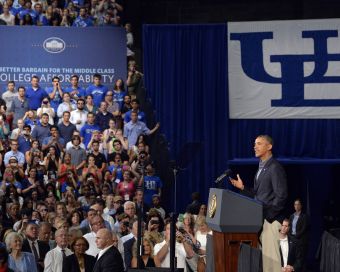
Unfortunately, Obama’s plan focused almost exclusively on the cost of college tuition and fees. His plan misunderstands the reasons for higher tuition rates, which largely stem from a 20% growth in university administration over the past two decades, rather than an increase in instructional costs. The costs of new technologies has also affected university budgets. At public universities, higher tuition rates have also resulted from massive cuts in educational funding by state legislatures.
Obama-SUNY-Buffalo

Obama’s plan misdiagnoses the problems in higher education, focusing almost exclusively on tuition rates. See my previous posts in the section on “Education Policy” for data on tuition rates and the cost of higher education.

One of the major features of the plan would be a rating system of colleges and universities, based on “performance.” The Chronicle of Higher Education reports: “The president’s proposal to reward colleges based on a new kind of rating system, one that Mr. Obama said would favor colleges that are improving their performance and that are “helping students from all kinds of backgrounds succeed,” is broader than similar ideas he has put forth before.” But, the ratings for “performance” would assess colleges and universities for the performance of the students themselves. So, a student who earned Ds, Fs, or dropped out would reflect poorly on the university, even the student never showed up to class at all. Such a system would merely encourage grade inflation and passing students who failed to perform up to standards. This is no way to assess how higher educational institutions are performing.

Another element of the plan encourages universities to embrace teaching methods employing technologies, especially Massive Open Online Courses (MOOCs). MOOCs have some role to play in higher education, but the President is following the inflated rhetoric of Bill Gates and other computer gurus in presenting MOOCs as a panacea for the problem of rising educational costs. MOOCs cannot replace face-to-face contact and classroom learning, so they can at best supplement other forms of instruction and learning, rather than providing cheap education. See my other posts on MOOCs in this website’s sections on “Education Policy”, “Humanities Education”, and “Information Management”.

Obama’s plan is hardly original. The ideas he is advancing have been developed by major educational foundations and think tanks, some of them with lobbying connections to large corporations that produce educational software and publications.

The Chronicle of Higher Education reports that: “The president’s plan dovetails closely with the agendas of the Bill & Melinda Gates Foundation, which has spent $472-million to remake college education in the United States, and of the Lumina Foundation, the largest private foundation devoted solely to higher education. Many features of the president’s plan have been advocated, too, in the research and analysis of the New America Foundation’s education-policy program.”

The President’s overview of his plan is available on the White House website.  The Chronicle of Higher Education reports on the plan itself, the sources of its ideas, as well as reactions to the plan and criticism of its provisions.


Posted in Education Policy, Humanities Education, Information Management, Political Culture | Leave a comment

On Chemical Weapons and Military Intervention

Chemical weapons seem to have been used in the Syrian Civil War last week, probably by Syrian government forces.

Médecins sans frontières (MSF), known in English as Doctors Without Borders, has issued a statement confirming that approximately 3,600 Syrian civilians have been treated for neurotoxic symptoms consistent with chemical weapons. MSF states that “Patients were treated using MSF-supplied atropine, a drug used to treat neurotoxic symptoms. MSF is now trying to replenish the facilities’ empty stocks and provide additional medical supplies and guidance.”

Syrianvictims

Dr. Bart Janssens of MSF indicates that “MSF can neither scientifically confirm the cause of these symptoms nor establish who is responsible for the attack.” But, Janssens argues that “the reported symptoms of the patients, in addition to the epidemiological pattern of the events—characterised by the massive influx of patients in a short period of time, the origin of the patients, and the contamination of medical and first aid workers—strongly indicate mass exposure to a neurotoxic agent. This would constitute a violation of international humanitarian law, which absolutely prohibits the use of chemical and biological weapons.”

A United Nations (UN) team has been deployed to Syria to investigate the site of the alleged chemical weapons attack. The UN team has already attempted to reach the site, but had to turn back after coming under fire by snipers, according to the BBC.

Amid vociferous calls for military intervention in the Syrian Civil War, following this alleged chemical weapons attack, comes a potent historical reminder of the politics of chemical weapons.

Newly available documents show that the CIA knew of Iraqi chemical weapons stockpiles during the Iran-Iraq War of the 1980s. Further, the CIA provided Saddam Hussein with military intelligence on the Iranian Army’s positions, even though the CIA was predicting that Hussein would order chemical weapon attacks on the Iranian soldiers.

SaddamHusein-1988

According to Foreign Policy, “In contrast to today’s wrenching debate over whether the United States should intervene to stop alleged chemical weapons attacks by the Syrian government, the United States applied a cold calculus three decades ago to Hussein’s widespread use of chemical weapons against his enemies and his own people. The Reagan administration decided that it was better to let the attacks continue if they might turn the tide of the war. And even if they were discovered, the CIA wagered that international outrage and condemnation would be muted.”

For the MSF statement, see its website. BBC reports on the UN team’s attempts to investigate the alleged chemical attack. Foreign Policy reports on the CIA’s assistance to Saddam Hussein during the Iran-Iraq War.

Posted in Civilians and Refugees in War, European Union, History of Violence, Human Rights, Laws of War, Strategy and International Politics, War, Culture, and Society | Leave a comment

The French Question

The “French Question” has become central to European economic development and  European Union (EU) politics. Labor unrest, racial tensions, and high unemployment have created a delicate political and economic situation in France.

Paris-GoodyearStrike

According to the New York Times, “The French are justifiably proud of their social model. Health care and pensions are good, many French retire at 60 or younger, five or six weeks of vacation every summer is the norm, and workers with full-time jobs have a 35-hour week and significant protections against layoffs and firings.”

The French system clearly has great strengths that have produced a high quality of life for French citizens over the past 50 years. “But in a more competitive world economy,” the New York Times points out, “the question is not whether the French social model is a good one, but whether the French can continue to afford it. Based on current trends, the answer is clearly no, not without significant structural changes — in pensions, in taxes, in social benefits, in work rules and in expectations.”

Economists and political analysts have been advocating major reforms to the French social system for years. According to the New York Times, “there is a broad consensus that real social and structural renovation can be carried out only by the left. But that can happen only if Mr. Hollande, who has a legislative majority, is willing to confront his own party in the name of the future, as the former German chancellor Gerhard Schröder did a decade ago with a series of legal modifications that now get much of the credit for Germany’s revival.”

Any comprehensive reform would be difficult, as it would be require scaling back or stripping popular economic and social benefits from government workers, unionized workers, and French citizens in general. It is not at all clear that the German or American social systems can provide a model for French reforms, nor is it clear that French President Hollande can provide the leadership for comprehensive reform.

The New York Times reports on the “French Question.”

Posted in European History, European Union, French History, Globalization, Human Rights | Leave a comment

History of the Muslim Brotherhood in Egypt

briansandberg's avatarCluster for the Study of Religious Violence

The Muslim Brotherhood has been an important religious and political organization in Egypt for decades and is one of the major participants in the ongoing Egyptian Revolution.

NPR provides a brief history of this important Islamic organization, which was founded in 1928. The article points out that “The Muslim Brotherhood, which has a presence in dozens of Muslim countries, has been banned, repressed or restricted for much of its more than eight-decade history in Egypt, the place where it was born.” So, although current reporting has focused on violence by members of the Muslim Brotherhood against Coptic churches in Egypt, the Muslim Brotherhood has been targeted for violence by Egyptian military and police forces throughout much of its existence. The photo below shows the Muslim Brotherhood headquarters being burned in 1954.

MuslimBrotherhoodHQ-1954

The NPR article quotes Vidino Lorenzo, the author of The New Muslim Brotherhood in the West, on the development…

View original post 101 more words

Posted in Civil Conflict, Civilians and Refugees in War, History of Violence, Mediterranean World, Religious Politics, Religious Violence, Terrorism, War, Culture, and Society | Leave a comment

Supporting the Arts and Humanities

The National Endowment for the Arts (NEA) and the National Endowment for the Humanities (NEH) are currently leaderless.  Although they have acting directors and staffs, both endowments desperately need active leadership—especially in a time of budget cuts.

The New York Times reports that “The House Appropriations Committee has proposed cutting each budget by half. Present financing levels are about $155 million each, a mite in the federal government’s overall $3.5 trillion budget. Even at these modest levels, the endowments are essential to art and enlightenment all across the country, and they help local economies in the bargain.”

The budgets of the NEA and NEH have already been cut significantly in recent years.  A 50% cut in their budgets would be simply disastrous for research, teaching, exhibitions, and performances in the arts and humanities.

Many communities’ arts and humanities programs (museum programs, art exhibitions, dance performances, public sculptures, public history, digital humanities projects, public lectures, scholarly conferences, historical preservation projects, student programs, teaching development programs, community college programs, etc.) would be directly affected by the lack of grants and matching funds for local initiatives that are often supported by the NEA and NEH.

In Illinois, the Illinois Humanities Council (IHC) is supported by the NEH, as well as donations and gifts by public and private organizations. The IHC, in turn, has made grants to organizations such as the Jane Addams Hull-House Museum, African American Cultural Center of UIC, Springfield Art Association, Bishop Hill Heritage Association, Chicago Metro History Education Center, Instituto Cervantes of Chicago, Illinois Institute For Community Law, Chicago Filmmakers, and New Philadelphia Association. The NEH also directly supports other organizations within Illinois.

The NEH provides a fact sheet on its support of the humanities within each state.  The NEH’s Illinois fact sheet is available. Find your own state’s NEH fact sheet here.

An editorial at the New York Times comments on the current situation of the NEA and NEH.

Posted in Digital Humanities, Education Policy, Humanities Education, Museums and Historical Memory | Leave a comment

A New Production of Mother Courage

briansandberg's avatarCluster for the Study of Religious Violence

Shakespeare and Company is producing a new version of Bertolt Brecht’s Mother Courage, a play about everyday life and death in Germany during the Thirty Years’ War (1618-1648).

Bruce Chadwick provides a synopsis of the 1939 play in his review of this production: “Mother Courage is about a small tine war profiteer, Ann Fierling, who, with her three grown children, two men and a mute woman, follows the Swedish army and trudge across enemy lines pulling their canteen wagon to sell food, drink and supplies to soldiers. They are sucked into the middle of the war and quickly discover that everybody likes them – and everybody hates them. It is the story of Anna’s need to make money in a war that leaves her practically bankrupt and threatens the lives of her children. Yet she keeps at it.”

MotherCourage

According to Chadwick, “Director Tony Simotes has staged a dramatic play…

View original post 114 more words

Posted in Uncategorized | Leave a comment