Procedures for the Papal Conclave

As cardinals prepare to elect a new pope in the Vatican, observers may want a refresher on the procedures for a papal conclave.

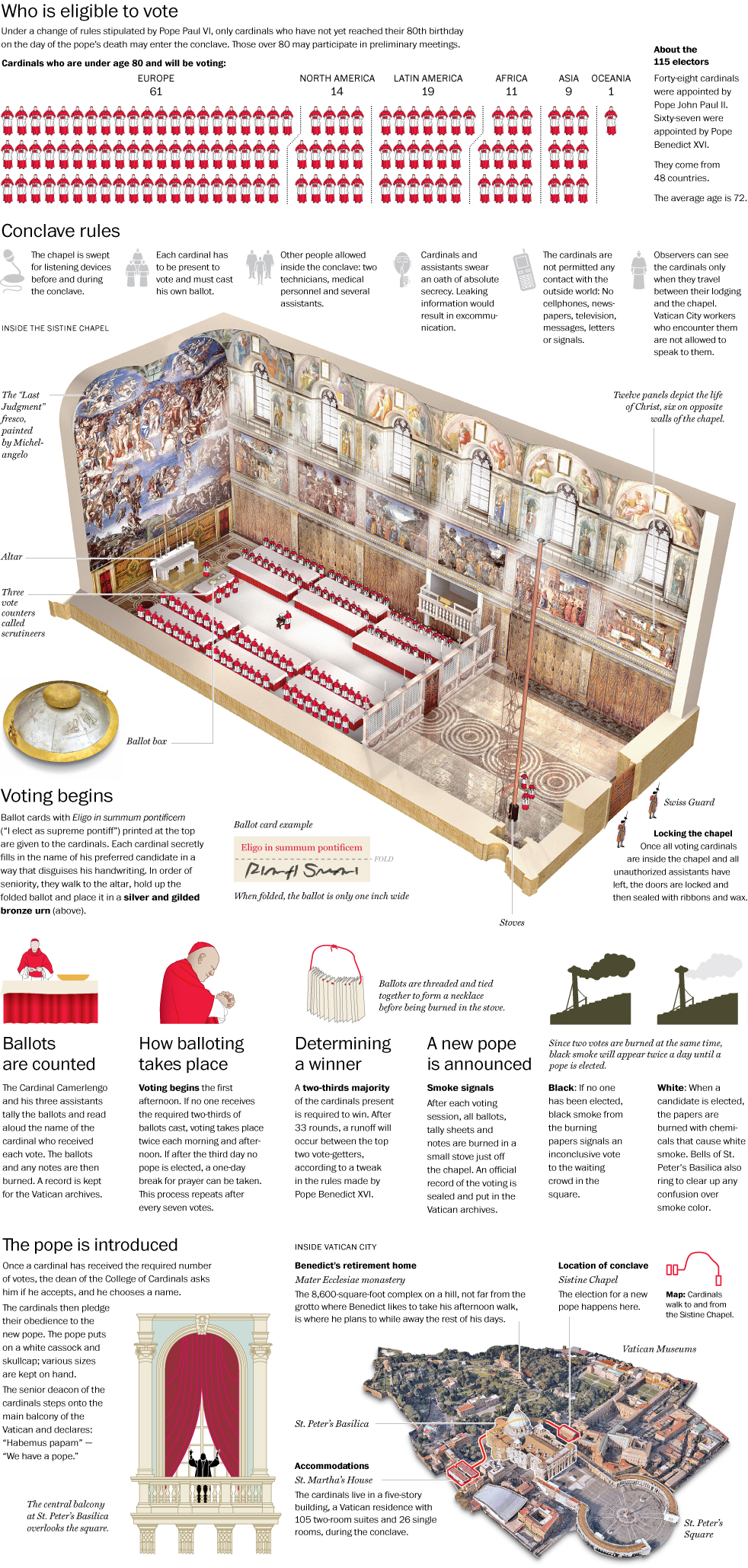
The Washington Post reports on the preparations for the upcoming papal conclave and provides the following graphic explaining rules and procedures for the conclave:

conclave-graphic

The BBC offers an insider’s view of the conclave process by Cardinal Cormac Murphy-O’Connor, who participated in the conclave that elected Benedict XVI but is too old to vote in the upcoming conclave.

NIU students in HIST 414 European Wars of Religion and HIST 420 The Renaissance will be interested in following the conclave process and noting comparisons with the Renaissance papacy.

Posted in Early Modern Europe, European History, European Wars of Religion, Italian History, Political Culture, Reformation History, Religious History, Renaissance Art and History | Leave a comment

Sequestration and Cuts in Education

How will the sequestration affect education in the United States?  Teachers, professors, and administrators are scrambling to assess the fall-out of the major cuts that will be implemented in educational institutions across the United States.

Federal spending cuts will directly affect many high-school students, college students, professors, and research scientists whose financial and research funding is provided by federal programs.

College and university students will begin to notice cuts when the new fiscal year begins in July 2013. “Although the Pell Grant program is exempt from cuts for the first year of sequestration,” reports the Chronicle of Higher Education, “programs like the Supplemental Educational Opportunity Grant and Federal Work-Study would be cut by millions of dollars, eliminating more than 100,000 students from participation.” These cuts are predicted to affect would-be college students over the next decade, perhaps preventing many from attending college.

Educational institutions at all levels of American society will feel the impact of the sequestration, since federal funding indirectly assists city, county, and state education.

Federal research funding through the National Science Foundation, National Endowment for the Humanities, and National Endowment for the Arts will also be cut, seriously hampering new research studies and initiatives in all disciplines.

The sequestration will result in deep cuts that will limit students’ access to education and restrict professors’ ability to conduct new research. The cuts will only further erode the already weakened position of the United States in the competition for global leadership in education.

An article in the Chronicle of Higher Education attempts to gauge the key areas of educational budgets that may be affected.

Posted in Education Policy, Humanities Education, Political Culture | Leave a comment

Holding Your Own Conclave

As cardinals gather in the Vatican to elect a new pope, other people are holding their own conclaves.

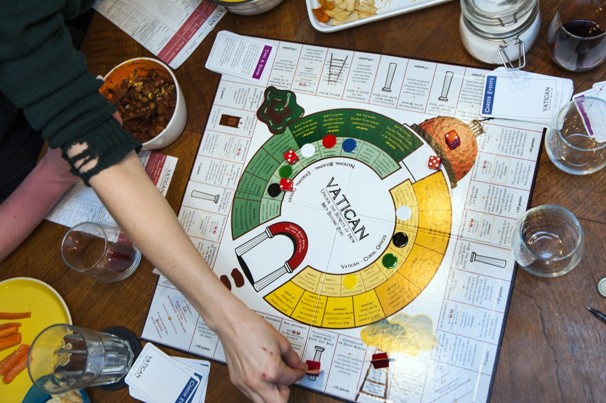
Vaticanboardgame

The board game “Vatican: Unlock the Secrets of How Men Become Pope” provides a fun way to learn about the process of electing popes. The game was designed by Stephen Haliczer, Professor Emeritus of History at Northern Illinois University.

The Washington Post reports on the game Vatican and a group of Catholic women who recently played the game. These women are part of a movement, known as Call to Action or the Women’s Ordination Conference, which is pushing for female Catholic priests and religious leaders. “We’ve been figuring out,” one of the women said, “how to get pink smoke to Rome.”

womenplayVatican

Harper’s Magazine excerpted some of the game’s cards in 2008.

NIU History students will be interested to track the success of this board game, which was produced by one of their own professors. High school and college teachers of History, Political Science, and Religious Studies may be interested in using this board game as a teaching tool.

Now, if you can get your hands on a copy of Vatican, you can hold your own conclave.

Posted in European History, History in the Media, Humanities Education, Italian History, Political Culture, Religious History, The Past Alive: Teaching History, Uncategorized, Women and Gender History | Leave a comment

Pope Benedict XVI Resigns

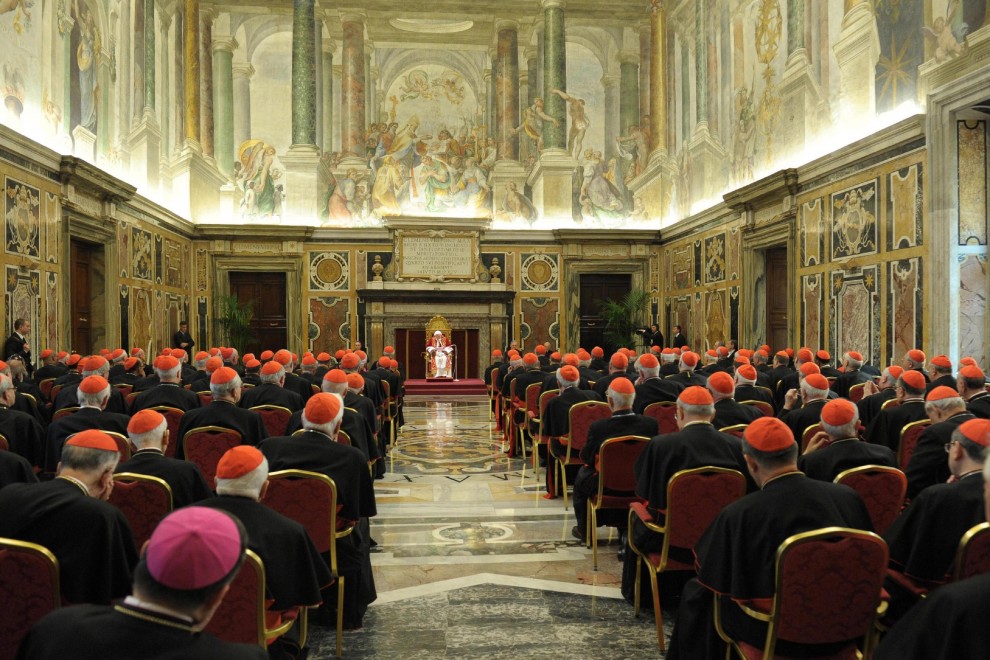
Pope Benedict XVI officially resigned yesterday, becoming the first pope to resign since 1415. Benedict addressed the cardinals for a final time, charging them with electing his replacement: “May the College of Cardinals work like an orchestra, where diversity — an expression of the universal church — always works toward a higher and harmonious agreement.”

Papeecardinali-dimissioni

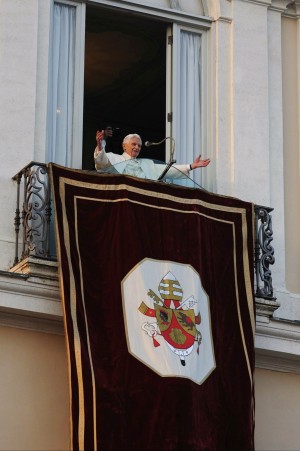
The pope appeared at the window of the Vatican Palace to greet the throng of Catholic faithful gathered below in the square, chanting “Viva il Papa!” Benedict XVI told the crowd that “I am simply a pilgrim beginning the last leg of his pilgrimage on this Earth.”

Papa-ultimosaluto

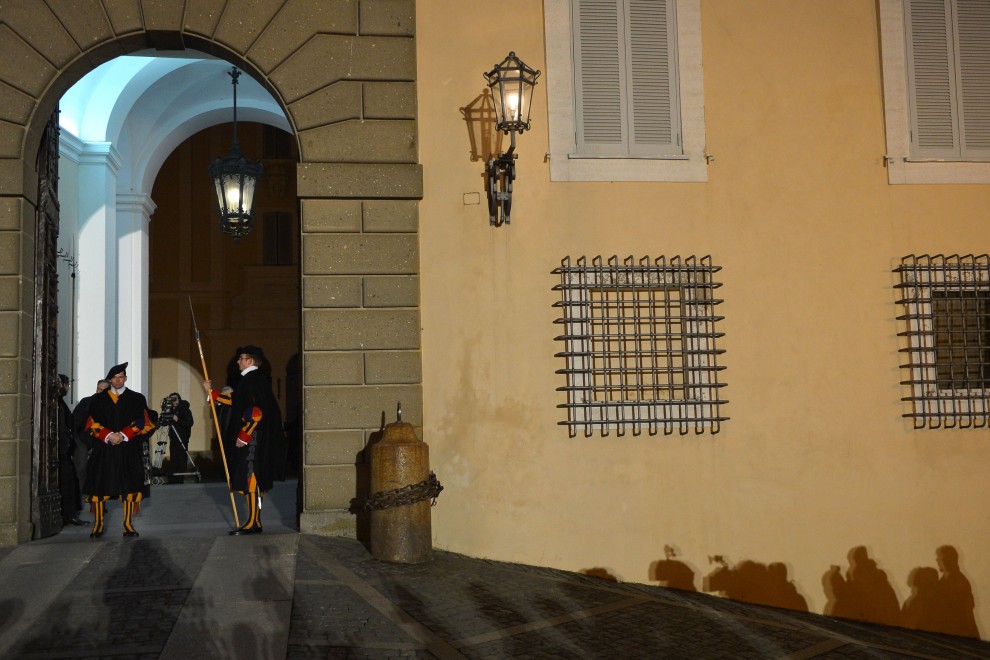
Benedict XVI, now Pope Emeritus, then departed the Vatican for the nearby Papal retreat of Castel Gandolfo. Soldiers of the Swiss Guard closed the gates after Benedict XVI entered his retirement.

GuardieSvizzere

According to the Washington Post, “Benedict’s decision to live at the Vatican in retirement, be called ’emeritus pope’ and ‘Your Holiness’ rather than revert back to ‘Joseph Ratzinger’ and wear the white cassock associated with the papacy has deepened concerns about the shadow he might cast over the next papacy.”

The Washington Post reports on Benedict XVI’s resignation. La Repubblica reports on the resignation in Italian and has numerous photo galleries of Benedict XVI’s final day as pope, as does Corriere della Sera. NPR reports on the resignation in the context of a broader identity crisis in the contemporary Catholic Church.

Benedict XVI’s decision to resign is being seen by some analysts as part of a long-planned and carefully orchestrated strategy.

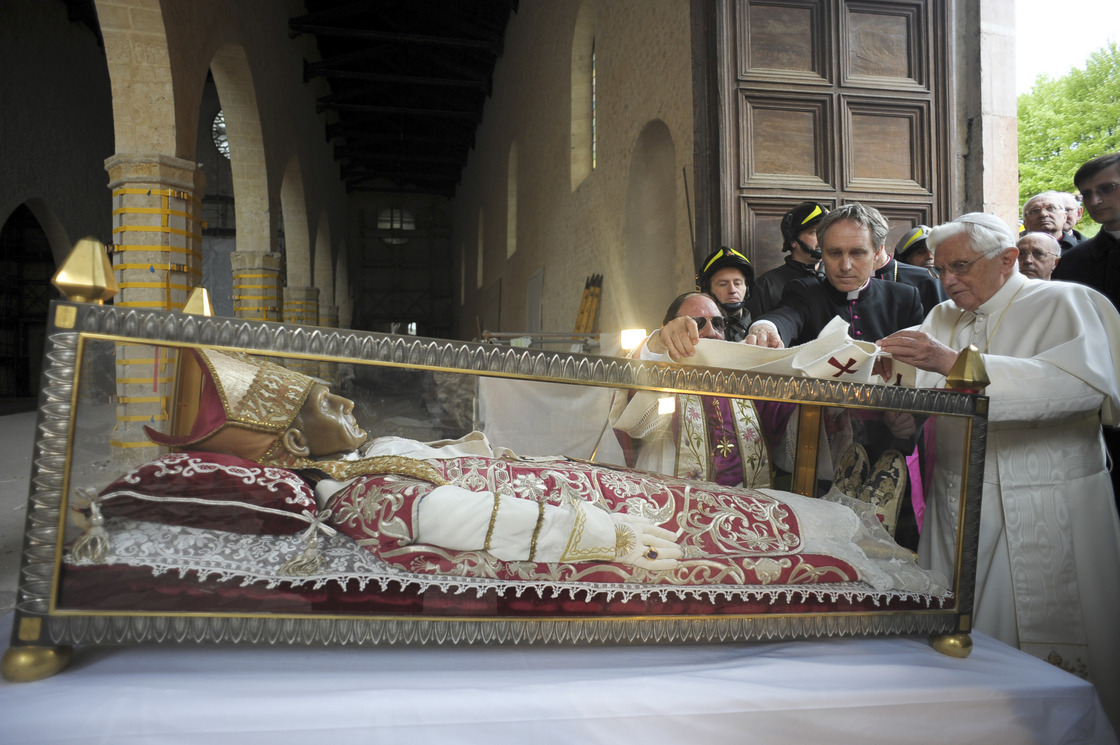
twopopes2

Benedict XVI’s veneration of Pope Celestine V, who retired in 1294, seems to point to a crafted policy of Papal retirement. NPR reports on comparisons between Celestine V and Benedict XVI’s retirements.

Posted in Early Modern Europe, European History, Italian History, Renaissance Art and History | Leave a comment

Atrocities in Vietnam

The United States military forces committed widespread atrocities during the Vietnam War, according to documents unearthed in the National Archives by journalist Nick Turse. The evidence of numerous mass killings of Vietnamese civilians reveals that the infamous My Lai Massacre was neither an accident nor an aberration, but rather a normal part of the American practice of warfare in Vietnam.

turse-anythingthatmoves

Turse has published his findings in new book entitled, Kill Anything that Moves: The Real American War in Vietnam (Metropolitan Books, 2013). For a bio of Turse, see his own website.

Kill Anything that Moves is receiving considerable media attention in the United States. NPR recently interviewed Turse about the book. Salon reports on Turse’s findings.  Bill Moyers recently conducted a video interview with Turse about the book.

The LA Times previously published a series of articles by Turse based on his research for the book.

Alfred W. McCoy, Professor of History at the University of Wisconsin at Madison and a leading scholar of Southeast Asian History, reviews Turse’s book at HNN.

I have not yet had a chance to review Turse’s book, but hope to do so soon.

Posted in Archival Research, Civil Conflict, Civilians and Refugees in War, Empires and Imperialism, History of Violence, Strategy and International Politics, War, Culture, and Society | Leave a comment

Stephanie Coontz Lecture at NIU

Stephanie Coontz, a leading gender historian, will be presenting at Northern Illinois University today.

Coontz will offer a  seminar on “How to Talk to the Media About Your Scholarship (and Get Them to Listen).” The seminar will be held in the Capitol Room South of the Holmes Student Center from 10:00-11:15 a.m.

Coontz will also offer a lecture on “50 Years After the Feminine Mystique: How Far Have We Come?”  This lecture is scheduled for 6 p.m. the Visual Art Building, room 100.

NIU History students are encouraged to attend these events, which are free and open to the public.


Posted in Careers in History, Graduate Work in History, Humanities Education, Lectures and Seminars, Northern Illinois University, Undergraduate Work in History, Women and Gender History | Leave a comment

Betting on the New Pope

Pope Benedict XVI’s surprise announcement that he will resign and go into retirement stunned the Catholic world. Some Catholics have been protesting Benedict XVI’s decision, claiming that popes can never step down, while other believers have been flocking to the Vatican to witness this pope’s final public prayers. Meanwhile, cardinals from around the world are preparing to gather in the Vatican for a conclave to elect a new pope.

Catholics are not the only people curious about who will be elected as the next pope, however. Many papal followers are betting on who the next pope will be. And, there are  lots of options in betting.

papalconclave2013-betting

Betting sites like Intrade allow people to bet on the nationality of the new pope, individual papal candidates, and the number of ballots it will take to elect the new pope.

Of course, betting on papal elections is nothing new. Since at least the early sixteenth century, betting agencies have published odds on papal elections. Renaissance Romans also placed bets on who would be created cardinal during promotions.

For more on early modern papal conclaves, see: John M. Hunt, “The Conclave from the ‘Outside In’: Rumor, Speculation, and Disorder in Rome during Early Modern Papal Elections,” Journal of Early Modern History 16 (2012): 355-382.

On bidding and gambling in Renaissance Italy, see: Evelyn Welch, Shopping in the Renaissance: Consumer Cultures in Italy, 1400-1600 (New Haven, CT: Yale University Press, 2005), 185-209.

Thanks to NIU graduate student Alex Revzan for the Intrade link. NIU students in HIST 420 The Renaissance will want to track the upcoming conclave to learn more about papal elections. NIU students may also be interested to know that Stephen Haliczer, Professor Emeritus of History at Northern Illinois University, created a board game entitled Vatican on the papal electoral process.

Posted in Early Modern Europe, European History, Italian History, Mediterranean World, Political Culture, Reformation History, Renaissance Art and History, Uncategorized | Leave a comment

Renaissance Italian Bank in Trouble

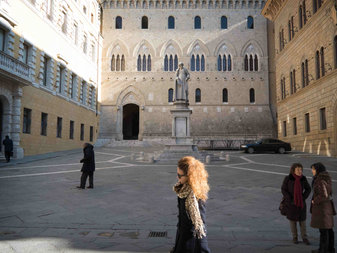
Monte dei Paschi di Siena is in deep financial trouble. “To howls across Italy,” the New York Times reports, “the government has hastily arranged a €3.9 billion, or $5.1 billion, bailout. The widening scandal, which hit at a time of growing economic distress in Italy, has boiled over into an issue in nationwide elections to be held Sunday and Monday.”

MontediPaschidiSiena

The bank was founded in 1472 and is considered the oldest existing bank in the world. A New York Times article emphasizes that “since the days of the Medici in Florence, to the north, the banking house of Monte dei Paschi has rained wealth on the people of Siena. For 541 years, it has endured war, plague and panic, and it stands today as the world’s oldest bank.”

The New York Times reports on the difficulties at Monte dei Paschi di Siena. The Economist and BBC both recently reported on Monte dei Paschi di Siena’s risky investments.

NIU students in HIST 420 The Renaissance will want to track this developing story.

Posted in Early Modern Europe, Early Modern World, European History, European Union, Globalization, Italian History, Political Culture, Renaissance Art and History | Leave a comment

Anglocentric History in the United Kingdom

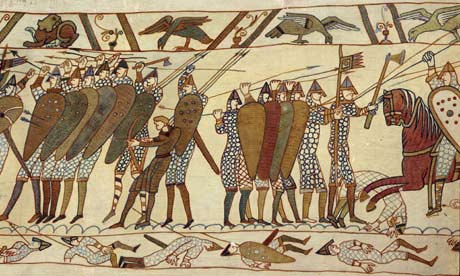
A controversy has erupted in the United Kingdom over new History curriculum proposals. Conservative politicians are pushing for new national curriculum that would emphasize certain aspects of British history.

Foot Soldiers

Many historians have criticized the new proposals as politically motivated attempts to instill a particular version of Anglocentric history.

Conservative popular historian Niall Ferguson has written in defense of the proposed new curriculum in the Guardian.

The Guardian also publishes historians’ comments on the controversy.

The controversy seems to center around the teaching of certain events in medieval and early modern English history that have often been viewed through a Whig interpretation of history.

Thanks to my colleague Sean Farrell, Associate Professor of History at Northern Illinois University, for sharing this piece.

Posted in Early Modern Europe, Education Policy, European History, European Union, Historiography and Social Theory, Humanities Education, Political Culture | 2 Comments

Stephanie Coontz on Gender Equality

Historian Stephanie Coontz published an important op-ed yesterday in the New York Times on “Why Gender Equality Stalled.”

This op-ed is one of a series of new pieces celebrating or reassessing the 50th anniversary of Betty Friedan’s The Feminine Mystique, a foundational work of the feminist movement that has significantly influenced the development of women and gender history.

paidmaternalleave

One of the factors that Coontz considers is paid maternity and paternity leave, arguing that the United States is far behind the curve on establishing leave policies.

Northern Illinois University students will be interested in this op-ed, since Stephanie Coontz will soon be visiting NIU’s campus as a speaker for the Women’s Studies Program.

Posted in Human Rights, Humanities Education, Women and Gender History | Leave a comment