Preserving Timbuktu’s Cultural Heritage

Timbuktu has been an important center of Islamic learning, scientific research, and legal scholarship for centuries. The city’s medieval manuscript collections are regarded as some of the best in the Islamic world. Because of its libraries and architectural sites, Timbuktu is recognized as a World Heritage site by UNESCO.

AhmedBabaInstitute-manuscriptsIslamist and Tuareg militants targeted Sufi tombs and other heterodox religious sites for destruction during their recent occupation of Timbuktu.

As French and Malian forces approached Timbuktu last week, reports circulated of  militants burning manuscripts. Many observers feared that the famous manuscript collections might be completely destroyed.

Now we know that although some destruction did occur, most of Timbuktu’s manuscripts have survived. “When the moment of danger came,” according to the New York Times, “Ali Imam Ben Essayouti knew just what to do. The delicate, unbound parchment manuscripts in the 14th-century mosque he leads had already survived hundreds of years in the storied city of Timbuktu. He was not about to allow its latest invaders, Tuareg nationalist rebels and Islamic extremists from across the region, to destroy them now. So he gingerly bundled the 8,000 volumes in sackcloth, carefully stacked them in crates, then quietly moved them to a bunker in an undisclosed location.” The New York Times reports on the hiding of the manuscripts.

The close call for the Timbuktu manuscripts is a reminder of how important humanities digitization projects are for the preservation of historic archival collections.


Posted in Archival Research, Civil Conflict, Civilians and Refugees in War, Digital Humanities, Early Modern World, History of the Book, History of Violence, Mediterranean World, Museums and Historical Memory, War, Culture, and Society | Leave a comment

Representing Battle

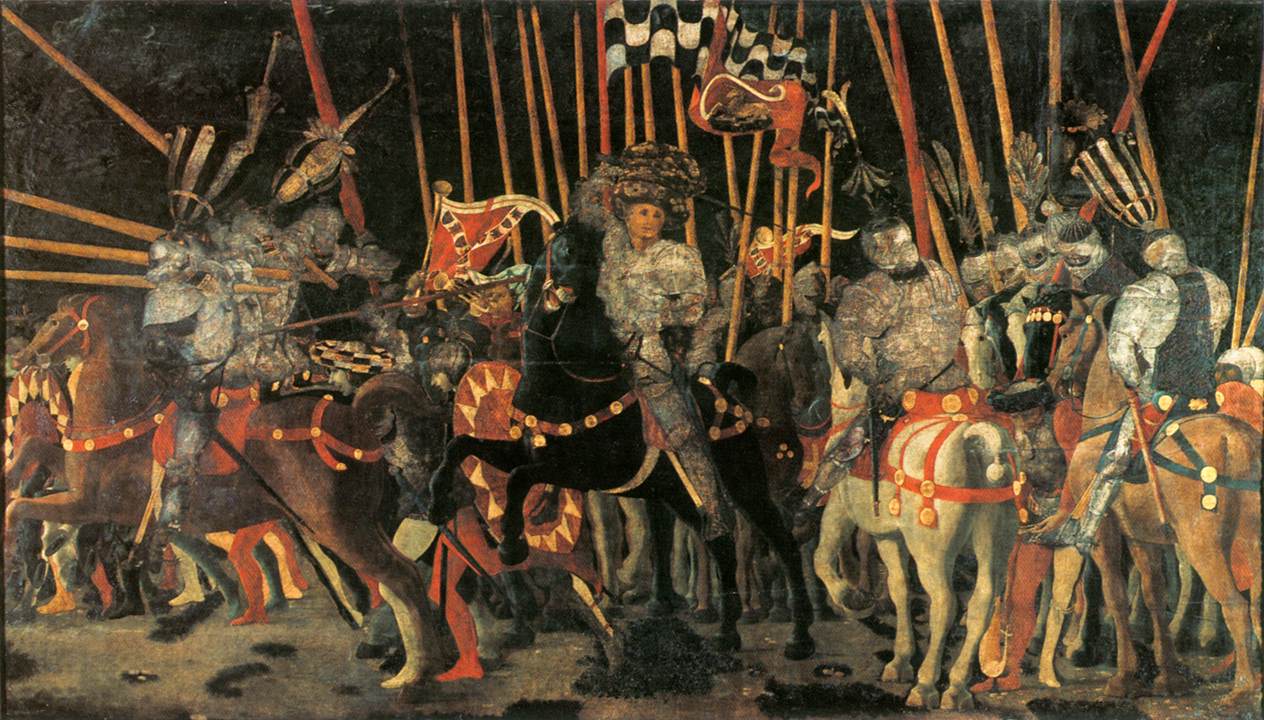
Images of battle are present in all periods of art history, but serious analyses of representations of battle are relatively new. Some of the best scholarly work so far examines battle imagery in the early modern period.

battledesanromano

Historian Peter Paret’s Imagined Battles (1997) offers an interesting discussion of depictions of battle. Numerous art historical studies have considered Jacques Callot’s battle scenes and depictions of the miseries of war. A new interdisciplinary collective volume on Beholding Violence in Medieval and Early Modern Europe, ed. Allie Terry-Fritsch and Erin Felicia Labbie (2012) examines ways of visualizing battles in the broader context of witnessing violence. My chapter in this volume examines how early modern Europeans experienced and observed siege warfare.

A conference entitled Représenter la bataille was recently held at the Musée du Louvre in Paris on the problem of how battle has been represented throughout history. The sessions focused on the example of the Chanson de Roland and its imagery of battle.

Unfortunately, my research sabbatical in Paris wrapped up just a few weeks before this conference, so I was unable to attend.

The Louvre website presents a conference program and description.


Posted in Art History, Early Modern Europe, Early Modern World, History of Violence, Renaissance Art and History, War, Culture, and Society, Warfare in the Early Modern World | Leave a comment

Gun Makers Appeal to Children

Gun makers in the United States regularly appeal to American children through advertising campaigns and promotions.

gun-makers-children

An article by Jordan Weissmann in the Atlantic discusses the importance of gun purchases by hunters in the United States. Weissmann points out that “although they’ve been overshadowed a bit by handgun buyers in recent years, public data suggest that hunters are the backbone of U.S. firearms sales. According IBISWorld, American civilians purchase roughly $7 billion worth of guns and ammunition annually. And although their analysis doesn’t separate money spent by sportsmen from purchases by doomsday preppers, the U.S. Fish and Wildlife Service estimates that hunters alone alone spent around $4.3 billion on guns and ammo in 2011.”

Weissmann demonstrates the declining interest in hunting in the United States and the corresponding aging of the hunting population. “In short,” he argues, “when we talk about hunting, we’re talking about a pastime responsible for more than half of retail gun sales. And over the past 20 years, hunting has not fared well. Although their numbers have risen since hitting a trough in 2006, there are around 300,000 fewer Americans stalking deer, cramming themselves into duck blinds, and gunning down turkeys than in 1991, according to the Fish and Wildlife Service. As a result, hunters have fallen from more than 7 percent of the population to a bit under 6 percent.”

According to Weissmann, gun manufacturers need to make guns and hunting more popular in order recruit a new generation of domestic customers for their weapons.

This sort of research needs to be compared with data on gun manufacturers’ sales of weapons to civilians abroad, as well as to military organizations.


Posted in Arms Control, History of Violence, War, Culture, and Society | Leave a comment

Medici Archive Project Online Paleography Course 2013

MAP Online Paleography Course 2013

bia-announcement

For the fourth consecutive year, the Medici Archive Project will offer a 12-week
Online Paleography Course. The course is designed to furnish participants with
basic skills for reading historical manuscript materials from the late 15th- 17thcentury
Tuscany. This course also offers a general introduction to the nature of
Italian archives. From personal letters to the inventories and wills, the digitized
documents used to train the course’s participants in paleographic skills will also
expose them to a wide range of document types useful for scholarly research.

Enrollment will be limited to 20 students. Priority will be given to graduate
students, post-graduate scholars, and professionals with relevant scholarly
interests. Basic knowledge of Italian is required. The course is taught in English.
The online course will be held from Monday, September 23 to Friday, December
13, 2013.

The tuition for this course is US $ 500, payable by PayPal upon acceptance.
To apply, send: 1. A brief letter of introduction explaining the motivation for
taking the course. 2. A curriculum vitae that details linguistic aptitude and (if
applicable) archival experience.

All materials should be sent to Dr. Elena Brizio, ebrizio@medici.org by September
1, 2013.


Posted in Archival Research, Conferences, Digital Humanities, Early Modern Europe, European History, Graduate Work in History, Grants and Fellowships, Italian History, Reformation History, Renaissance Art and History | Leave a comment

Seminar on Paleography and Archival Studies

Seminar on Paleography and Archival Studies

bia-announcement

For the third consecutive year, the Medici Archive Project will be offering a two-week
intensive seminar on archival research especially intended for advanced
graduate students in Renaissance and early modern studies. This seminar will be
team-taught by current MAP staff. Course participants will have the opportunity
to work directly with original documents and will visit a number of Florentine
archives.

The seminar aims to teach scholars to navigate Italian archives (with particular
emphasis on Florentine collections), to examine in depth various document
typologies, to read the documents, to identify paleographic conventions, and to
apply this research to their scholarly pursuits. Class-size is restricted to twelve,
so that each participant will receive personal guidance.

The seminar will run from Monday, June 10 to Saturday, June 22, 2013.
The tuition for this course is US $ 700, payable by PayPal upon acceptance.
For further information, or to apply, contact Dr. Elena Brizio ebrizio@medici.org .
To apply, please send a CV and a brief statement explaining how this course will
benefit your current research project by May 1, 2013.

Posted in Archival Research, Conferences, Digital Humanities, Early Modern Europe, Graduate Work in History, Grants and Fellowships, Italian History, Mediterranean World, Reformation History, Renaissance Art and History, Study Abroad | Leave a comment

Space and Piety in the Mediterranean

CFP: CONFRATERNITIES, GUILDS/FUTUWWA, AND BROTHERHOODS/TARIQAHS:

SPACE AND PIETY IN THE IRANO-MEDITERRANEAN FRONTIER ZONE

Colin Mitchell and Megan Armstrong are seeking papers for a special interdisciplinary mini-conference on popular religious communities of the post-medieval Irano-Mediterranean frontier. It will take place at the annual meeting of the SCSC, this year to be held in Puerto Rico.

The early modern era (1400-1650) was undoubtedly a period of contact and acculturation. In recent years, there has been increasing interest by scholars in identifying and discussing how expanding cultures and polities – be they based in Istanbul, Venice, Seville, or Isfahan – understood their counterparts across what was once described in the late 1990s by Aziz al-Azmeh as “the Irano-Mediterranean Frontier”. Al-Azmeh’s designation of such was neither fanciful nor facile. He argued, quite convincingly, that the seemingly disparate medieval worlds of Islam and Christendom inherited a vision of society, politics and religion that had been forged in the post-Hellenistic crucible which had so profoundly shaped the worlds of both Mediterranean and Iranian civilization during late Antiquity. To be sure, the religious landscape of the Irano-Mediterranean frontier zone underwent profound changes from the 8-10th centuries as both Christianity and Islam engaged this legacy on a number of levels – theological, legal, societal, philosophical, scientific – to produce new cosmographies and socio-cultural systems which accommodated their respective surrounding contexts.

On this front, the theme of this proposal is to invite papers that focus on namely those “lay” communities who advocated a unique religious identity that did not necessarily prescribe to the ecclesiastical and discursive norm that had emerged by the late medieval period. Such Muslim, Jewish and Christian popular “associations of piety” – e.g. confraternities, guilds, brotherhoods – are now increasingly of interest to modern scholars and their quest to query the dominant narrative defined by the hybrid “establishment” of church/mosque and state.

The theme of these proposed panels is designed fundamentally to bring together those scholars of the early modern Mediterranean and Middle East who are interested in how such constituencies, communities, and organizations shaped and influenced socio-religious categories of orthopraxy, orthodoxy, and heterodoxy. For instance, how does current scholarly research on European confraternities (often seen in the context of guilds, purgatorial societies, meistersingers, troupes performing mystery/miracles plays) share the same body of concerns, questions, and debates currently informing the academic study of pre-modern Sufi tariqahs (brotherhoods), futuwwa (urban pietistic associations), and other popular heterodox Muslim communities.  The question emerges: to what extent can we identify and discuss the post-medieval Irano-Mediterranean frontier zone as a space wherein such pietistic collectives and associations were moving alongside, or independent of, established ecclesiastical and juridical spheres in their respective quotes to locate a “genuine” religious identity? On a more philosophical level: can we look to such communities as vehicles of transmission for innovative cosmologies and metaphysical systems which swept across the post-medieval worlds of Europe and the Middle East in the 15-17th centuries?

Possible panel topics:

Cities/civic governance and pietistic associations

Literature/drama/aesthetics and pietistic associations

Religious texts/exegesis and pietistic associations

Pietistic associations and relationship with the state

Resistance and pietistic associations

Theology/theosophy and pietistic associations

Social history and pietistic associations

Socio-ethnic history and pietistic associations

Philosophy and pietistic associations

Conversion and pietistic associations

Submission

Scholars interested in participating in this event should send an abstract and brief biography to either Colin Mitchell (c.mitchell@Dal.Ca) or Megan Armstrong (marmstr@mcmaster.ca)  no later than March 10, 2013. Complete panels as well as individual submissions are welcome.

Conference Registration

Once accepted, all participants will be expected to register with the SCSC for its main conference. There is no separate registration for the mini conference. Hotel information and all other details on the SCSC conference can be found on its website: www.sixteenthcentury.org. You will also find attached here the CFP for the event.

Please do not hesitate to ask us should you have any questions about the event.

Colin Mitchell and Megan Armstrong

Posted in Conferences, Early Modern Europe, Early Modern World, European Wars of Religion, Globalization, Reformation History, Renaissance Art and History | 1 Comment

College Students’ Desired Fields of Study

Each fall, as a new class of freshmen head off to colleges and universities, incoming students are surveyed to find out information on their backgrounds and aims. Educational research organizations conduct these surveys and attempt to maintain the same questions over decades so that comparative data can be traced over time and analyzed.  The results of these studies are often very revealing.

The Chronicle of Higher Education reports on this year’s survey results. An interactive feature allows viewers to examine the responses to individual questions.

One of the interesting questions asks incoming students to indicate their intended field of study. These are defined in broad groupings rather than by individual departments or disciplines: Arts and Humanities, Business, Education, Engineering, Health Professions, Mathematics or Computer Science, Physical and Life Sciences, Social Sciences, Other and Undecided.

freshmen-fieldsofstudy

The results for the question on intended fields of study are on the Chronicle of Higher Education.

This way of organizing disciplines is highly problematic. Many of the Humanities are closely allied with Social Sciences, rather than Arts. History, Anthropology, and Sociology are sometimes considered Humanities and other times considered Social Sciences. Physical and Life Sciences, Social Sciences, Mathematics, and Humanities would all typically be grouped together in a College of Liberal Arts. Computer Science is sometimes included within a College of Liberal Arts, but sometimes located elsewhere. At universities, Arts would typically be placed within a College of Fine Arts or Performing Arts. Students who enter colleges and universities as undecided majors are often effectively placed in the College of Liberal Arts with a designation of Liberal Arts-Undecided.

Despite these problems with the study, the results are intriguing. Some fields show remarkable stability over the past three to four decades: Arts and Humanities have been the choice of about 12-13 percent of incoming freshmen since the early 1970s. Health Professions have remained steady at approximately 14% of incoming students over the past four decades. Mathematics and Computer Sciences have been the choice of a mere 2-4 percent of freshmen most years. Social Studies have been level at approximately 12-14 percent of freshmen. Engineering students have hovered around 10 percent ever since the late 1970s. The Other and Undecided students have been in the range of 12-14.5 percent most years.

Physical and Life Sciences have varied widely from as low as 6 percent to as high as 15 percent. Education has also varied, falling off from approximately 11 percent in 2000 to 5.7 percent in 2012.

Other fields have clearly lost significance. Business declined from a highpoint as the choice of 25.7 percent of freshmen in 1987 to 14.4 percent in 2012.

Higher education administrators should investigate whether or not funding priorities and department budgets match students’ choices of field of study. I suspect not.

Posted in Education Policy, Humanities Education, Undergraduate Work in History | Leave a comment

Obama’s Strategic Vision

U.S. President Obama has articulated a strategic vision that focuses on war’s terrible costs, but argues that engaging in warfare is sometimes necessary, according to Bob Woodward. The President seems to share this view of strategy with Chuck Hagel, nominee for Secretary of Defense. Veteran reporter Bob Woodward reports on the the similarities in Obama’s and Hagel’s views of strategy in the Washington Post.

Woodward’s observations are interesting, but seem to refer more to the political level of military decision-making than the sphere of strategy.

Many historians examine military institutions and their prosecution of warfare using the concept of distinct political, strategic, operational, and tactical levels of organization and activity. On this approach, see the classic study: Allan R. Millett and Williamson Murray, eds., Military Effectiveness, 3 vols. (Cambridge, MA: Unwin Hyman, 1988).

Journalists often seem to confuse decision-making over whether or not to commence military action, ultimately a political act, with strategic thinking. Similarly, the Surge, a political decision to send reinforcements to Iraq, is frequently described as a strategy.

The lack of clarity in reporting on war and society issues in the American media unfortunately tends to produce uncritical and ineffective discussions of military priorities and policies.


Posted in History of Violence, Political Culture, Strategy and International Politics, War, Culture, and Society | Leave a comment

French and Malian Forces take Gao

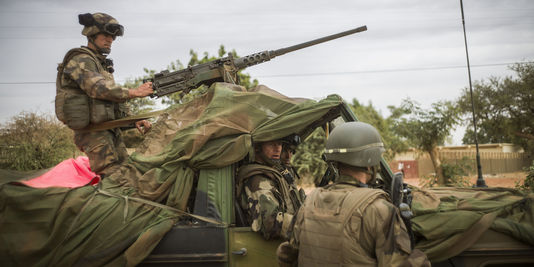
French and Malian military forces have retaken the city of Gao.

armeefrancaiseagao

Le Monde reports that on the French government’s statements on the taking of Gao.

The combined French and Malian government forces are now reportedly advancing into Timbuktu, which has been held by Islamist militants for months. BBC and Le Monde report on the advance toward Timbuktu and the seizure of the city’s airport.

Meanwhile, the mayor of Timbuktu has indicated that militants have destroyed a library that housed historic manuscripts in the city. Timbuktu has been an important center of learning and Islamic legal thought, as well as a major trading center on the Trans-Saharan caravan routes, since the 12th century. The Islamic militant groups that seized control of Timbuktu last year have reportedly destroyed Sufi tombs and other historic sites in the city over several months. The loss of the Timbuktu’s important manuscript collections and religious sites is tragic for the citizens of Mali and for the historians of Africa, Islam, legal history, and comparative religion. The Guardian and the Washington Post report on this story.

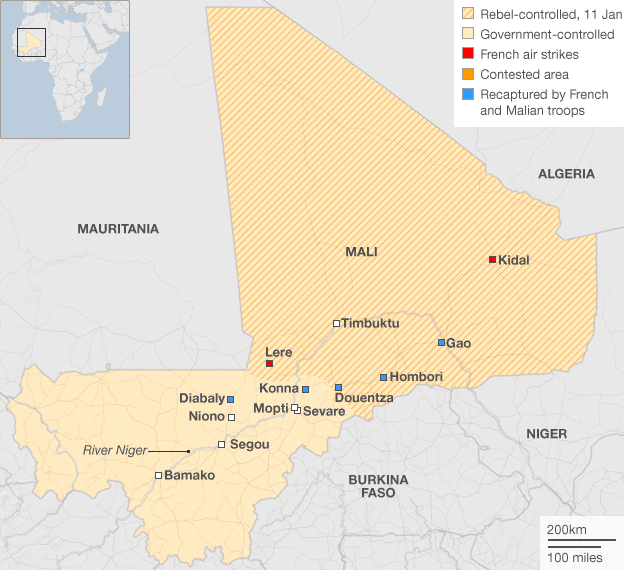
The military situation on the ground is clearly fluid at this point.  The BBC provides this map illustrating strategic sites that have been involve in the fighting:

mali-conflict

Posted in Civil Conflict, Early Modern World, French History, History of the Book, History of Violence, Religious Violence, Strategy and International Politics, War, Culture, and Society | Leave a comment

First-Person War on Film

Warfare is now filmed by participants and observers with an intimacy and immediacy never before possible.

lookingbehindsightlines

Soldiers, journalists, and civilians in the Iraq War, Afghan War, Syrian Civil War, and other current conflicts are able to use micro digital cameras mounted on their helmets, smart phones, and rooftops to observe violence. Video clips can then be quickly uploaded to YouTube and other media distribution and exchange websites, where a video has the potential to go viral.

The perspectives offered by first-hand participant-observers can be fascinating, but risk offering completely decontextualized episodes of violence that offer the thrill of first-person shooter video games, but little of the “reality” of warfare.

The Washington Post reports on first-person video shot by U.S. soldiers in Afghanistan.

Students in HIST 390 History and Film: War on Film will be interested in this piece.

Posted in Civil Conflict, Historical Film, History of Violence, Strategy and International Politics, War in Film, War, Culture, and Society | Leave a comment