Addio Berlusconi!

Italian Prime Minister Silvio Berlusconi resigned over the weekend, in the midst of a major debt crisis in Italy. Rising interest rates and a market downturn finally forced Berlusconi to step down after passing austerity measures. La Repubblica, Corriere della Sera, La Stampa, BBC, and the New York Times reported Berlusconi’s resignation and have full coverage of the political transition.
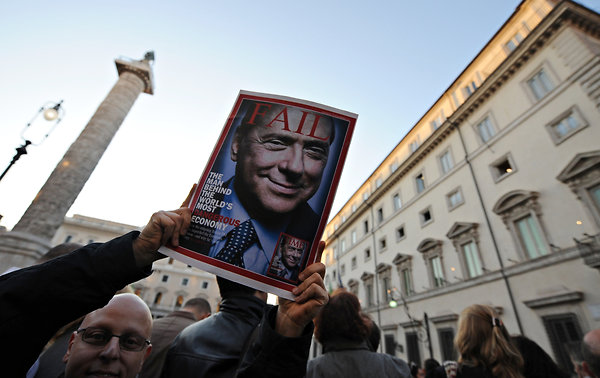
Crowds gathered in Rome and other cities across Italy to celebrate the end of Berlusconi’s government. La Repubblica reports on the celebrations, which included a performance of Handel’s “Hallelujah Chorus” and cries of “Buffone! Buffone!” directed at Berlusconi.

Mario Monti, an economist, has been appointed by Italian President Giorgio Napolitano to head a technocratic government. Sylvia Poggioli of NPR reports on Mario Monti’s attempts to form a new government. Meanwhile, columnist Beppe Severgnini, of Corriere della Sera, provides a commentary on the meaning of Berlusconi’s resignation for Italian society and politics.

Many Italians are bidding “Addio Berlusconi!” — goodbye to Silvio Berlusconi, his bunga-bunga scandals, and his corrupt politics. Italian politics remains in crisis, but new possibilities and new directions seem to be opening up.

Posted in European Union, Italian History | Leave a comment

Debate over Warrior Pursuits

A new review of my book, Warrior Pursuits, has been published by Professor Jay M. Smith in H-France Review.

The book review editor at H-France invited me to write a response to Smith’s review, which has now been published along with Smith’s review in the November issue of H-France Review online.

I hope that the review and response provoke some debate over noble culture and civil conflict in early modern France, as well as over methodological approaches for studying elites and civil violence in comparative contexts.

The full citation for the review and response is:

Brian Sandberg, Warrior Pursuits: Noble Culture and Civil Conflict in Early Modern France., Baltimore: The Johns Hopkins University Press, 2010. xxx + 393 pp. Table, illustrations, notes, bibliography, and index. $60.00 U.S. (cl). ISBN 10: 0-8018-9729-7

Review Review by Jay M. Smith, University of North Carolina at Chapel Hill.
H-France Review Vol. 11 (November 2011), No. 245

Response by Brian Sandberg, Northern Illinois University.
H-France Review Vol. 11 (November 2011), No. 246

Posted in Civil Conflict, Current Research, Early Modern Europe, European History, European Wars of Religion, French History, French Wars of Religion, History of Violence, Noble Culture and History of Elites, War, Culture, and Society, Warfare in the Early Modern World | Leave a comment

Italian Neo-Fascism and the Veneration of Il Duce

Neo-Fascism is alive and well in modern Italy, where a range of extremist groups and political parties celebrate the fascist history of Italy.

Frequent commemorations of the death of the Italian dictator Benito Mussolini, who is venerated as “Il Duce”, display the continuing fascination with fascism in Italy.

Each year, tens of thousands of visitors flock to see Mussolini’s tomb in the town of Predappio, in central Italy.  The New York Times reports on the neo-fascist commemorations at Mussolini’s tomb. In other parts of Italy, Mussolini calendars and fascist memorabila are readily available at news stands and in markets.  Neo-fascist political parties and social groups routinely organize rallies in public squares and streets.

Neo-fascist parties may be relatively small in Italy and many other European nations, but they are vocal and seem to be growing.  Mussolini commemorations and neo-fascist tourist activities suggest a disturbing acceptance of fascist conceptions of the past and present.

Posted in European History, European Union, History of Violence, Italian History, War, Culture, and Society | Leave a comment

Review of Warrior Pursuits by Frederic J. Baumgartner

A new review of Warrior Pursuits has just been published in the latest issue of the Journal of Military History.

The table of contents of this issue of JMH may be found online.  The review itself may be accessed through the EBSCO database at most major libraries.

The full citation for the review is: Warrior Pursuits: Noble Culture and Civil Conflict in Early Modern France, by Brian Sandberg, reviewed by Frederic J. Baumgartner, The Journal of Military History 75 #4 (October 2011): 1286-1287.

Posted in Civil Conflict, Early Modern Europe, European History, European Wars of Religion, French Wars of Religion, History of Violence, Noble Culture and History of Elites, Religious Violence, War, Culture, and Society, Warfare in the Early Modern World | Leave a comment

Galileo in the News

A new book about Galileo Galilei’s approach to natural philosophy and mathematics has put Galileo in the news once again.

Professor Mark A. Peterson’s Galileo’s Muse: Renaissance Mathematics and the Arts (Harvard University Press, 2011), reexamines Galileo’s method of using of ancient mathematics.

The Chronicle of Higher Education reports on the book.

I have not yet had a chance to read Peterson’s book, but will update this post once I get a hold of the book.

Posted in Early Modern Europe, Early Modern World, European History, History in the Media, History of Science, Renaissance Art and History | Leave a comment

Review of Warrior Pursuits by Robert A. Nye

A new review by Professor Robert A. Nye of my book, Warrior Pursuits: Noble Culture and Civil Conflict in Early Modern France, has just appeared in the Journal of Interdisciplinary History.

I am pleased to read Professor Nye’s critique of my book, since he has worked extensively on French nobles and masculinity. Nye’s Masculinity and Male Codes of Honor in Modern France (Oxford: Oxford University Press, 1993) is one of the earliest serious studies on noble honor to employ history of masculinity approaches.

Professor Nye’s review is available as a .pdf download, but only through individual journal subscriptions to the Journal of Interdisciplinary History or through library databases.

Posted in Civil Conflict, Current Research, Early Modern Europe, Early Modern World, European Wars of Religion, French History, French Wars of Religion, History of Violence, Languedoc and Southern France, Noble Culture and History of Elites, Religious Violence, War, Culture, and Society | Leave a comment

History of the World in 100 Objects

The British Museum offers a history of the world through some of its celebrated objects.

The museum is publishing a book entitled, A History of the World in 100 Objects, based on a BBC Radio 4 program on the same concept. The radio show constructed its history in a series of short episodes that were presented by Neil MacGregor, who is director of the British Museum.

The New York Times reports on the new book, which is being released in the United States.


Posted in Art History, Digital Humanities, Early Modern World, Globalization, History in the Media | Leave a comment

Oligarchies and Wealth Defense

The Occupy Wall Street movement has brought great attention to the problems of wealth concentration and income disparities in the United States.

An understanding of American elites has been missing from the debates over tax policies and financial reform following the 2008 financial crisis.

WBEZ’s Worldview now provides an in-depth discussion of the role that elites play in American political economy. Professor Jeffrey Winter of Northwestern University is interviewed on Worldview about his new book Oligarchy, a study of the history of oligarchies and wealth defense.

The history of elites has long been ignored by social and cultural historians, who have been more interested in studying “history from below.” A critical comparative history of elites is desperately needed in order to assess patterns of economic, military, and political domination in societies. Scholars such as Jonathan Dewald and Hamish Scott have laid a groundwork for the comparative study of nobilities and elites.  More research on elites could effectively build on this research to demonstrate the differing modes of power deployed by elites in societies around the world.

My own research deals with French noble culture in the early modern period, including their ways of mobilizing wealth and protecting their patrimonies.  Their methods seem to fit with some of the notions of “wealth defense” articulated by Winters. I have developed a course on early modern European nobilities and hope to teach it soon at Northern Illinois University.


Posted in Globalization, History in the Media, Noble Culture and History of Elites | Leave a comment

L’Histoire globale

World history and global thematic perspectives have become integral parts of European history, at least as practiced in the United States. Historians in France are now increasingly grappling with how to mesh global historical interpretations with French national history, which is often viewed as part of la patrimoine, or the French national patrimony. The problem, then, is how to consider global perspectives that sometimes clash with the powerful French concepts of citizenship and national heritage that are present in French historical writing and teaching—as well as in representations of history in French media and popular culture.

An article in Le Monde reports on how the tensions between transnational global history and national French history have emerged at the current Les Rendez-vous de l’Histoire conference being held in Blois on the theme of “L’Orient.”

Posted in Conferences, Early Modern Europe, Early Modern World, European History, French History, Globalization, Mediterranean World | Leave a comment

Braudel Revisited

My latest book review, of a collective volume entitled Braudel Revisited: The Mediterranean World, 1600-1800, has been published online in H-France Review.

Here is the full citation:

Gabriel Piterberg, Teofilo F. Ruiz, and Geoffrey Symcox, eds., Braudel Revisited: The Mediterranean World, 1600-1800, UCLA Center/Clark Series, 13. Toronto: University of Toronto Press, 2010. vii + 281 pp. Notes. $65.00 U.S. (cl). ISBN 978-1-4426-4133-4.

Review by Brian Sandberg, Northern Illinois University.
H-France Review Vol. 11 (October 2011), No. 218.

Students in HIST 458 Mediterranean World, 1450-1750 will be interested in this review, as well as the collective volume that it assesses.


Posted in Current Research, Early Modern Europe, Early Modern World, European History, Mediterranean World | Leave a comment