Runaway Societies and Stateless Peoples

Runaway societies, or maroon communities, have been known for centuries. Some African slaves in the early modern Caribbean and South America were able to escape from plantations and form their own communities in dense rainforests and mountainous areas. Other stateless peoples have been discerned by historians studying various geographic regions and historical periods.

Now, a new book by anthropologist James C. Scott examines stateless peoples in current Southeast Asia. Scott claims that approximately 100 million people live in runaway societies in the mountainous regions of countries such as Vietnam,
Burma, Cambodia, Laos, and Thailand, and Burma. His book ascribes considerable agency to these peoples, arguing that “ethnic identities in the hills are politically crafted and designed to position a group vis-à-vis others in competition for power and resources.”

Scott’s book has already provoked significant controversy among scholars studying Southeast Asia and state development theory.

The Chronicle of Higher Education reports on the debates aroused by Scott’s book.

I look forward to reading Scott’s book soon myself.

Posted in Empires and Imperialism, Globalization, State Development Theory | Leave a comment

Understanding Europe

American business students often wonder why they should be concerned with learning about European culture, society, and history.

Here are a few data points that suggest the importance of Europe for American businesspeople and for the American economy:

The American Chamber of Commerce to the European Union emphasizes that: “Total US investment in Europe amounts to $700 billion, and supports over 4 million jobs.”

According to the European Commission of the European Union: “In 2006 the EU and the US combined economies accounted for nearly 60% of global GDP, 33% of world trade in goods and 42% of world trade in services. The EU and the US are each other’s main trading partners. Trade flows across the Atlantic amount to around €1.7 billion every day.”

See the European Commission’s website on trading relations with the United States online for more data on US-EU commerce, which is often referred to as the Transatlantic relationship.

Business students at Northern Illinois University should be aware that the Chicago metropolitan area “has long been a hub of international business activity, home to well over 1,500 foreign-based companies, and with more than $40 billion in foreign direct investment,” according to World Business Chicago. Many of these foreign-based companies—such as Siemens, K+S AG, Lufthansa, Deutsche Telekom, Willis, Unilever, and Nestle—are from European countries.

As a French historian, I am particularly interested in Franco-American business connections in Chicago. French-based companies such as Veolia Environment, Alcatel-Lucent, and Schnieder Electric all have a major presence in the Chicago area.  Aon, Hyatt, McDonald’s, Kraft, and other Illinois-based companies do extensive business in France.

World Business Chicago also lists 79 Consulates, at least 40 international or ethnic Chambers of Commerce, and numerous foreign-based trade organizations located in Chicago.

Northern Illinois University students interested in working for European companies in the United States or for American companies doing business in Europe need to have a firm grasp of European culture and history. A working knowledge of European languages and an appreciation of European history can provide students with a real edge in the international job market.

NIU has a variety of international and study abroad programs that support European studies through linguistic, historic, literary, and political science approaches.

Posted in Education Policy, European History, French History, Globalization, Humanities Education, Northern Illinois University | 1 Comment

France’s New Role in North Africa

France has played a prominent diplomatic and military role in the revolutions and civil conflicts in the Arab world this year. President Sarkozy intervened early in the Libyan Civil War, supporting the rebel groups opposing Qaddafi in Libya.

France has a history of colonial and neocolonial relationships with the region of North Africa, and its policies affect the entire Mediterranean world.

NPR reports today on France’s new role in North Africa.

Posted in Civil Conflict, Comparative Revolutions, French History, Mediterranean World | 1 Comment

DNA Evidence of the Black Death

The Black Death is back in the news.

Several teams of scientists have been working over the past decade to extract DNA evidence from bodies of victims of the Black Death in fourteenth-century Europe.

The latest findings confirm several other teams’ work in identifying Yersinia pestis as the microbe responsible for the Black Death pandemic. More research is needed to determine the pattern of transmission of the disease, however, since it spread much more rapidly than modern forms of the bubonic plague.

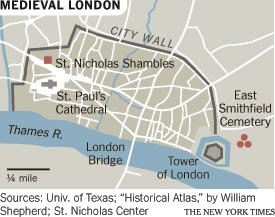
The New York Times reports on the latest team’s research on bodies from a London cemetery.


Posted in Early Modern Europe, Early Modern World, European History, History in the Media, History of Medicine, Renaissance Art and History | Leave a comment

Historical Research and Human Subjects

Academic researchers who work on human subjects are required to request authorization from boards that review research methods for potential ethical violations. The goal is to ensure that human subjects in research studies (especially medical experiments, drug trials, and psychological studies) are not harmed.

Historians and other humanities scholars have to submit reports and statements to such boards as a routine part of their grant and fellowship applications, even if their human subjects cannot possibly be harmed.  I often report that my research will not harm the French and Italian subjects of my research, since they have been dead for over 400 years. This sort of reporting wastes time and energy of researchers and research boards.

Now, it seems that a new procedure may soon exempt historians and some other scholars from these unnecessary bureaucratic procedures. The Chronicle of Higher Education reports that new human research guidelines are currently being considered that would change the requirements.

Posted in Academic Freedom, Archival Research, Graduate Work in History, Humanities Education | Leave a comment

Climate Change and Civil Conflict

For decades, historians have examined evidence of correlations between climate change and civil conflict. Bad weather and sustained droughts have often been seen as causes of  peasant revolts and revolutions, such as the French Revolution of 1789, yet these arguments often consider localized weather factors, rather than global climate in their analyses.

One of the most exciting areas of research on climate change and civil conflict involves global cooling in the early modern period. Some historians have argued that the peak of the Little Ice Age in the seventeenth century contributed significantly to civil unrest and political conflicts such as the Thirty Years’ War, the English Civil Wars, and the Fronde. Various theories of a General Crisis of the Seventeenth Century have been developed to explain links between climate change, economic disruption, and social conflict.  For a recent reappraisal of these debates, see a forum on “The General Crisis of the Seventeenth Century Revisited,” published in American Historical Review 113 (October 2008): 1029-1099.

Now, a new scientific study argues that the El Niño climate pattern has significantly influenced civil conflicts in the tropical regions of the world since the 1950s. The research is based on a statistical analysis of civil conflicts and unrest between 1950 and 2004, finding that civil conflicts occurred twice as often in El Niño years.

This new research is published as:

Solomon M. Hsiang, Kyle C. Meng, and Mark A. Cane, “Civil Conflicts are Associated with the Global Climate,” Nature 476 (25 August 2011): 438-441.

This study is controversial because of its definitions of civil conflict and its assumptions about the causation of civil wars. Andrew R. Solow criticizes the Hsiang et al study in Nature 476 (25 August 2011): 406-407, suggesting that Hsiang and his colleagues may be going too far in arguing that climate change actually causes civil conflicts (as opposed to worsening them). Solow asserts that “Whether global climate variations give rise to new civil conflicts or modulate existing ones would seem to have somewhat different implications for improving the situation.”

Historians of civil conflicts and revolutions will be interested in this new research, although I suspect many will find the study’s assumptions and methods problematic.

NPR provides a brief report on the new study and other news media are reporting this story.

Posted in Civil Conflict, Environmental History, French Revolution and Napoleon, History of Violence, War, Culture, and Society, Warfare in the Early Modern World | 1 Comment

Today’s College Freshmen

Welcome to the beginning of the 2011-2012 academic year as summer ends and classes begin again.

Each fall semester, Beloit College publishes “The Mindset List,” a humorous attempt to capture the attitudes and experiences of incoming college freshmen students.

Here are a few of the descriptions of today’s college freshmen:

  • There has always been an Internet ramp onto the information highway.
  • Ferris Bueller and Sloane Peterson could be their parents.
  • Amazon has never been just a river in South America.
  • Refer to LBJ, and they might assume you’re talking about LeBron James.
  • We have never asked, and they have never had to tell.
  • There has never been an official Communist Party in Russia.
  • Video games have always had ratings.
  • The Rocky Horror Picture Show has always been available on TV.
  • Jimmy Carter has always been a smiling elderly man who shows up on TV to promote fair elections and disaster relief.
  • Women have always been kissing women on television.
  • Music has always been available via free downloads.
  • Sears has never sold anything out of a Big Book that could also serve as a doorstop.
  • No state has ever failed to observe Martin Luther King Day.
  • Public schools have always made space available for advertising.
  • They’ve often broken up with their significant others via texting, Facebook, or MySpace.
  • Andy Warhol is a museum in Pittsburgh.

“The Mindset List” is available at Beloit College’s website.

Posted in Education Policy, Humanities Education, Northern Illinois University | Leave a comment

A Publishing Revival

Publishers have been complaining for years of a publishing crisis, while pundits portend the end of the physical book.  The financial crisis of 2008 fueled increased apocalyptic fears among many writers and editors, which were later heightened by the bankruptcy of Borders.

New data suggests that a publishing revival may be gathering steam.  The New York Times reports that book sales in various sectors have been stronger than expected.

The field of publishing—and especially academic publishing—continue to face numerous challenges and transformations, but don’t count the book out just yet.

Posted in Academic Publishing, History of the Book | Leave a comment

Devotion, Discipline, Reform: Conference at the Newberry Library

September 15 – 17, 2011

Devotion, Discipline, Reform: Sources for the Study of Religion, 1450-1640
A Conference in Honor of Sister Ann Ida Gannon, BVM

The Newberry Library, Chicago

http://www.newberry.org/renaissance/conf-inst/devotion.html

Printable flier:
http://www.newberry.org/renaissance/conf-inst/DevotionConference.pdf

Speakers include:
Gregory R. Crane, Classics and Computer Science, Tufts University
David Crook, Music, University of Wisconsin-Madison
Lori Anne Ferrell, English and History, Claremont Graduate University
Alexander J. Fisher, Music, University of British Columbia
M. Patrick Graham, Theological Bibliography, Candler School of Theology,
Emory University
Susan Karant-Nunn, History, University of Arizona
Elsie Anne McKee, Reformation Studies and History of Worship, Princeton
Theological Seminary
Walter S. Melion, Art History, Emory University
Mary Quinlan, Art History, Northern Illinois University
Brian Sandberg, History, Northern Illinois University
Regina M. Schwartz, Religion, Literature, and Law, Northwestern University
David Steinmetz, History of Christianity, The Divinity School, Duke
University

Free and open to the public; registration in advance is required.

Posted in Conferences, Early Modern Europe, Religious Violence, Warfare in the Early Modern World | Leave a comment

H-France Webinars

H-France is launching a webinar series beginning this fall.

Graduate students in History at NIU, as well as undergraduate students in HIST 311 Early Modern France, 1500-1789 and HIST 423 French Revolution and Napoleon will be interested in this series.

Here is the announcement from H-France:

H-France is launching its webinar series this fall.  Designed particularly for graduate students, the seminar is open to anyone.  Information will be forthcoming in the fall to aid with technical issues.

The first webniar, organized by Charles Walton, Yale University, will occur on Thursday, October 6, 2011 at 4:00-5:30 pm e.t.

The webinar will be led by Lynn Hunt, UCLA, on the topic “The Age of Revolutions in Global Context.”  The three readings for the webinar are as follows:

  • Lynn Hunt, “The French Revolution in Global Context,” in David Armitage and Sanjay Subrahmanyam (eds.), The Age of Revolutions in Global Context, c. 1760-1840 (New York:  Palgrave Macmillan, 2009).
  • Suzanne Desan, “Transatlantic Spaces of Revolution: The French Revolution, Sciotomanie, and American Lands,” Journal of Early Modern History 12 (2008), pp. 467-505.
  • William Max Nelson, “Making Men: Enlightenment Ideas of Racial Engineering,” American Historical Review 115 (December 2010): 1364-1394.

We certainly would encourage you to include the seminars in any appropriate graduate courses you may be teaching or recommending it to your graduate students.

Further details on the seminar will be provided in the fall.

Posted in Comparative Revolutions, Early Modern Europe, French History, French Revolution and Napoleon, Graduate Work in History, History in the Media, Human Rights, The Past Alive: Teaching History | Leave a comment