French Intellectuals in the Media

France has long had a robust history of public intellectuals—Renaissance essayists  such as Michel de Montaigne, Enlightenment philosophes such as Voltaire, and modern philosophers such as Sartre. Tony Judt and other French historians have traced the developments in modern French intellectual history and philosophy.

Robert Zaretsky, a French historian, now adds a commentary on the current state of French public intellectuals in a review of Pascal Boniface’s Les Intellectuels Faussaires
(“The Counterfeit Intellectuals”). Zaretsky’s review is published in the Chronicle of Higher Education as a selection for subscribers only, but may be accessed through most university libraries’ online databases.

Graduate students in French history and literature courses may be interested in this story.

Posted in Academic Publishing, European History, French History, History in the Media, History of the Book, Human Rights | Leave a comment

Dissertation Travels and Archival Research

Historians are used to traveling for research. Most graduate students and professors of history head to archives and specialized research libraries to consult manuscripts, rare books, and printed documents. Although a some important document collections have been digitized, the vast majority of archives may only be accessed by traveling to specialized collections. Archival research remains the vital field work of most historians.

A doctoral student in history at the University of Texas at Austin chronicles her experiences traveling to do archival research for her dissertation in a piece in the Chronicle of Higher Education.

Of course, this student’s research travels in the United States seem remarkably easy (and even quaint) compared with the complexities and costs of traveling to European, Asian, Latin American, or African archives. Doctoral students traveling to collections abroad normally have to deal with using foreign languages, employing other currencies, learning different housing procedures, navigating government bureaucracies, discerning archival policies, and appreciating local cultures.

But, then again, traveling abroad is part of the allure of studying the history of other cultures!

Posted in Archival Research, European History, Graduate Work in History | Leave a comment

The Antichrist in Politics

Historians and students of the Reformation are very familiar with the role of the Antichrist in religious reformers’ thinking and religious politics. Bob Scribner’s classic study, For the Sake of Simple Folk, analyzes Lutheran print propaganda, including imagery of the Antichrist. The Four Horsemen of the Apocalypse, by Ole Peter Grell and Andrew Cunningham, emphasizes the Apocalyptic culture of the Reformation period, which envisioned the Antichrist as already active in fomenting evil on the earth. Many Reformation leaders believed that the Last Days were coming in their own lifetime.

The concept of the Antichrist is alive and well in American politics today.  An op-ed in the New York Times by Matthew Avery Sutton, Associate Professor of History at Washington State University, discusses the role that the Antichrist plays in current politics in the United States.


Posted in Early Modern Europe, Early Modern World, European Wars of Religion, French Wars of Religion, Religious Violence | Leave a comment

States of Early Modernity: Symposium at the Newberry

Newberry Center for Renaissance Studies

A Symposium and Workshop on States of Early Modernity

Registration deadline: Friday, September 30
Symposium: Friday, October 14, 2011, 9 a.m. to 5 p.m.

Leaders:
Crystal Bartolovich, Syracuse University
Victoria Kahn, University of California, Berkeley
Ania Loomba, University of Pennsylvania
Mark Netzloff, University of Wisconsin-Milwaukee

http://www.newberry.org/renaissance/conf-inst/EarlyModernity.html

Printable PDF flyer – please feel free to distribute and post: http://www.newberry.org/renaissance/conf-inst/StatesOfEarlyModernity.pdf

This program is free and enrollment is not limited, but registration in advance is required. Readings will be precirculated electronically to registrants.

Faculty members and graduate students from member institutions of the Center for Renaissance Studies consortium may be eligible to apply for travel funding to attend this program. See http://www.newberry.org/renaissance/consortium/ReimburseInfo.html for details.

Posted in Conferences, Early Modern Europe, Early Modern World, Empires and Imperialism, State Development Theory | Leave a comment

Early Modern French Historian Wins MacArthur Fellowship

Jacob Soll, a historian of early modern French history, has won one of the prestigious MacArthur Fellowships.

Soll works on information management and state development in early modern France.  He has published books on Publishing ‘The Prince’, about a French translation of Machiavelli’s famous work, and The Information Master, a study of Jean-Baptiste Colbert’s methods of organizing information during Louis XIV’s reign.

The MacArthur Foundation introduces Jacob Soll and all of this year’s MacArthur Fellows at their website.

Graduate students in early modern European history will want to find out about Jacob Soll’s work and his award.

Posted in Early Modern Europe, French History, Humanities Education | Leave a comment

Libyan Women at War

Libyan women have been closely involved in the Libyan Civil War over the past six months. Many Libyan women have participated in the Civil War as combatants, logistical supporters, medical assistants, and family mangers.

An article in the New York Times reports on Libyan women’s experiences of civil warfare and their status in the emerging Libyan society.

Posted in Civil Conflict, Comparative Revolutions, Gender and Warfare, War, Culture, and Society, Women and Gender History | Leave a comment

Devotion, Discipline, Reform Conference

September 15 – 17, 2011

Devotion, Discipline, Reform: Sources for the Study of Religion, 1450-1640
A Conference in Honor of Sister Ann Ida Gannon, BVM

The Newberry Library, Chicago

http://www.newberry.org/renaissance/conf-inst/devotion.html

Printable flier:
http://www.newberry.org/renaissance/conf-inst/DevotionConference.pdf

Speakers include:
Gregory R. Crane, Classics and Computer Science, Tufts University
David Crook, Music, University of Wisconsin-Madison
Lori Anne Ferrell, English and History, Claremont Graduate University
Alexander J. Fisher, Music, University of British Columbia
M. Patrick Graham, Theological Bibliography, Candler School of Theology,
Emory University
Susan Karant-Nunn, History, University of Arizona
Elsie Anne McKee, Reformation Studies and History of Worship, Princeton
Theological Seminary
Walter S. Melion, Art History, Emory University
Mary Quinlan, Art History, Northern Illinois University
Brian Sandberg, History, Northern Illinois University
Regina M. Schwartz, Religion, Literature, and Law, Northwestern University
David Steinmetz, History of Christianity, The Divinity School, Duke
University

Free and open to the public; registration in advance is required.

Posted in Conferences, Current Research, Early Modern Europe, European Wars of Religion, Religious Violence | Leave a comment

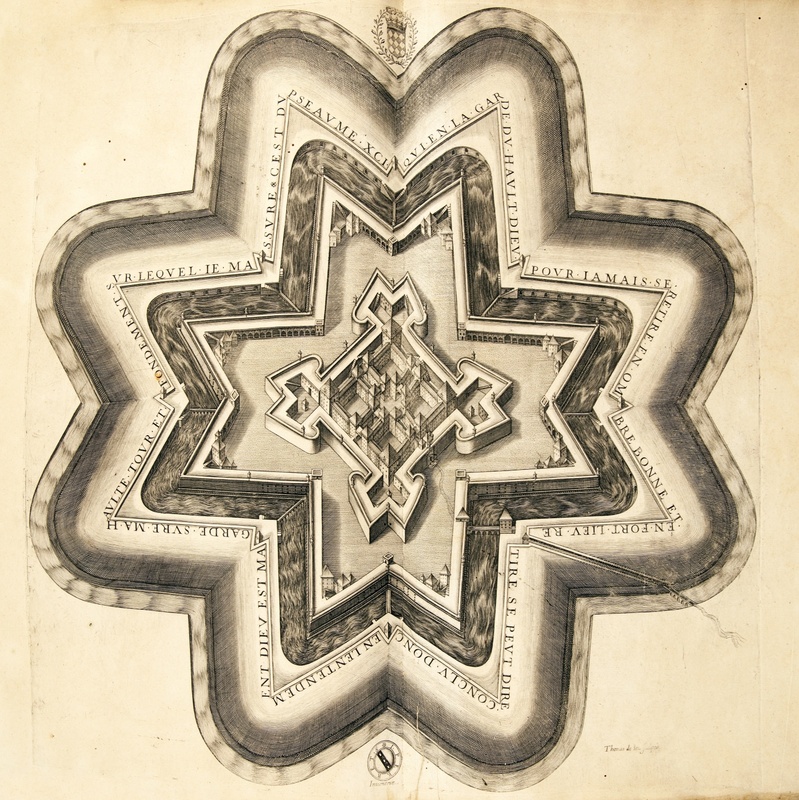
Military Architecture Exhibition at the Newberry Library

The Newberry Library in Chicago is currently presenting an exhibition on “Ballistics and Politics: Military Architecture Books at the Newberry.”

The exhibition includes fortifications treatises, city plans, siege views, and related maps and documents from the early modern period. Some of the items featured in the exhibition relate directly to the French Wars of Religion, the European Wars of Religion, and the Wars of Louis XIV.

The exhibition is on view until 29 October 2011.

For information on the exhibition, see the “Ballistics and Politics: Military Architecture Books at the Newberry” digital exhibition site at the Newberry Library website.

Students in HIST 311 Early Modern France, 1500-1789, HIST 414 European Wars of Religion, and graduate students at Northern Illinois University will be interested in this exhibition.

Posted in Art History, Digital Humanities, Early Modern Europe, Early Modern World, European Wars of Religion, French Wars of Religion, History of Violence, Renaissance Art and History, War, Culture, and Society, Warfare in the Early Modern World | Leave a comment

Michael Sells on Religious Violence

Michael Sells, Professor of Islamic History and Literature at the University of Chicago, discussed contemporary issues of religious violence today on WBEZ’s Worldview with host Jerome McDonnell.

Sells is the author of a number of books on Islamic culture and on issues of religious violence, including The Bridge Betrayed: Religion and Genocide in Bosnia, and The New Crusades: Constructing the Muslim Enemy.

Northern Illinois University graduate students who have taken HIST 640 Religious Violence in Comparative Perspective will be interested in this discussion. The podcast of the program may be accessed on the Worldview website.

Posted in History of Violence, Religious Violence, Terrorism, War, Culture, and Society | Leave a comment

NIU Professors Comment on Libyan Civil War

The Northern Illinois University community is following developments in the Libyan Civil War and the revolutionary conflicts in the Arab World.

NIU student journalist Eric Nofsinger recently asked several professors, including me, to comment on the Libyan Civil War for an article in the NIU student newspaper, the Northern Star.  I contributed a historical perspective on civil warfare to the article, while other NIU professors offered political and philosophical commentaries on the conflict.

The article appeared in yesterday’s Northern Star.


Posted in Civil Conflict, Comparative Revolutions, Current Research, History of Violence, Northern Illinois University, War, Culture, and Society | Leave a comment