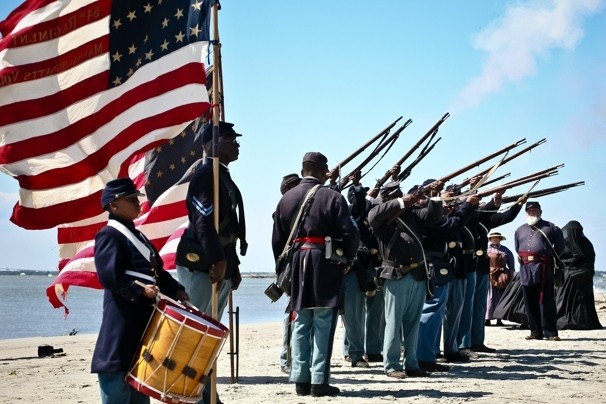
54th Massachusetts Reenactors

As the 150th anniversary of the American Civil War unfolds, historical reenactors are enthusiastically commemorating most of the major events of the war.

African-Americans are apparently getting involved in Civil War historical reenactment in increasing numbers. One new group has created a unit to honor the famous 54th Massachusetts Colored Infantry, the first African-American regiment of the Civil War whose service was portrayed in the 1989 film Glory.
Historical film and historical reenactment are often closely associated, especially in the case of war films. Filmmakers working on historical subjects frequently rely on reenactors to participate in battle scenes, parade scenes, and camp scenes. Historical reenactors also seem to be an important audience for historical films.

The Washington Post reports on the African-American reenactors who portray the 54th Massachusetts soldiers.

Students in HIST 390 War in Film will be particularly interested in this story.

Posted in Civil Conflict, Historical Film, History in the Media, War in Film, War, Culture, and Society | Leave a comment

Controversial Steve Reich WTC Album Cover

A new album of composer Steve Reich’s music, performed by the Kronos Quartet, is stirring controversy. The album cover uses an iconic September 11 photo of the second plane just before it crashes into the World Trade Center. Reich’s composition, WTC 9/11 deals precisely with the September 11 Attacks, so the choice of photo seems entirely appropriate from a historian’s point of view. Yet, the album cover has already been criticized by some viewers, who regard it as shocking and offensive.

NPR discusses this story online. Graduate students who took my recent course, HIST 640 Religious Violence in Comparative Perspective, will be interested in this story. The story also is important for students working on commemoration and historical memory.


Posted in Contemporary Art, Music History, Religious Violence, Terrorism | Leave a comment

E-Book Revolution Transforms Publishing Course

An e-book revolution has been gathering steam and transforming the world of books for at least a decade now.  Academic researchers and writers have been following the changes closely, and participating in many of the new initiatives.  Historians have participated actively in developing e-journals, e-books, multimedia book/DVDs, the e-Gutenberg project, humanities digitization projects, blogs, and web resources.

Meanwhile, the entire publishing industry has been in seemingly perpetual crisis over the past generation. The growth of big box bookstores, the rise of Amazon.com, the decline of independent booksellers, and the weakening of college bookstores have all forced adaptations by academic and independent publishers.  University and independent presses have had to respond to broad market forces and new technologies, often at the cost of less rigorous attention to excellence in publishing.

Now, one of the most important university courses preparing future publishers is getting a radical make-over.  The course at Columbia University is now trying to assess the emerging directions of the ongoing e-book revolution and prepare a new generation of publishers for a radically altered publishing landscape.

The New York Times reports on the course.


Posted in Academic Publishing, Digital Humanities, Education Policy, History of the Book | Leave a comment

French Rocker in American Press

It is rare to see French rock music discussed in American popular culture, but the New York Times ran a fairly long story today about the iconic French rocker Johnny Hallyday.

Johnny Hallyday is an aging rock star and national hero to many French people, who still flock to his concerts. He has crafted dozens of hit albums and done numerous tours across Europe.

Over the past decade, his political commentaries and his criticisms of the French tax code have angered some of his fans, however. His highly-publicized departure from France as a tax exile to Switzerland a few years ago raised a public debate about tax policies and the responsibilities of the rich within French society.

The New York Times reports on Hallyday’s health struggles and his continuing work.

Students of French history will enjoy discovering Johnny Hallyday and his music.

Posted in French History, Music History | Leave a comment

The Fall of the Faculty

What is the biggest problem in American universities?

According to Benjamin Ginsberg, a Professor of Political Science at Johns Hopkins University, it is the growth of university administration. Ginsberg describes this growth as “administrative blight,” which has come at the expense of faculty leadership and autonomy at universities—hence the title of his new book, The Fall of the Faculty: The Rise of the All-Administrative University and Why it Matters.

Ginsberg traces the dramatic growth of “deanlings” and other administrators over the past several decades. Across the United States, the number of university administrators has grown by 85% between 1975 and 2005, while the number of professional staff (i.e., bureaucrats) has grown by a shocking 240% in the same period! During the same period of time, faculty positions have only grown by a meager 51%.

Students and parents who are concerned about access to universities and the cost of tuition should examine the growth of administrative and bureaucratic positions closely. Most of the administrative positions, and many of the bureaucratic ones, command higher salaries than faculty positions.

Want to control the price of higher education? Examine cuts in excessive bureaucracy and extraneous student “services” (entertainment, recreation, sports, etc.) that are peripheral to the educational mission of universities.

Inside Higher Ed has an interview with Benjamin Ginsberg. Thanks to Taylor Atkins and Rebecca Hannagan for the link. I am looking forward to reading Ginsberg’s book.

Posted in Academic Freedom, Education Policy, Humanities Education | 1 Comment

Genealogist Challenges DAR

Amateur genealogist Wayne Bates is challenging the Daughters of the American Revolution (DAR) over the rejection of his relative’s application for recognition of their ancestor as a veteran of the Continental Army during the American War of Independence. Wayne Bates is contesting the rejection and questioning the DAR’s policies.

This clash raises interesting issues for historians, who do not engage in genealogy but who deal with historical records of families from the past. Historians have to grapple with contested conceptions of family and lineage, which have not been stable in the past. Members of the current Bates “family” is here trying to establish a fixed Bates “lineage” to support their current aims and agendas. The DAR is defending its definitions of “lineage” and military service in the interests of its current members and their lineages. Family history thus intersect with family politics at the heart of this clash.

Historians often encounter genealogists and their research. Academic historians work alongside genealogists, both amateur and professional, in archives around the world. Historians of the family routinely use genealogies that have been produced by genealogists in the past, even though these sources are incredibly complex and problematic as historical sources. Genealogy, family history, and local history are major areas of interest for many people who have never studied history as an academic subject.

History students and professional historians arguably need to become more aware of the multiple encounters between history and genealogy.

The Washington Post reports on the story.

Posted in Archival Research, Comparative Revolutions | Leave a comment

Mediterraneans Abandon Diet

For decades, nutritionists have celebrated the concept of the “Mediterranean Diet,” touted for its focus on vegetables, fish, and minimal meat. Historians and anthropologists have long considered the concept problematic, since actual diets vary widely across Mediterranean societies.

Whatever the benefits of the “Mediterranean Diet,” it seems that many people around the Mediterranean Sea are radically changing their food consumption habits, eating much more meat and fast food. This is hardly a surprise for historians who have spent time in Mediterranean countries doing research over the past decade or so.

Students in HIST 458 The Mediterranean World at NIU will be interested in a report on NPR that discusses the changing “Mediterranean Diet.”

Posted in Food and Cuisine History, French History, Italian History, Mediterranean World | Leave a comment

US-France Women’s World Cup Match

French historian Laurent Dubois commented on the US-France Women’s World Cup match yesterday.

Dubois is a historian of the French Revolution in the Caribbean, but he recently published a book on soccer and politics in France.

Dubois’s comments on the Women’s World Cup can be heard on PRI’s The World.


Posted in French History | Leave a comment

KUT’s Texas Music History

University of Texas at Austin’s KUT radio station has created a streaming mix of Texas music history that is worth checking out.

Texas music history is much more diverse than most people realize.

NPR has the story and the mix online.


Posted in Music History | Leave a comment

Berlusconi’s Bad Week

Italian Prime Minister Silvio Berlusconi is having a bad week.

Berlusconi announced earlier this week that he would not run for re-election, although some observers see this simply as a political maneuver.

Now, Berlusconi’s company Fininvest has lost a legal case and has been ordered to pay 560 million Euros in damages to a rival company over bribery allegations in Fininvest’s acquisition of the publisher Mondadori.

BBC reports on the story, as does La Repubblica.


Posted in European Union, Italian History | Leave a comment