EU as the “Sick Man of Europe”

Is the European Union the “sick man of Europe”?

This formulation represents an intriguing twist on historical references to the Ottoman Empire as the “sick man of Europe.”

Eurozine has published a series of articles entitled “Europe Talks to Europe” and a public debate on the theme of the possible disintegration of the European Union, using the image of the “sick man of Europe.”

Eurozine introduces the public debate by describing the presentation of one of the speakers, Martin Simecka: “Introducing himself as an ‘expert on disintegration’, Slovak writer and journalist Martin Simecka recalled how shortly after 1989, seeing Slovak nationalists in Bratislava, he had the intimation that Czechoslovakia would collapse. Now he has the same forebodings about Europe. You can see this in the language with which Europe is being discussed, he said. When a declaredly Europhile outlet like EUobserver adopts Stalinist vocabulary to describe the institutions of the EU, you know the mood is bad (Simecka was referring to the use of the word ‘troika’ to denote the trio of the European Commission, the European Central Bank and the International Monetary Fund on their recent visit to Lisbon).”

Students in European and Mediterranean history courses, including HIST 423 French Revolution and Napoleon and HIST 458 Mediterranean World, 1450-1750, at Northern Illinois University may be interested in this issue.


Posted in Empires and Imperialism, European History, European Union, Mediterranean World | Leave a comment

Attending to Early Modern Women CFP

Call for Proposals

Attending to Early Modern Women: Remapping Routes and Spaces

June 21-June 23, 2012

Milwaukee, Wisconsin

Attending to Early Modern Women, which has been held seven times at the University of Maryland since 1990, is moving to the University of Wisconsin-Milwaukee, thanks to the generous support of the College of Letters and Science at UWM. The conference will retain its innovative format, using a workshop model for most of its sessions to promote dialogue, augmented by a plenary session on each of the four conference topics: communities, environments, exchanges, and pedagogies. It will be held at the UWM School of Continuing Education Conference Center in the heart of downtown Milwaukee, within easy walking distance of the lakeshore, the Milwaukee Art Museum, the Milwaukee Public Museum, and the Amtrak station.

Attendees will stay in the near-by and newly renovated Doubletree Hotel. The conference will run from Thursday June 21 through Saturday June 23, 2012, and attendees will also have the opportunity to participate in a special pre-conference seminar on Wednesday June 20 at the Center for Renaissance Studies at the Newberry Library in Chicago.

A detailed description of the conference and the call for proposals is now available at: www.atw2012.uwm.edu

Proposals for workshops that address the conference themes may now be submitted, to atw-12@uwm.edu. Deadline: August 31, 2011.

Please forward this call to colleagues and students who you think might be interested.

Posted in Conferences, Early Modern Europe, Early Modern World, Women and Gender History | Leave a comment

Review of Warrior Pursuits

The first review of Warrior Pursuits: Noble Culture and Civil Conflict in Early Modern France has been published.  Professor Phillip John Usher, of Barnard College, reviews my monograph in Renaissance Quarterly.

I am happy that book reviews of Warrior Pursuits are beginning to appear in academic journals.  This review provides more summary than assessment of the book’s arguments, however.

Posted in Current Research, Early Modern Europe, French Wars of Religion, History of Violence, Renaissance Art and History, War, Culture, and Society, Warfare in the Early Modern World | Leave a comment

Business Education as a Model?

Are you sure that you want to take business education as a model?

Many businessmen and higher education “reformers”, such as Jeff Sandefer in Texas (see previous post), argue that business education points the way to “transform” academics for the 21st century.

The Chronicle of Higher Education now reports that: “Business majors spend less time preparing for class than do students in any other broad field, according to the most recent National Survey of Student Engagement: Nearly half of seniors majoring in business say they spend fewer than 11 hours a week studying outside class. In their new book, Academically Adrift: Limited Learning on College Campuses, the sociologists Richard Arum and Josipa Roksa report that on a national test of writing and reasoning skills, business majors had the weakest gains during the first two years of college. And when business students take the GMAT, the entry examination for M.B.A. programs, they score lower than do students in every other major.”

The Chronicle of Higher Education then asks: “And what about employers? What do they want?”

“According to national surveys,” the story continues, “they want to hire 22-year-olds who can write coherently, think creatively, and analyze quantitative data. They’re perfectly happy to hire English or biology majors. Most Ivy League universities and elite liberal-arts colleges, in fact, don’t even offer undergraduate business majors.”

The Chronicle of Higher Education points out that even some business education leaders have doubts about the utility of a business major: “Back in 1980, J. David Hunger, the St. Benedict/Saint John’s fellow, wrote a monograph about the travails of undergraduate business education. He has never quite resolved his ambivalent feelings about the field. ‘At some times in my life,’ he says, ‘I’ve argued that we don’t really need a business major.'”

Want to reduce the costs of higher education?

Reexamining the costs of business schools within university budgets would a good place to start.  According to the recently released AAUP Faculty Salary Survey, which examines academic salaries across the nation, Professors of Business Administration and Management earn on average 50.9% more than Professors of English Language and Literature.

Another place to save money?  Soaring administrative costs.   But, that’s a story for another post.

Meanwhile, read the full story in the Chronicle of Higher Education.

Posted in Education Policy, Humanities Education | Leave a comment

Evaluating Faculty by “Productivity”?

Across the United States, there have been attempts to corporatize universities and to evaluate faculty “productivity” using student evaluations and business metrics.

Now comes news that Texas Governor Rick Perry intervened in academic decision-making, pushing Texas universities to adopt a plan for evaluating and ranking faculty by “productivity” that was developed by a campaign donor, Jeff Sandefer, who is a businessman.

The Chronicle of Higher Education and the Houston Chronicle report that Governor Perry e-mailed University of Texas regents, pressuring them to adopt Sandefer’s plans.

The Houston Chronicle quotes the former President of the University of Texas, Dr. Peter Flawn, who described Perry’s pressuring of the regents “absolutely a new and unique situation.”

Dr. Flawn indicates that Sandefer’s plan would reduce tenured faculty at the University of Texas. He argues “to me, that would be a backward step from a first-class research university to a second-class undergraduate degree mill.”

Sandefer’s plans have sparked significant controversy in Texas, which has now led to the dismissal of Rick O’Donnell, a protégé of Sandefer, as special adviser to the University of Texas Board of Regents.  Read about this development in the Chronicle of Higher Education.

Posted in Academic Freedom, Education Policy, Humanities Education | 1 Comment

Art Attacked in Avignon

Artist and photographer Andres Serrano’s famous photographic work, Immersion Piss Christ (1987), was attacked today in Avignon.  This photograph created a major controversy in the United States over its perceived criticism of Catholicism and ignited a  debate over the public funding of art in the United States Congress.  The media storm around this debate became one of the first major controversies of the so-called “Culture Wars” in American popular culture of the late 1980s and early 1990s.

Apparently, two Catholic activists attacked Immersion Piss Christ with hammers while it was on display in the Collection d’art contemporain Yvon Lambert in Avignon, in southern France.  Read more about this attack in Liberation online.

Students who have taken HIST 640 Religious Violence in Comparative Perspective or HIST 414 European Wars of Religion may be interested in this contemporary story with strong echoes of early modern iconoclasm and religious intolerance.

Posted in Art History, Contemporary Art, French History, Religious Violence, Uncategorized | Leave a comment

Afghan War in Film

A new documentary, Where Soldiers Come From, tells the story of a group of young men from Michigan who enlist in the National Guard and serve in the Afghan War.  The film was screened at the South by Southwest (SXSW) Festival in Austin, Texas.  PBS’s POV will be airing the documentary and has a trailer on the POV website.

POV will air Armadillo, another documentary about the Afghan War, from the perspective of Danish soldiers fighting in Afghanistan, this August.

POV previously aired a documentary, entitled Afghanistan Year 1380, filmed during 2001-2002, before and during the initial phases of United States military intervention in the Afghan War.

Students in HIST 390 Film and History: War in Film may be interested in these documentaries.

Posted in Empires and Imperialism, History of Violence, War in Film, War, Culture, and Society | Leave a comment

The Princess of Montpensier

Bertrand Tavernier’s The Princess of Montpensier has been released.  The film focuses on the life of a young noblewoman at the Valois court during the French Wars of Religion.

The film is an adaptation of a classic early French novel by Marie-Madeleine Pioche de La Vergne, comtesse de La Fayette, published in 1662.  The novel was written during the early reign of Louis XIV, but refers to historical events of the French Wars of Religion of 1562-1629.  The Bibliothèque Nationale de France’s Gallica database has the first edition available for download as a .pdf file.

Reviews of the new film adaptation of The Princess of Montpensier are available at NPR and New York Times websites.  Thanks to Greg Bereiter and Bethany Aidroos, graduate students in early modern French history at Northern Illinois University, for these links.

I missed The Princess of Montpensier at the Landmark Theatre in Chicago, but recently saw it on DVD.  I will post more information on the film soon.


Posted in Early Modern Europe, French History, French Wars of Religion, Gender and Warfare, Historical Film, Religious Violence, War in Film, Warfare in the Early Modern World, Women and Gender History | Leave a comment

University Administrators’ Salaries

Salary inequities continue to get worse at universities and colleges across the United States.  Over the past generation, the number of administrators have grown, while faculty numbers have remained almost constant.  Those administrators’ salaries have also ballooned, while faculty salaries have flat-lined (adjusting for inflation).

Now, the American Association for University Professors (AAUP) has published a new annual salary report showing that university presidents’ salaries have continued to increase during the latest recession (academic years 2007-2008 through 2010-2011).  The AAUP reports that “During this recessionary period, the average salary increase for presidents was twice the average faculty salary increase at public institutions and nearly three times the faculty salary increase at private institutions. Such a disproportionate increase in compensation for a single individual is an indication of misplaced institutional priorities—especially when faculty members and other higher education employees have been faced with involuntary unpaid furloughs, hiring and salary freezes, and cuts to benefits.”

See the AAUP’s summary or the entire 2010-2011 report online.  See the Chronicle of Higher Education or the New York Times for additional reporting on this issue.

Faculty and graduate students at Northern Illinois University should be aware of the issues raised by the AAUP’s report.

Posted in Education Policy, Humanities Education | Leave a comment

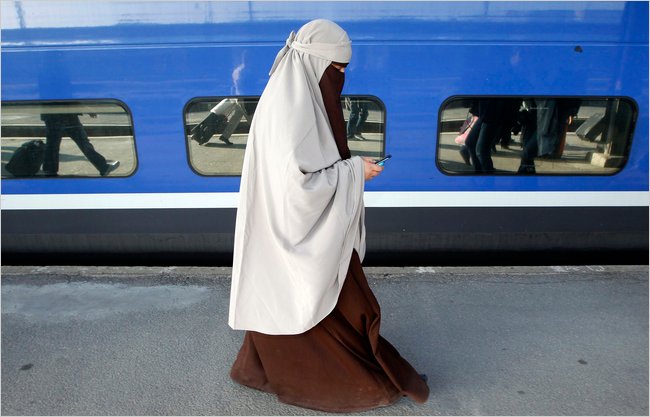
France Bans Niqab

France is implementing a recent law banning the niqab, or full-face veil, in public spaces.  The French notion of laïcité, a version of secularism, is being used to justify outlawing the niqab, as well as to argue for banning other forms of veils.

Women’s rights advocates in France are split on this issue, with some feminists seeing the niqab as a sign of oppression of women and others arguing that women have the right to choose their own attire.  The law stipulates strong punishments for individuals who force women to wear the niqab, suggesting that its authors assume that Muslim women would not voluntarily choose to wear the niqab.  Very few French women currently wear the full-face veil, but the law would also apply to tourists and other visitors to France.  Some critics of the law argue that the law is motivated by racism, anti-Islamic sentiment, and neo-imperial concerns in France.  The ban clearly raises a number of questions about human rights, women’s rights, individual choice, and racism in France and the European Union.

This story will prompt reflections by historians familiar with sartorial regulations, sumptuary laws, and religious conflicts in the early modern period.  My own research deals with the formation of early notions of religious coexistence in seventeenth-century France, which later became known as laïcité.  The concept of laïcité has often been linked with human rights discourses and revolutionary action, but it can also be closely associated with restrictions on individual and collective rights.

Students who have taken HIST 640 Religious Violence in Comparative Perspective, HIST 414 European Wars of Religion, or HIST 458 Mediterranean World may be interested in this issue.

The New York Times reports on the implementation of the ban on the niqab.

Posted in French History, Globalization, Human Rights, Mediterranean World, Religious Violence, Women and Gender History | Leave a comment