Artemisia Gentileschi Exhibition in London

A major exhibition on Artemisia Gentileschi’s paintings just opened at the National Gallery in London.

The New York Times reports: “The National Gallery opted for a one-word title for its new blockbuster show: ‘Artemisia.’ The name of the exhibition, which opened on Saturday and runs through Jan. 24, 2021, has a pop star ring, befitting the most celebrated female artist of the 17th century.”

Gentileschi’s “Self Portrait as Saint Catherine of Alexandria” is the centerpiece of the current exhibition.
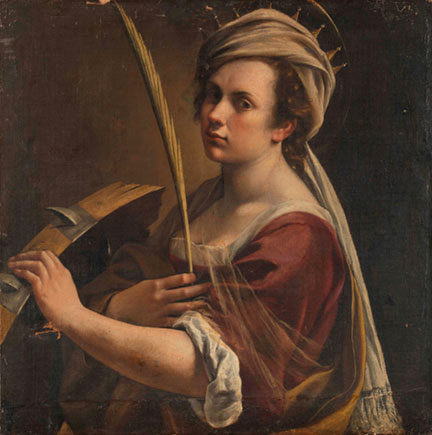
According to The New York Times, “In 2018, the National Gallery acquired its first work by Gentileschi, ‘Self Portrait as Saint Catherine of Alexandria,’ making her only the eighth female artist in a collection that has work by more than 700 men. The curatorial team recognized the opportunity to stage a major monographic show, which would resonate with the #MeToo movement and help counter the gender imbalance of the collection.”

Northern Illinois University students in HIST 422 Early Modern Europe and in Renaissance studies will be interested in this exhibition.

For more information on the remarkable career of Artemisia Gentileschi, see:

Sheila Barker, ed., Artemisia Gentileschi in a Changing Light (Turnhout: Harvey Miller/Brepols, 2017). [Book description at Brepols.]

Sheila Barker, ed., Women Artists in Early Modern Italy. Careers, Fame, and Collectors (Turnhout: Harvey Miller/Brepols, 2016). [Book description at Brepols.]

Jane Fortune, ed. Invisible Women: Forgotten Artists of Florence (Florence: Florentine Press, 2009).

Fedrika J. Jacobs, Defining the Renaissance ‘Virtuosa’: Women Artists and the Language of Art History and Criticism (Cambridge: Cambridge University Press, 1997).

Paola Tinagli, Paola Tinagli Baxter, Mary Rogers, Paulo Tinagli, eds., Women in Italian Renaissance Art: Gender, Representation and Identity (Manchester: Manchester University Press, 1997).

The New York Times reports on the opening of the Artemesia exhibition on Saturday 3 October 2020.
Posted in Art History, Early Modern Europe, Early Modern World, European History, Museums and Historical Memory, Women and Gender History | Leave a comment

Black Lives Matter Mural at NIU

The Black Lives Matter movement is bringing awareness of racial issues to the campus of Northern Illinois University and the DeKalb community.

Northern Illinois University’s Center for Black Studies recently suffered a vandalism attack, in which someone spray-painted a racist slogan on its building. See my previous post on Racist Vandalism on Campus.

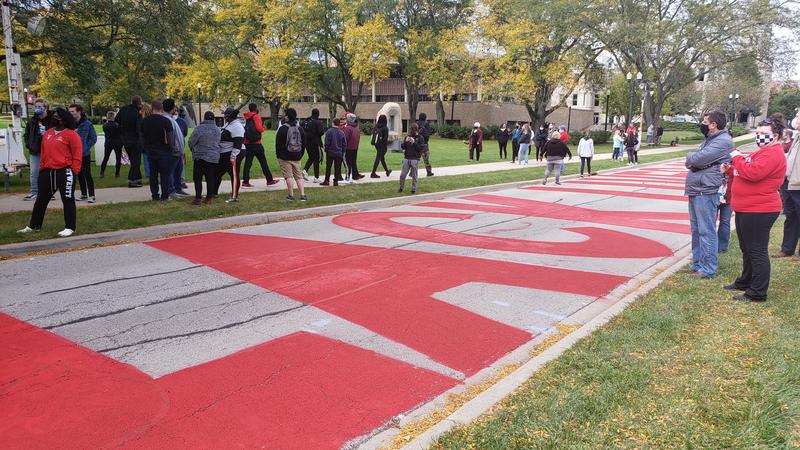
Black Lives Matter activists responded creatively to this attack with an anti-racist mural painting project on campus. On Thursday, 1 October 2020, the Center for Black Studies and the College of Visual and Performing Arts organized an event called “Art and Soul,” to paint a bold mural stating “Black Lives Matter” on Castle Drive. According to Northern Public Radio, “Participants with masks on took turns painting the street while listening to live music performed throughout the affair.”

Photo: Northern Public Radio

Northern Public Radio reports on the mural painting project and the Black Lives Matter movement at Northern Illinois University. A post on Black Lives Matter at Northern Illinois University discussed the “Art and Soul” event.

Posted in History of Race and Racism, History of Violence, Human Rights, Illinois History and Society, Northern Illinois University, Political Culture | Tagged , , , , , | Leave a comment

Black Lives Matter at Northern Illinois University

Northern Illinois University students, faculty, and staff are actively involved in the Black Lives Matter movement in Illinois.

The Center for Black Studies at Northern Illinois University is responding with creativity and activism to a recent racist vandalism attack on its building [see my previous post on Racist Vandalism on Campus].

The Center for Black Studies and the College of Visual and Performing Arts are hosting “Art and Soul,” a Black Lives Matter activist event today, Thursday 1 October 2020, on campus.

NIU undergraduate and graduate students in History are invited to participate in this event.

The Daily Chronicle reports on the “Art and Soul” event.

Here is the official announcement for this event:

“Art and Soul” BLM Street Painting Event

The Center for Black Studies and the College of Visual and Performing Arts are hosting an art for social justice event, “Art and Soul.”  The event will be held on Thursday, October 1, from 1 – 4 p.m. at the main entrance of the university on Castle Drive. The Huskie Buses will be re-routed from noon, Thursday, October 1 until Friday morning.

The entire community is invited to join together to help paint “Black Lives Matter” on Castle Drive.  Paint, rollers, and brushes will be supplied.

Participants will be limited to 50 at any one time, but you may join in throughout the afternoon to make your mark and show your commitment to social justice.

All safety measures will be followed.  Masks must be worn, and some will be available at the event.  Wipes will be used to clean the brush handles and rollers after each use.  Safety protocols will be facilitated by members of the Center for Black Studies and students in the College of Visual and Performing Arts.

In addition to the group painting, there will be performances and speakers throughout the event, including singers, jazz ensembles, percussion ensembles, dance improvisation, and readings from a variety of texts.

“The paint used is water-based and non-toxic,” said Paul Kassel, Dean of the College of Visual and Performing Arts. “It is expected to last through the rest of the fall semester. Though the image may fade, our commitment to social justice and to a strong Huskie community will remain vivid and strong. We believe that one answer to a hateful act is an act of affirmation of our values. It is in that spirit that this event is being held—to testify and signify to all that NIU holds an unshakeable belief that Black Lives Matter.”

For more information, email the College of Visual and Performing Arts’ Donee Spizzirri at dspizzirri@niu.edu.

Posted in Culture, History of Violence, Human Rights, Humanities Education, Northern Illinois University, Political Culture, The Past Alive: Teaching History | Leave a comment

New Research on Vikings

DNA studies are revealing new information on complicated ethnic backgrounds of Viking warriors and traders in medieval Europe.

A research team led by a professor at the University of Copenhagen has analyzed the genomes of 443 bodies buried in Viking graves in northern Europe and Greenland from the 700s to the 1100s.

The New York Times reports that the team “found considerable genetic variety in the ancient remains, indicating migration of Southern Europeans, before the Viking Age, to the area of Denmark, which undermines any idea of a single Nordic genetic identity. Some of the earliest inhabitants of Britain, the Picts, were buried as Vikings, for example.”

The New York Times reports on the new DNA research on Vikings. History.com has published an article on an archaeological find of two Viking boat graves at Gamla Uppsala, Sweden.

Northern Illinois University students in HIST 110 History of the Western World I may be interested in this new research on Vikings.


Posted in Cultural History, European History, History of Medicine, History of Science, History of the Western World, History of Violence, Maritime History, Material Culture, Medieval History, Museums and Historical Memory, War and Society, War, Culture, and Society, World History | Leave a comment

Racist Vandalism on Campus

I was saddened and angered to hear of the racist vandalism on Northern Illinois campus early yesterday (Thursday 17 September 2020) morning, when someone spray-painted racist slurs on the Center for Black Studies in an act of targeted vandalism. This racist act of aggression and defacement is currently being investigated by the police as a hate crime.

President Lisa C. Freeman has issued a message concerning this racist act and Northern Illinois University’s response. The President’s message is available online: https://www.niu.edu/president/communications/9-17-20-addressing-the-racist-incident-that-occured-on-campus.html

The Northern Star student newspaper has published an article on the racist vandalism and will presumably provide updates.

Photo: Northern Star

I want to let my current and former students know that I condemn this racist act of targeted vandalism and stand with African-American students, faculty, and staff as an ally who is committed to opposing racism.

As a historian who studies violence, political extremism, and warfare in historical contexts, I am fully aware of the serious nature of targeted violence and destruction. This symbolic attack against a single building targeted a specific group of people on campus, but is also clearly intended to threaten the entire NIU community and its values. Persons of color and international students may feel personally targeted by this attack.

Northern Illinois University is a public research university that has a teaching, research, and service mission to serve all of its students and the entire State of Illinois. I am confident that NIU faculty and staff will respond to this attack with a strong anti-racism message and measures.

I want to assure my current students that we will continue to explore the historical contexts of racism, political authority, power structures, economic inequalities, gender relations, social conflict, imperialism, and warfare in my courses on History of the Western World I and on Early Modern Europe throughout the semester.

Studying the history of race and racism can help expose the cultural, social, political, and institutional dynamics of racial prejudices and racist acts in modern societies.

The National Museum of African American History and Culture provides information on The Historical Foundations of Race on its website. The Center for Race and Ethnicity in Society at Indiana University-Bloomington offers additional resources on the history of race and racism.

Posted in Academic Freedom, Cultural History, Empires and Imperialism, Globalization, History of Race and Racism, History of Violence, Human Rights, Illinois History and Society, Northern Illinois University, Political Culture, Social History, United States History and Society, World History | Leave a comment

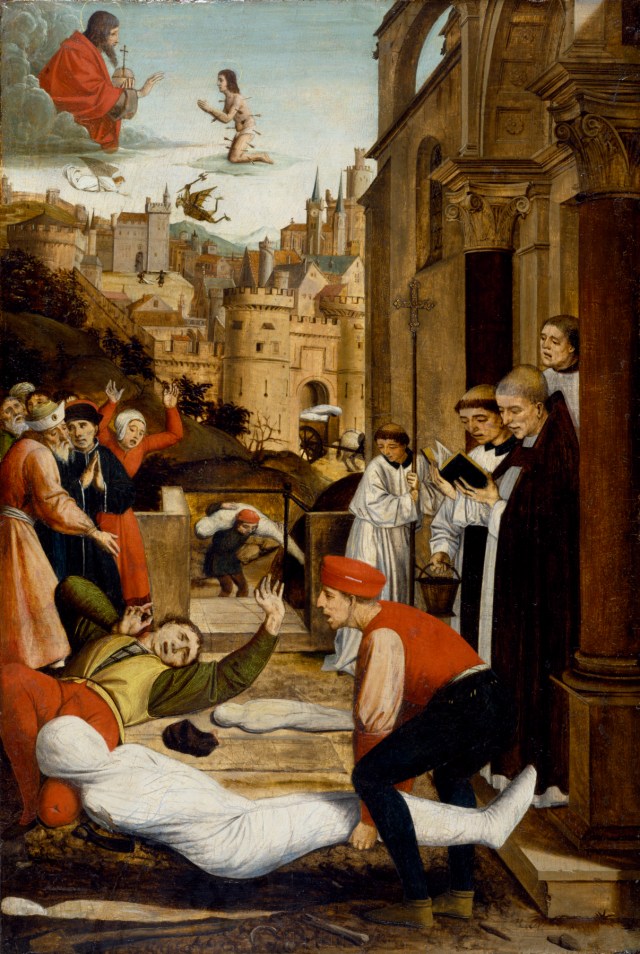
Saint Sebastian and the Arrows of the Plague

The Center for Renaissance Studies at the Newberry Library has published a new episode of its series on Learning from Premodern Plagues on “Saint Sebastian and the Arrows of the Plague.”

Students in my courses on HIST 110 History of the Western World I and HIST 422 Early Modern Europe at Northern Illinois University are studying the Black Death and recurrent plague this semester and may be interested in this video presentation, which is available for streaming on YouTube.

Here is the announcement from the Center for Renaissance Studies:

Saint Sebastian and the Arrows of the Plague
Learning from Premodern Plagues

CRS is pleased to announce the latest episode of “Learning from Premodern Plagues,” a series of videos exploring peoples’ experiences of plagues from the sixth through the eighteenth century. Each short (3-5 minute) video focuses on one object that tells the story of a particular moment in plague history, and are ideal for the classroom. Many of the books and manuscripts presented here form part of the Newberry Library’s collections. Each episode is hosted by a scholar affiliated with the Center who is passionate about researching the past to help to enlighten us about today.

St. Sebastian is perhaps the best-known patron saint of plagues, and he appears extensively in medieval and early modern art and devotional culture. Sarah Wilson, medievalist and Program Coordinator in the Department of Public Engagement at the Newberry Library, provides a brief history of his rise to prominence in the wake of the Black Death, and discusses his appearance in Margaret of Croy’s Prayerbook in the Newberry collection. See the full video here: https://youtu.be/5Pcmkp6udfs

Please stay tuned to this playlist for more videos. If you have any questions about the videos or how to use them in classes, please send an email to renaissance@newberry.org.

Posted in Cultural History, Early Modern Europe, Early Modern World, European History, History of Medicine, History of Science, Lectures and Seminars, Religious History, Renaissance Art and History | Leave a comment

Archaeological Fieldwork in the Age of Enlightenment

Jennifer Westerfeld (University of Louisville) will offer an online seminar on “‘I await the financial recovery of France’: Funding Archaeological Fieldwork in the Age of Enlightenment” on 18 September 2020.

This seminar is hosted by the Center for Renaissance Studies at the Newberry Library as part of its Premodern Studies Seminar series.

Upper-division undergraduate students in HIST 422 Early Modern Europe and graduate students in HIST 522 Microhistories of Early Modern Europe at Northern Illinois University may be interested in this seminar.

The Center for Renaissance Studies’ announcement follows:

“I await the financial recovery of France”: Funding Archaeological Fieldwork in the Age of Enlightenment


Jennifer Westerfeld, University of Louisville

Premodern Studies Seminar
Friday, September 18, 2020
2-3:30 pm

CRS is pleased to announce the first meeting of the 2020-2021 Premodern Studies Seminar. In this virtual session, Jennifer Westerfeld (Univ. of Louisville) will discuss the development of early modern Egyptology in the eighteenth century. Using the work and writings of Claude Sicard, a Jesuit missionary active in Egypt who carried out extensive research on Egypt’s historic geography from 1712 to 1726, this seminar will reconstruct a detailed picture of the circumstances under which Egyptological knowledge was produced in the first quarter of the eighteenth century.

The Premodern Studies Seminar provides a forum for new approaches to classical, medieval, and early modern studies, allowing scholars from a range of disciplines to share works-in-progress with the broader community at the Center for Renaissance Studies. Our sessions feature discussion of a pre-circulated paper and a presentation of collection materials.

The seminar will be conducted virtually via Zoom. This event is free and open to the public, but registration is required and space is limited. To register and receive a copy of the precirculated paper, send an email to scholarlyseminars@newberry.org. Registrants will receive a copy of the precirculated paper and a link to the Zoom session. Please do not request a paper unless you plan to attend.

For more information about the Premodern Studies Seminar, please visit our website here: https://newberry.org/premodern-studies-seminar

Posted in Cultural History, Early Modern Europe, Early Modern World, European History, French History, Graduate Work in History, History of Science, Intellectual History, Lectures and Seminars | Leave a comment

Marketing Premodern Studies Beyond Academia

The Center for Renaissance Studies at the Newberry Library recently hosted an online seminar on Marketing Premodern Studies Beyond Academia.
This seminar, organized by Christopher Fletcher (Newberry Library) and Lindsey Martin (Northwestern University) was the third session in the Center for Renaissance Studies’ Professional Development Seminar Series.
A recording of the virtual session is available for streaming (along with a handout) at the Marketing Premodern Studies Beyond Academia website.
Graduate students in medieval, renaissance, and early modern studies at Northern Illinois University may be interested in this program, which provides information on jobs and careers beyond colleges and universities.
Posted in Careers in History, Cultural History, Digital Humanities, Early Modern Europe, Early Modern World, European History, Graduate Work in History, Jobs and Positions, Lectures and Seminars, Reformation History, Renaissance Art and History | Leave a comment

Speech as Protest: Being Heard and Taking Up Space in the Premodern World

The Center for Renaissance Studies at the Newberry Library is hosting a virtual conference on Speech as Protest: Being Heard and Taking Up Space in the Premodern World.

This virtual conference is organized by Elisa J. Jones (College of Charleston) and will include a keynote address by Ada Palmer (University of Chicago).

I am looking forward to participating in one of the roundtable sessions at the conference and presenting on “‘There is Not a Single Catholic in This City’: Public Preaching and Conversion during the French Wars of Religion.”

Graduate students in medieval and early modern history at Northern Illinois University are invited to attend the virtual conference. See the announcement from the Center for Renaissance Studies and a registration link at the Speech as Protest: Being Heard and Taking Up Space in the Premodern World conference page on the Newberry Library website.

Speech as Protest:
Being Heard and Taking Up Space
in the Premodern World

October 22-29, 2020
Organized by Elisa J. Jones, College of Charleston

What constitutes speech? What is a public space, and how is it policed? How are the boundaries drawn between those who want to be seen and heard, and those who want them to remain absent? This interdisciplinary symposium will address how the permeable boundaries between public presence and absence were created, enforced, and challenged in the medieval and early modern periods. Ada Palmer, professor of history at the University of Chicago and renowned author, will deliver the keynote address, “The Modern Political Impact of How We Talk about Premodern Censorship,” on Thursday evening and will participate in the final roundtable.

Through roundtable discussions and collection presentations, the symposium will explore how various premodern publics were formed and contested by a range of cultural forces. Possible topics include social mobility, public spaces, printing and censorship, control over one’s body, slavery and personhood, representation aurally or visually of minority groups, and tolerance or intolerance of religious sects.

This virtual conference will frame discussions about these premodern subjects as part of a larger conversation about the ways that rights exist as cultural artifacts with premodern histories, as well as how premodern scholars can best bring these histories about premodern publics into contemporary public conversations.

For more information, including a complete schedule and registration link, please visit our website here: https://www.newberry.org/10222020-speech-protest-being-heard-and-taking-space-premodern-world


Posted in Conferences, Cultural History, Early Modern Europe, Early Modern World, European History, European Wars of Religion, French History, French Wars of Religion, Graduate Work in History, History of Violence, Political Culture, Reformation History, Religious History, Religious Politics, Religious Violence, Renaissance Art and History | Leave a comment

Graduate Student Conference in Renaissance Studies

The Center for Renaissance Studies at the Newberry Library has issued a call for papers for its annual Multidisciplinary Graduate Student Conference. The conference will be held through virtual roundtables held on 8-13 February 2021.

Gradaute students in History at Northern Illinois University are encouraged to participate, since NIU is a Newberry Library Consortium member.

Paper proposals should be submitted by 12 October 2020.

Here is the Center for Renaissance Studies’ call for papers:

The Center for Renaissance Studies at the Newberry Library is pleased to announce that abstract submissions for our 2021 Multidisciplinary Graduate Student Conference are now being accepted.

This annual graduate student conference, organized and run by advanced doctoral students, has become a premier opportunity for emerging scholars to present papers, participate in discussions, and develop collaborations across all fields of medieval, Renaissance, and early modern studies. Participants from a wide variety of disciplines find a supportive and collegial forum for their work, meet future colleagues from other institutions and disciplines, and become familiar with the Newberry and its resources.

In 2021, the conference will be held virtually in a seminar-style format. Participants will circulate short papers in mid-January, give and receive feedback on their papers by early February, and convene for a series of virtual roundtables to discuss their findings between February 8-13, 2021.

We invite proposals for papers from students in master’s or PhD programs on any humanities topic relating to material before 1800. The 2021 conference schedule will include virtual workshops and sessions with rare books in addition to the seminar roundtables.

Abstract submissions will be accepted online only. The deadline to submit an abstract through our online submission form is Monday, October 12, 2020 at midnight CDT.

Preference is given to proposals from students at member institutions of the Center for Renaissance Studies Consortium, but we also welcome proposals from students of the Folger Institute Consortium.

For more information about the conference, visit our calendar page here: https://www.newberry.org/02082021-2021-multidisciplinary-graduate-student-conference-nlgrad21 

Posted in Conferences, Early Modern Europe, Early Modern World, European History, Graduate Work in History, Reformation History, Renaissance Art and History | Leave a comment