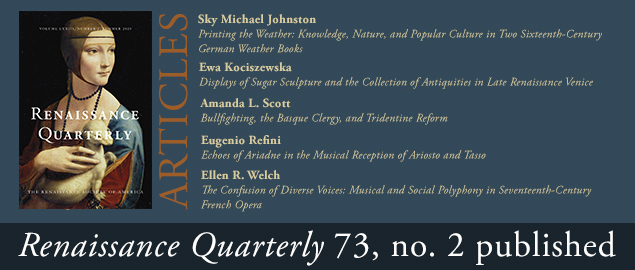
Renaissance Society of America Fellowships

The Renaissance Society of America offers fellowships for graduate students and faculty who are conducting research on topics in Renaissance studies.

“The Society awards a number of competitive fellowships to members each year supporting individual research projects and publications that advance scholarly knowledge about the period 1300–1700. Fellowships are made possible by donations from RSA members and grants from the Samuel H. Kress Foundation.”

The Renaissance Society of America publishes Renaissance Quarterly, which will be of interest for all students in HIST 422 / 522 Early Modern Europe.

The Fellowships

“The RSA offers two types of research fellowships: residential fellowships supporting one month of research at one of the institutions with which the RSA has a partnership agreement and short-term research fellowships that may be used to support research at the collection or collections of the applicant’s choice. For 2021, we define a “short-term research fellowship” more broadly to include expenses related to research that are not explicitly travel. These expenses might include (but are not limited to) copy-editing, access fees to online archives, digital images and permissions, and publication subventions.

“Those who have received an RSA fellowship in the past will not be considered for further fellowships for three years after the award and will not be considered for further fellowships for the same project. Applicants will win at most one fellowship per year; the RSA does not give multiple awards to the same individual in a single year.

“All applicants must be current RSA members. If an applicant is not a current member, they should either join the RSA or renew their membership before applying for a fellowship. As of June 2018, RSA memberships last for a full twelve months from the start date or time of renewal.

“Successful applicants must agree to complete the proposed research by 30 June 2022 and submit to the RSA a brief report indicating the accomplishments of the fellowship within one month of returning from the research trip.”

For more information, see the Renaissance Society of America website.

Posted in Early Modern Europe, Early Modern World, European History, Graduate Work in History, Grants and Fellowships, Renaissance Art and History | Leave a comment

Art of Renaissance Warfare

The Center for Renaissance Studies at the Newberry Library (Chicago) will host a virtual conversation with Jonathan Tavares (The Art Institute of Chicago) and Suzanne Karr Schmidt (Newberry Library) on The Art of Renaissance Warfare, to be held on Zoom.

Thursday 17 September 2020

12 to 1 pm

“The development of gunpowder, stirrups, and new techniques for polishing armor changed the face of war in sixteenth-century Europe. In this virtual conversation, Jonathan Tavares of the Art Institute of Chicago and Suzanne Karr Schmidt of the Newberry will discuss the importance of Renaissance-era innovations in military technology by focusing on a model cannon, pair of stirrups, and collection of armor on view in the Renaissance Invention exhibition as loans from the Art Institute.”

For more information and to sign up for this free seminar:

https://www.newberry.org/09172020-art-renaissance-warfare


Posted in Art History, Cultural History, Digital Humanities, Early Modern Europe, Early Modern World, Empires and Imperialism, European History, European Wars of Religion, Globalization, History of Science, History of Violence, Italian History, Lectures and Seminars, Material Culture, Mediterranean World, Museums and Historical Memory, Noble Culture and History of Elites, Reformation History, Renaissance Art and History, War and Society, Warfare in the Early Modern World, World History | Leave a comment

Renaissance Invention Exhibition

A new exhibition on Renaissance Invention: Stradanus’s Nova Reperta opens today (Friday 28 August 2020) at the Newberry Library.

The exhibition will run from 28 August to 25 November 2020 in the Trienens Galleries at the Newberry Library in Chicago.

Image: Philips Galle after Johannes Stradanus, Lapis polaris magnes (Magnet), circa 1588. Engraving. VAULT Case Wing folio Z 412 .85. Newberry Library, Chicago.

“During a time of globalization, colonization, and warfare, Europeans in the Renaissance embraced new technology even as they lamented its disruptive, destructive, and destabilizing consequences.

“Co-curated by CRS Director Lia Markey and Suzanne Karr Schmidt, the George Amos Poole III Curator of Rare Books and Manuscripts at the Newberry, this gallery exhibition explores the conception of novelty and technology through an unprecedented study of Nova Reperta (New Discoveries), a late sixteenth-century print series that celebrated the marvels of the age, including the stirrup, the cure for syphilis, and the so-called discovery of America. Designed in Florence and printed in Antwerp, the Nova Reperta images spread far and wide, shaping Europeans’ perceptions of the innovations that were changing the world and breeding anxiety about the future.

“In Renaissance Invention, materials from the Newberry’s collection will appear alongside armor from the Art Institute of Chicago and astronomical instruments from the Adler Planetarium, transporting visitors to a time of change, disruption, and technological development that bears a striking resemblance to our own today.”

Northern Illinois University students in HIST 422 Early Modern Europe and HIST 522 Microhistories of Early Modern Europe will be particularly interested in this exhibition.

For more information, see the website: https://www.newberry.org/renaissance-invention.


Posted in Art History, Atlantic World, Cartographic History, Cultural History, Digital Humanities, Early Modern Europe, Early Modern World, Empires and Imperialism, European History, European Wars of Religion, Globalization, Intellectual History, Maritime History, Material Culture, Mediterranean World, Museums and Historical Memory, Reformation History, Renaissance Art and History, World History | Leave a comment

People in Motion Podcasts on the History of Pandemics

The People in Motion: Entangled Histories of Displacement across the Mediterranean (PIMo) network of historians is providing a series of podcasts on the history of pandemics to provide a deeper context for understanding on the current Covid-19 pandemic.

In one of the podcasts, Professor Ann Thomson (European University Institute) discusses quarantine practices against the bubonic plague in early modern Europe and considers why Europeans increasingly associated the plague with Ottomans during the eighteenth century.

Podcast 2: ‘The Turks and the Plague in the 18th Century,’ Prof Ann Thomson, A PIMo-CROMOHS Contagion Podcast

“Eighteenth-century European views of the Ottomans reveal a complex set of politico-religious interests, as the Ottoman Empire declined militarily and gradually became less an object of fear. It was associated with certain clichéd images, in particular of despotism and fanaticism. Among these associations was the prevalence of the plague, which was endemic in many parts of the Ottoman empire, while after 1720 it no longer ravaged Europe. While this situation was often explained by the climate, many authors associated the prevalence of the plague with what they called Turkish “fatalism”, claiming that the Muslim belief in predestination prevented governments and individuals from taking any of the precautions against the disease used by Europeans. Thus the plague became part of the stock of anti-Turkish arguments, used in the justifications for political alignments in the Mediterranean. In the 1780s, an anti-Turkish author like the Frenchman Volney opposed those who supported the Ottomans as a bulwark against Russian expansionism, and argued for their expulsion from Europe and the Mediterranean; he went as far as identifying the Turks with the contagion, claiming that it was brought from Istanbul and had never been known in the Mediterranean before the arrival of the Turks.”

Podcast 2 is available to stream on the People in Motion website.

Posted in Cultural History, Early Modern Europe, Early Modern World, Empires and Imperialism, European History, Globalization, History of Medicine, History of Science, Maritime History, Mediterranean World, Religious History, Strategy and International Politics | Tagged | Leave a comment

Considering Civil Wars

Civil wars fracture political systems and rend societies, often leaving deep scars and traumatic memories that haunt generations.

Yet civil wars often continue to be understood primarily through the lens of national historiographies that focus on nation-states and the history of state development.  National histories have not escaped state formation processes, ethnic politics, and the forces of nationalism.

The English Civil War (1642-1651), the American Civil War (1861-1865), and the Russian Civil War (1918-1922), and the Spanish Civil War (1936-1939) have each inspired massive historiographies in which the trauma of civil war is normally treated as a formational experience in the life history of a single nation-state. The history of civil warfare thus shapes historical memory and reifies nation-states as objects of distinct and isolated national histories.

I have taught courses on civil conflict, civil warfare, religious violence, and wars of religion, and I am always surprised how few comparative studies of civil violence are available. There are numerous comparative studies of bread riots, peasant revolts, religious riots, terrorist attacks, revolutions, and genocides across the fields of history, anthropology, political science, sociology, and violence studies. Curiously, comparative studies of civil warfare remain relatively rare.

David Armitage’s Civil Wars: A History in Ideas (2018) attempts to construct such a comparative history of civil warfare.

I am pleased that my book review of Armitage’s Civil Wars has recently been published in The Journal of Modern History.

Brian Sandberg, “David Armitage, Civil Wars: A History in Ideas,” The Journal of Modern History 92, no. 2 (June 2020): 390-391.

https://doi.org/10.1086/708559

Posted in Civil Conflict, Early Modern Europe, Early Modern World, Empires and Imperialism, European History, History of the Western World, History of Violence, Political Culture, Revolts and Revolutions, State Development Theory, Strategy and International Politics, War and Society, War, Culture, and Society, Warfare in the Early Modern World | Leave a comment

On the Business of War

The business of war is unfortunately all too present in today’s world, yet the activities of weapons researchers and developers, arms manufacturers, military contractors, military gear designers, military trade shows, gun dealers, military suppliers, and private military companies are not well understood.

Secrecy, arms accords, military espionage, corporate spying, and economic competition often result in military logistics and arms issues being obscured from public view. Certainly, Hollywood tends to treat the business of war as a nefarious underworld in war films—and perhaps that is completely justified.

Unfortunately, there continue to be few comprehensive studies of the business of war.

David Parrott’s The Business of War: Military Enterprise and Military Revolution in
Early Modern Europe (2012) is thus especially welcome. This book provides an important historical study of the business of war in the early modern Europe and lays the groundwork for future studies of the business of war in different historical periods.

My book review of David Parrott’s The Business of War has now been published in H-War and is available online at: https://www.h-net.org/reviews/showrev.php?id=38909

The full listing for the book is:

David Parrott. The Business of War: Military Enterprise and Military Revolution in Early Modern Europe. Cambridge: Cambridge University Press, 2012. xvii + 429 pp. $29.99, paper, ISBN 978-0-521-73558-2.

Posted in Arms Control, Civilians and Refugees in War, Early Modern Europe, Early Modern World, European History, European Wars of Religion, History of Violence, Laws of War, Strategy and International Politics, War and Society, War in Film, War, Culture, and Society, Warfare in the Early Modern World | Leave a comment

Reflecting on the European Wars of Religion in an Age of Religious Violence

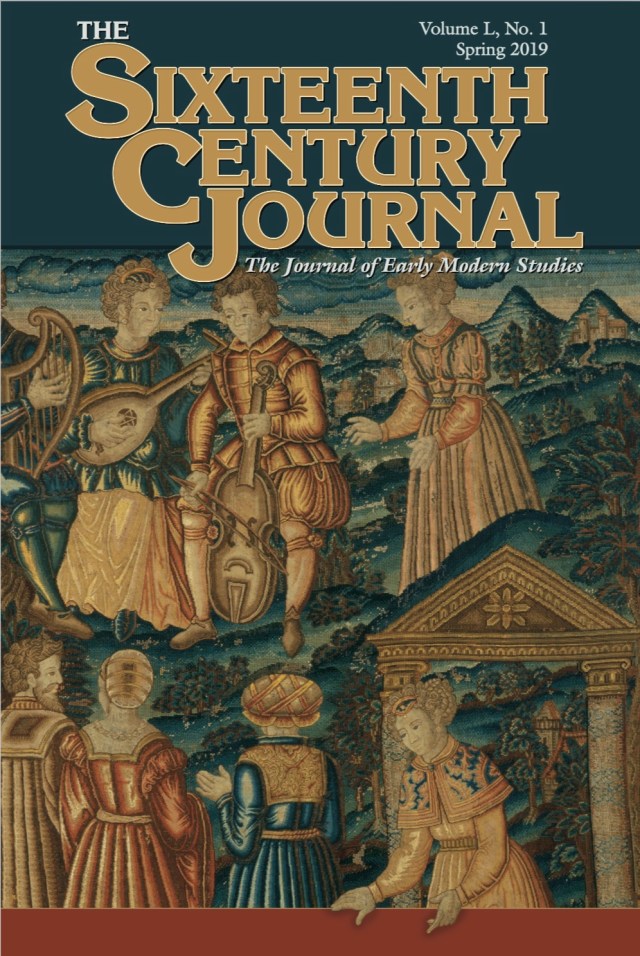
I am happy to report that my latest article has been published in the 50th anniversary issue of Sixteenth Century Journal.

“We allegedly live in an age of religious warfare. Ever since the September 11 Attacks in 2001, journalists, analysts, observers, and scholars have frequently used the concept of “religious wars” to explain terrorist attacks and armed conflicts around the world. The spectacular violence and massive destruction of the attacks confirmed a return to religion in international politics and reinforced the concept of a grand “clash of civilizations” as defining war. … ”

The article continues to consider the concept of “new” wars of religion:

“The comparisons between “old” and “new” wars of religion certainly present conceptual and theoretical challenges for historians working on religious violence in the early modern period. Modern religious conflicts also present opportunities for early modern scholars to rethink the European Wars of Religion (1520s-1650s) as a period that represents one of the most important historical cases of religious warfare. Reinterpreting the history of early modern religious conflicts allows us to consider the connections between past and present cases of religious violence and to raise new methodological questions. This is an important task for the present, since ‘religious violence is among the most pressing and dangerous issues facing the world community.'”

For the full article, see: Brian Sandberg, “Reflecting on the European Wars of Religion in an Age of Religious Violence,” Sixteenth Century Journal 50: 1 (Spring 2019): 176-182.

The Sixteenth Century Journal is affiliated with the Sixteenth Century Society and Conference and is available (by subscription) at the Sixteenth Century Journal website or through JSTOR database (through most major libraries).

Posted in Civil Conflict, Early Modern Europe, European History, French Wars of Religion, History in the Media, History of Violence, Peacemaking Processes, Reformation History, Religious History, Religious Politics, Religious Violence, Strategy and International Politics, War and Society, War, Culture, and Society, Warfare in the Early Modern World | Leave a comment

Containing Coronavirus in Brussels

I have been conducting archival research in Belgium as a Fulbright Research Scholar and collaborating with colleagues at the Université Catholique de Louvain this semester, but the coronavirus pandemic has intervened and disrupted our plans.

Belgians had been following the news of the worsening situation in Italy during February and early March, observing European governments begin to take steps to contain the growing epidemic. Carnival celebrations went ahead across Belgium, even as Venice cancelled its Carnival celebrations and Italy imposed a lockdown in Lombardia and Veneto.

The Belgian government instituted aggressive containment measures against the coronavirus epidemic on Friday 13 March and life in Brussels altered quickly. The Archives Générales du Royaume closed early that afternoon, along with the KBR Bibliothèque Royale, and all other libraries. As a result, my archival research is on hold and I am working on writing projects at home while sheltering in place.

The US Department of State’s latest travel advisory called on all US citizens abroad to return to the United States or shelter in place. I have chosen to shelter in place here in Brussels because of the dangers of traveling, the chaotic US response to the coronavirus pandemic, and the restrictions on Europeans traveling to the US. Some of the other Fulbright scholars in Belgium has also decided to shelter in place here for similar reasons.

Belgium has now been under coronavirus containment measures for 17 days, with restaurants, bars, cinemas, businesses, schools, museums, archives, and cultural institutions all closed for at least another two weeks. Only essential government agencies, hospitals, pharmacies, grocery stores, and take-away food stands remain open.

Photo credit: Le Soir

The grocery stores are fully stocked daily (except for Sundays), so flour, pasta, meat, fish, and some other products do tend to run out by the late afternoon, but then are restocked the next morning. Belgians and other Europeans seem to be doing lots of baking during this period of isolation. Grocery stores have had to change their food providers for some produce (from Italy and Spain, for example), due to travel and transport restrictions.

There are restrictions on how many people can enter grocery stores at a time, so there are lines outside sometimes.  In the city center, there are multiple grocery stores and it is easy to shop during the day and avoid peak periods when grocery stores are busy. There are also lots of small food shops (bakeries, cheese shops, butcher’s shops, fish stands, organic veggie shops, etc.) still open.  A grocery shopping expedition involves wearing medical gloves and then washing hands thoroughly after getting home and unpacking the groceries.

Le Soir is reporting the current number of coronavirus cases in Belgium as 12,775, but only around 12 percent of the cases are in Brussels.  The rate of new cases has been fluctuating day by day, so it is hard to tell the trend. But, the containment measures seem to be slowing the spread of the virus. On the confinement measures in Belgium, see Le Soir.

European nations are definitely taking a huge economic hit with the containment measures, but many fewer people have been laid off thanks to social systems that provide job security. Unemployment benefits are also more robust in European nations than in the States. Of course, the economic situation varies enormously by sector and by nation.

Most European nations began implementing virus containment measures as the situation in Italy worsened. Italy, Spain, and Switzerland are the hardest hit in terms of per capita cases. Italy’s high death rate is almost certainly linked to elderly age of the overall Italian population and to the heavy concentration of cases in Lombardia. Germany, France, Belgium, Netherlands, and other nations seem to be slowing the spread of the virus, at least so far, with much lower per capita cases. Politico.eu has a Coronavirus Tracker with European maps and numbers, updated each day.

The European Union’s response has been slow and continues to be fragmented, partly due to the continuing political crisis that Brexit created. As the capital of the European Commission and co-capital of the European Parliament, Brussels is especially concerned with the European response to the crisis. Le Soir reports on worries that the future of the European Union depends on its ability to manage the coronavirus pandemic.

However, this is nothing compared to the delays and mixed messages of the United States’ response to the pandemic. Some states and cities seem to have recognized the serious threat and began reacting early enough to make some difference.  The federal government’s response has been slow, confused, and chaotic, and I am afraid that a lot of people are going to suffer as a result.

The new coronavirus cases are following the curve of Italy’s new cases. So, the cases are going to be very substantial in the States, even if the death rate is likely to be much lower than in Italy. Italy’s total confirmed coronavirus cases now represent 1,749 per million inhabitants. If the United States ends up with something similar, then that would be looking at 578,000+ confirmed cases. Again, that’s confirmed cases, not deaths. Nonetheless, there is clearly a great need to spread out the cases and not have them come all at once and overwhelm the hospitals.

For a good report in English on the desperate situation in Lombardia, see this New York Times piece from a couple of days ago.


Posted in Archival Research, Current Research, European History, European Union, History of Medicine, Study Abroad | Leave a comment

Women and War in Belgium

Gabrielle Petit stares defiantly into the distance, under gray skies in Brussels. Almost every morning, I walk beneath Petit’s stern gaze on my way to the archives, thinking about her last moments and about the long history of women and warfare.

Gabrielle Petit was a Belgian woman who became swept up in the chaos of the First World War (1914-1918), after Germans overran Belgium in August 1914 and occupied the country. Petit fled as a refugee but then returned to Belgium as a spy for the British Army, gathering information on German military dispositions across Belgium beginning in August 1915. German soldiers soon became suspicious of Petit’s movements in occupied Belgium and arrested her for spying in February 1916. A German military court tried her for military espionage and condemned her to death. Gabrielle Petit allegedly say: “I will show you how a Belgian woman dies,” before being executed by firing squad on 1 April 1916.

The bronze statue commemorating Gabrielle Petit’s patriotism stands in place Saint-Jean, near the center of Brussels. The sculptor, Égide Rombaux, attempts to capture Petit’s brave stance before the German firing squad, but figures Petit in a heroic pose that that evokes neoclassical works such as Eugène Delacroix’s Liberty Leading the People. Historian Sophie De Schaepdrijver recently wrote a book exploring the ways in which Belgians commemorated Gabrielle Petit’s sacrifice and constructed the historical memory of the First World War [1]. After the war, Petit was celebrated as a modern Joan of Arc, but the memories of her role in the occupation of Belgium gradually faded. The bronze statue of Gabrielle Petit nonetheless still offers a reminder that women have often played active roles in warfare.

When we think of women and war, then we conjure up images of mythical and historical warrior women, such as Wonder Woman, Amazon warriors, and Joan of Arc. Modern women increasingly serve in combat roles in the armed forces of the United States, Russia, Israel, and other nations. Nonetheless, gender issues surrounding the military service of women and persons with LGBTQ identities can still be controversial.

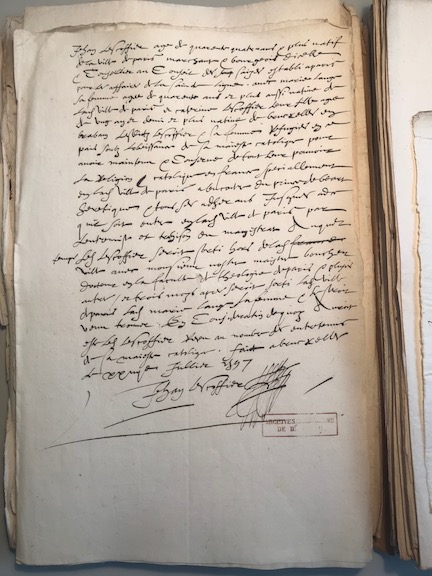
The issues of women, gender, and war thus flood my mind as walk through place Saint-Jean on my way to the Archives Générales du Royaume. Each day in the archives, I sift through manuscripts dealing with women and warfare from long ago. My current research focuses on gender and violence in the European Wars of Religion of the late sixteenth and early seventeenth centuries. I am searching for traces of gendered dynamics of the religious conflicts between Catholics and Protestants in the extensive records of the government of the Spanish Netherlands, which are held at the Archives Générales du Royaume.

The Low Countries (including today’s Belgium) was then embroiled in the Dutch Revolt, a bitter religious conflict between Protestants and Catholics in the Spanish Netherlands. The conflict began with protests over anti-heresy legislation and iconoclastic attacks on sacred images, and then expanding into a long civil war, known as the Eighty Years’ War (1566-1648). Flemish and French-speaking women were directly involved in these religious conflicts in many ways, but the sources dealing with women and gender issues are fragmentary. The heroic women who defended their communities at the sieges at Haarlem and Ostend were celebrated in the political culture of the Dutch Revolt, as historian Peter Arnade has demonstrated [2]. The women of the religious wars thus provided examples of courage to later Belgian women who have engaged in military service and participated in modern conflicts.
Although the statue of Gabrielle Petit stands alone in place Saint-Jean, she was actually part of a broad resistance movement in occupied Belgium during the First World War. Emmanuel Debruyne (Professor of History at the Université Catholique de Louvain) has examined the organization of the Belgian resistance movement, including its gendered dimensions [3]. I am fortunate to have the opportunity to exchange ideas on women and war with Emmanuel and his colleagues at the Université Catholique de Louvain during my Fulbright research stay in Belgium this spring.

Sources

[1] Sophie De Schaepdrijver, Gabrielle Petit: The Death and Life of a Female Spy in the First World War (Bloomsbury, 2015).

[2] Peter J. Arnade, Beggars, Iconoclasts, and Civic Patriots: The Political Culture of the Dutch Revolt (Ithaca, N.Y.: Cornell University Press, 2008).

[3] Emmanuel Debruyne, “Combattre l’occupant en Belgique et dans les départements français occupés en 1914-1918: Une « résistance avant la lettre »?,” Vingtième Siècle. Revue d’histoire, 115 (juillet-septembre 2012): 15-30; Emmanuel Debruyne et Laurence van Ypersele, eds., Je serai fusillé demain. Les dernières lettres des patriotes belges et français fusillés par l’occupant, 1914-1918 (Bruxelles : Racine , 2011).

Note: A version of this essay will be posted on the website of the Fulbright in Belgium Program.

Posted in Archival Research, Civil Conflict, Civilians and Refugees in War, Current Research, Early Modern Europe, Early Modern World, Empires and Imperialism, European History, European Wars of Religion, French History, French Wars of Religion, Gender and Warfare, History of Violence, Laws of War, Reformation History, Religious Violence, War and Society, War, Culture, and Society, Warfare in the Early Modern World, Women and Gender History | Leave a comment

Newberry Library Graduate Student Conference

The Center for Renaissance Studies at the Newberry Library is hosting its annual Multidisciplinary Graduate Student Conference on 23-25 January 2020.

Here is the announcement from the Center for Renaissance Studies:

CRS announces the schedule for the 2020 Multidisciplinary Graduate Student Conference. Organized and run by advanced doctoral students, this conference has become a premier opportunity for emerging scholars to present papers, participate in discussions, and develop collaborations across the field of medieval, Renaissance, and early modern studies in Europe, the Americas, and the Mediterranean world. Participants from a wide variety of disciplines find a supportive and collegial forum for their work, meet future colleagues from other institutions and disciplines, and become familiar with the Newberry and its resources.

For the full schedule and other information, visit the conference website here: https://www.newberry.org/01232020-2020-multidisciplinary-graduate-student-conference-nlgrad20

Posted in Conferences, Court Studies, Cultural History, Early Modern Europe, Early Modern World, European History, European Wars of Religion, Graduate Work in History, Italian History, Religious History, Renaissance Art and History | Leave a comment